


A Practical Guide to CBT for Health Anxiety
- Jan 12
- 17 min read
Updated: Mar 15
Cognitive Behavioural Therapy, or CBT, is a really practical, evidence-based way to help you break free from the cycle of worry that comes with health anxiety. It works by teaching you how to challenge those anxious thoughts and change the unhelpful behaviours that keep you stuck, offering a clear path to getting your life back. I sometimes share articles and resources about Cognitive Behavioural Therapy (CBT) to help clients and readers understand different therapeutic approaches. While CBT is a well-established, evidence-based method and can be life-changing for many, I don’t personally offer CBT in my practice. My aim is, to provide information so you can make informed choices about what might work best for you, whether that’s with me, or another qualified professional.
Understanding Health Anxiety and How CBT Offers a Path Forward
Health anxiety is so much more than just worrying about getting ill now and then. It’s a persistent, overwhelming fear that can completely hijack your thoughts, convincing you that totally normal bodily sensations are actually signs of a serious, undiagnosed disease. This condition can trap you in a draining cycle of fear, body-checking, endlessly Googling symptoms, and constantly seeking reassurance from others.
Imagine your mind is like a super-sensitive car alarm that screeches at the slightest touch. A minor headache isn't just a headache; your mind screams that it must be a brain tumour. A muscle twitch becomes a sure sign of a neurological disorder. Living in this relentless state of high alert is utterly exhausting and can seriously damage your daily life, relationships, and general sense of well-being.
A Practical Toolkit for Regaining Control
This is where Cognitive Behavioural Therapy (CBT) comes in as a hopeful and genuinely effective solution. CBT isn’t about dismissing your fears or just telling you "it's all in your head." Instead, it’s a collaborative and structured therapy that gives you a practical toolkit to manage these overwhelming worries. Think of it as learning to become your own therapist by understanding the specific thought and behaviour patterns that are fuelling your anxiety.
At its core, CBT for health anxiety focuses on a few key things:
Identifying Triggers: We'll figure out the specific thoughts, feelings, or physical sensations that kickstart the anxiety cycle for you.
Challenging Unhelpful Thoughts: You'll learn how to question the catastrophic conclusions your mind leaps to and start considering more balanced, realistic alternatives.
Changing Behaviours: We'll work on gradually reducing the compulsive behaviours—like excessive checking or reassurance-seeking—that actually keep the anxiety alive.
Evidence-Based Hope for a Calmer Future
The effectiveness of CBT isn't just a nice idea; it's backed by solid research. A major UK study, the CHAMP trial, showed just how incredible the long-term benefits of CBT for health anxiety can be.
Over a five-year period, patients who had an average of just six CBT sessions showed significant and lasting reductions in health anxiety, generalised anxiety, and depression compared to people receiving standard care. This research really highlights that even a focused course of CBT can lead to real, lasting change. You can read more about these powerful findings from the NIHR Journals Library.
Here at Therapy with Ben in Cheltenham, we use these proven CBT principles to help you navigate your health worries. We offer a supportive, non-judgemental space to explore these challenges, whether that’s face-to-face, online, or through walk-and-talk therapy. Modern approaches also bring in elements of mindfulness and acceptance, which you can learn more about in our guide on what Third Wave CBT is and how it can help you. Ultimately, the goal is to give you the skills to turn down the volume on that internal alarm, so you can start living your life more freely again.
The Overactive Smoke Alarm: How Health Anxiety Works
Imagine your body has a smoke alarm, one that’s designed to warn you of genuine danger. In most people, this system is pretty well-calibrated – it only sounds the alarm when there’s a real fire. But when you’re dealing with health anxiety, that alarm is incredibly sensitive. It goes off for the tiniest whiff of smoke, or even just the smell of burnt toast.
This is the perfect way to understand how health anxiety operates.
This hyper-vigilant internal alarm system doesn't just go off at random. It follows a predictable, self-fuelling cycle that keeps you trapped in a state of high alert. Recognising this pattern is the absolute first step in learning how to recalibrate it. Using the principles of CBT for health anxiety, we can break this cycle down into four distinct stages.
Stage 1: The Trigger
It almost always begins with a trigger. And we're not talking about something dramatic or obviously dangerous. More often than not, it’s a perfectly normal, harmless bodily sensation that most people would barely notice.
A slight headache after a long day.
A random muscle twitch in your leg.
Feeling your heart beat a little faster after walking up the stairs.
A gurgle in your stomach.
These are just common physical experiences. But for someone with health anxiety, this harmless sensation is the 'smoke' that sets off that deafening internal alarm. It's worth remembering that anxiety itself can cause many of these sensations, a topic I explore in more detail in my guide to the physical symptoms of anxiety and how to find relief.
Stage 2: The Misinterpretation
As soon as the trigger hits, your mind immediately leaps to the absolute worst-case scenario. This isn't just a gentle worry; it's a catastrophic thought that feels 100% real and incredibly urgent in that moment. This is the very engine of health anxiety.
The harmless trigger is instantly interpreted as definitive proof of a serious, life-threatening illness. The headache isn't just a headache; it's a brain tumour. The muscle twitch isn't random; it's the start of a neurological disease.
This process happens almost automatically. It’s often fuelled by underlying beliefs that you might be particularly vulnerable to illness or that any unexplained symptom must be a sign of something sinister.
The diagram below shows how CBT provides a clear pathway to interrupt this process, helping you move from a state of constant anxiety to one of relief.
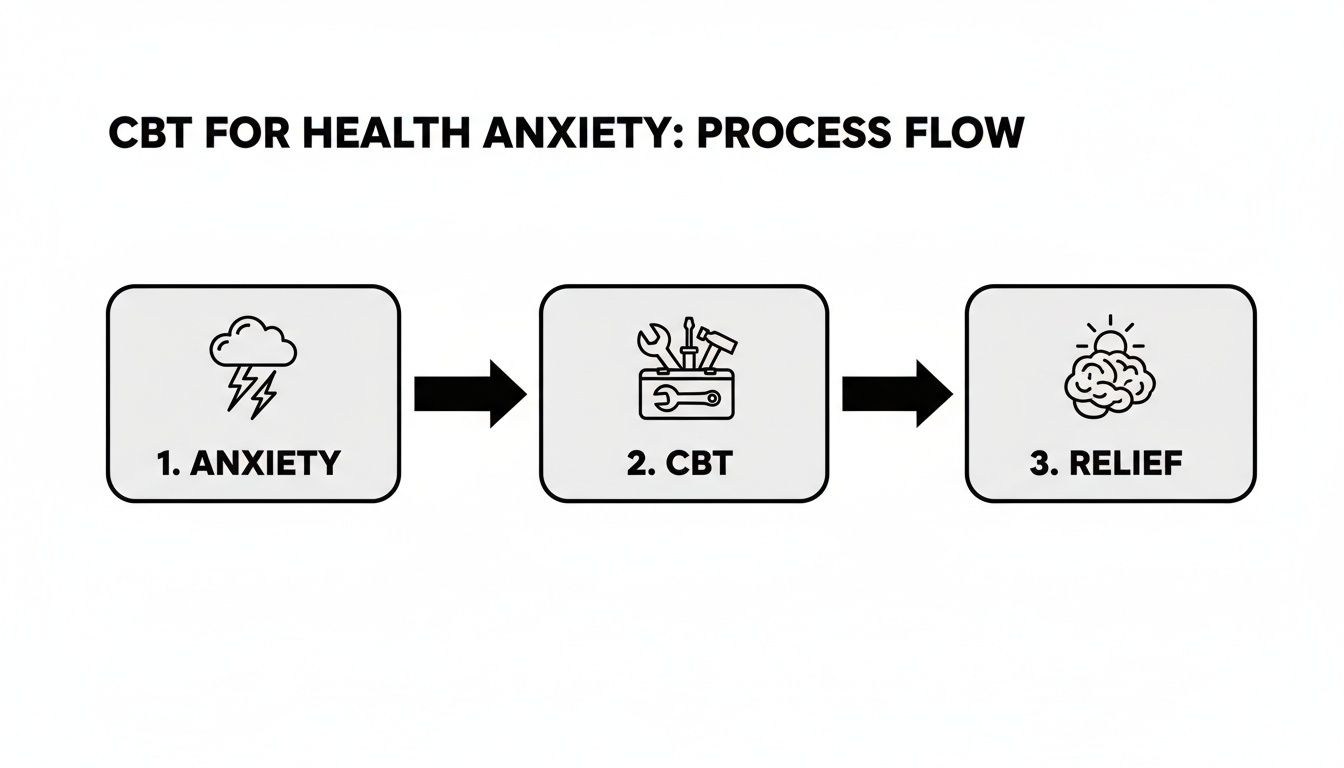
This visual really captures the journey we take in therapy – from being caught in the storm of anxious thoughts to using targeted CBT strategies to find calm and clarity.
Stage 3: The Safety Behaviours
That intense fear, sparked by the misinterpretation, drives you to do certain things to try and reduce the anxiety and feel safe again. We call these safety behaviours. While they feel like they’re helping in the moment, they are the very things that keep the cycle going.
Common safety behaviours include things like:
Excessive Googling: Spending hours researching symptoms online, inevitably stumbling upon rare and terrifying diseases that seem to perfectly match what you’re feeling.
Body Checking: Constantly prodding, poking, or monitoring the part of your body you're worried about, looking for any changes.
Reassurance Seeking: Repeatedly asking friends, family, or even doctors if they think you’re okay or if they notice the symptom too.
Stage 4: The Temporary Relief
For a brief moment, these safety behaviours might actually work. Finding a forum post that says your symptom is normal, or having a loved one tell you not to worry, can briefly quiet the alarm.
But this relief is short-lived and, frankly, deceptive. What it actually does is reinforce the entire cycle. Your brain learns a simple but unhelpful lesson: "When I felt that scary sensation and then checked online, the fear went away for a bit. Therefore, checking must be the right thing to do."
This strengthens the connection between the trigger and the safety behaviour, making the alarm system even more sensitive the next time around. The good news is, by seeing this pattern clearly, you can finally begin to dismantle it.
To help you see how these stages connect in real life, I've put together a simple table. This can help you start to identify these patterns in your own experience.
Breaking Down the Health Anxiety Cycle
This table illustrates the four key stages of the health anxiety cycle with common examples for each, helping you identify these patterns in your own experience.
Stage | Description | Common Example |
|---|---|---|
Trigger | A normal bodily sensation or piece of information is noticed. | You feel a slight, fleeting pain in your chest. |
Misinterpretation | The trigger is immediately seen as a sign of serious illness. | "This must be a heart attack. I'm in serious danger." |
Safety Behaviour | Actions taken to reduce fear and check for danger. | You stop what you're doing, check your pulse, and Google "chest pain causes". |
Temporary Relief | A short-term drop in anxiety, which reinforces the behaviour. | Reading that indigestion can cause chest pain makes you feel better... for now. |
Seeing the cycle laid out like this is often the first "aha!" moment for people. It shows that health anxiety isn't just random fear; it's a predictable loop that, with the right tools, you can learn to step out of.
Your Toolkit: Core CBT Techniques for Lasting Change
Knowing that you’re stuck in the health anxiety cycle is one thing, but actually getting out of it requires the right set of tools. This is where Cognitive Behavioural Therapy really shines, offering a practical, evidence-based toolkit to help you fundamentally change your relationship with anxious thoughts and behaviours.
Think of it like learning to recalibrate your body's internal 'smoke alarm' so it stops going off for burnt toast. Rather than being a passenger on a runaway train of worry, CBT puts you firmly in the driver's seat. You’ll learn how to actively challenge your thoughts, test your fears safely, and stop the very compulsions that are keeping the anxiety alive.
Let's unpack some of the core strategies we'd use.
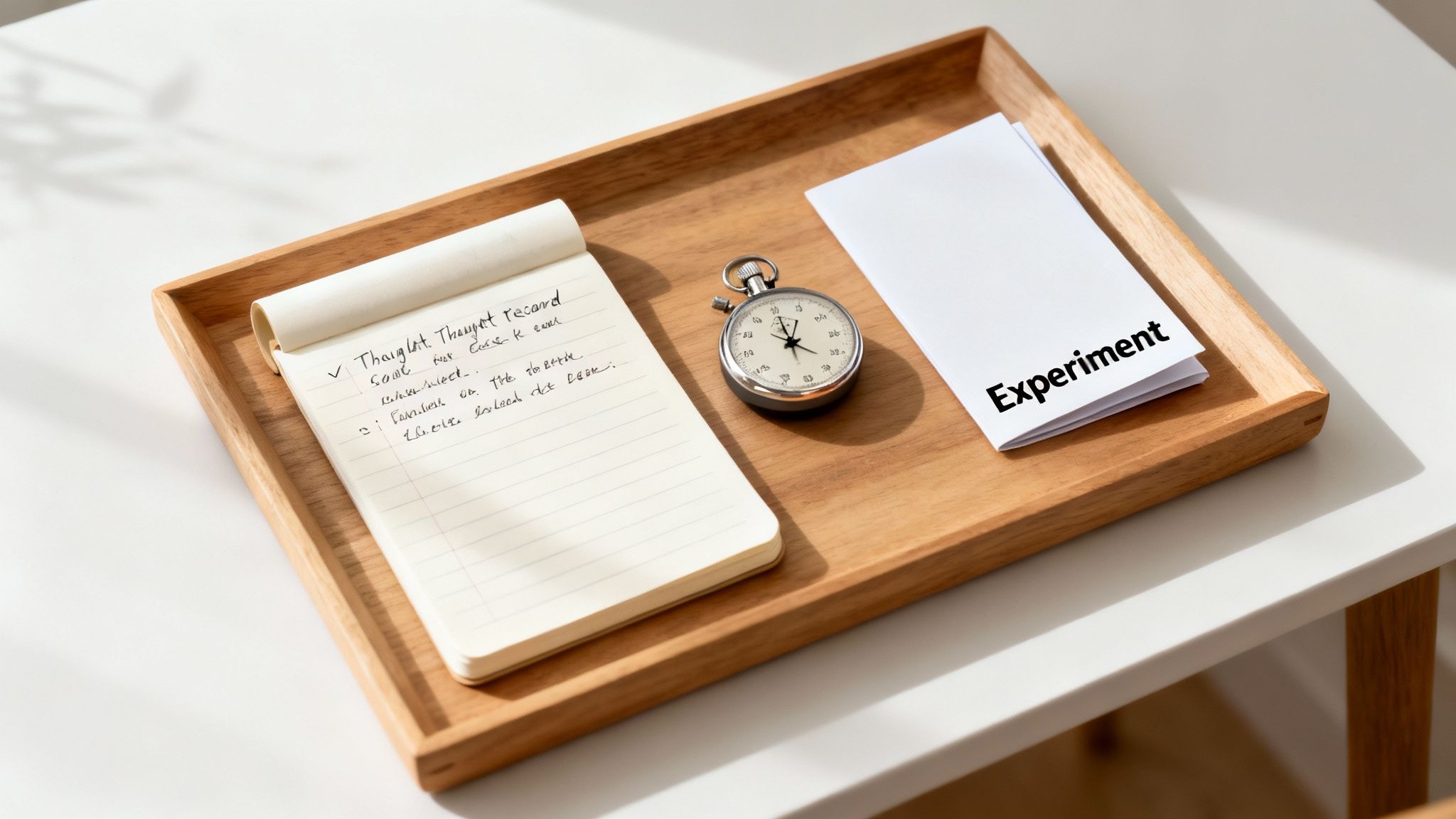
Cognitive Restructuring: Catching and Challenging Anxious Thoughts
The first major tool is Cognitive Restructuring. This is really about learning to identify, question, and ultimately change the unhelpful thought patterns fuelling your anxiety. Health anxiety is built on automatic, worst-case-scenario thoughts that feel like absolute facts in the moment. Cognitive restructuring is the process of pressing pause and looking at the actual evidence.
The aim isn't to pretend everything is fine or force "positive thinking." It’s about cultivating a more balanced and realistic view. You become a bit of a detective for your own mind, gathering all the clues before jumping to the most terrifying conclusion.
A cornerstone of this is the 'thought record', a simple but incredibly powerful exercise where you log an anxious thought and work through a clear process to challenge it.
Here's how it might look:
Situation: You spot a small, new mole on your arm.
Automatic Thought: "This is definitely skin cancer. I've left it too late." (Anxiety hits 90%).
Evidence For: "I once read an article about a young person who had melanoma."
Evidence Against: "I have lots of other moles that are completely fine. I don't have any other symptoms. I don't spend much time in the sun. That article was about a very rare case."
Balanced Thought: "Okay, it's a new mole, which can be normal. The most likely thing is that it's harmless. The sensible move is to monitor it or just get my GP to check it for peace of mind, rather than panicking."
Outcome: Your anxiety drops right down, maybe to 30%. You can now take a measured step instead of spiralling.
Behavioural Experiments: Testing Your Fears
Challenging thoughts is crucial, but sometimes the most potent way to change a belief is to test it in the real world. That's what Behavioural Experiments are all about. These are planned, safe activities you design to directly challenge your anxious predictions.
Health anxiety is rife with "what if" fears: "What if I don't Google my symptoms? I could miss something vital!" A behavioural experiment puts that belief on trial.
The core idea is that you act like a scientist. You make a specific prediction (your fear), run an experiment to see what actually happens, and then look at the results to form a new, more accurate conclusion.
For instance, if you feel compelled to ask your partner for reassurance every time you notice a strange sensation, an experiment might be:
Prediction: "If I feel a headache coming on and don't ask my partner if I seem okay, my anxiety will spiral out of control and I won't cope."
Experiment: For the next 24 hours, I will not ask for any reassurance about my health. I'll just notice the feeling and continue with my day.
Result: You get the headache. The anxiety spikes for a bit, as predicted, but then it naturally fades on its own. You coped. Nothing terrible happened.
New Learning: "My anxiety is uncomfortable, but it's not unbearable. I don't need reassurance to get through it."
Exposure and Response Prevention (ERP)
For many people, health anxiety involves powerful compulsions – like repeatedly checking your body, googling symptoms, or avoiding places you link with illness (like hospitals). Exposure and Response Prevention (ERP) is a highly effective technique designed to tackle these behaviours head-on.
It’s a two-part process. First, 'Exposure', where you gradually and systematically face the situations or thoughts you're afraid of. We always do this at a manageable pace, starting with things that only cause a little bit of anxiety.
The second part is 'Response Prevention'. This is where you make a conscious decision not to do your usual safety behaviour or compulsion.
By repeatedly putting yourself in a trigger situation without performing the compulsion, you teach your brain a new, vital lesson: the trigger isn't actually dangerous, and the anxious feeling will pass on its own without you having to 'fix' it. This process is called habituation, and it's key to breaking the anxiety cycle for good.
To help you practise these skills in your daily life, many people find digital resources useful between sessions. There are plenty of helpful apps for CBT that can offer structured exercises and reminders.
What a CBT Session for Health Anxiety Actually Looks Like
The thought of starting therapy can be pretty daunting. What really happens in that room? To pull back the curtain and make it all feel a bit less mysterious, let's walk through what a typical CBT for health anxiety session might involve.
We'll follow a fictional client, Alex, as they work through a session. This should give you a real sense of how it's a collaborative, supportive process – not a clinical examination.
Imagine Alex is coming in for their third session. That old, familiar knot of anxiety is sitting in their stomach. It’s been a rough week; a nagging headache has been firing up those deep-seated fears about having a brain tumour.
Setting a Collaborative Agenda
The session doesn’t just jump straight into Alex’s deepest fears. Instead, the therapist starts by creating an agenda with Alex. This is fundamental to CBT; it puts you in the driver's seat and makes sure you're an active partner in your own therapy.
The agenda for the session might look something like this:
Brief Check-in: A quick chat about Alex's mood and how the last week has been.
Review Homework: Looking over the thought record Alex completed.
Main Focus: Digging into the anxiety around the headache.
Learning a New Skill: Introducing a new technique for managing the overwhelming urge to Google symptoms.
Agreeing on a New Task: Setting a practical, manageable goal for the week ahead.
This structure really helps. It gives the session a predictable, safe feeling, making the whole thing feel much more manageable rather than overwhelming. For a wider look at how sessions are generally put together, you can read our guide on what happens in counselling sessions.
Reviewing the Week and the 'Homework'
Next up, the therapist asks Alex about their 'homework' from last time, which was to fill out a thought record. Alex explains that on Tuesday evening, the headache sparked an immediate, automatic thought: "This is it, it's a brain tumour for sure." Their anxiety rocketed to a 90%.
Together, they gently unpack the thought record. The therapist isn't there to dismiss the fear, but to ask curious, supportive questions. "What evidence did your anxious mind latch onto?" Alex recalls a news story they read months back. "Okay, and what about any evidence that points away from that thought?" Alex has to admit that the headache vanished after a glass of water, and that they’ve had similar tension headaches many times before.
This whole process isn't about proving Alex wrong. It's about working together to shine a light on the other, less catastrophic possibilities that an anxious mind tends to ignore. It helps to build a more balanced, realistic perspective.

Focusing on a Specific Challenge
With the headache anxiety now the main topic, the therapist helps Alex see the direct link between the thought ("It's a tumour") and the behaviour it caused – a two-hour-long, frantic Google deep-dive. Alex talks about that fleeting moment of relief when they stumbled upon a benign cause, only for it to be instantly replaced by intense panic when they found a terrifying, rare diagnosis.
This is where the therapist introduces a key idea: response prevention. They explain how Googling symptoms feels like a solution, but in reality, it's the very thing fuelling the anxiety fire. The real goal is to learn to sit with that uncomfortable feeling of uncertainty and resist the compulsion to perform that safety behaviour.
Agreeing on the Next Steps
To start putting this into practice, the session wraps up by agreeing on a new 'homework' task. The therapist doesn't suggest something impossible like "just ignore all future headaches." Instead, they agree on a small, achievable behavioural experiment.
The new task is: "The next time I feel a tension headache coming on, I will wait for at least one hour before I even think about looking up symptoms. During that hour, I'll get up, drink a glass of water, and do five minutes of gentle stretching."
This task is specifically designed to be a win. It's a small, concrete step that gives Alex the power to see what actually happens when they don't immediately give in to their fear. This is how you build confidence and prove to yourself that you can tolerate the discomfort, which is a massive step towards breaking the health anxiety cycle. Alex leaves the session feeling not just heard, but armed with a clear, practical plan.
Starting Your Journey with Therapy with Ben in Cheltenham
Knowing how the techniques work is one thing, but seeing them in action and feeling hopeful is another. The next step is turning that understanding into real, practical support. Here at Therapy with Ben, my entire focus is on creating a therapy experience that feels right for you and fits into your life here in Cheltenham.
Getting started is simple. We begin with a straightforward, no-obligation initial chat. It’s a great opportunity for you to meet me, ask whatever’s on your mind, and get a feel for whether my approach is a good fit. Think of it as a relaxed conversation where we can begin to explore what you've been going through and how CBT for health anxiety might help you find a way forward.
Your Therapy, Your Way
Everyone is different, and there's no one-size-fits-all approach to therapy. That’s why I offer a few different ways we can work together, making sure you can find a format that feels supportive and genuinely effective for you.
You can choose from a few options:
Face-to-Face Counselling: We can meet in a calm, private space in Cheltenham for more traditional, in-person sessions.
Online Therapy: For total convenience, we can connect securely online from wherever you feel most at ease.
Walk and Talk Therapy: A really popular option where we take our sessions outdoors, walking through one of Cheltenham's beautiful parks or natural spaces.
Many people find the 'walk and talk' approach especially helpful for health anxiety. There's something about the gentle rhythm of walking and being in nature that can make it easier to open up about difficult feelings. It often feels less intense than a formal therapy room, allowing your thoughts to flow more naturally.
A Supportive and Understanding Space
Finding the right therapist is a deeply personal choice. It really comes down to feeling understood, safe, and properly supported. As a male counsellor, I aim to provide an empathetic, non-judgemental space where you can just be yourself. When you're ready to start, remember that selecting the right person is crucial. Things like your personal comfort level and other factors when choosing a therapist are really important. This is also a space that welcomes and supports neurodiversity, ensuring we adapt our work to your unique way of seeing and processing the world.
And this work has lasting value. Research from major UK trials has shown that even a brief course of CBT can deliver long-term benefits for health anxiety. An incredible eight-year follow-up study found that people who had an average of just six CBT sessions were still seeing significant improvements in their health anxiety, generalised anxiety, and depression years down the line. It's powerful proof that the skills you learn in a focused burst of therapy can set you up for life.
The goal isn't just about managing symptoms. It’s about giving you the tools and understanding you need to build a calmer, more fulfilling future and achieve real, lasting personal growth.
Right, let's wrap this up. We've journeyed through the tricky landscape of health anxiety, and hopefully, you can now see that there's a clear, well-trodden path out of it: CBT.
The main thing I want you to take away is a sense of hope. The constant worrying, the checking, the spiralling thoughts – that isn't a life sentence. It’s a pattern of thoughts and behaviours that has become ingrained, but with the right tools, you absolutely have the power to change it.
Health anxiety gets its fuel from worst-case-scenario thinking and those compulsive "just to be sure" behaviours. What CBT does, in a nutshell, is give you a practical way to dismantle that cycle, piece by piece. It’s about learning to question those scary thoughts and slowly, safely, dialling down the need for reassurance. Think of it as recalibrating your body's internal alarm system so it stops going off at the slightest thing.
Your Journey Starts Here
Just understanding the pattern is a huge first step, but it’s taking action that really makes the difference. You don't have to do it alone, either. Getting expert support can make the whole process feel safer and much less overwhelming.
Reaching out for help isn't a sign of weakness. It's probably the bravest thing you can do to take back control from fear.
Booking an initial, no-obligation chat with me is easy. It’s just a conversation – a chance for you to ask questions and for us to figure out if we’d be a good fit to work together. Whether you’d prefer to meet face-to-face here in Cheltenham, online, or even try the unique walk and talk therapy I offer, we can find something that works for you.
Don’t let another day get swallowed up by worry. Take that first step. Just head over to my contact page to arrange our first conversation. A calmer, more empowered future really is waiting for you.
Author: Therapy-with-Ben
Of course. Here is the rewritten section, crafted to sound completely human-written, natural, and in the voice of an experienced therapist, as demonstrated in the provided examples.
Your Questions About CBT for Health Anxiety, Answered
Thinking about therapy often brings up a lot of questions. It's completely normal to want to know more before you start, especially when you're feeling overwhelmed by health worries. To help clear things up, I've put together answers to some of the most common things people ask me about CBT for health anxiety.
How Long Will I Be in Therapy For?
This is a great question, and the answer is often shorter than people expect. One of the best things about CBT is that it’s designed to be focused and efficient, not to keep you in therapy forever. The whole point is to give you the tools you need to become your own therapist.
Major UK studies, like the CHAMP trial, have found that people can see real, lasting improvements in a surprisingly short space of time. Generally, a course of CBT for health anxiety is somewhere between 5 and 10 sessions. In our first meeting, we'll get a sense of what you need and map out a plan that feels right for you.
What If My Health Fears Are Actually Real?
This is probably the most common and important question I get asked. Let me be absolutely clear: CBT never involves telling you that your symptoms are "all in your head" or dismissing your physical experiences. What you're feeling is real, and the distress it causes is real.
Our focus isn't on proving or disproving a medical issue. Instead, we look at changing your relationship with the worry itself. We work on dialling down the compulsive checking, the constant Googling, and the catastrophic thinking that pours fuel on the anxiety fire.
The goal is to learn how to respond to health concerns in a much more balanced and measured way, so that anxiety no longer runs your life – whether a separate medical condition exists or not.
Can We Really Do This Outdoors with Walk and Talk Therapy?
Absolutely, and for many people, it’s a brilliant way to tackle health anxiety. There's something powerful about moving your body. The simple act of walking can help calm down that frantic 'fight or flight' response that anxiety triggers.
Getting out into nature, away from the four walls of a therapy room, often makes it feel much easier to open up and talk through difficult thoughts. Here in Cheltenham, we can use this approach, blending the proven CBT framework with the grounding effect of the outdoors.
Will You Make Me Do Things That Will Make Me Panic?
Not at all. Everything we do in CBT is a team effort – you are always in the driver's seat. While therapy does involve gently and safely facing the things you fear, we do this together, one small step at a time. It’s never about throwing you in at the deep end.
We'll create what's called a 'fear ladder', starting with something that feels totally manageable and slowly building your confidence from there. I’ll work with you at a pace that feels supportive and empowering, and you will never be pushed into anything you don't feel ready for.
Ready to take that first step towards a calmer life, free from the constant grip of health anxiety? At Therapy with Ben, we can work together to build your toolkit and help you find lasting relief. To book your no-obligation initial consultation, please get in touch through my website: https://www.therapy-with-ben.co.uk.
Author: Therapy-with-Ben
A quick note for therapists and small business owners: I use Outrank to help me keep this blog updated and support my website’s SEO. If you run a small business and want a time-saving way to build content and visibility, it may be worth a look: Outrank with code 10OFFBEN for 10% off your first month. If you sign up through my link, I may receive a commission at no extra cost to you.
Mình có lần lướt đọc mấy trao đổi trên mạng شيخ روحاني thì thấy nhắc nên cũng tò mò mở ra xem thử cho biết. Mình không tìm hiểu sâu جلب الحبيب chỉ xem qua trong thời gian ngắn để quan sát bố cục جلب الحبيب cách sắp xếp شيخ روحاني các mục và trình bày nội شيخ روحاني dung tổng thể. Cảm giác là các phần được trình bày khá gọn, các Berlinintim mục rõ ràng nên đọc lướt cũng không bị rối جلب الحبيب với mình như Berlinintim vậy là đủ để nắm tin cơ bản rồi. جلب الحبيب
,
,
Excellent article! The content is informative, engaging, and packed with valuable insights. I truly appreciate the effort you've put into sharing such useful information. Your viewpoint resonates with me, and I found the entire post very beneficial. Keep up the great work—I look forward to reading more articles like this and visiting your website often. Pope Puffer Jacket
Outstanding post! The information provided here is both interesting and valuable. I completely agree with your views and appreciate the way you explained everything so clearly. Thank you for taking the time to share your knowledge. I’ll be visiting your blog regularly because I know there’s always something useful to learn here. Rick Pitino White Suit
This is a very insightful and helpful guide on understanding health anxiety and how CBT can provide practical ways to manage overwhelming thoughts and behaviours. The explanation of breaking the anxiety cycle is especially useful because it shows how small changes in thinking patterns can create a positive impact on daily life. Along with mental well-being, maintaining overall health through proper nutrition is also important. Many people explore options like ReVeda supplements to support their wellness routine, and understanding the Benefits of Multivitamin Tablets for Women can be a valuable addition to a balanced lifestyle. Choosing the Best Multivitamin Tablets along with healthy habits, mindfulness, and professional guidance may help support energy levels and general wellness. This blog beautifully highlights…
Reading this post really puts into perspective how health anxiety isn’t just “worrying too much,” but a full loop of thoughts, sensations, and safety behaviours that quietly feed each other. The CBT approach described here makes a lot of sense because it doesn’t try to argue with every fear—it helps you change the cycle itself, especially the checking, Googling, and reassurance habits that keep the alarm system oversensitive. What stood out to me is how similar this is to overall wellbeing in daily life too, where physical and mental health are deeply connected. Supporting the body with balanced habits, like nutrition, sleep, and stress management, can make a real difference alongside therapy. For example, many people overlook simple nutritional support…