


A Therapist's Guide to Learn to Love Yourself
Posted by: Therapy-with-Ben
Learning to love yourself isn’t about chasing those fleeting moments of high confidence. It’s about building a real, stable, and compassionate relationship with the person you are right now. This means truly accepting all of you—the brilliant bits and the bits you’d rather hide—and treating yourself with the same warmth you’d give a close friend. It’s an active process of looking after your own wellbeing, setting boundaries that protect you, and forgiving yourself for not being perfect.
Why It Is So Hard to Learn to Love Yourself

If you've ever felt a bit frustrated by the simple advice to "just love yourself," you're definitely not alone. While the intention is good, this kind of instruction often glides over the genuine, complex barriers that get in our way. The truth is, the path to self-love is rarely a straight line because we’re all trying to navigate a lifetime of conditioning and outside pressures.
From a young age, we’re bombarded with messages—some subtle, some not so subtle—about who we should be. Societal standards, what we see in the media, and even comments from family can build up an idealised version of ourselves that feels impossible to live up to. This constant comparison game can easily leave us feeling like we’re not good enough.
The Voices We Internalise
Beyond all the external noise, it’s often our own inner critic that becomes the loudest voice we hear. This internal monologue is usually a collection of past criticisms, perceived failures, and deep-seated fears. It’s the voice that tells us we aren’t smart enough, successful enough, or simply worthy enough, making the whole concept of self-acceptance feel very distant and unearned.
This struggle is far more common than you might think. Here in the UK, issues around confidence and self-esteem are a significant part of why people seek support for their mental wellbeing. In fact, research from the British Association for Counselling and Psychotherapy shows that 28% of people cited confidence and self-esteem as their main reason for seeking therapy. It's a clear sign of how many of us are quietly fighting these internal battles.
The challenge isn't that you are uniquely flawed; it is that you are trying to cultivate self-worth in a world that often profits from your self-doubt.
Setting a Compassionate Foundation
Just acknowledging how difficult this is can be a powerful first step. This isn't about blaming anyone or anything; it's about understanding the landscape of your own inner world. When you can recognise where the struggle comes from, you can start to approach yourself with a bit of compassion instead of harsh judgement.
Before we dive into some practical strategies, it's so important to validate your experience. It makes sense that this is hard when you consider:
Societal pressures create unrealistic expectations that are tough for anyone to meet.
Past experiences and negative feedback can shape a really persistent inner critic.
The habit of self-criticism often becomes automatic, making it incredibly difficult to break.
Understanding why it's so hard isn't an excuse. It's the foundation for building real, lasting change. It helps you shift from a place of self-blame to one of self-awareness, getting you ready for the meaningful work ahead.
Meet Your Inner Critic and Understand Its Story

We all have that nagging voice inside our heads. It’s the one that whispers you’re not good enough, smart enough, or deserving enough. This internal monologue, what we often call the inner critic, isn’t just random negativity. It’s a deeply ingrained pattern of thought, and it has an origin story we can trace and understand.
Before you can even think about quieting its harsh judgements, you first need to get to know it a bit better.
Think of your inner critic less like an enemy to be defeated and more like a misguided protector. Believe it or not, its primary job is often to keep you safe. It’s trying to prevent you from experiencing failure, rejection, or embarrassment by convincing you not to take risks in the first place. The problem is, its methods are outdated and harmful, holding you back from growth and happiness.
The first step in taking away its power is simply to listen and identify its specific messages. This isn’t about agreeing with the criticism, but about observing it with a sense of genuine curiosity. What are the exact words it uses? When does it tend to show up?
Identifying Your Critic's Favourite Phrases
Your inner critic probably has a few go-to lines it repeats over and over. These phrases often feel like absolute truths, even when they’re not based on any real fact.
Take a moment to reflect. Do any of these sound familiar?
"You always mess things up."
"You're not as talented as they are."
"Everyone else knows what they're doing."
"If you try that, you'll only embarrass yourself."
"You should have known better."
By recognising these recurring scripts, you begin to create a separation between them and your own authentic voice. You start to see them for what they are: not objective truths, but learned messages playing on a loop.
Your inner critic’s voice is loud, but it isn’t wise. It’s a relic of your past, not a predictor of your future. Learning to love yourself involves recognising that its playbook is old and its warnings are no longer serving you.
To truly address your inner critic, it helps to understand the process of fundamentally changing your belief system about yourself and your worth. This involves questioning these ingrained negative thoughts and actively replacing them with more compassionate and realistic ones.
Tracing the Critic's Origins
Once you have a clearer idea of what your critic says, the next natural step is to explore why. These negative self-beliefs didn't just appear out of nowhere; they’re often rooted in specific life experiences.
Consider where these messages might have come from:
Childhood experiences: Critical feedback from parents, teachers, or peers can be internalised at a young age, forming the bedrock of your inner critic.
Past failures or mistakes: A significant event where you felt you fell short can create a lasting fear of repeating that experience, which then fuels self-doubt.
Societal conditioning: We’re constantly bombarded with ideals about success, beauty, and productivity that can make us feel inadequate if we don't measure up.
For example, maybe your critic gets particularly loud during work presentations. Could this be linked to an experience in school where you were embarrassed while speaking in front of the class? Perhaps it surfaces in social situations, stemming from a past friendship that ended badly and left you feeling you were "too much" or "not enough."
Mapping these connections is a crucial part of the process. This isn't about dwelling on the past or placing blame, but about gaining understanding. When you realise your inner critic is just echoing an old fear or a past hurt, its words start to lose their authority. You can see it for what it is: a protective mechanism stuck in a time loop, trying to solve today’s challenges with yesterday’s logic.
By understanding its story, you can begin to write a new, more compassionate one for yourself.
Posted by: Therapy-with-Ben
Cultivating Self-Compassion in Your Daily Life
Self-compassion is the gentle, active antidote to that harsh inner critic we all know. While understanding your critic is a huge first step, the real, lasting change kicks in when you start to intentionally practise kindness towards yourself. This is especially true during those difficult moments when your first instinct is to do the opposite.
This is where we move from theory into the practical, day-to-day stuff.
Learning to love yourself isn’t about waiting until you feel perfect or have it all figured out. It’s about offering yourself kindness precisely when you feel you’re falling short. Think about it: how would you treat a good friend who was struggling? With warmth, care, and understanding. The goal is to start extending that same courtesy to yourself. This simple shift in perspective is the very foundation of a healthier relationship with the person who matters most—you.
The whole practice starts by simply noticing your self-talk without jumping to judgement. When you make a mistake, what’s your immediate internal reaction? For so many of us, it’s a waterfall of criticism. The aim here is to interrupt that old, tired pattern and consciously choose a more compassionate response.
The Power of the Self-Compassion Break
One of the most effective ways I've found to introduce self-compassion into a busy life is a technique called the 'Self-Compassion Break'. It’s a brief, mindful practice you can pull out of your back pocket anytime you feel overwhelmed by stress, pain, or self-criticism. It’s built on three core ideas that help you acknowledge your struggle in a supportive way.
Next time you're having a really difficult time, just pause for a moment and gently bring these ideas to mind:
Acknowledge the Struggle: Say to yourself, "This is a moment of suffering" or even just "This is really hard right now." This isn't about adding drama; it's about validating your own feelings with a bit of mindfulness.
Recognise Common Humanity: Remind yourself, "Suffering is just part of life" or "Other people feel this way too." This is so important because it helps you feel less isolated. Your inner critic loves to make you feel uniquely flawed, and this directly counters that.
Offer Yourself Kindness: Place a hand over your heart or somewhere else that feels soothing. Then, say something like, "May I be kind to myself" or "May I give myself the compassion I need." This is a direct, physical act of self-care.
This simple exercise can ground you right in the present moment, breaking that cycle of negative thinking and creating a little space for a kinder inner voice to finally be heard.
From Harsh Self-Talk to Supportive Dialogue
Reframing your thoughts is a skill, and like any skill, it gets stronger the more you practise. It involves catching a self-critical thought and consciously swapping it for one that’s more balanced, supportive, and realistic. It’s not about letting yourself off the hook or ignoring your mistakes, but about fundamentally changing how you speak to yourself about them.
This infographic really captures the fundamental difference between these two internal responses.
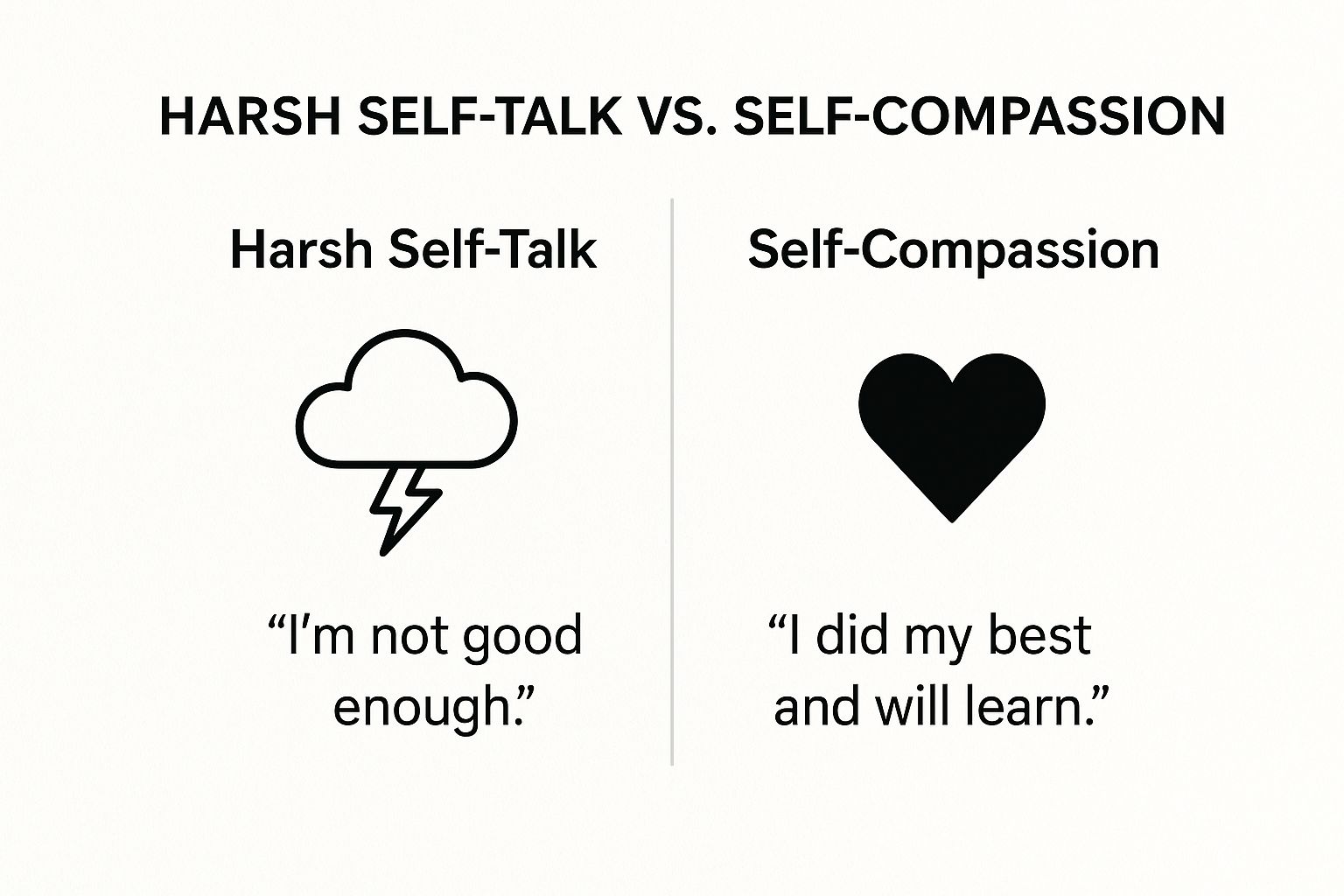
As you can see, making the shift from a harsh inner critic to a more compassionate voice changes everything. Your focus moves away from blame and shame, and towards learning and growth.
Self-Criticism vs Self-Compassion A Practical Comparison
Let’s look at how these two mindsets play out in real life. The following table breaks down the internal dialogue and long-term effects of self-criticism versus self-compassion when facing common challenges. It really highlights the practical difference this shift can make.
Situation | Self-Critical Response | Self-Compassionate Response | Long-Term Outcome |
|---|---|---|---|
Made a mistake at work | "I'm so stupid. I can't do anything right. Now everyone thinks I'm incompetent." | "Okay, I made a mistake. It's frustrating, but it happens. What can I learn from this?" | Criticism: Increased anxiety, fear of failure, avoidance of challenges. Compassion: Resilience, problem-solving, increased motivation. |
Feeling lonely | "No one ever wants to spend time with me. There must be something wrong with me." | "Feeling lonely is hard. It's a normal human emotion. I'll reach out to a friend." | Criticism: Social withdrawal, low self-esteem, isolation. Compassion: Proactive connection, self-validation, stronger relationships. |
Didn't stick to a goal | "I'm such a failure. I have no willpower. Why even bother trying again?" | "I'm disappointed I didn't meet my goal, but I tried. Let's see what got in the way and adjust the plan." | Criticism: Giving up on goals, cycle of shame, procrastination. Compassion: Persistence, adaptability, growth mindset. |
Notice how the compassionate response acknowledges the difficulty but immediately pivots to constructive action and self-support. The self-critical response, on the other hand, just leads to a dead end of shame and inaction. This is why cultivating compassion isn't about being 'soft' on yourself; it's about being effective.
Cultivating self-compassion is not about letting yourself off the hook. It is about creating the psychological safety needed to take responsibility, learn from your errors, and keep moving forward without being crushed by shame.
Building Your Self-Compassion Toolkit
Turning this into a consistent habit really helps if you have a few practical tools in your emotional toolkit. If you’re looking for more guidance and worksheets to help build these skills, you can explore our collection of mental health resources.
For some extra inspiration to deepen your daily practice, I'd also recommend checking out these 15 remarkable self-compassion quotes to embrace. Sometimes, a few well-chosen words can serve as a gentle reminder on those days when being kind to yourself feels especially difficult.
Just remember to start small and be patient with yourself. Every single compassionate thought is a step in the right direction.
Posted by: Therapy-with-Ben
Putting Self-Love into Practice with Healthy Boundaries

True self-love isn't just a warm feeling or a string of positive affirmations. It’s an active, daily practice, and one of the most powerful ways it shows up is in setting healthy boundaries. This is where your internal feelings of self-worth meet the real world, creating a necessary buffer to protect your time, energy, and emotional wellbeing.
Learning to establish boundaries is a profound act of self-respect. It’s about communicating your limits clearly and teaching people how you expect to be treated. When you genuinely start to love yourself, you begin to realise your needs are valid and deserve to be protected. This isn't about shutting people out; it's about building gateways and deciding who, and what, you let through.
Why Boundaries Are Actually an Act of Kindness
A lot of us get tripped up by the idea that setting a boundary is selfish or mean. In my experience, the opposite is true. When you don't have clear boundaries, resentment quietly builds, poisoning relationships from the inside out.
Think of your personal energy as a finite resource, because it is. Every time you say 'yes' when you’re screaming 'no' on the inside, you're giving a piece of that resource away. Protecting your energy isn't just good for you; it allows you to show up for others as the best, most authentic version of yourself, rather than a depleted, resentful one.
Overcoming the Fear and Guilt
Of course, knowing you should set boundaries is one thing. Actually doing it is another beast entirely. The biggest hurdles I see people face are almost always rooted in a few common fears.
Fear of Conflict: The worry that saying 'no' or stating a need will kick off an argument.
Fear of Disappointing Others: That deep-seated sense of responsibility for everyone else’s happiness.
Feelings of Guilt: The nagging voice that says you're being selfish for putting your needs first, especially if you've been a 'people-pleaser' your whole life.
Just acknowledging these fears is a huge first step. You have to remind yourself that your worth isn’t tied to how much you can do for other people. Real, healthy relationships are built on mutual respect, and that absolutely includes respecting your limits.
Setting a boundary is a declaration that your wellbeing matters. It is a vital, non-negotiable part of any self-love practice, translating your internal sense of worth into a clear, external standard.
Practical Scripts for Setting Boundaries
Finding the right words can feel incredibly awkward at first, particularly if it's new territory for you. It helps to have a few simple, polite phrases in your back pocket. The aim is to be clear, kind, and firm—without feeling the need to over-explain or apologise for having needs.
Here are some starting points you can tweak for your own situations:
For Saying 'No' Gracefully:
"Thank you for thinking of me, but I don’t have the capacity for that right now."
"I appreciate the offer, but I'm going to have to pass this time."
"That doesn’t quite fit with my priorities at the moment, but I wish you the best with it."
For Articulating a Need:
"I really need some quiet time to decompress after work. Can we pick this up later?"
"I find it overwhelming when we discuss several big topics at once. Could we focus on one thing at a time?"
"To do my best work on this, I need a clear deadline to work towards."
For Protecting Your Time:
"I've only got about 15 minutes to chat before my next thing."
"I need to head off by 7 pm to make sure I get enough rest tonight."
"I switch off from work emails over the weekend, but I'll get back to you first thing on Monday."
Notice how these statements are direct, simple, and don't leave much room for negotiation. They state your reality. Start by practising in low-stakes situations to build your confidence. Every time you hold a boundary, you're sending a powerful message back to yourself: you are worthy of respect and care.
Posted by: Therapy-with-Ben
How to Navigate Setbacks on Your Self-Love Journey
If you're on this journey to learn to love yourself, it's important to accept one fundamental truth right from the start: it is not a straight line. There will absolutely be days when the old, familiar voice of your inner critic feels louder, when your motivation dips, and when self-compassion feels miles away. This isn't a sign that you're failing; it's a sign that you're human.
Setbacks are an inevitable part of the process. In fact, I'd go as far as to say they're a crucial part. They act as feedback, giving you a chance to learn, tweak your approach, and get a deeper understanding of what you really need. The goal isn't to somehow avoid these moments, but to learn how to move through them with grace and kindness when they show up.
This shift in perspective is everything. Instead of seeing a tough day as proof you're "not getting it," you can reframe it as a chance to practise the very skills you’re trying to build—patience, forgiveness, and genuine self-support.
Your Setback Toolkit: Practical Strategies
When you feel yourself slipping back into old habits of self-criticism or neglect, it really helps to have a few reliable tools ready. Think of this as your emotional first-aid kit, designed to help you reconnect with your path gently and effectively.
A key part of this toolkit is self-forgiveness. This means consciously letting go of the harsh judgement you might feel for having a setback in the first place. A simple but powerful exercise is to talk to yourself as you would a dear friend who is struggling.
You wouldn't tell them, "See, I knew you couldn't do it." You’d offer warmth, understanding, and encouragement. Try using phrases like:
"It's okay that today was hard. You're doing your best."
"This is just one moment. It isn't the whole journey."
"What do you need right now to feel just a little bit better?"
This simple act of kindness can stop a shame spiral in its tracks and give you the space to move forward.
Reconnecting With Your Why
During a setback, it’s all too easy to lose sight of why you even started this journey. Your motivation can feel buried under layers of frustration or disappointment. This is the perfect time to pause and reconnect with your core reasons.
Take a few moments to think about what inspired you to learn to love yourself. Was it to build healthier relationships? To pursue a goal without self-doubt holding you back? Or was it simply to feel more at peace in your own skin? Reminding yourself of your "why" can refuel your commitment and shift your focus back to the bigger picture.
It’s also important to acknowledge the world we're living in. The prevalence of common mental health conditions among young adults in England has risen sharply, with 25.8% of 16- to 24-year-olds now identified with such a condition. On a positive note, access to treatment has also improved, with 47.7% of adults with symptoms now reporting they receive it. This shows that while more of us face challenges that can chip away at self-love, there is also a growing understanding that seeking support, especially after a setback, is a sign of strength. You can read more about these mental health trends in the full report.
A setback is not a step backwards. It is a pause, an opportunity to rest, recalibrate, and come back to your practice with new wisdom and deeper compassion for yourself.
Gently Guiding Yourself Back
Building resilience is all about how you respond, not about avoiding difficulty. The journey of self-love is a lifelong practice, not a destination you arrive at. This mindset removes the immense pressure to be perfect and encourages a more sustainable, patient, and ultimately more loving approach to your own growth.
If you find that setbacks are becoming overwhelming or that old patterns feel particularly hard to shift, it might be a sign that some extra support could be beneficial. Working with a professional can provide a safe space and tailored strategies to help you through. You can always find a therapist who is right for you to guide you on your journey.
Posted by: Therapy-with-Ben
Common Questions About Learning to Love Yourself
As you start trying these ideas out, it's completely normal for questions to bubble up. The path to learning to love yourself is a really personal one, and figuring it out often means getting clear on a few common sticking points. This section is here to tackle those practical questions with straightforward, compassionate answers.
Think of this as a few friendly signposts to keep you heading in the right direction, especially when things feel a bit wobbly.
How Long Does It Actually Take to Learn to Love Yourself?
Honestly, there's no finish line. This is more of a lifelong practice than a destination you arrive at. The good news is, many people start to feel real, positive shifts in their self-talk and general sense of wellbeing within just a few weeks or months of consistent, gentle effort.
The real aim here is progress, not perfection. Try to celebrate the small wins, like when you catch yourself in a moment of self-criticism and manage to choose a kinder thought instead. That's huge. Be patient with yourself, particularly if you're working to undo years of harsh self-judgement.
Is Learning to Love Yourself the Same as Being Selfish?
This is probably one of the biggest fears people have, but genuine self-love is actually the opposite of selfishness. Selfishness tends to come from a place of deep insecurity—a feeling that you need to take from others just to feel okay.
True self-love, on the other hand, builds your internal security and resilience from the inside out. Far from making you self-absorbed, it actually grows your capacity for empathy and generosity. When you learn how to meet your own needs, you're so much better equipped to show up for others in a healthy way, without feeling burnt out or resentful.
What if These Self-Compassion Exercises Feel Fake at First?
That feeling is completely normal. In fact, I'd be surprised if it didn't feel a bit strange at first. If your brain's default setting has been self-criticism for years, actively being kind to yourself will feel unfamiliar and awkward. It’s a bit like using a muscle you haven't worked in a long time.
The key is just to stick with it, without judging that initial awkwardness. Acknowledge the thought ("Okay, this feels a bit silly") and then gently carry on with the exercise anyway. Over time, your brain will start to form new neural pathways, and these compassionate actions will begin to feel much more natural and authentic.
When Should I Consider Seeing a Therapist for This?
You can make incredible progress on your own with the kinds of tools we've talked about. However, if that inner critic just feels relentless, if you find past trauma is blocking your progress, or if you simply feel persistently stuck, working with a therapist can be invaluable.
A therapist offers a safe, non-judgemental space and can help you with strategies tailored to your specific situation. They can help you explore the deeper issues that might be at the root of a struggle with self-worth. If you're curious about what therapy actually involves, you might find it helpful to look through some FAQs about counselling.
At Therapy with Ben, I provide a supportive space to explore these challenges and develop a truly compassionate relationship with yourself. If you’re ready to take the next step, I invite you to learn more about my approach and how we can work together. Find out more at https://www.therapy-with-ben.co.uk.
Comments