


ADHD Right to Choose in England: A Practical Guide
You've read the same list of ADHD traits four times this week. The unopened post, the seventeen browser tabs, the birthday you remembered at nine in the evening. You've started to wonder whether something more than "a bit disorganised" is going on, so you looked up an NHS assessment and found a waiting list measured in years. Then you closed the laptop.
That's usually where Right to Choose enters the conversation, often as something passed between friends rather than explained by a clinician: you can ask for a different provider, and it might be quicker. There's truth in it, but the detail matters. Right to Choose is an access route, not a fast track, and the assessment is only one piece of what is needed for ongoing care.
I'm an integrative counsellor, and much of my work is with adults who recognise neurodivergent traits later in life. What comes up most often isn't confusion about paperwork. It's frustration at the wait, and a quieter question underneath it: would a formal diagnosis change anything?
What ADHD Right to Choose Is and Who Can Use It
ADHD Right to Choose is an NHS patient-choice route available in England. When your GP agrees that an ADHD assessment is clinically appropriate, you can choose which NHS-funded provider carries out that first outpatient appointment, and that can include an independent clinic holding an NHS contract. The Black Country ICB guidance on Right to Choose referrals sets out the terms plainly: it's a legal patient-choice route for an NHS-funded first outpatient appointment, your GP must make the referral, you must generally be registered with a GP in England, and the provider must hold an NHS contract to deliver that assessment service.
It applies in England, and only England. The route sits inside the wider NHS Choice Framework, and West Sussex County Council's explanation of the framework makes the point that NHS patient-choice rules aren't identical across the UK nations. If you live in Scotland, Wales or Northern Ireland, you'll meet a different process, and it's worth checking your own nation's guidance rather than assuming this one applies to you.
The short version: Right to Choose changes who assesses you. It doesn't change whether you're assessed on the NHS, and it doesn't remove clinical judgement from the process.
What Right to Choose does not do
It isn't self-referral. You can't book yourself in, however well you research the provider.
It isn't a guarantee of diagnosis. A clinician may confirm ADHD, identify something else, or conclude your difficulties come from a mix of factors.
It isn't a route to counselling. Diagnosis and psychological support run on separate pathways, which is worth knowing before you pin your hopes on one appointment.
It isn't a way around triage. Your GP still decides whether an assessment is clinically appropriate.
Who it usually covers
The clearest way to check your own position is to find the row that sounds like you.
Situation | Usually applies? | What to do next |
|---|---|---|
Registered with a GP in England | Usually yes | Ask your GP whether a Right to Choose referral is clinically appropriate |
Not registered with a GP in England | No, not through this route | Register with a GP first and check local arrangements |
Urgent or emergency concern | Usually no | Use urgent NHS services or speak to your GP straight away |
Already receiving ADHD care for the same condition | Usually no | Ask your current clinical team how care will continue |
Wanting to refer yourself | No | Ask your GP to make the referral |
Paying privately for an assessment | No, not NHS-funded | Compare private providers on their own terms |
Living in Scotland, Wales or Northern Ireland | Different rules | Check your nation's NHS guidance |
One row often catches people out: if you're already under a service for the same condition, the choice route generally doesn't apply, so the conversation becomes about the care you're already in rather than a fresh referral. Check that before you book anything.
How to Approach Your GP and Choose a Provider
The GP appointment is where this either moves or stalls, and preparation does most of the work. The NHS information on ADHD for adults confirms the shape of the route: the choice applies to a first planned outpatient appointment rather than a general right to pick any therapist or skip triage, and the GP identifies the clinical need first. That's why the steps below put evidence before requests.
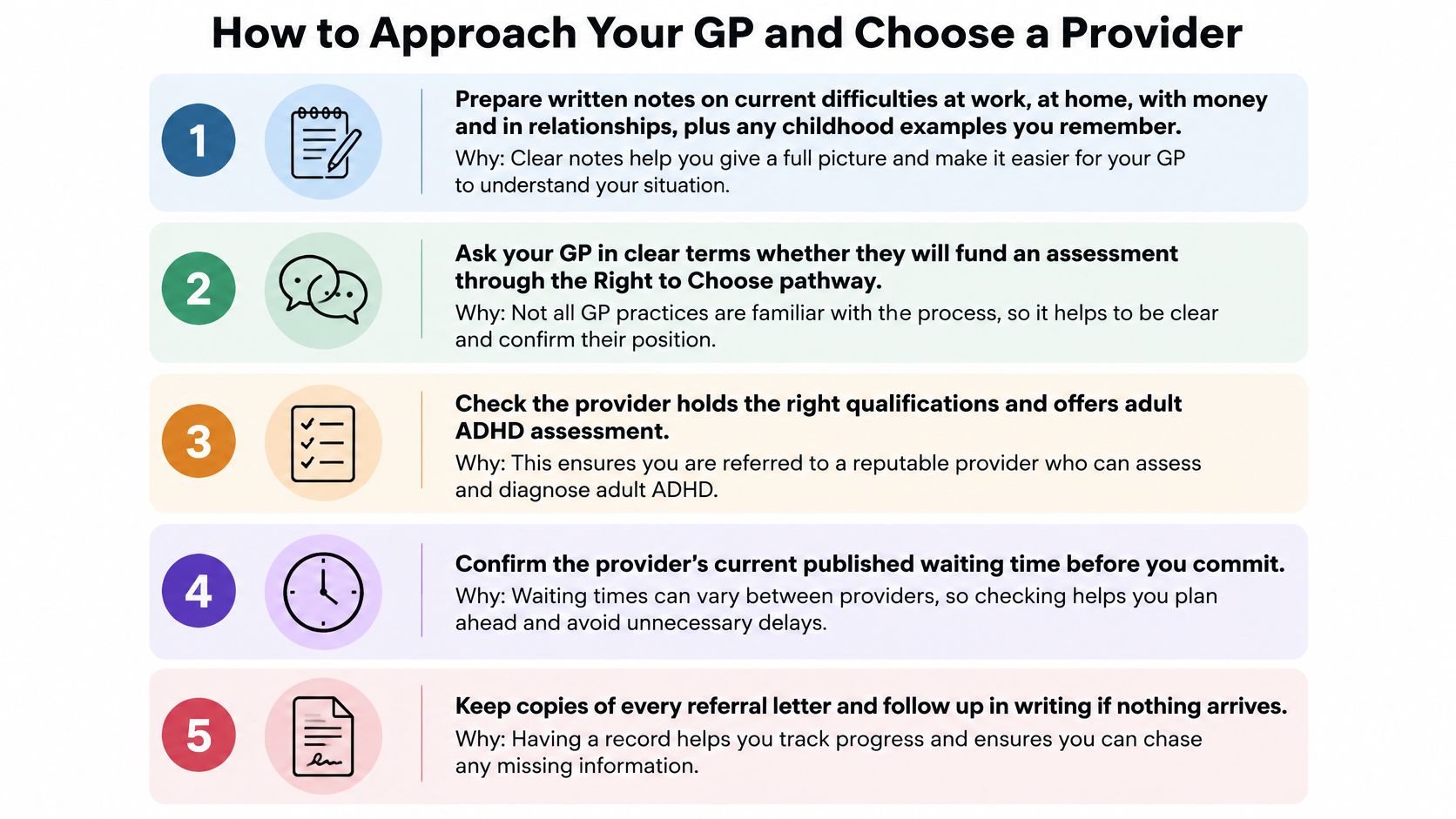
Write your evidence down before you go. Note concrete examples: deadlines missed at work, bills left unopened, conversations you lost the thread of, strain in relationships. Add any childhood examples you remember or can gather from family. The GP is looking for functional impairment across settings, not a self-diagnosis, so specifics carry the conversation. Turning up with nothing written is the most common slip.
Name the purpose in the first minute. Say you want to discuss an ADHD assessment and ask whether Right to Choose applies to you. Without that, the appointment can drift into a general chat about stress and end without a plan.
Let the GP make the clinical decision. You can ask, prepare and present. You can't refer yourself, and pushing for a referral the GP doesn't consider clinically appropriate usually costs you goodwill rather than gaining ground.
Ask for the list of eligible providers, then check your integrated care board. The practice should be able to tell you which providers are commissioned for your area and hold an NHS contract. Your ICB's published information is the cross-check.
Compare before choosing. Location, service model and each provider's current published wait are the three variables that matter most. A clinic that only assesses and discharges is a different proposition from one that starts and stabilises medication.
Expect the provider to decide. They review your referral and either accept or decline it, so ask your GP directly what happens if it's declined. Assuming choice guarantees acceptance is the second common slip.
Close the loop. After the assessment, the provider reports back to your GP. Ask for a copy of that report and keep it somewhere you'll find it again.
Leave the surgery holding three things: your written summary, the name of the provider being approached, and a date to follow up if nothing arrives. A referral that sits unsent in a system is indistinguishable from one that was never made.
How Long the Wait Is and What It Covers
There is no single national Right to Choose waiting time. Waits vary by provider, and the sensible habit is to check each provider's current published estimate rather than trusting a figure in a forum thread from two years ago.
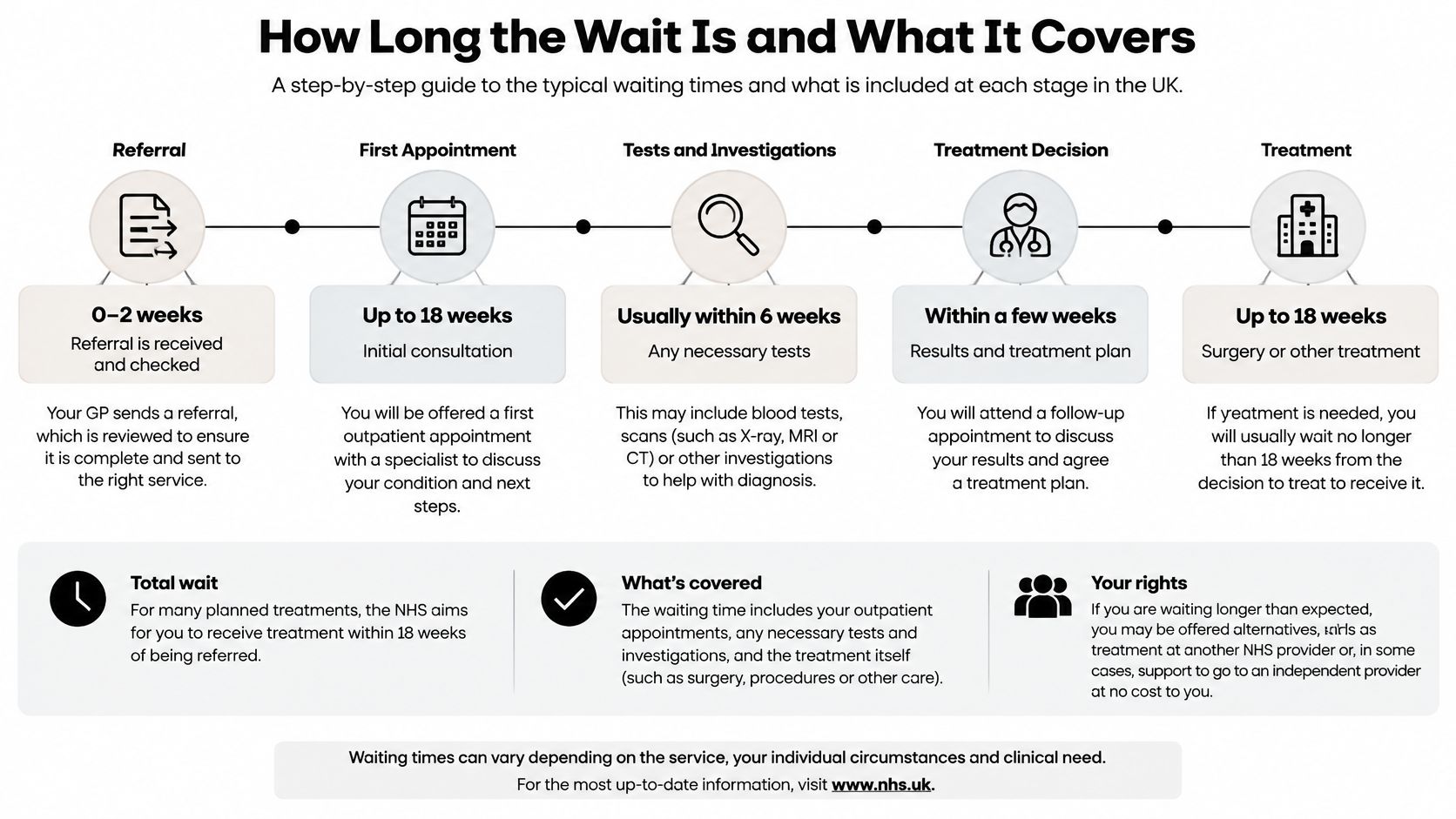
The Grove Medical Group's patient information on Right to Choose assessments is useful precisely because it refuses to promise anything: NHS guidance advises checking each provider's current estimate, local arrangements still affect access, and NHS North East and North Cumbria reported an approximately 78-week minimum wait for an initial assessment for 2026/27, even where providers were funded by that integrated care board. A quoted wait also needs unpacking, because the number in a headline may cover triage, the first appointment, diagnosis, or something narrower.
Stage | What to ask | Published timing |
|---|---|---|
GP referral review | How long the practice takes to send the referral | Set locally, so ask for the date it was sent |
Provider triage | Whether triage is a separate wait from the assessment | Check the provider's current estimate |
First assessment | Whether the quoted wait covers this appointment | About 78 weeks minimum for an initial assessment in NHS North East and North Cumbria, 2026/27 |
Diagnosis and report | How the results are shared with you and your GP | Confirmed by the provider after the assessment |
Medication start | Whether prescribing and titration are a separate wait | Ask the provider, because prescribing and titration can be separate stages |
Demand explains much of this. The independent government review into ADHD and autism support reported that NHS spending on independent-sector ADHD services rose by approximately 252% over three years, with a projected overspend of £164 million across the ICBs it analysed. The same review found that only around 10 of roughly 120 ADHD service providers submitted routine data, so any headline waiting figure deserves a degree of caution.
Four habits make the wait easier to manage:
Ask for the date your referral was received, and quote it every time you chase.
Request confirmation in writing, so your position doesn't depend on someone's memory.
Keep a dated log of contacts, including who you spoke to and what they said.
Use the time to build your examples, since the assessment asks about childhood and current functioning and memory is unreliable under pressure.
Money is a common background stress during a long wait, especially when admin slips. If budgeting systems have never stuck, this guide to managing bills without rigid budgets offers a gentler structure than most spreadsheets.
What to Check Before Choosing a Provider
Here's the assumption worth challenging early: that a referral leads to a prescription. It often doesn't, at least not in the way people expect.
A Right to Choose diagnosis doesn't automatically mean your GP will prescribe ADHD medication. If medication is clinically appropriate, NHS-funded care can include prescribing and titration through the specialist service. Once things are stable, the provider may ask your GP to take over prescribing under a shared-care arrangement. The Hampshire and Isle of Wight ICB guidance on ADHD assessment and medication explains both halves of that, and notes that some GP practices or local systems don't accept shared-care arrangements with private providers, even when those providers deliver NHS-funded Right to Choose assessments. One NHS practice states explicitly that it won't enter shared care for medication started by a Right to Choose provider.
Shared care, in plain terms: a separate agreement where your GP takes on specified prescribing and monitoring while the specialist stays involved. It is negotiated, not automatic.
So before you commit to a provider, get answers to these:
Is this provider commissioned for my area under an NHS contract? If not, the route doesn't apply.
Does the quoted service include medication initiation, titration and monitoring? Some providers assess and discharge, and that changes what happens next.
Who prescribes once I'm stable, and what happens if my GP declines shared care? Ask for the answer, not an assurance.
Which reports reach my GP, and when? You want the assessment to be legible to whoever holds your record.
Then ring your own surgery and ask the same shared-care question from their side. Practices vary, and a receptionist may not know, so ask for the practice manager or a GP. If shared care is refused, the plan might be ongoing specialist prescribing, a different provider, or a decision not to pursue medication at all. Better to know that now than eight months into a queue. If you're weighing private assessment against the NHS route, this piece on private ADHD diagnosis sets out how the two paths differ.
Common Questions About ADHD Right to Choose
Public guides often describe choice as an equal entitlement. The interim report of the independent ADHD Taskforce is blunter, reporting that waits can reach four or more years for children and eight or more years for adults, and that access is even more delayed or inequitable for people from lower-income, care-experienced, minority, marginalised and female groups. A right you have to fight for isn't experienced as a right.
What if my GP refuses to refer
Ask for the reasons in writing. Check whether your integrated care board publishes local guidance on Right to Choose, and take that to a second appointment rather than arguing from memory. Cooperation varies between practices, and a refusal isn't always final.
Can I get support while I wait
Often, yes, though it depends on what's available locally. Ask your GP what support exists in the area, and remember that counselling can run alongside the diagnostic route rather than waiting for it. Nothing about a pending referral prevents you from working on how you're feeling now.
What if I don't meet the diagnostic criteria
Support doesn't depend on a diagnosis. Ask what help is available for the specific difficulties you described, and keep a note of what you've already tried, because that history is useful whoever you speak to next.
Where do I check current information
Start with the NHS website, then your ICB's published pages, then the provider's own current waiting estimate. If paperwork or online forms are a barrier, asking someone to sit with you while you fill them in is reasonable. Administrative capacity shapes who benefits from this route, so treat that as a practical problem to solve rather than a personal failing.
Is a Formal Diagnosis Worth Pursuing for You

Some adults want a formal diagnosis for certainty, or for a route to medication if it's clinically appropriate. Others want workplace adjustments, or documentation that makes an informal understanding official, or an explanation for years of difficulty that they can hold in their hands. Those are all legitimate reasons to pursue it.
Others already recognise many ADHD traits in themselves and have no interest in medication. For them, a referral, a long wait and a diagnostic letter may add little that feels practical. Both positions are reasonable, and neither needs defending.
It's worth knowing what a diagnosis will and won't do. The NHS guidance on ADHD for adults makes the point that diagnosis and support needs are not the same thing: people can need support without meeting diagnostic thresholds, and two people with the same diagnosis can need quite different kinds of help. An assessment or diagnosis doesn't automatically bring psychological support, practical coping help, or treatment for anxiety, depression or relationship difficulties. Right to Choose may improve access to a diagnosis for some people without solving the wider care pathway. NHS guidance also notes that waits still vary from several months to years, and that providers using the route can have long queues of their own.
Four questions are worth sitting with before you decide:
If I had the diagnosis tomorrow, what would be different?
What would I do with it that I can't do now?
Would the wait still feel worth it if medication weren't part of the picture?
Would I want help with these difficulties even without a label?
A diagnosis can open doors to adjustments and treatment conversations. It rarely settles the questions you carry about your own history. That work is personal, and it can happen with or without a label.
Choosing not to pursue a diagnosis is a valid decision. So is pursuing one now, or coming back to it in a year.
Waiting, Self-Criticism and the Emotional Side

The referral goes in, then the quiet stretches out. For many adults that gap is heavier than the appointment itself, because asking for an assessment can feel like putting years of coping up for judgement.
By the time someone reaches this point, they have often spent a long time working harder than other people to look ordinary. Systems get built, abandoned and rebuilt. Apologies for lateness become reflexes. Jokes about being chaotic arrive before anyone else can make them. That is masking, and it drains energy in a way that is difficult to explain to people who have never needed it.
Self-criticism then starts posing as accuracy. Forgetfulness is treated as carelessness. A missed deadline becomes evidence of laziness. A person told at school that they were not applying themselves can still be repeating that sentence thirty years later, now in their own voice.
The emotional mix is rarely simple. Relief can sit beside grief, anger beside anxiety, hope beside dread about what an assessment might say. A Right to Choose referral is an access route, so the queue is for assessment rather than a promise about medication, shared care or ongoing support. Knowing that does not shorten the wait, though it can stop the silence being read as a verdict on your character.
Notice the commentary that arrives with memories of school reports, jobs that never quite suited you, and relationships where you felt misunderstood. It is worth examining because it is often harsher than the evidence supports.
Procrastination belongs here too. It often looks like knowing exactly what needs doing and still being unable to begin, which is closer to overload, fear of failure or interest slipping away than to a character flaw. For the narrower task of getting started, Litter Caterpillars' guide to taking action may be useful alongside the pattern described in ADHD and perfectionism.
Ben has a particular interest in ADHD, autistic traits, late recognition of neurodivergence, masking, emotional intensity, shame and the experience of feeling different. Those are often the parts that hurt most and are discussed least. Feeling different is a human experience. Understanding it can begin before any label arrives, and it can continue whatever the assessment finds.
How Counselling Can Help While You Wait
Counselling isn't advice, and it isn't a diagnosis. It's a space to explore thoughts and feelings with someone who isn't going to grade your answers. My role is often to help work out what you'd like to do, not to tell you what the right decision is. I work integratively, drawing particularly on person-centred and psychodynamic approaches, which in practice means we go at your pace, I reflect back what I hear, and we notice patterns that repeat across your life.
In this context, that might mean looking at how you've understood yourself since childhood, the ways you've learned to mask, the voice that calls you lazy, and the emotional cost of finding things harder than they appear to be for other people. It can also mean sitting with the uncertainty of a referral that hasn't been answered, and thinking about what you'd want if the assessment goes one way rather than another.
Counselling can run before, during or after an assessment. It won't push you towards diagnosis or away from it. If you're not sure whether to pursue one at all, that's a useful thing to bring, and it doesn't need resolving before we start.
The practical options are straightforward. I offer online counselling to adults across the UK, face-to-face sessions in Cheltenham, and Walk & Talk counselling in Pittville Park for people who find talking easier while walking. Some people do. Sitting opposite someone in a quiet room can feel formal, and movement takes some of the pressure out of it. If you're not sure which would suit you, that's worth a conversation in itself. And if what you need is beyond what I offer, I'll say so and suggest where else to look. More on how I work with ADHD is in this piece on counselling for ADHD.
If you're sitting on a waiting list, weighing up whether to ask your GP for a referral, or wondering whether a diagnosis would change anything at all, Therapy with Ben offers online counselling across the UK, face-to-face sessions in Cheltenham and Walk & Talk counselling in Pittville Park. We can use the time to make sense of how you've understood yourself so far and what you want next, without pushing you towards or away from an assessment. You can get in touch through Therapy with Ben when you're ready.


Comments