


Anxiety Therapist UK: How to Find and Choose One
Two therapists have a free appointment next Tuesday. One works ten minutes from your flat, the other on a video call from a different county. Both list anxiety among their specialisms. Which do you choose, and what would you need to know before you could answer?
Most guidance for an anxiety therapist UK search collapses into two questions. Is it NHS or private, and how long is the wait. Both matter. Neither decides whether therapy helps. The thing that shapes the work is fit: whether the therapist's way of working suits the shape of your anxiety, and whether the format makes it possible for you to say the true thing out loud.
Fit isn't vague. Some of it can be checked before you book a single session. The rest you'll know within two or three.
Routes to Anxiety Support in the UK
Route | Who it suits | Typical access | Typical cost |
|---|---|---|---|
NHS Talking Therapies (England) | Adults with anxiety or depression who want stepped-care support | Self-referral online or by phone; waiting times vary | Free |
GP appointment | Anyone needing a physical check, medication advice or specialist referral | Booked appointment at your surgery | Free |
Private counsellor or psychotherapist | People wanting a chosen therapist, flexible times or exploratory work | Often a quicker start, depending on availability | Charged per session, often around £40 to £100 |
Clinical psychologist or psychiatrist | Complex, severe or diagnostic needs | Usually through GP or specialist referral; private options too | Free on the NHS; private fees are higher |
More than one row can apply to you at once. Anxiety is common rather than niche: the Adult Psychiatric Morbidity Survey for England, published by NHS England in 2025 and covering 2023/24, found that 20.2% of adults had a common mental-health condition in the previous week, around 9.4 million people, with generalised anxiety disorder alone affecting 7.5% of adults.
NHS Talking Therapies is the free, England-wide route. It works through a stepped-care model, offering the least intrusive support likely to be effective first, and you can usually refer yourself online or by phone. The NHS Talking Therapies service description notes that guided self-help based on CBT principles is one of the options, and that it isn't recommended for social anxiety disorder or post-traumatic stress disorder. The type of anxiety you have changes what's on offer, so say clearly what yours looks like.
Your GP is where the checks other routes skip happen. Thyroid problems, medication side effects and long-running sleep disruption can all produce anxiety-like symptoms, and a GP can rule them out, review medication and refer you on if the picture is complex or severe.
A private counsellor or psychotherapist is the route where you choose the person, the pace and the format. You pay per session, which means you aren't waiting for a service's intake, but you're also choosing without a triage assessment to guide you.
Clinical psychologists and psychiatrists come in when things are complex, severe, or need a diagnosis. Psychiatrists review medication; clinical psychologists often work with entrenched difficulties. Access is usually through your GP.
A simple test: name the route that matches your situation this week. If you're unsure whether something physical is driving this, start with the GP. If you want free structured support and can wait, self-refer. If choosing your therapist matters, look privately. Routes combine, and mental health support in the UK shows how the pieces fit together.
Waiting for NHS Support and Going Private Alongside It
Measure | Figure | What it means |
|---|---|---|
Target: first treatment within six weeks | 75% of people | An access target, not a guarantee for each person |
Target: first treatment within 18 weeks | 95% of people | The maximum standard for most people |
Actual: accessed services within six weeks (May 2025) | 90.3% | Shows speed of access, not therapeutic fit |
Average gap between first and second treatment (2024/25) | 66.7 days | Shows the continuity gap after the first session |
Second treatment started within 18 weeks (2024/25) | 82.7% | Most people, but not all, start on time |
NHS England sets its targets around the first attended treatment appointment, with 75% expected to begin within six weeks and 95% within 18 weeks, as set out in NHS England's access and waiting time standards. In May 2025, 90.3% accessed services within six weeks. That's a real achievement for speed. It also tells you nothing about whether the therapy you're offered fits how your anxiety works.
The second-stage figure is the one people rarely see. In 2024/25, the average interval between first and second treatment was 66.7 days, and 82.7% began that second treatment within 18 weeks. The first appointment can be an assessment or a low-intensity step, and what follows may arrive two months later with a different clinician. Continuity is part of what makes therapy work, and it isn't measured by the six-week number.
What the figures measure: a 90.3% six-week figure tells you when the door opens, not what happens once you're through it.
There's a wider gap too. NHS England's survey of treatment and service use found psychological therapy was reported by 5.1% of all adults and by 16.2% of adults with a common mental-health condition. Need runs ahead of access.
So can you start private counselling while an NHS referral is open? Yes, and the practical step is to tell both. Your GP records it, and the therapist knows what else is in place. Private work complements NHS care rather than replacing it, and if a therapist can't help with what you bring, they may refer you on or signpost you to someone better placed.
How to Check a Therapist Is Qualified and Suited to You
BACP, NCPS and UKCP each publish an online register. A listed therapist should be findable there by name and membership number, and checking takes two minutes before you send an email. Here are questions to ask and examples of good responses.
Question to ask | Good answer | Warning sign |
|---|---|---|
Which professional body are you registered with? | Names a recognised body such as BACP, NCPS or UKCP and gives a membership number you can check | No membership, or membership that cannot be verified |
Are you qualified and insured to practise? | A clear yes, with training named | Vague answers about training or insurance |
Do you have regular supervision? | Yes, with a supervisor bound by confidentiality | Dismisses the question or avoids it |
What approach do you use, and why? | Explains the approach in plain language and how it suits your needs | Promises the same fixed programme for everyone |
What happens if you cannot help me? | Refers on or signposts to other support | No plan for referral |
How do I raise a concern? | Names the professional body and the complaints route | Unclear or no information given |
Why registration carries weight
A register isn't a certificate of talent, it's a form of accountability. Members agree to a code of ethics and a complaints process, which means there's somewhere to go if something goes wrong. The practical detail: unresolved concerns about a therapist's work can be taken to their professional body, and for me (Ben) that body is the BACP (and also the NCPS). Registration doesn't guarantee good work, but it does mean the work has a route to review.
Supervision and insurance, in plain terms
Supervision is where a therapist talks through their work with an experienced colleague. I have regular supervision, and the supervisor would not know who the client is, so confidentiality holds. A therapist who can't answer the supervision question, or who seems annoyed by it, is telling you something.
Insurance and training should come out without hedging. I am a fully qualified and insured counsellor and a registered member of both the BACP and the NCPS, which is the sort of specificity to expect.
The fit check after session one
Accuracy gets you a competent therapist. Fit gets you one you can be honest with. After the first session, ask yourself three things: did I feel heard, or did I feel managed? Did the pace suit me? And did they explain how they work, rather than describing a programme they run on everyone?
If you're still unsure whether you want a counsellor or a psychologist, the difference between a counsellor and a psychologist explains what each title covers and which fits which kind of problem.
Matching Your Approach to Your Anxiety
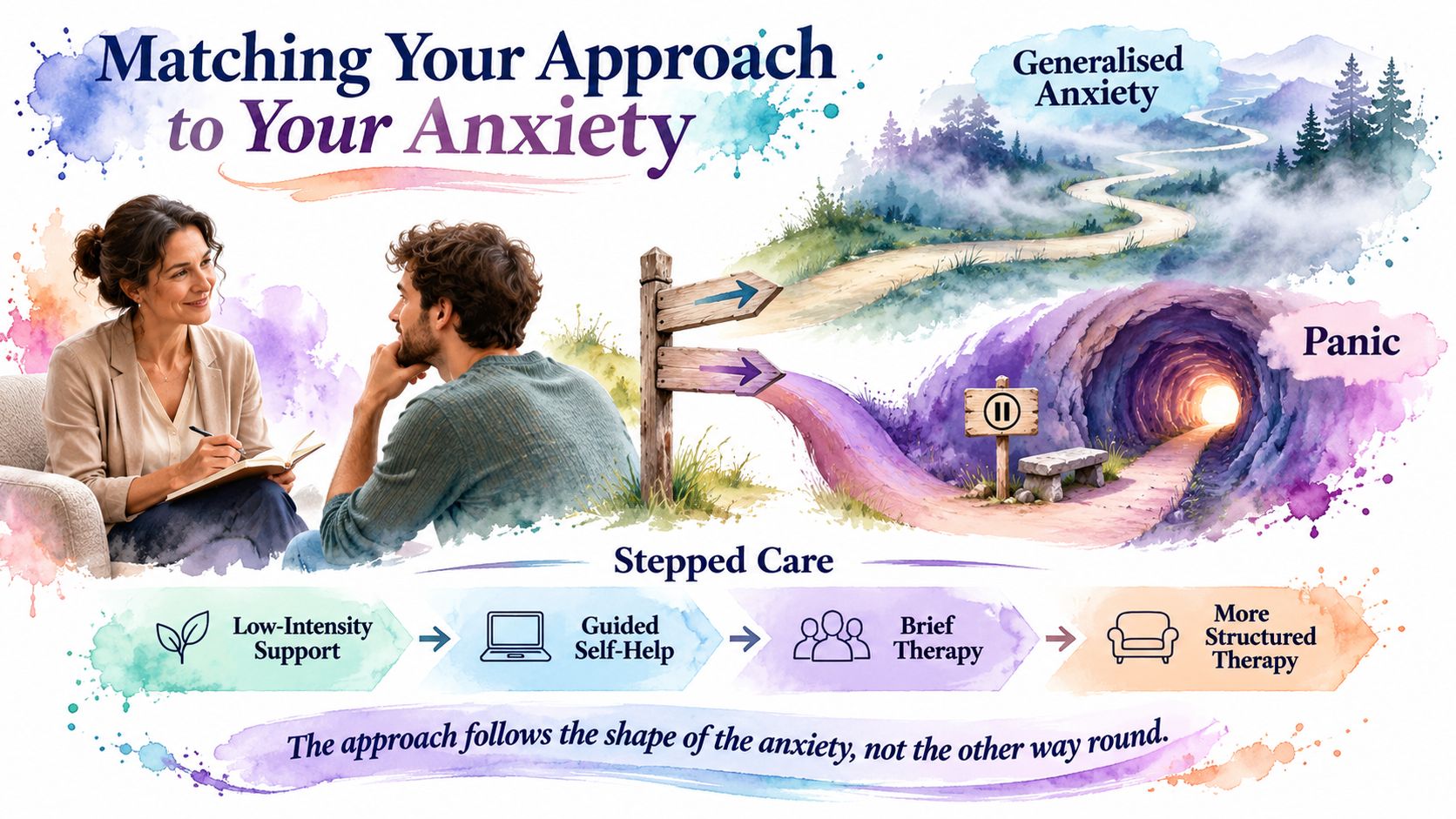
The approach should follow the shape of the anxiety, not the other way round. NICE's guideline on generalised anxiety disorder and panic disorder sets the principle: start with the least intrusive intervention likely to be effective, and increase intensity according to severity, the impact on daily life, how you respond, and what you prefer. That principle works even if you never touch a manual.
What the main approaches actually do
Cognitive behavioural therapy works on the thoughts and behaviours that keep worry and avoidance going, usually with tasks between sessions. Structured, practical, outward-facing.
Person-centred counselling puts being understood first. You set the agenda and the therapist follows, reflects and stays alongside rather than steering.
Psychodynamic counselling asks how patterns from earlier relationships are turning up now, including in the room with the therapist.
Integrative counselling draws on more than one of these and adapts as the work develops, rather than committing you to a single method.
Matching the pattern to the approach
Someone with persistent worry about everyday things may want the structure of CBT, because the work is about testing predictions. Panic attacks often respond to understanding the physical surge itself, which is where structured work earns its place. Someone avoiding shops, buses or meetings might need help with the avoidance first, then the meaning underneath it.
Anxiety that arrives with a life change, a relationship breakdown or a persistent sense of not knowing who you are tends to need more room than a symptom plan allows. So does anxiety tangled up with self-criticism or with neurodivergence and masking, where the first task is often finding language for an experience you've never had words for.
No diagnosis needed: you can begin therapy with a suspicion, a pattern or a tangle of feelings and no label at all.
Both structured symptom work and exploratory therapy are legitimate. Neither is the grown-up choice. The question is which one your anxiety responds to, and you can often only answer that by trying.
Three questions to ask yourself before you shortlist: what pattern do I keep noticing, what do I want to be different, and how much structure do I want from the hour? A person who wants homework and a plan will feel unmoored in open-ended work. A person who wants to be understood will feel processed by a worksheet.
What Happens in Anxiety Counselling Sessions
The shape of a counselling course is more predictable than the content. Here's the sequence, with the practical detail at each stage.
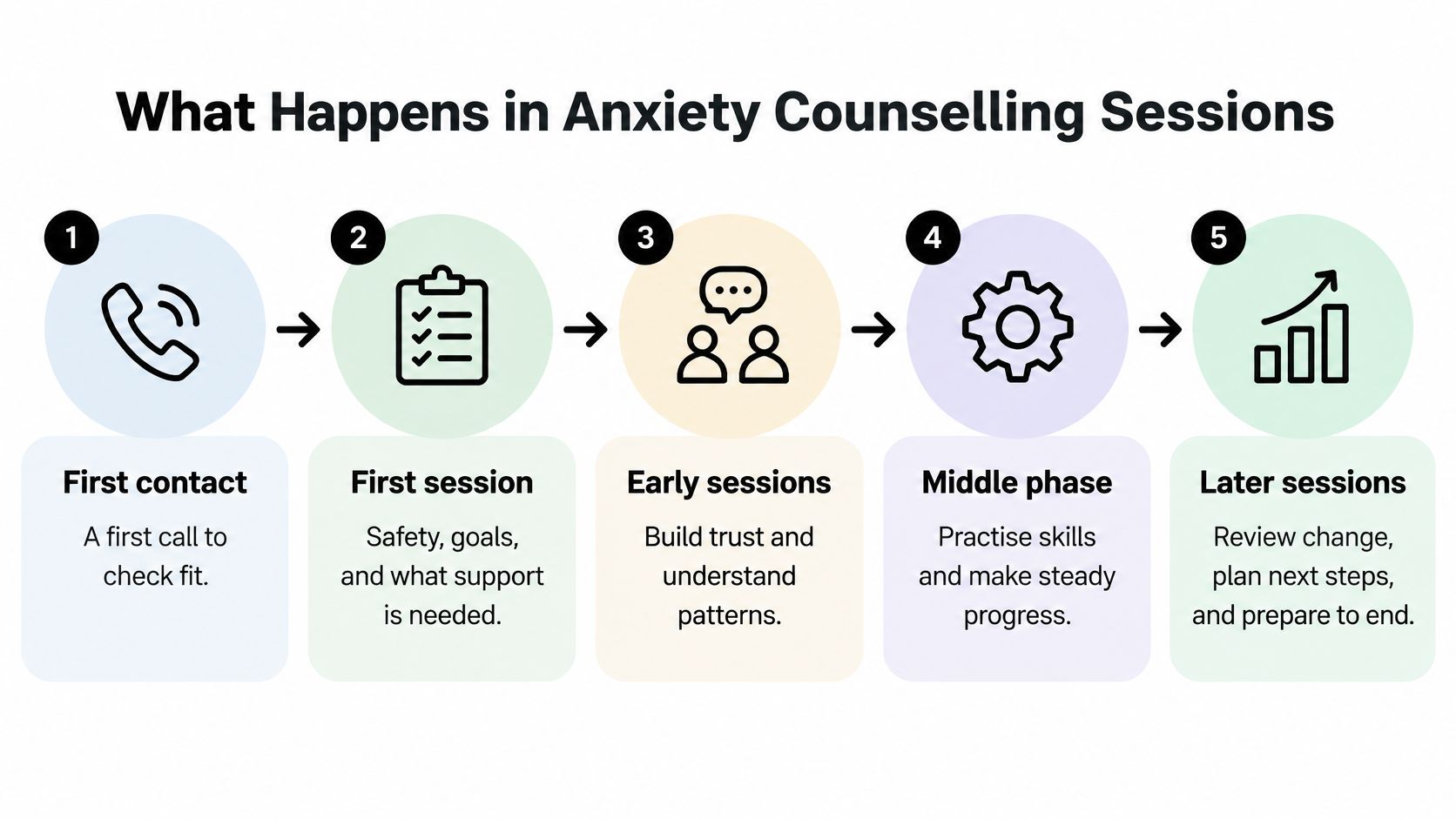
First contact. Usually a short call or exchange of messages, and its purpose is fit rather than assessment. Ask how the therapist works, what they'd want to know before a first session, and whether the format you're considering is available. If the answer is no, you've learned that cheaply.
First session. Confidentiality gets explained, including its limits: it can be broken if someone is at risk of serious harm, and you'll hear this at the first meeting rather than discovering it later. Then you talk about what brought you, in whatever order it comes out.
Early sessions. Trust builds slowly and unevenly. You might circle the same subject for three weeks before saying the sentence underneath it. This is normal, not slow progress.
Middle phase. The work turns to patterns: what sets the anxiety off, what it protects you from, what you do to keep it manageable. Counselling explores thoughts and feelings rather than handing out advice, and the therapist helps you work out what you might like to do rather than telling you.
Review and ending. A good course has a review point and a planned ending, so it doesn't just trail off.
What the commitment looks like
Counselling isn't structured like a protocol, so it helps to have a comparison. NICE's guidance on generalised anxiety disorder and panic disorder describes a high-intensity CBT course for generalised anxiety as roughly 7 to 14 hours of treatment, commonly weekly sessions of 1 to 2 hours completed within about four months. That gives you a sense of what a substantial course feels like, while leaving room for the fact that counselling works at a different pace.
I work collaboratively, adapting the conversation to the person rather than running a rigid programme, so the content of session six depends on what happened in session five.
How you know it's working
NHS England's service standard expects at least 69% of people who complete a course of NHS Talking Therapies treatment to show reliable improvement, meaning the change in scores exceeds the measurement error of the scale. It's a service benchmark, not a promise about you, and it explains why services use questionnaires. In counselling, the signs are quieter: anxiety takes up less of the day, there's more room between the feeling and the response, and sessions start to feel more focused than circular.
Some sessions feel lighter and some leave you raw. Both are ordinary. The pattern across a month tells you more than any single hour.
Choosing Online, Walk-and-Talk or In-Person Sessions
Format is underrated as a variable. The same therapist can feel unreachable on a screen and easy to talk to in a park, for reasons that have nothing to do with skill.
Format | Suits | Practical trade-offs |
|---|---|---|
People who want a dedicated private space and face-to-face contact | Travel time and fixed location | |
People in other areas, with busy schedules or who find leaving home hard | Needs a private room, stable connection and a plan for dropped calls | |
People who find sitting still hard or who think better while moving | Weather dependent, less privacy in public spaces, and mobility needs to consider |
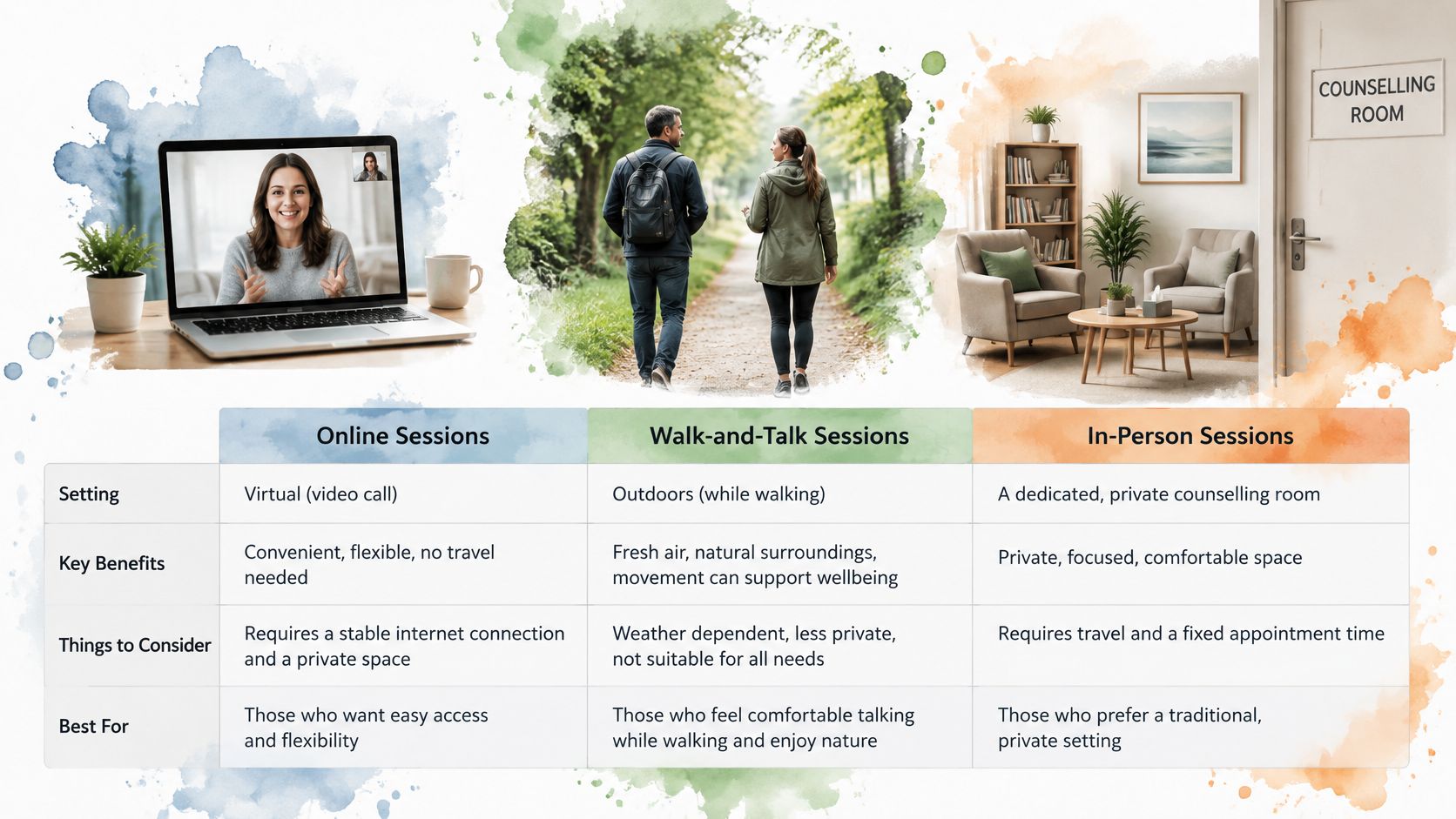
In-person means a dedicated room that belongs to the work. Ben's room is at Suite 1, Portland House, 4 Albion St, Cheltenham, GL52 2LG, in central Cheltenham. You get a fixed, private space and no risk of being overheard, and you accept the travel and the fixed slot that come with it.
Online works across the UK, which matters if the local choice is thin, if you travel, or if leaving the house is exactly what anxiety has made difficult. It needs a private room and a stable connection, and it's worth agreeing before you start what happens if the call drops mid-sentence.
Walk-and-talk means moving side by side rather than sitting opposite someone. Ben offers walk-and-talk sessions in Pittville Park. Many people find the lack of eye contact makes honesty easier, and if your anxiety spikes in still, enclosed spaces, walking can lower the barrier. Weather, background noise and privacy are the trade-offs, and so is mobility.
Practical rule: decide what you'll do if the connection fails or it rains before the session, not during it.
If your anxiety is loudest at night, the SleepHabits guide to calming nighttime thoughts has practical techniques for the 2am spiral that don't require getting out of bed.
Why format matters more for some people
The BACP Mindometer, a survey of 2,980 therapists conducted in September 2025, found neurodivergence-related issues and general anxiety were the joint most frequently increasing presenting concerns, each reported by 62% of respondents. The same survey found 57% of therapists working with men had seen more men seek therapy, while 41% said male clients tended to be more sceptical in the early sessions.
That scepticism rarely means someone doesn't want help. It usually means the conventional setup, a stranger, a chair, a question about feelings, feels like a test they'll fail. Ben works with neurodiversity, including Autism and ADHD, and with masking, so you don't need a diagnosis or a tidy explanation of how your brain works before you start. You can bring a suspicion.
If you want to know how online therapy in the UK runs in practice, from the practical setup to the first call, it's worth reading before you decide.
Taking Your First Step Towards Support
The gap between wanting therapy and starting it is usually not information. It's the last small decision. Three steps will get you past it this week.
Pick your route, allowing for two at once. GP for a physical check, NHS self-referral for free structured support, private for choice of therapist and format, or a combination.
Shortlist two or three therapists and run the checks. Registers, insurance, supervision, approach, and what happens if they can't help. Ten minutes per therapist.
Send one short message. What you've been noticing, how you'd like to work, and when you're free. Then decide the format on the call, not before it.
Therapy with Ben offers online counselling across the UK, and in-person and walk-and-talk sessions in Cheltenham, with work covering anxiety, low mood, self-esteem, relationships, life changes and neurodivergence. You can call, text or WhatsApp 07462 291471, or use the contact page to say hello in writing if a phone call feels like too much today.
If you feel at risk of harm, contact your GP, call NHS 111, or 999 in an emergency. The Samaritans are available on 116 123, at any hour.
One thing worth naming: many people delay by refining the shortlist, rewriting the message, and waiting to feel more ready. It's the same trap described in this piece on stop endlessly polishing the pitch deck, where the work keeps getting prepared and never quite gets sent. A first conversation is only a fit check. You're allowed to have it and decide afterwards, and allowed to take your time.
If the question you started with was which therapist to choose rather than how quickly you can be seen, Therapy with Ben works with anxiety, low mood, self-esteem, relationships and neurodivergence through online sessions across the UK and in-person or walk-and-talk sessions in Cheltenham. A first conversation is a chance to check fit, ask how the work runs, and decide what suits you. Visit Therapy with Ben to get in touch.


Comments