


Breaking the Silence on Stonewalling in a Relationship
Author: Therapy-with-Ben
When one partner in a relationship repeatedly pulls away, either emotionally or physically, during a conversation, that’s stonewalling. It’s more than just needing a quick breather; it's a consistent pattern of withdrawal that basically shuts down all communication, making it impossible to sort anything out. Think of it like a silent wall being built, brick by brick, during every single tough conversation.
What Stonewalling in a Relationship Really Means
Stonewalling is a powerful, yet often misunderstood, dynamic in relationships. It’s not simply about ducking out of an argument. It's a complete disengagement from your partner and from the problem you’re trying to discuss. When someone stonewalls, they aren't just hitting pause on the chat—they're ending it on their own terms, leaving their partner feeling completely abandoned and unheard.
This pattern can be incredibly damaging because it snaps the very connection that a healthy partnership relies on. Communication grinds to a halt, problems fester, and resentment starts to simmer on both sides. The person on the receiving end feels invisible and frustrated. Meanwhile, the person doing the stonewalling often feels completely overwhelmed and powerless, seeing retreat as their only form of self-protection.
A Silent Problem in Seemingly Stable Relationships
It’s easy to think that relationships only break down after a series of loud, explosive fights. The reality is that stonewalling often thrives in the quiet, creating a huge emotional gulf without any obvious conflict. This can lead to what feels like a sudden and shocking end to a partnership that, from the outside, looked perfectly calm.
Research here in the UK really brings this home. One analysis found that among couples who separated, a staggering 80% of cohabiting break-ups and 60% of divorces happened in what were considered low-conflict relationships. Stonewalling plays a devastating part in these scenarios. It fosters a deep emotional isolation that eats away at the relationship’s foundation, all without the drama of constant fighting. You can read more about these findings in the Marriage Foundation's analysis.
At its core, stonewalling is a defence mechanism. It’s often a reaction to feeling emotionally flooded—a state of such intense psychological distress that rational thought becomes difficult, and the instinct is to escape the situation entirely.
Getting your head around this is crucial. It helps shift the focus from blame ("They just don't care about me") to curiosity ("What is making them feel so unsafe that they have to shut down like this?"). This more compassionate view is the first step towards dismantling the wall. It’s about creating a safe environment where both of you feel able to face difficult conversations together, rather than one of you feeling like you have to go it alone. By seeing it as a sign of being overwhelmed, couples can start to address the deeper issues at play.
How to Recognise the Signs of Stonewalling
Spotting stonewalling in a relationship can be a slippery business. It rarely starts with a dramatic, door-slamming silent treatment. Instead, it often creeps in subtly, with small, dismissive actions that leave you feeling confused, alone, and a bit like you’re talking to a brick wall. Learning to recognise these signs is the first real step towards figuring out what’s actually going on.
It’s crucial to understand that stonewalling isn't just one thing. It can be verbal, non-verbal, or a frustrating mix of both. Think of it like this: there's a world of difference between a partner saying, “I’m feeling completely overwhelmed right now, can we please take a 10-minute break?” and them simply picking up their phone and disappearing into a scroll hole while you're mid-sentence. The first is a healthy request for space; the second is a shutdown.
The Spectrum of Stonewalling Behaviours
The signs of stonewalling really do exist on a spectrum, from gestures so subtle they're easy to miss, to blatant acts of withdrawal that are impossible to ignore. The common thread tying them all together? They slam the brakes on communication and make any kind of resolution feel impossible. One of the biggest red flags is a sudden, jarring shift from a two-way conversation to a complete emotional and communicative retreat.
Here are some of the most common ways stonewalling can show up:
Physical Avoidance: This is the classic act of physically leaving the room when things get tough. It could also be refusing to sit down to talk in the first place, or pointedly moving to the other end of the sofa to create a physical gulf between you.
Verbal Shutdowns: These are short, sharp phrases designed to kill the conversation stone dead. Things like, "I'm done with this," "There's nothing more to say," or the infuriatingly dismissive, "Whatever."
Distracting Actions: Suddenly, your partner becomes intensely focused on something else. Maybe they turn the TV volume way up, start checking emails, or decide right now is the perfect time to do the washing up. The message is clear: the conversation is over for them.
Dismissive Body Language: This is often the most powerful sign, even if it’s the quietest. It’s the refusal to make eye contact, the tightly crossed arms, the body angled away from you, or a facial expression that’s gone completely blank and unreadable.
This simple diagram shows how the behaviour of building a wall is often a defence mechanism, rooted in deep feelings of being overwhelmed or powerless.
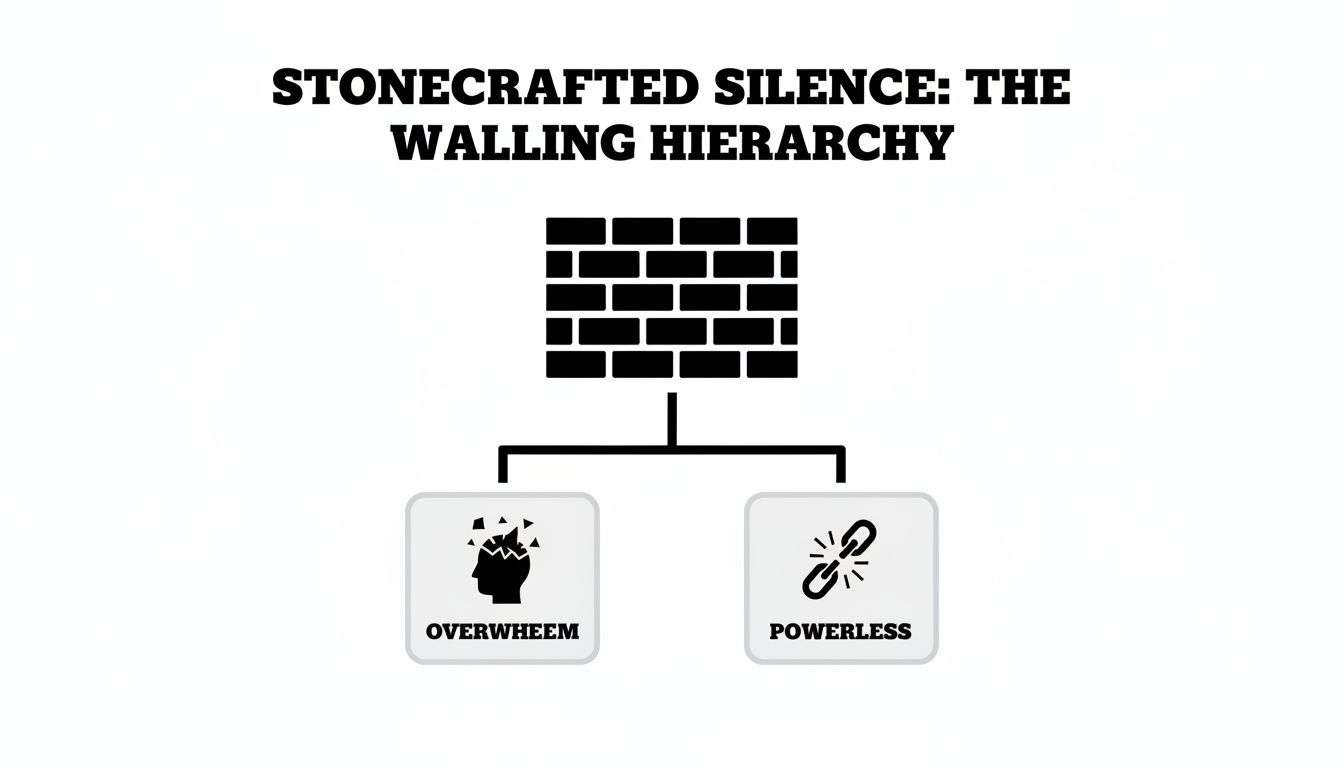
As you can see, the act of stonewalling is far more than a simple refusal to talk; it’s a reaction to an intense internal storm.
Stonewalling Behaviours From Subtle to Overt
To help you see how these behaviours can range from almost unnoticeable to completely obvious, here’s a quick breakdown.
Behaviour Category | Subtle Examples | Overt Examples |
|---|---|---|
Verbal Cues | Giving one-word answers ("Fine," "Okay"). Using a monotonous, flat tone. Changing the subject abruptly. | Saying "I'm not talking about this." Refusing to answer questions. Making dismissive comments like "Whatever." |
Body Language | Avoiding eye contact. A slight sigh or eye-roll. Fidgeting or looking at their phone. | Turning their body completely away. Crossing arms and legs tightly. Walking out of the room. |
Active Avoidance | "Forgetting" to reply to a text about a difficult topic. Suddenly getting busy with a chore. | Explicitly refusing to schedule a time to talk. Leaving the house during an argument. The full-blown silent treatment for hours or days. |
Recognising where a behaviour falls on this spectrum can help you understand the intensity of the shutdown and better gauge how to respond.
A Relatable Scenario
Let’s put this into a real-life context. Imagine you need to bring up your shared finances, a topic you know is a source of tension. You gently start with, “I’m feeling a bit worried about our spending this month, do you think we could look at the budget together?”
At first, your partner just nods, their eyes fixed on the TV. As you try to continue, they start fiddling with the remote, still not looking at you. You ask a direct question, and they mumble back, “It’s fine.”
You press just a little, saying it really doesn't feel fine to you. That’s the trigger. Suddenly, they stand up, say, “I can’t do this right now,” and walk straight out of the room. You’re left sitting alone, with the issue not only unresolved but now heavier than it was before.
This exact sequence—from the subtle avoidance with the remote to the complete physical withdrawal—is a classic case of stonewalling. It's more than just a bad end to an argument; it’s a total communication breakdown where one person has unilaterally pulled down the shutters, leaving the other feeling completely abandoned and powerless. Seeing this pattern for what it is, is absolutely crucial.
Understanding Why People Stonewall
To really get to grips with stonewalling, we first need to understand where it comes from. It’s all too easy to see it as a cruel, deliberate act, but more often than not, it's a desperate, clumsy attempt at self-protection. Stonewalling is rarely about a lack of care; it’s almost always about a lack of coping skills.
When a conversation gets heated, the person who stonewalls isn’t usually thinking, ‘I’m going to punish my partner’. Instead, their internal alarm system is screaming. Their reaction is fuelled by a deep-seated fear of conflict or a state of pure emotional overwhelm, a psychological state known as ‘flooding’.
The Science of Emotional Flooding
Think of your brain as a computer with way too many tabs open. It slows down, freezes, and eventually just shuts down completely to stop itself from crashing. That’s exactly what happens during flooding. The emotional centres of the brain hijack everything, making rational thought and calm conversation feel utterly impossible.
For the person going through it, their heart rate can skyrocket, their breathing gets shallow, and the classic fight-or-flight response kicks in. Putting up that silent wall feels like the only way to escape the emotional storm and stop things from getting even worse. It's a primal, instinctive move for self-preservation.
Flooding isn't a choice; it's a physiological reaction. The person stonewalling isn't ignoring you because they don't care; they're shutting down because their nervous system has been pushed far beyond its capacity to cope.
Grasping this biological reality is a game-changer for the partner on the receiving end. It helps shift the whole perspective from a personal attack ("They're doing this to hurt me") to a more compassionate one ("They're overwhelmed and don't know what else to do"). This shift is the first, crucial step towards creating a safer space for both of you. Often, this kind of behaviour can be a symptom of underlying anxiety, which massively impacts the intricate relationship between love and anxiety.
The Role of Upbringing and Neurodiversity
Our pasts have a huge say in how we handle conflict now. If someone grew up in a home where arguments were explosive and scary, they might have learnt early on that shutting down was the safest thing to do. This avoidant behaviour then becomes a deeply ingrained pattern that they carry into their adult relationships. Looking into your early life experiences can often reveal why these automatic responses happen; you can learn more about this by understanding what attachment theory is and how it shapes you.
It’s also really important to think about neurodiversity. For people with conditions like Autism Spectrum Disorder (ASD) or Attention-Deficit/Hyperactivity Disorder (ADHD), the world can be an incredibly intense place.
Sensory Overload: The sheer emotional intensity of a difficult conversation can lead to a severe sensory overload, making a shutdown an involuntary, protective reflex.
Emotional Regulation: If you struggle to identify and manage emotions, conflict can feel chaotic and impossible, leaving withdrawal as the only realistic option.
Processing Time: Some neurodivergent people simply need more time to process what's being said and figure out how to respond. What looks like stonewalling might actually be a necessary pause to stop them from saying something they don't mean.
Acknowledging these factors isn’t about making excuses for the behaviour. It’s about building empathy and understanding the complex 'why' behind the wall. When you can see stonewalling as a symptom of being overwhelmed rather than a sign of indifference, you open the door to a more constructive and compassionate conversation—one that focuses on solving the root problem, together. This changes everything.
The True Impact of Building a Silent Wall
Stonewalling does more than just stop a conversation in its tracks; it inflicts deep, lasting wounds on both people and the partnership itself. When one person repeatedly throws up a silent wall, it creates a toxic environment where genuine connection simply cannot survive. This isn’t just a minor annoyance or a bad habit—it’s a major relational threat that eats away at the very foundations of trust and intimacy.
The most immediate effects are often felt by the person being shut out. They’re left in a kind of emotional limbo, grappling with a profound sense of loneliness, frustration, and a feeling of being completely invalidated. Each time their partner withdraws, it sends a powerful, unspoken message: "Your feelings don't matter. You don't matter." Over time, this constant dismissal chips away at their self-esteem, leaving them feeling powerless and even questioning their own worth.

The Hidden Cost for the Person Who Stonewalls
While the damage to the receiving partner is obvious, the person who stonewalls also pays a heavy price. Their withdrawal is almost always a defence mechanism, a way to cope with overwhelming anxiety or fear, but it's a strategy that ultimately backfires. By consistently avoiding difficult emotions, they never learn healthier ways to manage them.
This only reinforces their avoidant coping style and prevents any real emotional connection from forming. The underlying issues that trigger the shutdown are never dealt with, just left to simmer under the surface. It creates a vicious cycle: anxiety builds, leading to more stonewalling, which in turn prevents the very connection that could soothe that anxiety. The wall they build to protect themselves ends up becoming their prison, isolating them from the intimacy they may secretly crave.
How Stonewalling Poisons the Partnership
For the relationship itself, stonewalling is like a slow-acting poison. It systematically destroys the key ingredients of a healthy partnership, creating a devastating cycle that’s incredibly hard to break.
Erosion of Trust: When communication is constantly shut down, trust withers and dies. The stonewalled partner learns they can't rely on the other to be present during tough times, which leads to deep-seated feelings of insecurity and emotional abandonment.
Loss of Intimacy: Emotional intimacy thrives on vulnerability and open communication. Stonewalling creates an atmosphere of fear and unpredictability, making it feel unsafe for either partner to be truly open and authentic.
The Pursue-Withdraw Cycle: A classic toxic dynamic often emerges. One partner, desperate for connection, pursues the other for any kind of response. This pursuit makes the stonewaller feel even more overwhelmed, causing them to withdraw further, which in turn intensifies the other’s pursuit.
This pattern is one of the most reliable predictors of relationship breakdown. It’s not just about poor communication; it’s a signal that the emotional safety net of the relationship has been completely shredded, leaving both partners feeling isolated and misunderstood.
A Predictor of Relationship Breakdown
The severity of this issue really can't be overstated. Persistent stonewalling is a massive red flag and often correlates with surging separation rates. Here in the UK, it contributes to a profound sense of unhappiness and creates power imbalances that can lead couples to split, often without any high-conflict drama.
In 2021, divorce rates in England and Wales climbed to their highest point since 2014, with 111,934 divorces among opposite-sex couples. Tellingly, 63.1% of these petitions were initiated by women, who often bear the brunt of the emotional disconnection caused by stonewalling. You can explore more about these statistics and trends in UK divorces. The data underscores a critical truth: stonewalling is far more than a bad habit—it's a destructive force with the power to end a relationship.
What to Do When You Are Being Stonewalled

When your partner suddenly throws up that silent wall, your first instinct might be to panic. You might feel a desperate urge to push harder, raise your voice, or demand they talk to you – anything to get a response. Unfortunately, every one of those reactions just adds another brick to the wall they’re building. The real skill is learning to respond constructively, not just react emotionally.
It's a delicate dance, really. You have to look after your own emotional wellbeing while also trying to create a space where conversation can eventually start up again. The goal here isn't to win the argument; it's to de-escalate the whole situation.
First Steps: De-escalate and Disengage
The moment you realise a shutdown is happening, the most powerful thing you can do is press pause. Trying to force a conversation with someone who is completely flooded with emotion is a losing game. Their brain has switched into survival mode, and there's just no room for rational problem-solving.
Instead of piling on the pressure, it's better to have a few gentle, pre-planned phrases ready to signal a break. This shows you're acknowledging their struggle without just accepting the stonewalling itself.
You could try saying something like:
"I can see this is getting really difficult. It feels like we're both a bit overwhelmed."
"I don't think we're going to solve this right now. What if we take 20 minutes to cool off and come back to it?"
"I really want to understand where you're coming from, but it feels like we've hit a dead end. Let's take a break."
Suggesting a pause isn't about giving in. It’s a strategic move that shows you're still committed to sorting things out, just in a more productive way. You're preserving the relationship, not abandoning the issue.
Focus on Your Own Response
While your partner takes their space, the spotlight has to turn back to you. This is your time to self-soothe and get a handle on your own feelings. The sense of frustration or abandonment is completely valid, but letting it spiral will only make it harder to reconnect later.
Your main job in that moment is to regulate your own nervous system. When you can find your own calm, you become a stable anchor that makes it feel safer for your partner to eventually lower their defences.
Try a few of these self-soothing techniques to weather the emotional storm:
Mindful Breathing: Take a few slow, deep breaths. Inhale for a count of four, hold for four, and then exhale slowly for a count of six. This simple act can help activate the part of your nervous system that promotes calm.
Change Your Environment: Step outside for a bit of fresh air, make yourself a cup of tea, or put on some music you find calming. Physically removing yourself from the tense space can do wonders for resetting your emotional state.
Acknowledge Your Feelings: It's okay to say to yourself, "I'm feeling really hurt and invisible right now, and that's understandable." Simply validating your own emotions without judgement can often take away some of their intensity.
Re-engage with a Softer Approach
Once you both feel a bit calmer, you can try to gently restart the conversation. This time, the key is to lead with "I" statements. It's a fundamental part of learning how to communicate better in relationships because it frames the issue around your feelings, which is much less likely to make your partner defensive.
Just compare the difference:
Blaming Statement: "You always shut down and refuse to talk to me."
'I' Statement: "I feel really lonely and disconnected when we can't talk through things."
See how the second one shares your experience without attacking their character? It opens the door for them to actually hear you.
As you work to break this cycle, rebuilding trust is absolutely essential. Taking time to work on some powerful trust exercises for couples can help both of you feel more secure and open with each other again. Ultimately, it’s all about shifting the dynamic from a battle against each other to a shared challenge you can face together.
How Professional Support Can Help
While sorting things out on your own is a powerful first step, breaking a deep-seated pattern like stonewalling often requires a guide. That's where professional counselling comes in. It provides a safe, neutral space where both partners can explore what’s really going on without the fear of blame or judgement.
Think of it this way: therapy shifts the dynamic from an endless battle into a shared project. It’s not about pointing fingers. Instead, it’s about mapping out the cycle of withdrawal so you can both see it, understand it, and finally, start to change it together. A counsellor can help you dismantle that wall, brick by brick, by spotting the triggers that lead to flooding and teaching you both healthier ways to manage those intense emotions.
Finding the Right Therapeutic Approach
Every couple is different, which is why I offer a few ways to work together. The most important thing is finding an environment that feels comfortable and productive for you both. As a male counsellor, I work hard to create a space where everyone, especially men who might find it tough to open up, feels understood and at ease.
Here are the main options:
Face-to-Face Sessions: Meeting in person at my Cheltenham practice offers a traditional, focused setting to properly unpack complex issues.
Online Counselling: If you have packed schedules or live further afield, online sessions are a convenient and surprisingly effective way to get consistent support from home.
Walk-and-Talk Therapy: This is a bit different. We take the session outdoors. There's something about walking in nature that can make difficult conversations feel less intense and more fluid.
Therapy as a Proactive Step
Seeking professional help isn't a last resort or a sign that you've failed. Far from it. It's a proactive, courageous step towards building a relationship that's more resilient and real. This is especially true during big life transitions, which can often bring stonewalling behaviours to the surface.
Take parenthood, for example. The journey into becoming parents is a massive stress test for any relationship. Government data from 2021-2022 showed that 10% of children in couple-parent families in the UK experienced parental relationship distress. When difficult conversations about childcare or conception challenges lead to one partner shutting down, it creates a damaging emotional gap right when you need each other most. You can read more about these findings on parental conflict directly from the source.
Therapy helps you navigate these challenges. It gives you the communication skills to stay connected, even when you're exhausted and overwhelmed, and helps you build a partnership strong enough to weather life’s biggest storms.
Ultimately, deciding to see a professional can be a real turning point. If you’re wondering what the process actually involves, our article exploring the question goes into more detail: Does Couple Counselling Work in Relationships?. It might help you get a clearer idea of what to expect and how this one supportive step can lead to lasting, positive change.
A Few Common Questions
It’s completely normal to have questions when you’re trying to get your head around something as complicated as stonewalling. Let's tackle some of the most common ones that come up.
Is Stonewalling a Form of Emotional Abuse?
This is a really important question, and the honest answer is: it depends. The line often comes down to intent. If someone is deliberately and repeatedly using silence to punish, control, or manipulate you, then yes, it absolutely can be a form of emotional abuse. It’s a conscious choice to inflict pain.
But often, that’s not what’s happening. Stonewalling can be an unconscious defence mechanism – a complete shutdown because someone is so emotionally overwhelmed they simply can't cope. It’s not a malicious act, but a panicked retreat. A good counsellor can help you figure out what’s really going on in your own relationship.
My Partner Says They Just Need Space. How Is That Different?
This is a crucial distinction to make. Asking for space can be a really healthy thing to do in a relationship. The key difference is communication.
When someone needs space in a healthy way, they’ll tell you. They might say something like, "Look, I'm feeling totally overwhelmed right now. I need 30 minutes to just cool down, and then we can come back and talk this through." That shows respect for you and for the conversation.
Stonewalling, on the other hand, is a complete shutdown. There’s no explanation, no timeframe, and no reassurance that they’ll come back to the conversation. It’s a silent, indefinite withdrawal that leaves you feeling abandoned and the problem hanging in the air. The difference is the promise of return.
What if I’m the One Who Stonewalls?
First off, just recognising that in yourself is a massive, courageous first step. It’s not easy to admit, so well done for getting this far. The next step is to learn to spot your own triggers before you get to that point of no return.
The goal isn't to never feel overwhelmed again, but to learn how to handle it differently. You can start by practising how to ask for a break, even if it feels clunky at first. A simple, "I am feeling overwhelmed and need a moment," is infinitely better for your relationship than just vanishing into silence. Therapy is a brilliant space to build these skills and find healthier ways to navigate those big, difficult feelings during a conflict.
If stonewalling is driving a wedge between you and your partner, you don't have to figure it out alone. At Therapy with Ben, I provide a safe, non-judgemental space to explore these patterns and build much stronger, healthier ways to communicate.
Get in touch today to see how face-to-face, online, or walk-and-talk therapy could help you reconnect. https://www.therapy-with-ben.co.uk


Comments