


How Do You Stop Feeling Guilty A Compassionate Guide
To get a handle on guilt, it's less about a quick fix and more about a gentle, three-part approach. First, we need to get to the bottom of where the guilt is coming from and figure out if it’s actually justified. From there, we can start to challenge its logic and reframe those unhelpful thoughts that keep us stuck. The final piece is about taking real, meaningful action—whether that’s apologising, making amends, or, just as importantly, forgiving yourself so you can actually move forward.
This process helps break that relentless cycle of going over and over things in your head, allowing you to learn from what happened without being constantly weighed down by it.
Understanding the Weight of Guilt
Guilt is a feeling we all know. It can feel like you’re carrying an invisible but incredibly heavy backpack around with you, colouring your days and shaping your decisions. In a healthy way, guilt can be our moral compass, that little nudge that tells us when our actions haven’t quite lined up with our values. It’s what prompts us to say sorry, make things right, and learn from our mistakes.
But not all guilt is helpful. When it becomes chronic, irrational, or completely out of proportion to the situation, it stops being a guide and turns into an anchor. This is what we call unhealthy guilt—a persistent, painful feeling that keeps you stuck in the past, replaying events on a loop. It’s the voice that tells you that you are bad, rather than that you did something bad.
Healthy Guilt vs Unhealthy Guilt: A Quick Comparison
Spotting the difference between these two types of guilt is the first, most crucial step towards managing it. One is a catalyst for growth; the other is a source of real distress. This little table should help you quickly get a sense of what you might be experiencing, which is the key to working through it effectively.
Characteristic | Healthy Guilt (Appropriate Guilt) | Unhealthy Guilt (Inappropriate or Chronic Guilt) |
|---|---|---|
Focus | On a specific action or behaviour. ("I feel bad for snapping at my partner.") | On your character or self-worth. ("I am a terrible person.") |
Motivation | Motivates you to repair harm, apologise, or change your behaviour. | Leads to rumination, shame, and withdrawal. |
Duration | Is temporary and eases once amends are made or the lesson is learned. | Lingers long after the event, sometimes for years, without resolution. |
Proportionality | The feeling is proportional to the action that caused it. | The feeling is excessive and disproportionate to the actual event. |
Outcome | Promotes personal growth, empathy, and stronger relationships. | Damages self-esteem and can contribute to anxiety and depression. |
Getting a feel for this difference is a really important step. Once you can see which type of guilt you're dealing with, you're in a much better position to know how to respond to it.
The Connection Between Guilt, Anxiety and Depression
Unhealthy guilt rarely travels alone. It’s often deeply tangled up with other mental health challenges, acting as fuel for both anxiety and depression. It’s a significant issue here in the UK, where the weight of guilt is a real factor in the wider mental health landscape. Just imagine carrying that heavy backpack day in, day out—it’s exhausting and can easily spiral into bigger struggles.
The Big Mental Health Report 2025 found that one in five adults in England (20.2%) lives with a common mental health problem. Guilt often makes these conditions worse, especially feelings of anxiety, which affect 6 in 100 people weekly with Generalised Anxiety Disorder. The good news is that more people are finding a way through; England's mental health services saw a record 5.2 million referrals recently, which shows that a path forward is definitely possible.
The nagging thoughts that guilt brings can easily become intrusive. If you're finding it hard to shake off persistent, unwanted thoughts, you might find our guide on dealing with intrusive thoughts offers some practical ways to regain a sense of control.
"Guilt is the feeling that you’ve done something wrong. Shame is the feeling that you are something wrong. The first can be a catalyst for change; the second is often a recipe for paralysis." - Brené Brown
Understanding this distinction is key. The journey to stop feeling guilty isn't about trying to erase a natural human emotion. It’s about learning to listen when it’s giving you useful guidance and learning how to set it down when it becomes a needless burden. Here in Cheltenham, therapeutic approaches like walk and talk therapy can provide a gentle yet powerful space to start unpacking this weight, showing you that you don’t have to carry it all on your own.
Challenging Your Guilty Thoughts
Once you’ve started to recognise that nagging, unhealthy guilt for what it really is—an unhelpful inner critic, not a moral compass—it's time to roll up your sleeves and challenge the thoughts that keep it alive. This isn't about pushing your feelings away; it's about asking them if they're actually telling you the truth. We're moving from just understanding guilt to using practical, hands-on techniques to dismantle it before it spirals.
Guilty thoughts often pop up automatically and feel like stone-cold facts. You might think, "I'm a terrible friend for cancelling our plans," and in that moment, it feels completely true. The skill to learn here is how to reframe that harsh statement into something more balanced. Something like, "I made a mistake cancelling last-minute, and I can apologise for that. But one action doesn't define our whole friendship."
It’s about creating just enough space between you and the thought so you can look at it a bit more objectively. This is a massive part of stopping that negative self-talk from taking over. If you want to dive deeper into this, our guide on how to stop negative self-talk walks you through a 5-step process to quieten that voice.
This simple infographic below breaks down the core process of tackling a guilty feeling head-on.
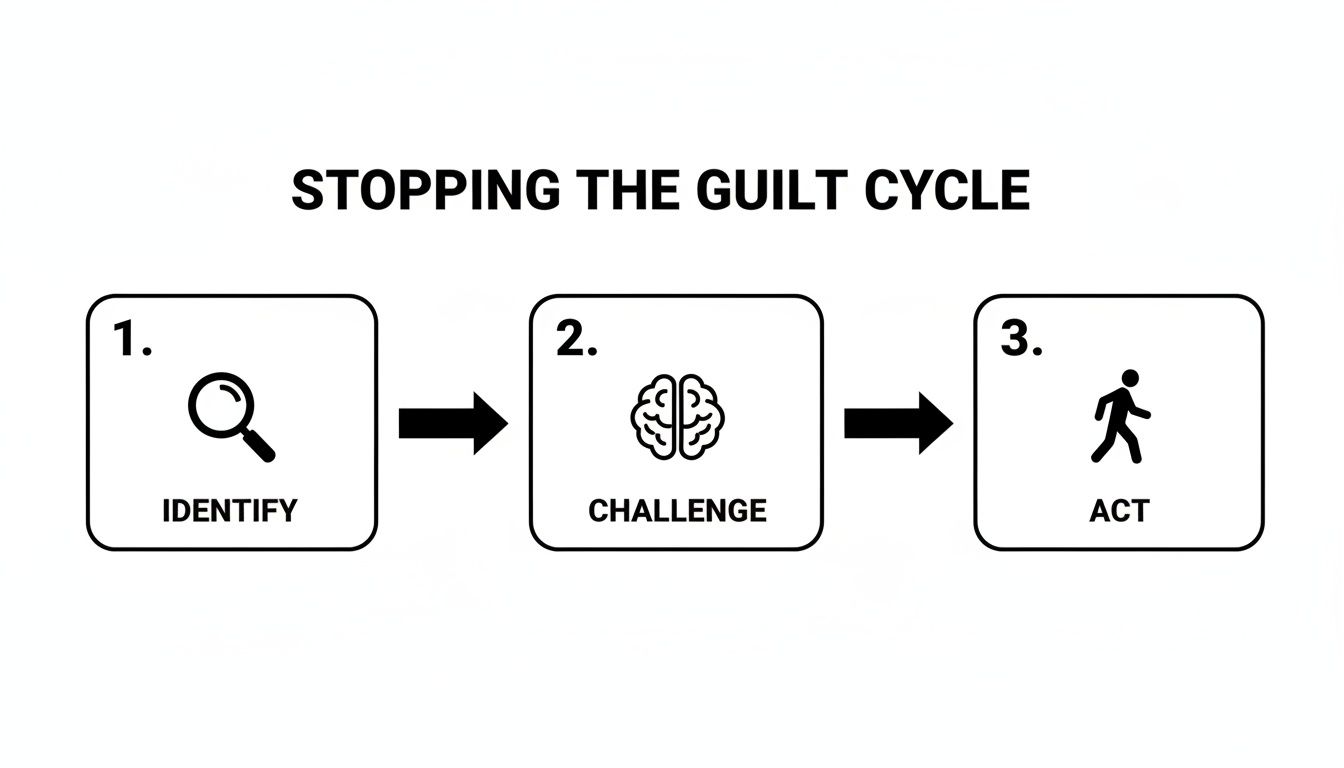
As the visual shows, it’s a three-part process: first, spot the thought, then challenge whether it's actually valid, and finally, take some kind of constructive action.
Putting Guilt On Trial
Here's a really effective exercise inspired by CBT: put your guilt on trial. Think of yourself as a detective or a lawyer looking at the situation with total impartiality. Your feelings aren't evidence here—only the facts.
Let’s take a common scenario. Say you feel a wave of guilt for taking an afternoon off for yourself instead of helping a family member with something they could probably handle alone.
Your instant thought might be: "I'm so selfish. I should have been there for them."
Now, let's get our legal wig on.
Evidence for the prosecution (the 'guilty' thought): I chose to do something for myself instead of helping someone else. They might feel let down.
Evidence for the defence (the counter-argument): I've helped them so many times before. I was completely drained and needed to rest to avoid burnout. They never said it was an emergency, and they are perfectly capable of doing it themselves. Looking after my own wellbeing is essential if I'm going to be able to support anyone in the long run.
When you lay it all out like this, you create that critical distance. You start to see that reality is far more grey than your black-and-white, emotionally-charged thought suggested. The aim isn't to prove you're flawless, but to land on a more balanced and compassionate truth.
A more balanced thought might be: "While it’s a shame I couldn't help this time, it was important for me to take care of my own needs. I am not a selfish person; I am a person with limits who made a reasonable choice."
This process is a powerful reminder that just because you feel guilty, doesn't automatically mean you are guilty.
Questioning Your Own High Standards
So much of our guilt comes from the ridiculously high standards we hold ourselves to. We tell ourselves we should be the perfect parent, the always-available friend, the employee who never makes a mistake. When we inevitably fall short of these impossible ideals, guilt rushes in.
When you're feeling guilty about not meeting a standard, try asking yourself these questions:
Whose rule is this, anyway? Is this a standard you genuinely believe in, or is it something you've picked up from family, society, or even social media?
Would I hold a friend to this standard? We are almost always far crueller to ourselves than to others. If a friend was in your situation, would you judge them so harshly?
Is this standard actually helpful? Seriously. Does trying to live up to this impossible expectation make you happier or more effective, or does it just lead to chronic stress and guilt?
Learning to challenge these internalised rules is key to breaking free from the grip of unhealthy guilt. For more structured ways to reframe these kinds of thoughts, you might find exploring Cognitive Behavioural Therapy techniques useful. These strategies provide a clear framework for spotting and changing the thought patterns that no longer serve you, helping you swap that harsh inner critic for a more supportive internal voice.
Taking Action to Repair and Move Forward

Once you’ve started to question your guilty thoughts, the natural next step is to take meaningful action. A nagging sense of guilt is often a sign that something still needs resolving, not just thinking about. This is where we shift from the internal work to the external steps that can finally bring a sense of closure, allowing you to properly move on.
Action doesn't always have to mean saying sorry. But when you know you’ve caused harm, making amends is a vital part of the healing process—for you and for the other person. Sometimes, though, the most important action is internal, focused on self-forgiveness and changing your own patterns for the future.
The Art of a Meaningful Apology
One of the biggest mistakes I see is people apologising simply to make themselves feel better. A genuine apology isn't about you; it's about acknowledging the real impact your actions had on someone else. It's for their validation, not your absolution.
For an apology to land properly, it has to be sincere and completely centred on the other person's experience.
Here’s a simple structure I often share with clients:
Be specific about what you're sorry for. Ditch vague phrases like, "I'm sorry for what happened." Try something direct: "I am sorry for speaking to you so sharply when I was stressed yesterday."
Acknowledge the impact. This shows you've actually thought about their feelings. For instance, "I realise my words were hurtful and probably made you feel unappreciated."
Take full responsibility. No excuses. Don't ruin a good apology by adding "...but I was really tired." That just negates the whole thing.
Explain what you'll do differently. This shows you’re committed to change. "In future, I'm going to make a point of taking a breath before I respond when I'm feeling overwhelmed."
Ask how you can make it right. This opens the door for repair, but you have to respect that they might need time or space.
Remember, they don’t owe you forgiveness. Your job is just to offer a sincere apology and give them the space they need. You can only control your side of things.
Challenging Guilt with Behavioural Experiments
Sometimes, guilt keeps us stuck in really unhelpful cycles. We feel guilty taking a day off, so we burn out. We feel guilty for saying "no," so we're constantly overstretched. A brilliant way to break these patterns is to use what we call behavioural experiments.
This is where you deliberately do the very thing your guilt is screaming at you not to do, and then you just observe what actually happens.
A behavioural experiment is like being a scientist of your own life. You have a hypothesis (e.g., "If I say no to this request, my friend will be furious") and you test it to see if it's true. More often than not, the catastrophic outcome you fear doesn't happen.
For instance, if you feel perpetually guilty for not being productive, your experiment could be to schedule a whole afternoon off. No chores, no work. Just rest. You'll likely discover the world doesn't fall apart. This real-world evidence is so much more powerful at weakening that guilty voice than just trying to argue with it in your head.
The Crucial Step of Self-Forgiveness
This is often the hardest part: learning to forgive yourself. This isn't about letting yourself off the hook or pretending what you did was okay. Self-forgiveness is about accepting your own humanity. It’s about acknowledging that you are flawed, you will make mistakes, and you are capable of learning from them.
Holding onto guilt forever doesn't help anyone; it just keeps you trapped in shame. Forgiving yourself is an act of self-compassion that gives you permission to grow.
Guilt can feel like a relentless weight, but UK data shows that practical, therapy-rooted steps can lift it. The rate of common mental health conditions in 16-24 year olds jumped from 18.9% in 2014 to 25.8% in 2023/24, with guilt over relationships often at the core. Methods used in UK services, like CBT, directly target and reframe these guilty thoughts, showing that change is possible. You can learn more from these UK mental health statistics.
Self-forgiveness isn’t a one-off event; it’s a process. It involves looking at the harm done, accepting your part in it, and making a conscious choice to release the self-punishment so you can move forward as a better, more aware person.
Building Your Resilience to Future Guilt

Dealing with guilt when it pops up is one thing, but building real, long-term emotional resilience can stop it from taking hold in the first place. This is less about fighting fires and more about creating a life where unhealthy guilt struggles to find fertile ground.
It’s a shift in mindset. Instead of just reacting to guilt, you start proactively shaping the conditions that support your emotional wellbeing day-to-day. Think of it as learning to set good boundaries, tuning into your feelings with a bit of mindfulness, and making sure your daily choices actually line up with what matters to you.
When you live a life that feels authentic to you, there’s just far less room for that misplaced, unhelpful guilt to creep in and disturb your peace.
Establish and Maintain Healthy Boundaries
Boundaries are the invisible lines we draw in our relationships, and they are absolutely fundamental to keeping guilt at bay. Without them, it's easy to become overstretched and resentful, which often leads to feeling guilty for not being able to do everything for everyone.
Setting a boundary isn't selfish; it’s a necessary act of self-preservation.
It might be as simple as saying "no" to another project at work when you're already swamped, or telling a friend you just don't have the mental space for a heavy chat right now. At first, this can feel incredibly uncomfortable and might even trigger guilt, especially if you’re a natural people-pleaser. But every time you honour your own limits, you teach others how to treat you while protecting your own mental health.
If you find yourself constantly overstretched, learning how to stop being overwhelmed by tasks is a crucial step in creating the space needed to maintain those boundaries long-term.
Live in Alignment with Your Core Values
One of the most powerful tools against unnecessary guilt is living a life guided by your core values. When your actions line up with what you hold dear—things like honesty, compassion, or creativity—you experience far less internal conflict. This alignment works like a 'values compass', giving you a clear sense of direction.
Not sure what your core values are? Try asking yourself:
What qualities do I really admire in other people?
What topics or causes get me fired up?
When have I felt the most proud or truly fulfilled?
Once you have a list, use it. If a decision feels ‘off’ or brings up guilt, check it against your compass. Is this choice pulling you away from your values? This simple check-in makes it so much easier to make choices you can stand by, which drastically reduces the chances of future regret and guilt.
"True resilience is born not from avoiding difficulty, but from learning to navigate it with your values as your guide. When you know your 'why', the 'how' becomes much clearer."
Practise Mindfulness and Self-Care
Mindfulness is really just the practice of paying attention to the here and now, without judging it. It’s a skill that helps you notice the first little flicker of guilt before it becomes a raging fire. By simply observing your thoughts and feelings as they come and go, you create a little bit of space. In that gap, you have the choice to respond thoughtfully instead of just reacting on autopilot.
This ties in directly with self-care and self-compassion. Things like getting enough sleep, eating well, and moving your body aren't luxuries; they are the bedrock of your emotional health. We explore this further in our article offering a quick guide to kinder thinking.
It's also important to recognise that persistent guilt is often linked with untreated mental health challenges. Recent analysis from Our Future Health, based on over 1.5 million questionnaires, found that 1 in 6 UK adults self-report a lifetime depression diagnosis and 1 in 7 report anxiety. Chronic guilt only makes these conditions worse. This might explain why demand for therapy has soared by 37.9% since 2019, as more and more people are seeking—and finding—relief.
When to Seek Professional Support
While the self-help strategies we’ve looked at are brilliant tools for managing everyday guilt, sometimes the weight is simply too heavy to shift on your own. It takes real strength to work through these feelings, but it also takes courage to recognise when you might need a helping hand.
Thinking about professional support isn’t a sign of failure; far from it. It’s a proactive step towards profound and lasting healing.
But knowing when to reach out can be tricky, can’t it? There isn't a simple checklist, but there are some clear signs that the guilt you're carrying has become too deep-rooted to manage alone.
Recognising the Signs You Need More Support
Persistent guilt that colours your entire world is more than just a passing feeling. It’s a significant emotional burden that chips away at your wellbeing. It’s important to listen to these signals – they are your mind’s way of telling you it’s time to find a safe, non-judgemental space to explore what’s going on under the surface.
See if any of the following patterns feel familiar:
The guilt is constant and overwhelming. It’s not a fleeting thought but a persistent background hum that drains your mood, your energy, and your ability to enjoy life.
It’s tangled up with past trauma. Guilt linked to traumatic events is incredibly complex and really does need a therapist’s guidance to navigate safely.
Your daily life is being disrupted. Perhaps you're struggling to sleep, finding it hard to concentrate at work, or just noticing your performance is slipping because your mind is always somewhere else.
Your relationships are suffering. Unresolved guilt can make you withdraw from loved ones, become irritable, or push people away – creating distance right when you need connection the most.
You're getting into self-punishing behaviours. This could be anything from harsh negative self-talk to more self-destructive habits that you're using to cope with how you feel.
If any of this resonates, it might be a sign that working with a professional is the most compassionate and effective next step you can take for yourself.
"Reaching out for therapy isn't about admitting defeat. It's about choosing a new strategy, one where you have a skilled and supportive ally in your corner, helping you find your way forward."
How Counselling Can Help You Stop Feeling Guilty
In therapy, you're given a unique space to explore where your guilt actually comes from, without any fear of judgement. A counsellor can help you untangle the complex knots of emotion that self-help techniques alone might not be able to reach.
Together, we can gently unpack the origins of these feelings, challenge the core beliefs that keep you stuck, and build personalised strategies for moving on.
At Therapy with Ben, my approach is client-centred, designed to meet you exactly where you are. My goal is simply to create a supportive environment where you feel safe enough to be vulnerable and explore these difficult feelings. We can work together to find a path towards freedom from that heavy burden.
Finding the Right Therapeutic Fit for You
I know that everyone’s needs are different. Finding the right setting is a key part of making therapy feel accessible and effective. That's why I offer a few distinct ways we can work together here in Cheltenham.
You can choose from several options:
Face-to-Face Counselling: Traditional sessions held in a calm, private therapy room, offering a dedicated space just for our work.
Online Counselling: Giving you flexibility and convenience, these sessions let you connect from wherever you feel most comfortable.
Walk and Talk Therapy: This is a unique approach where our sessions take place outdoors, walking side-by-side. Many people find the gentle movement and relaxed setting makes it easier to open up and process their thoughts.
The journey to stop feeling guilty doesn’t have to be a solitary one. Taking that first step to ask for help is a testament to your own strength. If you feel ready to lighten the load you’ve been carrying, I invite you to reach out for a consultation. Together, we can explore how therapy can help you find lasting peace.
Your Questions About Guilt Answered
As we dig into the heavy topic of guilt, it's completely normal for questions to pop up. In my therapy practice, I find that a few key questions come up time and time again. Getting some clarity on these can be a massive step forward in breaking free from that constant feeling of guilt.
Let's tackle some of the most common ones I hear.
Is It Possible to Completely Stop Feeling Guilt?
In short, no – and that's actually a good thing. The aim isn't to erase guilt from our emotional vocabulary. Healthy guilt is a bit like an internal compass; it helps us know when we've gone off track, nudging us to apologise or fix a mistake. It’s essential for maintaining our relationships and living by our values.
The real work is in learning how to deal with the unhealthy, chronic guilt. This is the kind that sticks around, weighs you down, and doesn't actually help you improve or repair anything. Our goal is to get better at telling the difference, so you can listen to helpful guilt and learn to release the rest.
What Is the Difference Between Guilt and Shame?
This is a brilliant question, and the distinction is crucial. They often get tangled up, but they have profoundly different effects on how we see ourselves.
Guilt is about what you did. It’s a feeling focused on a specific action, summed up by the thought, "I did something bad." Because it’s about behaviour, guilt can actually be productive, motivating you to make amends.
Shame is about who you are. It's a much heavier, more painful feeling about your core identity. Shame sounds like, "I am bad." It rarely leads to positive action; instead, it pushes us to hide and can be incredibly damaging to our self-esteem.
Grasping this is a real turning point for many people. Guilt says you made a mistake. Shame says you are the mistake. We can all learn from mistakes, but feeling fundamentally flawed is what keeps us stuck.
How Long Does It Take to Overcome Persistent Guilt in Therapy?
There’s no magic number here, as everyone's journey is unique. How long it takes to work through persistent guilt really depends on where it comes from, how long you've been carrying it, and what it’s tangled up with.
For some people, a few months of dedicated therapy provides them with the tools and relief they need. For others, especially if the guilt is connected to deeper issues like trauma, it might be a longer-term process. It’s not a race. The focus is always on your individual progress and wellbeing, moving at a pace that feels right for you.
At Therapy with Ben, I know that finding your way through these feelings is a personal process. If you're ready to start exploring this in a safe, confidential space, I invite you to see how we could work together. You can learn more at https://www.therapy-with-ben.co.uk and take the first step.


Comments