


How to Deal with Anger: Practical Steps for Calm, Confident Living
Right, let's talk about anger. It's not about stopping it entirely, but learning how to handle it. The trick is to spot it coming, hit the pause button before you react, and then choose a better way forward. It's a two-pronged attack: first, calm the physical feelings in your body, and then, challenge the thoughts that are stoking the fire. When you get this right, anger stops being this destructive force and becomes a useful signal, telling you what you need or where you need to draw a line.
Why Does Everyone Seem So Angry Right Now?
If you look around and see a lot of short fuses and frustration, you're not imagining things. From the daily commute to pressure at work or friction at home, modern life in the UK can feel like it's constantly testing our patience. It's easy to fall into the trap of thinking that feeling angry is some sort of personal failure, a sign that you're the problem. But that’s not the whole story.
Anger is a completely normal, human emotion. Think of it as an internal alarm system, a powerful signal from your brain that something feels unfair, threatening, or just plain wrong. The real challenge isn’t about trying to switch the alarm off; it's about learning how to deal with anger by figuring out what it’s trying to tell you.
A National Mood
This isn't just in your head; it's a feeling shared right across the country. Research from the British Association of Anger Management (BAAM) found that a massive 80% of us believe Britain is getting angrier. This isn't just happening out on the streets, either. It's spilling over into our work and relationships.
The numbers back this up, with a significant 45% of UK staff admitting they regularly lose their temper at work. You can have a look at the findings yourself over on the BAAM website. This all points to one thing: managing anger isn't some niche 'self-help' topic anymore. It's a crucial life skill for pretty much everyone.
Anger is just an emotion—it isn’t good or bad on its own. It's what we do with it that matters. If we can learn to listen to what our anger is saying, we can use that energy to make positive changes rather than letting it cause damage.
Learning to Respond, Not Just React
The good news is that managing anger is a skill, and like any skill, it can be learned. It all starts with acknowledging the feeling without judging yourself for it, and then creating just enough space to choose how you'll respond. That's what this guide is all about – giving you practical, proven strategies to do just that.
Here at Therapy with Ben, I offer a supportive, non-judgemental space to help you get to the bottom of your triggers and build a healthier relationship with this powerful emotion. Whether that’s through face-to-face sessions here in Cheltenham, online counselling, or even Walk and Talk therapy, the aim is always the same: to give you the tools you need for a calmer, more confident life.
Practical Ways To Cool Down In The Moment
When anger flares up, the gap between the trigger and your reaction can feel like a split second. The urge to lash out—to fire off that furious email or say something you know you'll regret—can be completely overwhelming. This is where having a few go-to techniques becomes essential. We’re not just talking about ‘counting to ten’; this is about actively calming your body’s physiological stress response.
The real goal here is to create a pause. Just a moment. That crucial pause gives your rational brain a chance to catch up with your emotional one, putting you back in control instead of letting the anger call the shots. It’s about consciously shifting from a knee-jerk reaction to a measured response.
Think of it like this: a pressure or trigger appears, the feeling of anger rises, and that's the precise moment to slot in a practical skill to change the outcome.
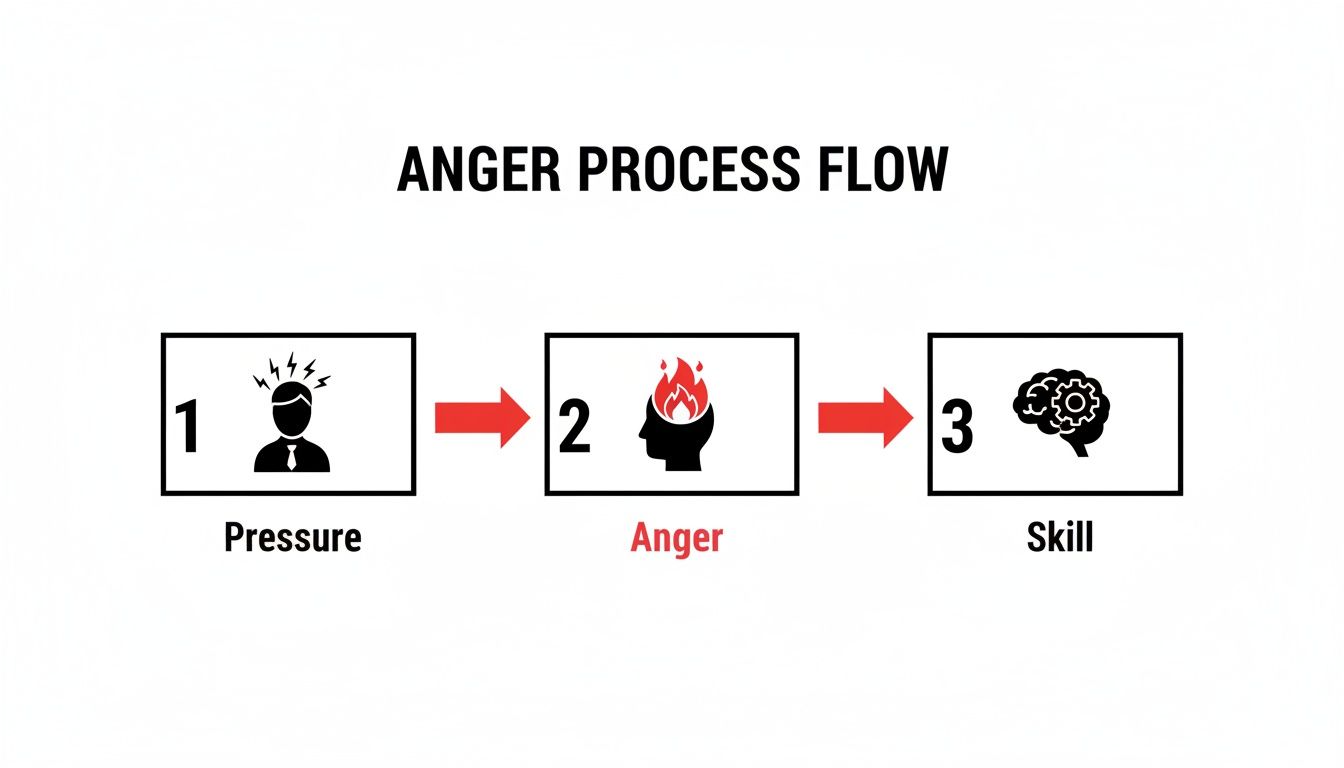
This process shows that anger doesn't just materialise from nowhere. It’s a reaction, and by intervening with a skill, you fundamentally alter what happens next.
Your In-The-Moment Anger Toolkit
To make this even more practical, here’s a quick-reference table. Think of these as your first-aid options for when anger suddenly hits. They are simple, discreet, and can be used almost anywhere.
Technique | Best For | How It Helps |
|---|---|---|
Belly Breathing | The first 30 seconds of feeling anger rising. | Directly signals your nervous system to calm down, slowing your heart rate. |
5-4-3-2-1 Grounding | When your mind is racing with angry thoughts. | Pulls your focus out of your head and into your physical surroundings. |
Muscle Relaxation | When you feel anger as physical tension (clenched jaw, tight shoulders). | Releases stored physical stress, which helps to release emotional tension too. |
Let's break down exactly how to use these to your advantage.
Use Your Breath To Calm Your Nervous System
When you get angry, your body goes into ‘fight or flight’ mode. Your heart races, your breathing gets shallow, and your muscles tense up. One of the fastest ways to reverse this is through diaphragmatic breathing, or belly breathing. It’s more than just a distraction; it physically counteracts the stress response.
By breathing deeply into your belly, you stimulate the vagus nerve, which in turn activates the parasympathetic nervous system—your body’s built-in relaxation switch.
Here’s a simple way to do it:
Find a comfortable position, sitting or standing. Place one hand on your chest, the other on your stomach.
Breathe in slowly through your nose for a count of four. Feel your stomach push out against your hand. The hand on your chest should barely move.
Hold that breath for a count or two.
Breathe out slowly through your mouth for a count of six, feeling your stomach fall.
Just five to ten rounds of this can send a powerful message to your brain that the threat has passed and it’s safe to stand down. For more guidance on this and other mindfulness exercises, feel free to explore my collection of online resources.
Ground Yourself In The Present Moment
Anger has a nasty habit of trapping us in our heads, replaying a past injustice or rehearsing a future argument. Sensory grounding is a brilliant technique for breaking that cycle and pulling your focus back to the here and now.
The 5-4-3-2-1 method is a straightforward way to do this. Wherever you are, just stop and silently identify:
Five things you can see (the pattern on the carpet, a car outside the window).
Four things you can physically feel (your watch on your wrist, the chair supporting your back).
Three things you can hear (the hum of the fridge, birdsong).
Two things you can smell (your coffee, the air freshener).
One thing you can taste (mint from your toothpaste, or even just the inside of your mouth).
This exercise forces your brain to focus on immediate, neutral sensory information, which starves the anger of the mental fuel it needs to keep burning.
Release Physical Tension With Progressive Muscle Relaxation
Anger isn’t just in your head; it lives in your body. You feel it in your clenched fists, tight jaw, or bunched-up shoulders. Progressive Muscle Relaxation (PMR) helps you notice and release that physical tension, one muscle group at a time.
Start with your toes. Tense them up for about five seconds, really focusing on the feeling of tightness. Then, let it all go for ten seconds and notice the difference. Work your way up your body: calves, thighs, stomach, hands, arms, shoulders, and finally, your jaw and face. This physical act of letting go often brings an emotional release along with it.
And these aren't just folk remedies. Research into anger management shows just how effective these simple actions are. Proven interventions demonstrate that basic relaxation techniques can slash anger intensity by 65%, and even something as simple as a bit of physical movement can reduce the frequency of angry outbursts by 55%. These aren't small numbers; they show just how much power you have to manage your emotional state in the moment.
Rewiring Your Thoughts for Long-Term Calm
While those in-the-moment techniques are fantastic first aid, finding a more lasting sense of calm means we have to look a bit deeper. It's about getting to grips with, and gently rewiring, the thought patterns that act as fuel for the fire. Anger doesn't just appear from nowhere; it's almost always kicked off by a thought or belief, often one that flashes through your mind so fast you barely even notice it.
The link between our thoughts, our feelings, and how we act is the bedrock of real anger management. A frustrating thing happens, we interpret it through our own unique mental filter, and that interpretation dictates how we feel. By learning to examine these filters, you can fundamentally change your relationship with anger. You start to understand it, rather than just being controlled by it.

This is precisely the kind of work we do in modern counselling. Take Cognitive Behavioural Therapy (CBT), for instance. It has a 76% success rate in helping people reduce aggressive behaviour, simply by helping them rewire these exact thought patterns. As you can discover in more detail from these findings, getting to the root cause is incredibly effective.
Spotting Your Personal Thinking Traps
We all fall into unhelpful ways of thinking sometimes. In psychology, they're often called ‘cognitive distortions’ or ‘thinking traps’. Think of them as mental shortcuts your brain takes that warp reality, usually in a negative way. When it comes to anger, a few common culprits pop up again and again.
Just learning to spot them in your own mind is the first step to disarming them.
Black-and-White Thinking: This is where everything is either perfect or a total disaster, with no middle ground. You might think, “There’s one small issue with the project, so the whole thing is ruined.”
Catastrophising: This is when you take a minor problem and blow it up into the worst-case scenario. A simple mistake suddenly becomes proof that everything is about to fall apart. For instance, “I was late for that meeting; my boss will think I’m unreliable and I’ll definitely get sacked.”
Mind Reading: This is when you assume you know what someone else is thinking—usually something negative about you—without any actual evidence. You see a colleague looking stressed and immediately think, “He’s annoyed with me for what I said yesterday.”
Overgeneralisation: Here, you take one negative event and see it as part of a never-ending pattern of defeat, often using words like ‘always’ or ‘never’. For example, “I always get stuck in traffic; nothing ever goes right for me.”
In the heat of the moment, these thoughts feel 100% true. The reality, though, is that they're distorted lenses, magnifying frustration and making things feel far more unjust than they really are.
Challenging and Reframing Your Thoughts
Once you can spot these traps as they happen, the next job is to actively challenge them. This isn't about telling yourself you're wrong or being harsh. It's about curiosity—questioning the thought and searching for a more balanced, realistic viewpoint. We call this cognitive reframing.
Let’s use a classic example: someone cuts you off in traffic. The automatic, black-and-white thought might be, “That idiot did that deliberately to disrespect me! People are so selfish.” That line of thinking is a guaranteed recipe for intense anger.
But what if we challenged and reframed it?
Challenge: “Do I know for a fact they did it on purpose? Is there any other possible reason?”Reframe: “Maybe they’re distracted by something stressful at home. Perhaps they’re rushing to the hospital. Or maybe they just made a genuine mistake. It’s frustrating, but it’s probably not about me.”
See the difference? The reframe doesn’t excuse the bad driving, but it removes the personal attack. That small mental shift can turn the emotional temperature way down, giving you the headspace to let it go instead of letting it ruin your day. Another powerful way to consciously manage these thought patterns is to learn how to meditate for beginners with a simple guide to mindfulness.
The Power of an Anger Journal
To really get to know your own anger, you need to become a bit of a detective. An anger journal is a surprisingly simple and powerful tool for this. The point isn’t to just vent onto the page, but to use it for structured reflection.
Try this for a week: every time you feel a significant surge of anger, grab your journal and jot down the answers to these questions:
What was the trigger? (Be specific: My partner didn’t take the bins out like they said they would.)
What was my automatic thought? (“They never listen to me; they just don’t respect me.”)
Which thinking trap was I using? (Overgeneralisation—that word ‘never’ is a big clue.)
How did I feel and what did I do? (Felt rage building in my chest, slammed the kitchen door.)
What’s a more balanced, reframed thought? (“It's frustrating that they forgot, but it doesn't automatically mean they don't respect me. I'll remind them calmly later.”)
After just a few days of this, you’ll start to see clear patterns emerge. You’ll pinpoint your most common triggers and your go-to thinking traps. This self-awareness is the absolute key to lasting change, empowering you to catch those anger-fuelling thoughts before they have a chance to spiral.
Improving How You Communicate When Frustrated
Anger has a way of putting a huge strain on our most important connections. In the heat of the moment, it's all too easy to say things we don't mean or to build walls where there used to be bridges. The goal isn't to stop feeling frustrated – that's impossible. It's about learning a new language to express that frustration, one that builds understanding rather than causing damage.
The real challenge is to get your needs and feelings across without either resorting to aggression or, just as damaging, shutting down completely. It’s a tightrope walk between lashing out and bottling it all up.
That middle ground is what we call assertive communication. At its heart, it’s about being honest about your own feelings, needs, and opinions while still respecting the person you're talking to.
Assertive vs Aggressive Communication
It’s surprisingly easy to mix these two up, especially when your emotions are running high. Aggressive communication is all about winning the argument, often through blame, intimidation, or control. Assertiveness, on the other hand, aims for understanding and finding a way forward together.
Here’s a quick look at how they differ in practice:
Aggressive Communication | Assertive Communication |
|---|---|
Uses "You" statements (e.g., "You always...") | Uses "I" statements (e.g., "I feel...") |
Aims to blame, shame, or control | Aims to explain, understand, and solve |
Leads to resentment and disconnection | Leads to connection and resolution |
Sounds like: "You never help around the house!" | Sounds like: "I feel overwhelmed when..." |
Switching to an assertive style isn't just about being 'nicer'; it's about being more effective. You get your point across without backing the other person into a defensive corner, which makes a positive outcome far more likely.
Master the 'I' Statement Framework
If there's one tool that can radically improve your communication, it's the 'I' statement. It's a simple formula that helps you own your feelings and talk about them without pointing the finger. This small shift can turn a brewing argument into a genuine conversation.
The basic structure is simple:
I feel [your emotion] when [the specific situation/behaviour] because [the impact it has on you].
Let’s see it in action. Say your colleague keeps missing deadlines, which piles the pressure on you.
Aggressive response: "You're completely unreliable! You've made my job impossible again." This is pure blame and will immediately put them on the defensive.
Assertive response: "I feel really stressed when the report is late, because it means I have to rush my part of the project." This is just a statement of fact about your experience. It's non-blaming and opens the door to actually solving the problem.
Shifting from "You did..." to "I feel..." is the difference between starting a fight and starting a conversation. It invites collaboration rather than conflict, which is crucial for turning moments of frustration into opportunities for better understanding.
Listening to De-Escalate
Of course, communication isn't a one-way street. Once you've had your say, it’s just as vital to listen to their side. So often, anger spirals because one or both people feel completely unheard.
Active listening is a skill that can instantly bring the temperature down in a room. It means you’re actually trying to understand, not just waiting for your turn to talk.
It involves:
Giving them your full attention (put the phone down, don’t interrupt).
Reflecting back what you think you heard (e.g., "So, if I'm hearing you right, you're feeling...").
Asking open questions to learn more (e.g., "Can you tell me more about that?").
When someone feels genuinely heard, their defensiveness melts away, making it so much easier to find a solution. This isn't just theory; studies have shown that effective communication training can boost conflict resolution skills by a staggering 70%. Learning to express your own needs while also listening with empathy is a powerful combination for any relationship. You can learn more about how Britain is getting angrier and how to resolve conflict.
Working on these communication patterns with a partner can be tough, which is where professional guidance can make all the difference. Exploring options like couples counselling provides a safe, structured space to practise these skills and start rebuilding those connections. By learning to talk and listen more effectively, you’re giving your relationships the tools they need to navigate conflict and become stronger in the long run.
Knowing When to Seek Professional Support
While the self-help strategies we've looked at are powerful tools for your emotional toolkit, there are times when they just don't feel like enough. Knowing how to deal with anger on your own is a valuable skill, but recognising when you need expert guidance is just as important. It’s not a sign of failure; it’s a sign of self-awareness and strength.
Sometimes, anger becomes so persistent or intense that it starts to seep into every corner of your life. It can affect your health, your job, and the people you care about most. This is the point where seeking professional support can make a profound difference, offering a structured, safe space to get to the heart of what’s going on.
Telltale Signs It Is Time to Talk to Someone
It can be difficult to know when to make that call. Many people think they should be able to handle it alone, but a good counsellor can provide insights and strategies that are hard to develop on your own. If any of the following feel familiar, it could be a strong signal that therapy would be a beneficial next step.
Consider seeking support if:
Your anger feels out of control. You find yourself having explosive outbursts over small things, or feel a constant simmer of rage that you can’t seem to shake.
It’s damaging your relationships. Your partner, family, or friends have mentioned they feel scared or hurt by your anger, or you find yourself constantly in conflict.
It’s leading to aggressive behaviour. This includes shouting, slamming doors, breaking things, or any form of physical intimidation or violence.
You're turning to unhealthy coping mechanisms. You might be using alcohol, drugs, or other behaviours to numb or suppress your feelings of anger.
It’s impacting your physical or mental health. Chronic anger can lead to high blood pressure, sleep problems, anxiety, and depression.
The goal of therapy isn't to eliminate anger but to understand its roots. A counsellor helps you uncover the 'why' behind the anger, providing a confidential, non-judgemental space to explore triggers and patterns you might not even be aware of.
This supportive environment allows you to develop personalised strategies that go beyond surface-level fixes, fostering genuine and lasting change.
Overcoming the Hurdle of Seeking Help
Despite its benefits, many people hesitate to seek professional help for anger. There's often a stigma attached, a feeling that asking for help is an admission of weakness. However, the data tells a powerful story. While over 28% of people in the UK worry about their anger levels, a much smaller number take that next step. You can discover more insights about the gap between concern and action, which highlights just how common this hesitation is.
Taking that step is a proactive move towards a healthier life. It's about investing in yourself and your relationships. If you're unsure where to start, a great first step is simply to find a therapist whose approach resonates with you.
Finding the Right Therapeutic Approach for You
Therapy for anger isn't a one-size-fits-all solution. Different approaches suit different people, and finding the right fit is key. At Therapy with Ben, I offer several options to ensure you feel comfortable and supported on your journey.
Face-to-Face Counselling in CheltenhamFor those who prefer a traditional therapeutic setting, face-to-face sessions provide a dedicated, private space to work through challenges. Meeting in person can help build a strong therapeutic connection, creating a secure foundation for exploring difficult emotions.
Online CounsellingIf you have a busy schedule, live outside Cheltenham, or simply feel more comfortable in your own environment, online counselling offers incredible flexibility. It provides the same high standard of professional support, just delivered in a way that fits seamlessly into your life.
Walk and Talk TherapyThis is a unique and increasingly popular approach that is particularly effective for managing anger. The simple act of walking can help regulate the nervous system and burn off the physical energy that anger creates. Discussing issues while moving side-by-side in nature often feels less intense and more collaborative than a traditional session, making it easier to open up.
No matter which path you choose, the most important thing is that you've decided to act. Reaching out for professional support is the first, most courageous step towards building a calmer, more controlled, and more fulfilling life.
Common Questions About Managing Anger
It's only natural to have questions when you start digging into something as complex as anger. It’s a powerful emotion, and wondering about its nuances is part of the process. I've put together some straightforward answers to the questions I hear most often, hopefully to give you a bit more confidence as you learn to handle anger in a healthier way.
Is It Actually Bad to Feel Angry?
Not at all. Anger is a perfectly normal, healthy human emotion. Think of it as a vital signal – it’s your brain's way of telling you that something feels unfair, wrong, or threatening. The problem is never the feeling itself, but how we react to it.
When channelled constructively, anger can actually be a powerful motivator for positive change, helping us to set boundaries or stand up for what we believe in. It only becomes a problem when it feels uncontrollable, is expressed in ways that harm yourself or others, or just becomes your go-to emotional state. The goal isn't to stop feeling angry; it's to learn how to manage it so you're the one in control.
How Does Walk and Talk Therapy Help with Anger?
Walk and talk therapy is a really effective approach for anger because it tackles both the physical and mental sides of the emotion at the same time. The simple act of walking helps to calm your nervous system and burn off the excess adrenaline and cortisol that often fuel feelings of rage.
Plus, just being outdoors in nature has a proven calming effect. Many people find that walking side-by-side with a counsellor feels less intense and confrontational than sitting face-to-face in an office. This different dynamic can make it much easier to open up and explore difficult emotions. It’s a powerful way of working that engages your body and mind together.
Can I Really Learn to Control My Anger on My Own?
For many people dealing with mild to moderate anger, the self-help techniques in this guide can make a huge difference. Consistently putting these strategies into practice can build your emotional resilience and give you a much greater sense of control.
However, getting professional support is crucial if your anger is leading to aggressive behaviour, damaging your relationships, causing trouble at work, or if it’s tangled up with other mental health challenges like anxiety or depression. A counsellor can offer personalised strategies, accountability, and a safe space to get to the deeper roots of your anger, which is often a more effective path to lasting change. For those curious about different approaches, particularly for younger individuals, you might find some useful insights in this guide on anger management strategies for children.
Remember, seeking professional help isn't admitting defeat. It's a courageous and proactive step towards building the skills you need for a calmer, more fulfilling life.
How Long Will It Take to See a Real Change?
There’s no magic timeline here; it’s a deeply personal journey that unfolds at its own pace. Some people start to feel more in control within just a few weeks of regularly using in-the-moment techniques like deep breathing and grounding.
For others, unpacking long-standing patterns of thinking and reacting through therapy might take several months before the changes feel solid. It's much healthier to see this as building a new skill rather than looking for a quick fix. Progress is all about consistency and self-compassion, not perfection. The real goal is steady improvement and building lasting emotional resilience. Every small step forward is a victory.
Therapy-with-Ben
I’m here to support you on this journey. Whether you're looking for face-to-face sessions in Cheltenham, the flexibility of online counselling, or the unique benefits of Walk and Talk therapy, we can find the approach that's right for you. https://www.therapy-with-ben.co.uk


Comments