


How to Emotionally Detach from Someone and Reclaim Peace
Updated: Feb 13
Learning how to emotionally detach from someone isn't about becoming cold or numb. It’s about creating the mental space you need to protect your wellbeing and stop letting another person’s behaviour dictate your emotional state. Think of it as an intentional act of self-care.
What It Really Means to Emotionally Detach
When people hear "emotional detachment," they often imagine building impenetrable walls or shutting down feelings entirely. In reality, healthy detachment is the complete opposite.
It’s not about suppressing your emotions. It's about learning to observe them without letting them take the driver's seat. It's a conscious decision to stop pouring your emotional energy into a person or situation that consistently brings you pain, anxiety, or distress.
Imagine you've been on the chaotic stage of a play, caught up in all the drama. Detachment is like moving to a seat in the audience. You can still see what's happening and understand the story, but you're no longer swept up in it. This distance gives you the clarity to make choices that serve your own mental health, rather than just reacting to someone else’s script.
A Tool for Self-Preservation
At its heart, emotional detachment is a powerful form of self-preservation. This is especially useful when you can't completely remove someone from your life—think of a difficult co-worker, a family member, or a co-parent. The goal is to change your internal response, even if the external situation stays the same.
So, what does this actually involve?
Setting Firm Boundaries: You start deciding what you will and will not accept from other people.
Reclaiming Your Energy: You consciously redirect your focus away from their problems and back onto your own life and goals.
Accepting What You Cannot Change: This is a big one. It's about realising you can't control another person's choices or feelings, no matter how much you might want to.
This shift in perspective is often a gradual process. Here in the UK, for instance, the median duration of marriages ending in divorce has climbed to 12.9 years. This suggests many couples live with unresolved issues for a very long time before formally separating. You can read more about these UK divorce statistics on crispandco.com.
Detachment is not about ceasing to care. It’s about caring for yourself first, so that another person's emotional state doesn't become your responsibility.
Understanding the roots of how we connect with others is also a vital piece of the puzzle. The patterns we fall into are often shaped by our earliest experiences with caregivers. You can learn more about Attachment Theory and how it shapes you in our detailed guide on the topic.
Embracing detachment is the first real step towards reclaiming your emotional freedom and building a more resilient, centred version of yourself.
Recognising Unhealthy Emotional Attachment
Knowing when it’s time to detach really starts with being honest with yourself. Is this connection actually good for you, or has it started to cause more harm than good? This isn't about placing blame. It's about spotting a pattern that's leaving you feeling drained and unhappy.
You might find yourself endlessly scrolling through their social media, trying to piece together how they’re feeling or what they’re up to. Or perhaps you're constantly making excuses for their behaviour, telling yourself (and others) that it wasn't that bad, even when it hurt. A huge red flag is when your own self-worth gets completely tangled up with their opinion of you. If you feel a wave of anxiety when they don’t approve of something, that’s a sign things are off balance. For a deeper look, it's sometimes helpful in understanding conditions like BPD which can be linked to these intense attachment patterns.
Interdependence Versus Codependence
It’s so important to be able to tell the difference between healthy support and an unhealthy reliance. A healthy relationship is built on interdependence, where two complete individuals choose to be there for each other. On the flip side, unhealthy attachment often veers into codependence, where your very sense of self depends on the other person.
This little decision tree below is a great way to check in with yourself. Are you trying to detach to find peace, or are you just trying to numb out difficult feelings?
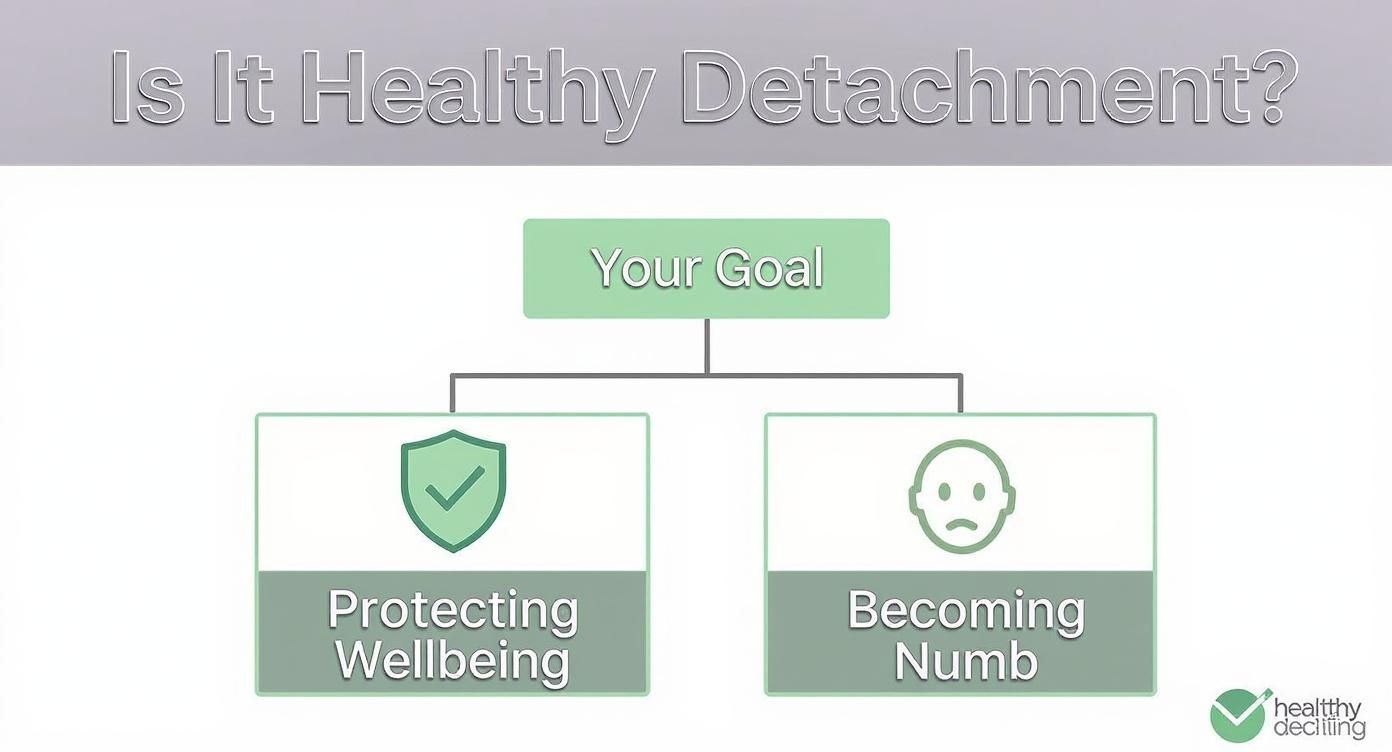
The real question is about your motive: is this about protecting your mental wellbeing, or is it an attempt to avoid feeling anything at all?
To help you get a clearer picture without any judgment, let's break down the two dynamics. Seeing them side-by-side can make it much easier to recognise where your own relationship falls. Learning the 7 signs of unhealthy relationships to watch for can also give you a more detailed lens to look through.
Unhealthy attachment feels like you need the other person to be okay. Healthy interdependence means you want the other person in your life, but you know you will still be okay without them.
Spotting these patterns is the first, and most crucial, step. It gives you the clarity you need to start moving forward and figure out how to detach in a way that truly allows you to heal.
Healthy Interdependence vs Unhealthy Attachment: A Comparison
To make things even clearer, this table contrasts what a healthy, supportive connection looks like versus an unhealthy, codependent one. It's a straightforward way to help you identify which patterns might be showing up in your own life.
Characteristic | Healthy Interdependence | Unhealthy Attachment |
|---|---|---|
Self-Worth | Your sense of self is stable and comes from within, independent of the relationship. | Your self-esteem rises and falls based on their approval, mood, or attention. |
Boundaries | You both respect each other’s personal space, time, and individual friendships. | Boundaries are blurred or non-existent; you feel responsible for their emotions. |
Decision Making | You make major life decisions collaboratively but maintain autonomy over personal choices. | You feel unable to make decisions without their input or fear their disapproval. |
Conflict | Disagreements are seen as problems to be solved together, with mutual respect. | Conflict feels threatening and destabilising, often leading to sacrificing your needs. |
Looking at it this way, you can start to see where the lines are. Acknowledging these differences is a powerful move towards reclaiming your emotional independence.
How to Create Real Emotional Distance
Creating a bit of emotional space isn't about grand, dramatic gestures. It's more about a series of small, consistent actions that slowly pull your focus back to where it belongs: on yourself. This is the point where you move from just understanding the problem to actually doing something about it. The real goal here is to build a buffer that protects your energy, letting you respond thoughtfully instead of just reacting emotionally.

This whole process kicks off with some really practical, deliberate steps. You’re essentially retraining your brain to stop centring the other person's behaviour and feelings. Instead, you're learning to prioritise your own wellbeing, and every small step you take reinforces that commitment to your own mental health.
Establish and Enforce Firm Boundaries
Boundaries are the absolute foundation of emotional detachment. It's important to remember they aren’t punishments; they are just clear guidelines for how you expect to be treated and what you will no longer put up with. This is all about defining your personal space, both physically and emotionally.
Think of it like putting a fence around your garden. The fence isn't there to keep everyone out forever, but to protect what’s growing inside from being trampled on. Your emotional wellbeing is that garden.
Start by pinpointing the specific behaviours that drain you. Is it the late-night phone calls? The constant criticism? Or getting dragged into discussions about topics you find upsetting? Once you know what the issues are, you can build a boundary around them.
Limit Contact: This might mean not replying to texts the second they come in, scheduling shorter visits, or even implementing a period of no contact if things are particularly tough. For instance, you could decide, "I will only respond to non-urgent messages between 6 pm and 7 pm."
Control Your Digital Space: Muting someone on social media is a surprisingly powerful tool. It lets you stay connected if you have to, but completely on your own terms, without their updates constantly popping up in your feed and disrupting your peace.
Define Off-Limit Topics: You can politely steer conversations away from subjects that are painful or just plain unproductive. A simple, "I’d rather not discuss that," is a complete sentence and a perfectly valid boundary.
For really tricky situations, like co-parenting with a high-conflict individual, it can be crucial to explore specific strategies like parallel parenting with a narcissist to establish that much-needed emotional distance.
Practise Mindful Observation of Your Feelings
Mindfulness is really just the practice of observing your thoughts and feelings from a distance, without judging them. So when you feel that surge of anger, anxiety, or sadness related to this person, the goal isn't to squash it down, but to simply notice it.
Try to imagine your emotions are clouds passing in the sky. You are the sky—vast and unchanging—while the clouds are just temporary weather patterns. Acknowledge them when they show up—"Ah, there is that feeling of frustration again"—and then just let them drift by without getting swept up in the storm.
This practice creates a crucial pause between feeling an emotion and acting on it. In that pause, you reclaim your power to choose a response that aligns with your goal of detachment.
The reason this works so well is that it breaks the cycle of emotional reactivity. Instead of being pulled into their drama, you become a neutral observer of your own internal state. Over time, this strengthens your emotional resilience more than you'd believe.
Use Journaling for Private Processing
When you're trying to detach, your mind can feel like a chaotic storm of thoughts and feelings. Journaling gives you a safe harbour to process everything without needing to talk it out with anyone else.
It’s your own private space to be completely honest. You can write down your anger, your hurt, your confusion—all the messy things you might not feel comfortable saying out loud. The simple act of getting these thoughts out of your head and onto paper can provide immediate relief and clarity.
It also helps you spot recurring patterns. As you read back over your entries, you might notice specific triggers or situations that repeatedly cause you distress. This kind of self-awareness is absolutely essential for strengthening your boundaries and making conscious choices that support your journey toward emotional freedom.
Navigating the Difficult Feelings of Detachment
Making the choice to emotionally detach from someone is a massive step. But let's be honest, what comes next is often a messy, complicated process. It's really important to know that this journey almost always brings a wave of tough emotions to the surface. You might find yourself grappling with guilt, a sharp sting of loneliness, or even a profound grief that feels like you're mourning a real loss.
These feelings aren't a red flag telling you you've made a mistake. Quite the opposite, actually. They are a completely normal and valid part of the healing process. Learning how to emotionally pull back from someone means learning to sit with this discomfort without letting it throw you completely off course.
Working Through Guilt and Loneliness
Guilt often shows up as an unwelcome guest during detachment, especially if you’ve spent a long time putting everyone else's needs before your own. You might feel a bit selfish for finally drawing a line in the sand or for not being as readily available as you used to be. It’s crucial to start reframing this. Protecting your own mental wellbeing isn't selfish; it’s an essential act of self-respect and preservation.
Loneliness can also hit like a tonne of bricks, leaving a gaping hole where the other person used to be. That sudden quiet can feel deafening at first, making you second-guess your decision. This is especially true after major life shifts like a separation or divorce.
For example, UK data really puts a number on the emotional toll. An estimated 51% of people report feeling more lonely after a divorce, and 28% go on to experience depression. This just shows how isolating the whole thing can feel, and it’s why having some coping strategies ready is so vital. You can find more on the connection between divorce and loneliness on dorsetmind.uk.
Remember, the sharp, temporary pain of moving on is far more productive than the chronic, dull ache of staying in a situation that harms you. The first is a sign of healing; the second is a sign of being stuck.
Coping with Sadness and Grief
You have to let yourself feel the sadness. You’re grieving the end of a connection, the loss of a future you imagined, or maybe the relationship you always hoped you'd have. Trying to bottle it all up or push it down will only make the pain stick around for longer. Instead, find healthy ways to let it out:
Talk it out: Find a trusted friend who can just listen without judgement. Sometimes, just saying the words out loud can make a world of difference.
Get moving: A brisk walk, a run, or any kind of physical activity can release endorphins and help clear your head when the feelings get too much.
Have a good cry: Crying isn't a sign of weakness. It's a natural, healthy release valve for all that pent-up sadness and stress.
Getting a handle on these intense feelings is a huge part of the journey. This is where building solid emotional regulation skills becomes so important, helping you navigate this storm without getting completely swept away. If you feel you need a bit of a hand with this, our guide on what is emotional regulation and how to master it is a great place to start.
By accepting that these difficult emotions are part of the deal and having some healthy coping tools in your back pocket, you can move through the discomfort with more kindness towards yourself, knowing you're on a path to a much healthier future.
Rebuilding Your Life and Rediscovering Yourself
When you detach from someone, it inevitably leaves a void. How you choose to fill that space is one of the most crucial parts of your healing. This is what I call the rebuilding phase—a genuine chance to figure out who you are outside of the relationship you’ve just left behind. It’s an opportunity to finally turn your focus inward and rebuild your self-esteem on your own terms.

Think of this part of the journey not just as an ending, but as the beginning of a more authentic, self-reliant life. It's about finding joy and purpose that is entirely yours.
Fill the Void with Meaningful Activities
All that emotional energy you once poured into the relationship is now yours to reinvest. This is the perfect time to get back in touch with the parts of yourself that might have been pushed to the side.
What did you love to do before? Think back to those hobbies that used to bring you genuine joy. Was it painting, playing an instrument, or maybe just getting out for a long hike? Re-engaging with old passions can feel like coming home to yourself. It's a powerful reminder of who you were before the relationship took centre stage.
This is also a fantastic chance to explore something completely new. I often suggest trying something you’ve never done before—a pottery class, a language course, or joining a local sports club. This helps build new neural pathways and creates fresh, positive memories that aren't tied to your past.
Nurture Your Social Support System
Meaningful connections with friends and family are a powerful antidote to the loneliness that often comes with detachment. Now is the time to reach out to the people who make you feel seen and supported for who you are.
Reconnect with Old Friends: Get in touch with those friendships that may have taken a backseat. A simple coffee or a walk can do wonders for the soul.
Invest in Healthy Relationships: Spend your time with people who lift you up and respect the boundaries you're working so hard to set.
Be Open to New Connections: Join groups or clubs that align with your interests. It’s a great, low-pressure way to meet like-minded people.
This process isn't just about passing the time; it’s about intentionally building a life that feels full and rewarding on its own merits. You're reinforcing your sense of self-worth through your own actions and accomplishments.
When to Seek Professional Support
Sometimes, the process of detaching is just too overwhelming to handle on your own, and that’s perfectly okay. Realising you need help is a sign of incredible strength, not weakness. This is especially true if the emotional attachment is tangled up with deeper psychological patterns from your past.
Research from NHS England highlights that one in four adults experience a diagnosable mental health problem each year, which can have a huge impact on relationship stability. This shows just how complicated detachment can be when underlying issues are at play, making professional support vital. You can find out more by reading about the role of mental health in relationship breakdowns.
If you’re struggling to cope with the emotions, finding it hard to function day-to-day, or simply feel stuck, speaking with a counsellor can give you the tools and compassionate support needed to navigate this transition in a healthy way.
Of course. Here is the rewritten section, crafted to sound like an experienced human expert while adhering to all your requirements.
Your Questions About Emotional Detachment, Answered
As you start to navigate the tricky waters of detaching from someone, it’s completely normal for questions to bubble up. The whole process can feel a bit confusing, and it's easy to wonder if you're even doing it 'right'. I've put together some straightforward answers to the questions I hear most often, hopefully giving you a bit more clarity and confidence as you go.
How Long Does It Take to Emotionally Detach?
Honestly, there’s no magic number. This isn't a race with a finish line; it’s a deeply personal process that unfolds on its own schedule. It might take weeks for some, months for others, and sometimes even longer. It all depends on things like the depth of the relationship, the support you’ve got around you, and your own unique way of healing.
Rather than fixating on a deadline, I encourage people to focus on the small victories. Seriously, celebrate them. Acknowledging that you went a whole day without checking their social media, or that you successfully held a boundary you’d set—that’s where the real progress is. It’s all about consistent steps forward, not speed, so please be kind to yourself along the way.
Can I Detach From Someone I Still Have to See?
Yes, absolutely. It is entirely possible, though it does call for much stronger and more deliberate boundaries. If you have to interact with a co-worker, co-parent, or family member, the aim is to shift the dynamic into what I call 'functional contact'.
This is all about keeping your conversations:
Brief: Don’t let chats linger or drift into personal territory. Keep it short and to the point.
Polite: A civil, neutral tone is your best friend here. It helps avoid escalating any existing tension.
Focused: Stick rigidly to the necessary topic, whether that’s a work project or sorting out the kids' schedules.
A really powerful tool here is to mentally rehearse these brief, neutral interactions beforehand. It helps you build a kind of internal shield, allowing you to maintain your emotional composure even when they're right there in front of you. This isn't about being cold; it's about taking back control of the interaction on your own terms.
What’s the Difference Between Detaching and Just Giving Up?
This is such an important distinction to make. 'Giving up' often comes from a place of impulse or reaction. It can feel like a personal failure, like you've been defeated. In complete contrast, healthy emotional detachment is a conscious, considered choice you make to protect your own wellbeing.
It’s about taking a clear-eyed look at a dynamic, recognising the harm it’s causing you, and then taking deliberate, strategic steps to create emotional safety for yourself. Detachment isn’t about punishing the other person or cutting them off in a fit of anger.
It's an act of prioritisation—you are consciously choosing to put your own mental health first, creating the space you desperately need to heal and move forward in a much healthier way.
Interested in exploring therapy further? Learn more about my walk-and-talk therapy in Cheltenham , see my counselling fees, or discover how therapy can help you. If you’d like to know more about my background, visit the about me page. Ready to take the next step? Contact me to arrange a first session or ask any questions.
If you're finding it difficult to navigate this process on your own, please remember that professional support is out there. At Therapy with Ben, we offer a safe, non-judgemental space to explore these challenges and find strategies that will actually work for you. You can find out more at https://www.therapy-with-ben.co.uk.


Comments