


How to Manage ADHD: Understanding What Helps You
What if learning how to manage ADHD isn't mainly about becoming more organised, but about understanding why everyday life takes so much effort? A calendar might help you remember an appointment. It won't necessarily soften the feeling that forgetting it makes you careless, unreliable or somehow not good enough.
Practical support matters, and so does the way you understand yourself. There's room for both, without turning your life into another project you're supposed to get right.
Why Managing ADHD Starts With Understanding Yourself
You might spend longer preparing for a meeting than anyone realises, still lose track of a question, then leave thinking you should have tried harder. The visible difficulty is keeping track. The less visible burden is the judgement you carry afterwards.
Managing ADHD doesn't have to mean fixing yourself. It can begin with noticing what takes effort, what helps and which expectations leave you repeatedly stretched beyond your capacity. ADHD affects people differently, so someone else's successful routine may tell you very little about your own needs.
The UK Government's independent review reported that diagnosed ADHD prevalence reached 1.19% in June 2025 in primary-care and regional health-record analyses, and that diagnoses increased sharply after the pandemic. Increased recognition doesn't establish that ADHD itself suddenly became more common. For an adult recognising these patterns later in life, it may mean longstanding difficulties finally have a name.
The contrast between effort and outward appearance can be easy to miss.

I work collaboratively rather than handing out fixed programmes. My particular interests include ADHD, autistic traits, late recognition of neurodivergence, masking, emotional intensity, shame and feeling different. A diagnosis can offer language and access to support without becoming a definition of who you are.
Carl Rogers expressed something central to my approach:
“The curious paradox is that when I accept myself just as I am, then I can change.”
Acceptance isn't giving up. It creates room to consider everyday supports, assessment, medication or counselling without making your worth depend on how well you cope.
Common ADHD Experiences and What Might Help
Read across this table as an invitation to recognise patterns, not as a checklist to pass. These experiences can occur with ADHD, but they aren't exclusive to it and don't establish a diagnosis.
Common ADHD experiences, supports and reflective questions
Experience | What it can look like | Supports worth exploring | A question to ask yourself |
|---|---|---|---|
Time blindness | Tasks feel either urgent or invisible, and you run late despite trying | Visible timers, calendars with buffer time, reminders set before you need them | What does time actually feel like for me? |
Procrastination | Freezing before starting, or feeling that a task is too large to begin | Breaking it into a first small step, naming the next action, working alongside someone | What makes this task feel so heavy? |
Emotional intensity | Strong reactions arrive quickly and leave shame behind | Naming feelings as they arise, pausing before responding, noticing what sets things off | What was I protecting when that reaction arrived? |
Overwhelm | Too many unfinished commitments, followed by shutting down when information piles up | One list of commitments, fewer options at once, planned breaks | What can I let go of this week? |
Masking | Holding things together in public, followed by exhaustion afterwards | Choosing when it feels safe to unmask, allowing recovery time, telling a trusted person | Where do I feel safe being myself? |
Meeting expectations | Feeling constantly behind standards that others seem to meet easily | Revisiting expectations, asking for clearer instructions, requesting reasonable adjustments | Whose standard am I measuring myself against? |
Forgetfulness | Lost items, missed appointments, things said and then gone | Phone reminders, voice assistants, one place for notes | Which reminders help, and which feel like nagging? |
Noticing what feels usable
You might choose the rows that feel most familiar and notice your response to the suggestions. Does a visible timer sound reassuring, irritating or like another demand? A support is a possibility, not a promise. A phone notification may relieve someone of remembering everything while making another person feel repeatedly told off.
The question beside procrastination matters because difficulty starting isn't always about planning. Say you need to reply to an email but keep avoiding it. Naming the next action might help, but you may also need to recognise that you're frightened of disappointing the person who wrote it.
These are low-risk possibilities you can explore without a diagnosis. They don't require you to buy a planner or download an app. If too many competing demands are the immediate problem, Refresh Psychiatry & Therapy's resource on practical strategies for ADHD overwhelm offers further ideas to consider, rather than another list you need to complete.
Looking beneath the visible difficulty
The rows overlap. You might mask your confusion at work, become overwhelmed by the effort and then react strongly to a small request at home. That doesn't excuse hurtful behaviour, but understanding the sequence gives you more to work with than deciding you're difficult.
Some distress may also relate to years of criticism or misunderstanding. It's possible to take responsibility for your actions while becoming less punitive towards yourself.
Getting Assessed and Coping While You Wait
Waiting can leave you in an uncomfortable middle ground: you recognise difficulties, but don't yet know how to understand them. NHS England estimated that up to 549,000 people in England could be waiting for an ADHD assessment in March 2025. That describes the scale of demand, not how long any individual will wait.
A GP can talk through your concerns and explain local referral arrangements. It can help to describe the impact rather than only naming symptoms: missed deadlines, difficulty managing household tasks or repeatedly losing track during conversations.
What a thorough assessment considers
Assessment involves more than scoring an online checklist. It should be carried out by a clinician trained in ADHD diagnosis and consider childhood history, difficulties across different settings and their impact on work, study, relationships or home life.
Anxiety, low mood, sleep problems, substance use and past trauma also deserve attention. They may coexist with ADHD or help explain difficulties that initially look similar. You don't need to arrive having already separated everything out.
Support during the uncertainty
Record specific examples. A brief note about what happened, where it happened and its consequences can help you explain your experience. Include work, study, relationships and ordinary daily tasks where relevant.
Notice patterns rather than grading yourself. Perhaps starting is harder when instructions are unclear, or remembering becomes more difficult when you're interrupted.
Try a low-risk environmental change. A quieter workspace or a reminder attached to an existing activity may reduce friction without requiring diagnostic certainty.
Share what you're noticing. Someone you trust might help you remember earlier experiences or make the uncertainty less isolating.
Your examples are there to explain patterns, not to prove you're struggling enough.
These suggestions support difficulties with planning, starting and remembering, sometimes called executive-function difficulties. They aren't a cure for ADHD, and finding something helpful neither confirms nor rules out a diagnosis.
If you're considering another route, my article on private ADHD assessment offers a starting point for thinking through that decision. You're allowed to seek support while still being unsure what the eventual explanation will be.
What Medication Reviews Involve
Medication is a medical decision made with a qualified prescriber. It isn't something to start, change or stop on your own, and it doesn't replace attention to the circumstances in which you're trying to function.
NICE's ADHD guidance recommends offering medication to adults when clinically important impairment persists after environmental modifications have been implemented and reviewed, and names lisdexamfetamine or methylphenidate as first-line options. During dose adjustment, the aim is to balance improvement with adverse effects, not to reach a higher dose.
What ongoing monitoring looks like
The schedule below summarises adult monitoring in NICE's diagnosis and management guideline, which specifies cardiovascular checks around dose changes and every six months, adult weight checks every six months, recording during titration and at least annual medication review.
What NICE recommends checking during adult ADHD medication
What is checked | How often | Why it matters |
|---|---|---|
Heart rate and blood pressure | Before and after each dose change, then every six months | Tracks how the body responds to medication |
Adult weight | Every six months | Monitors physical health and possible appetite changes |
Symptoms, impairment and side effects | At baseline and at each dose change during titration | Shows whether medication is helping in daily life |
Ongoing need and benefit | At least annually, with a trained healthcare professional | Helps decide whether medication should continue |
A review should leave room for your experience, not just measurements. Are everyday tasks more manageable? How are sleep, appetite and mood? A change that looks helpful on a symptom scale may still need discussion if the side effects are difficult to live with.
Feelings about medication matter too
You may feel relief about taking medication, uncertainty about needing it, or both. Counselling can offer space to explore those feelings, including shame, concerns about identity or the effect of side effects on how you see yourself.
Counselling can also address anxiety, low mood and relationship difficulties alongside medical care. It doesn't replace prescribing decisions or physical monitoring. Changes in mood or other possible adverse effects need to be raised with your prescriber, rather than treated only as something to process emotionally.
A useful question to take to an appointment is: which checks apply to me, how often will they happen, and whom should I contact if side effects begin changing how I feel about myself?
Therapy Approaches and Where Counselling Fits
ADHD support can take different forms. Before choosing, it may help to ask whether you mainly want practical planning support, structured work towards particular goals, or space to understand your emotional experience.
The descriptions below are broad distinctions, not guarantees about every practitioner or service. Asking how someone works can be more useful than choosing by an approach's name alone.
Therapy approaches compared for adults with ADHD
Approach | Typical focus | What it may offer | Good to know |
|---|---|---|---|
Cognitive behavioural therapy (CBT) | Structured work on thoughts, habits and specific goals | Practical strategies, often over an agreed course of sessions | I don't practise CBT; some people find its structure useful |
ADHD coaching | Planning, routines and skills for daily life | Accountability and practical goals | Usually not therapy; quality and practitioner backgrounds differ |
Person-centred counselling | Your own experience and self-understanding, at your pace | Space for greater self-acceptance and clarity | Collaborative, without a fixed programme |
Psychodynamic counselling | Recurring patterns and feelings that may link to earlier experiences | Exploration of why certain patterns repeat | Exploratory work that can take time |
Integrative counselling | Draws on different approaches to suit the person | Flexibility as needs change | Adapted to the individual rather than one method |
How I work
I'm an integrative counsellor working from person-centred and psychodynamic perspectives, based in Cheltenham and working with adults of all genders. I don't practise CBT, so if you're looking specifically for structured CBT, that distinction matters.
My focus is on exploring thoughts and feelings rather than giving advice. I don't routinely give homework, introduce fixed programmes or begin by prescribing a routine. Together, you and I can explore what's happening and what you might like to do.
For example, repeatedly agreeing to more than you can manage might involve difficulty estimating your capacity. It might also connect with a fear of letting people down. Counselling allows room for both the practical difficulty and the meaning it holds for you, without assuming one explanation accounts for everything.
You don't have to arrive with a clear goal or a polished explanation of what's wrong.
Finding a comfortable way to talk
Sessions can take place face to face in Cheltenham, outdoors through Walk & Talk counselling, or online across the UK. Some people find moving and talking side by side less intense than sitting opposite someone; others prefer the privacy and familiarity of an indoor setting.
Walk & Talk isn't a technique I use to promise better concentration. It's a different setting for a conversation, which may feel more comfortable for some people. My explanation of counselling for ADHD gives more detail about this exploratory approach.
Making Routines, Work and Relationships Easier
A useful adjustment removes one specific obstacle. It doesn't need to produce a perfectly ordered day. At home, that might mean keeping every commitment in a single place and making the next action visible, rather than building a system so elaborate that maintaining it becomes another task. Ask yourself what gets in the way, then address that one thing.
This visual offers a way to think about support across different settings.
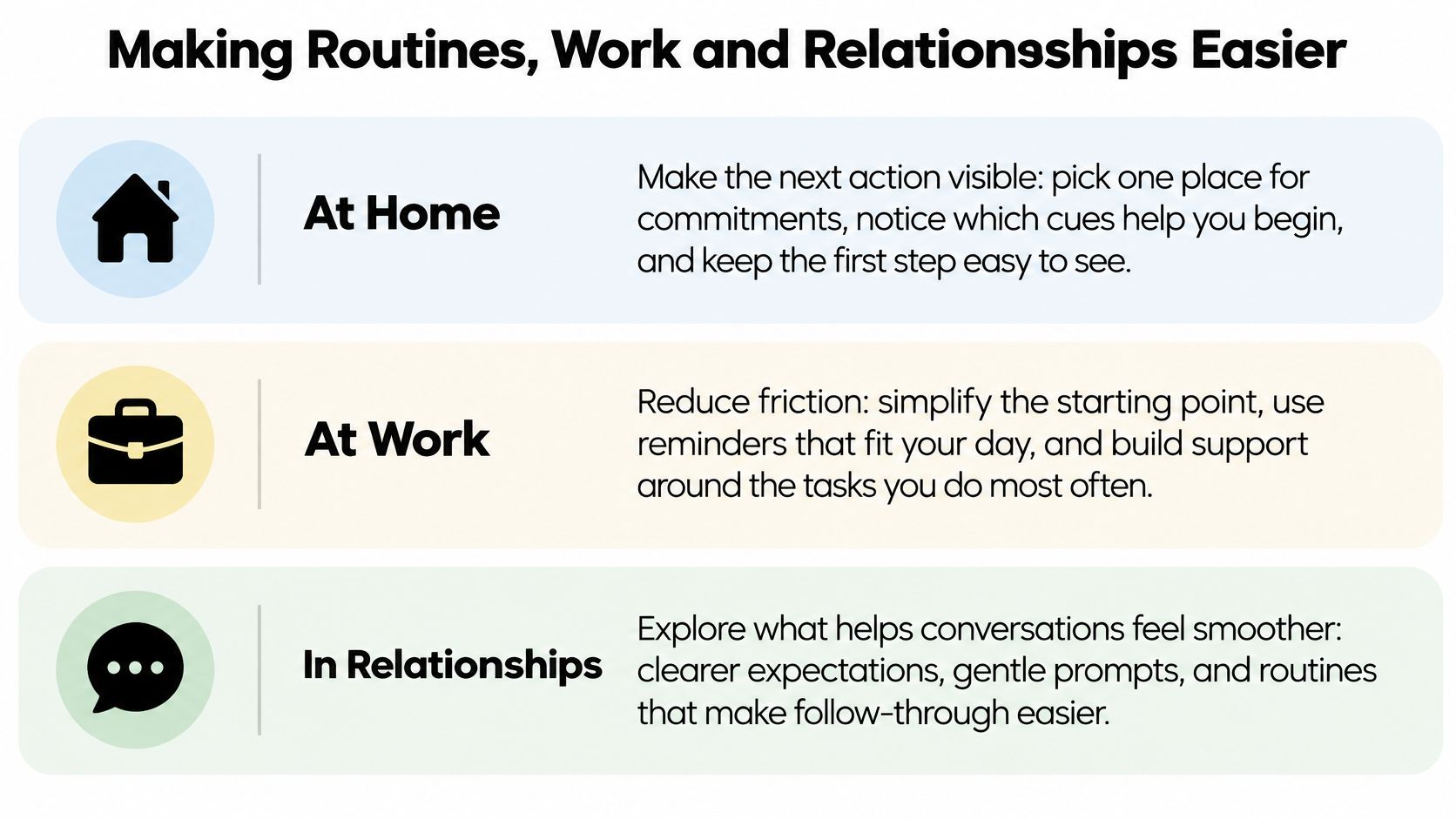
At home and at work
Take a task like sorting paperwork. A visible first step could be putting the unopened letters in one pile, rather than setting yourself the vague demand to sort out your finances. My article on why starting tasks can feel so hard with ADHD explores why beginning can feel disproportionately difficult.
If timed work suits you, Wigan Council's workplace guidance gives a Pomodoro example of 25 minutes of work followed by a 5-minute break, with a longer break after four cycles. Treat it as an option to try, not a standard to meet. Movement, headphones or a quieter room may suit you better, and part of this process is noticing which supports help rather than which ones sound like they should.
At work, it can be worth asking about adjustments rather than struggling on alone. Whether ADHD counts as a disability in law depends on its effects and how long they last, not the diagnosis alone, but you don't need to settle that question before raising what would help. Possible adjustments include clearer written instructions, flexible hours, reduced distractions, movement breaks, quieter workspaces or speech-to-text software.
An adjustment reduces a barrier. It isn't a reward for being disorganised, and asking for one isn't an admission of failure.
In relationships
Shared plans need shared understanding. It may help to agree where plans are recorded, who takes responsibility for updating them and how a reminder can be offered without sounding like criticism.
The person reminding you may feel ignored; you may feel monitored. Both reactions are understandable, and masking irritation on either side tends to make things worse over time. Naming both experiences can make it easier to agree on something workable, rather than arguing about whether either person cares enough.
If talking aloud helps you reflect, you might choose to pause with this video.
Try a small experiment: choose one support and give it a little time. Notice whether it makes the task easier and whether it feels kinder. You're allowed to keep it, adapt it or drop it without treating the result as a verdict on your effort.
When to Look for Urgent or Professional Help
You don't need to wait for an ADHD assessment before asking for help with something that's becoming difficult to manage. Persistent anxiety or low mood, repeatedly disrupted sleep, using alcohol or other substances to get through the day, or struggling to keep up with work, study or home life are reasons to arrange a GP appointment.
These experiences may have causes beyond ADHD. A GP can consider them alongside any referral, rather than assuming everything must wait until diagnostic questions are settled.
When you need urgent support
For thoughts of harming yourself or ending your life: contact NHS 111 and choose the mental health option.
To speak to someone at any time: call Samaritans on 116 123.
In an emergency: call 999 or go to A&E.
Ordinary overwhelm isn't always a crisis, but you don't have to decide alone how serious things are before reaching out. Asking early is a sensible response to distress, not an overreaction.
Choosing professional assessment carefully
If you consider a private assessment, check that the assessing clinician is appropriately trained in ADHD and that the process includes childhood history, difficulties across settings and their impact. A quick checklist alone isn't enough to untangle overlapping difficulties.
Counselling can support emotional exploration, but it isn't an ADHD diagnostic assessment or an emergency service. Being clear about those boundaries helps you find the kind of care you need, rather than expecting a single professional to provide everything.
Arranging an Introductory Conversation
An introductory conversation is a chance to ask questions and get a feel for whether talking together might be helpful, before you decide anything further.
You might arrive with something specific, such as the uncertainty of waiting for an assessment, or with a vaguer sense that things aren't working. Feeling exhausted by masking, friction at work or in relationships, and a persistent sense of falling short are all reasonable starting points. You don't need to have organised your experiences into a neat account first.
You don't need a diagnosis
I work with adults aged 18 and over, and you don't need a diagnosis to begin counselling. Many people are still unsure whether ADHD explains what they experience, or are somewhere on a waiting list, and that uncertainty itself can be worth exploring.
Sessions can be face to face in Cheltenham, outdoors as walk and talk therapy, or online anywhere in the UK. The setting can be part of deciding what feels comfortable, rather than something you have to adapt yourself to.
Deciding what fits
A first conversation is also a chance to consider whether my approach matches what you're looking for. I work integratively, drawing on person-centred and psychodynamic approaches, so the work is shaped around you rather than following a fixed programme. If I think a different kind of support would suit you better, I'll say so and can point you towards it.
Counselling doesn't ask you to be harsher with yourself to make progress, and it doesn't excuse you from responsibility either. The aim is a kinder understanding of how your mind works, alongside honest accountability for what you do.
I offer collaborative counselling for adults who want to understand their ADHD-related experiences, ease self-criticism and make more room for their own needs. Visit Therapy with Ben to arrange an introductory conversation and see whether talking together feels right for you.


Comments