


In-Home Primary Care: What It Covers and How to Access It
Some times I get post suggested to me from other providers/websites and if they feel like they may contain useful information then I share. Your older relative is too unwell to get to the GP surgery, but you're not sure who to call. They need a medical opinion, perhaps a dressing changed too, and someone has suggested “care at home”. Before you spend time chasing referrals, it helps to separate services that sound alike but do very different jobs.
Table of Contents
What In-Home Primary Care Means - Start with the need, not the service name
Services a Home Visit Can Provide - What each visit is for - Why practices plan visits carefully
Who Qualifies for Care at Home - Temporary difficulties and less visible barriers
How to Request a GP Home Visit - Confirm which service has accepted the request
Booking a Home Visit With Life Primary Care - When this model may fit
How It Differs From Home Health Care and Hospice - Comfort care is not the same as withdrawing care - Match the task and the funding route
Virtual Wards and Hospital-at-Home Care - Common assumptions to test - Questions before admission
Limits and Misunderstandings About Care at Home - Test the promise against the practical reality - Check whether the plan is usable
Confirm the Right Service Before You Book - Make room for the emotional impact
What In-Home Primary Care Means
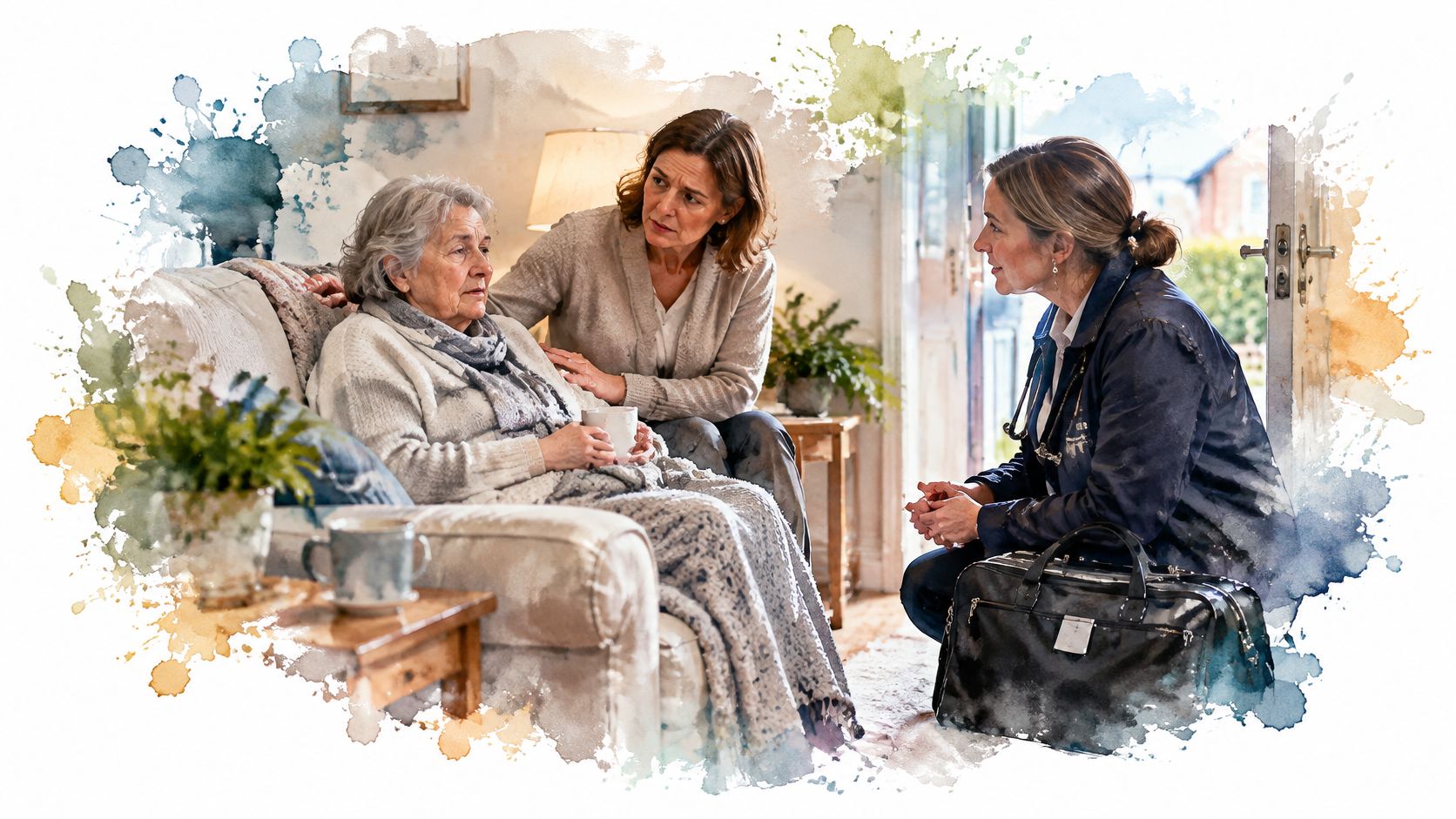
Say your father normally manages appointments with your help, but an illness has left him weak and struggling with the stairs. You're not asking someone to take over his daily routine. You need a clinician to assess what's changed and decide what treatment he needs.
In-home primary care is first-line medical care delivered where a person lives, usually by a GP or practice team. It is like changing the route on a sat-nav: the destination, medical assessment and treatment, stays the same, but the route changes because the patient can't safely travel.
Primary care is the usual front door to healthcare, including general practice, practice nursing and pharmacy. In the UK, GP home visits are the best-known home-based route, although the broader term can include private visiting doctors and community nursing. These services aren't interchangeable, and requesting one doesn't automatically arrange the others.
Start with the need, not the service name
An NHS home visit is considered when attending the surgery would be unsafe, unrealistic, or harmful, rather than just less convenient. It's a clinical service, not an arrangement for shopping, washing, or dressing.
First question: Does the person need a medical opinion, hands-on nursing, personal help or urgent care?
That distinction determines which phone call to make. Someone who needs an infection assessed may need the practice; someone who needs help getting washed needs a different route, even if both problems arose after the same illness.
Virtual wards and some service rules described here are England-specific. Scotland, Wales and Northern Ireland organise home-based care differently, so check arrangements with your own health board or trust.
Services a Home Visit Can Provide
Common home-based services and who provides them
Service | Usually provided by | Typical reasons | How it is arranged |
|---|---|---|---|
GP home visit | GP or GP registrar | Acute illness, falls, dehydration, housebound patients | Request through the GP practice |
Community nursing | Community or district nurse | Wound care, injections, catheter care, monitoring long-term conditions | Referral from GP or hospital team |
Practice review at home | GP, practice nurse or pharmacist | Long-term condition checks and medicine reviews for patients who cannot attend | Arranged by the practice |
Palliative symptom support | GP and community palliative team | Pain, breathlessness and symptom control with life-limiting illness | Referral from GP, hospital or hospice |
Private GP home visit | Private doctor | Faster access or care outside NHS routes | Booked directly and paid privately |
What each visit is for
A GP home visit can assess a suspected chest infection, urinary infection, dehydration or the consequences of a fall. The clinician can examine the patient, prescribe when appropriate and arrange further investigation or referral. A fall may need hospital assessment rather than treatment at home.
Community nursing provides planned, practical clinical care, including dressings, injections and catheter care. Nurses may also monitor people with conditions such as heart failure or chronic obstructive pulmonary disease, often shortened to COPD, under an agreed care plan.
A practice review at home addresses ongoing needs rather than a new illness alone. A nurse or pharmacist might review medicines, identify difficulties taking them or help the practice monitor a long-term condition.
Palliative symptom support focuses on problems such as pain, nausea and breathlessness. The GP and specialist community team can work together, including while treatment for the underlying illness continues.
A private visiting doctor offers a separately booked, paid consultation. Access may be quicker, but ask what the appointment includes, how prescriptions and investigations are arranged, and how information reaches the patient's NHS practice.
Why practices plan visits carefully
A British Journal of General Practice study reports more than 13 million UK GP home visits annually, with average consultation times of 23.4 minutes at home compared with 11.7 minutes in the surgery. These are published study figures, not a live count of current activity.
A visit creates space for assessment, but it doesn't bring every diagnostic facility into the house. Scans, X-rays and other investigations may still require a separate service or a journey elsewhere.
Who Qualifies for Care at Home
There isn't a single checklist that guarantees a GP home visit across the UK. The practice makes a clinical decision, considering the person's symptoms, mobility, safety and circumstances, as well as what assessment is needed.
Common reasons for considering a visit include:
Being housebound: Leaving home causes substantial difficulty, distress or risk.
Acute illness: Moving the person may be unsafe because they're significantly unwell. Severe breathlessness needs emergency assessment rather than waiting for a routine visit.
Frailty and complex illness: Several conditions together make a surgery appointment difficult to manage safely.
Living in a care home: The home's usual practice arrangements may provide visiting medical care.
Approaching the end of life: Travel may be exhausting or inconsistent with the person's care priorities.
A carer's limitations: The person who normally helps has health or mobility difficulties that affect safe attendance.
Temporary difficulties and less visible barriers
A broken leg might justify temporary home-based assessment, but it doesn't automatically mean every appointment must happen at home. A clinician may first decide whether telephone advice, video assessment or an accessible surgery appointment would meet the need.
Having a car available doesn't settle the question either. Dementia, confusion or severe anxiety can make an apparently straightforward journey distressing or unsafe. Explain what happens during travel, rather than relying on a diagnosis alone.
Stairs without a lift, difficulty transferring into a vehicle and the absence of someone who can help are relevant details. They aren't necessarily sufficient grounds by themselves, but the clinician needs the full picture.
Describe what the person cannot safely do, not just that getting to the surgery is difficult.
If the practice declines a request, ask for the reason and a workable alternative. You should understand both how the medical problem will be assessed and what to do if the person deteriorates.
How to Request a GP Home Visit
Keep the patient nearby if possible when you call, and have their agreement to discuss their care where they can give it. This visual summarises the initial contact process.
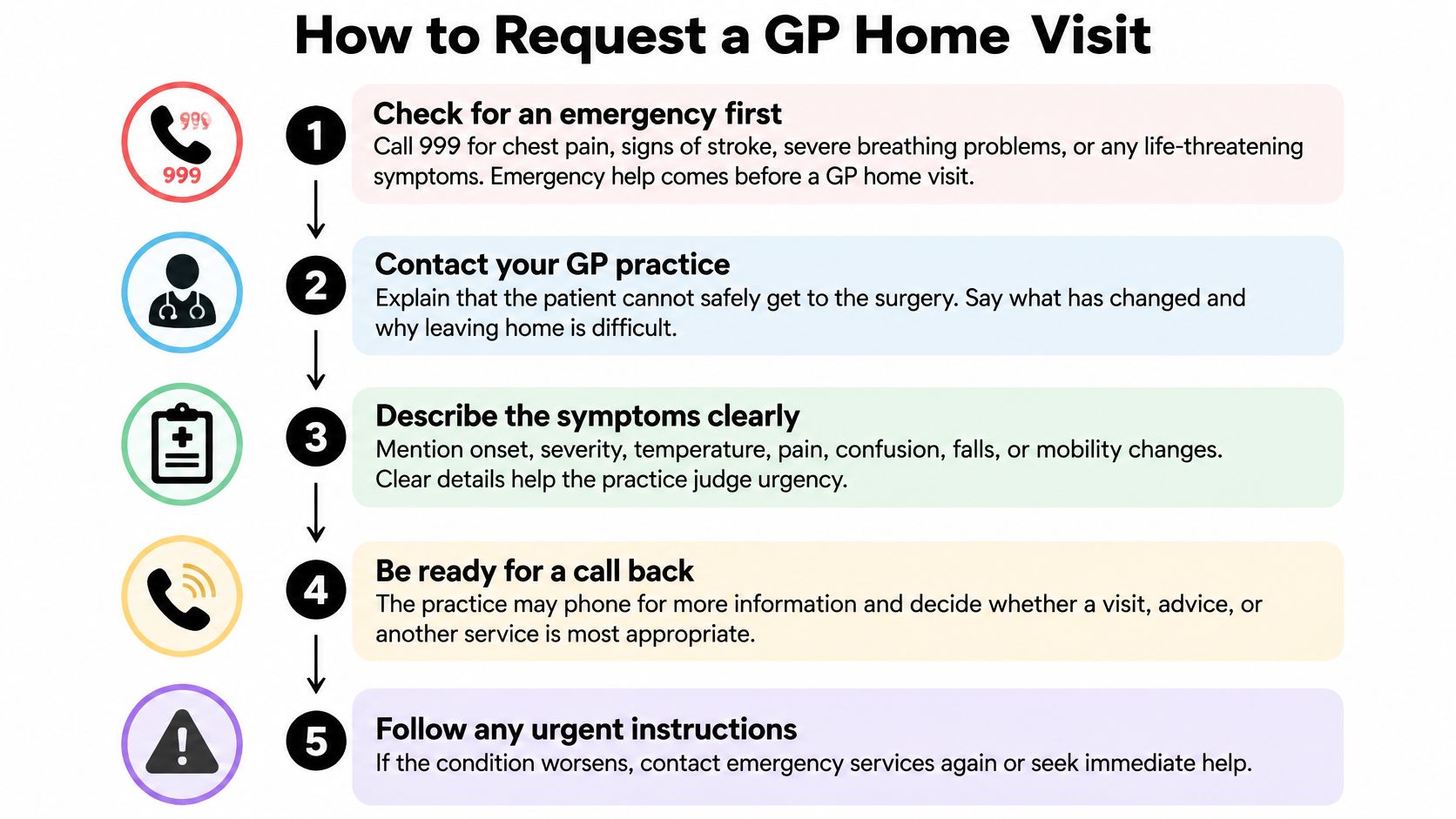
Check for an emergency first. Call 999 for chest pain, signs of stroke, severe breathing difficulty or collapse. For urgent advice when the surgery is closed, use NHS 111, rather than leaving a routine home-visit request.
Phone the practice and ask specifically for a home visit. Explain what has changed and why the patient can't safely attend. Call early where possible, because practices often organise visiting requests during the morning.
Expect clinical triage. A clinician may call back to ask about symptoms and decide whether a visit, telephone consultation, video assessment or another service is appropriate. Keep the phone available and tell reception if hearing or communication difficulties make callbacks difficult.
Prepare the practical facts. Have the symptom timeline, medicines and doses, allergies, address and access details ready. Mention stairs, entry codes, parking restrictions and how the clinician will get inside.
Ask who is coming and what follows. The visitor may be a GP, nurse or another clinician with an appropriate role. Ask how you'll receive the plan, results and any follow-up arrangements.
If a visit is declined, clarify the alternative. Ask why and whether community nursing, pharmacist advice or remote assessment would address the problem. Don't finish the call unsure who is responsible for the next step.
Plan for ongoing housebound needs. Ask whether the practice maintains a housebound register and whether the patient should be included. This can help distinguish planned reviews from requests about a new illness.
Confirm which service has accepted the request
NHS England's virtual-ward reporting distinguishes primary care, community and hospital-related settings. Ask for the actual service name, rather than assuming any home appointment provides hospital-level care.
The following video is an additional resource; your own practice's instructions should guide the booking process.
Booking a Home Visit With Life Primary Care
Route | Intended use | Booking and payment |
|---|---|---|
UK NHS GP home visit | Clinically appropriate assessment for a patient unable to attend | Through the registered practice |
Life Primary Care in New Jersey | Ongoing primary care delivered at home | Through its coordination office, with insurance verification |
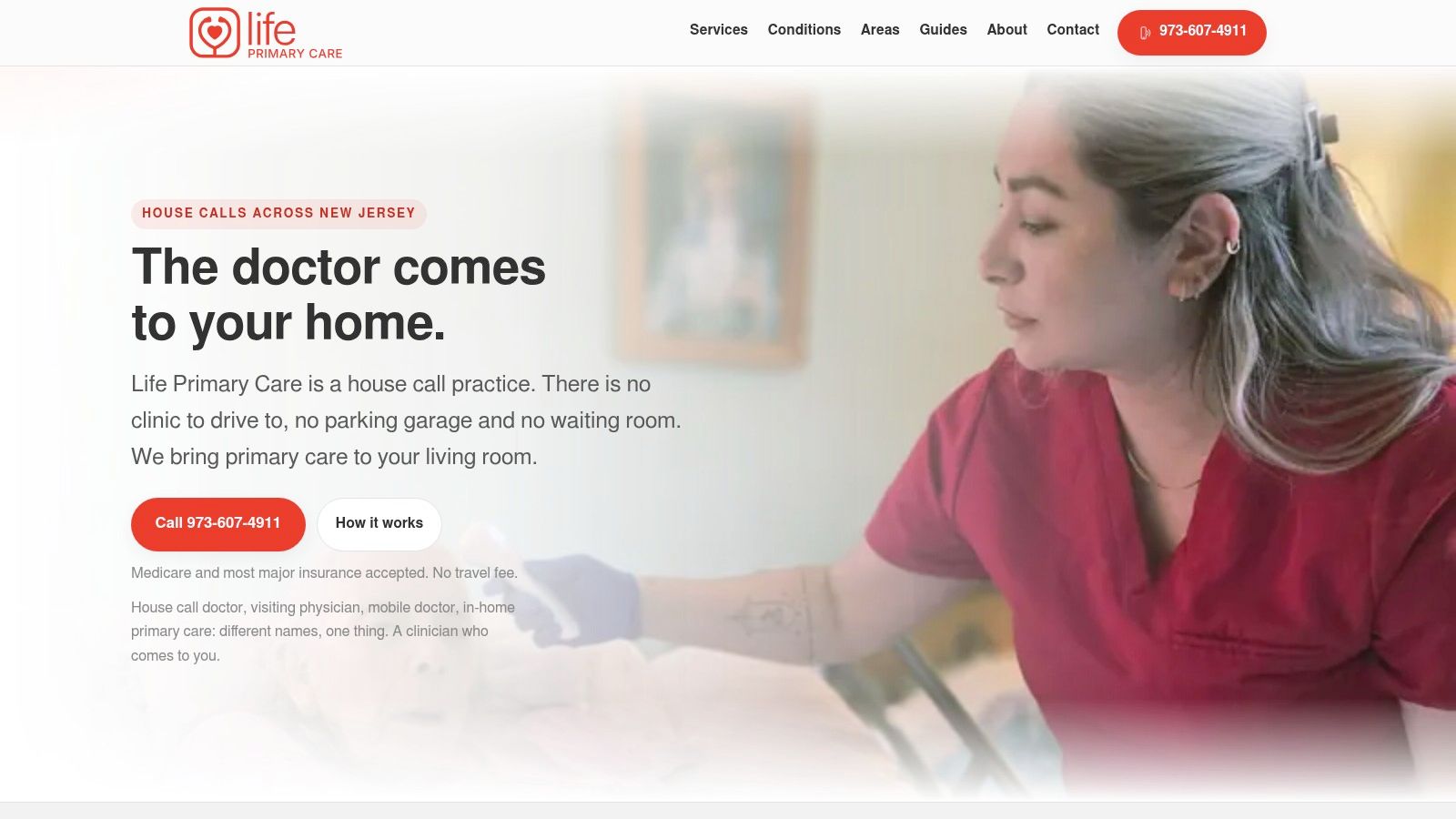
Life Primary Care is a US service, not an NHS referral option. Its model of in-home primary care serves northern and central New Jersey across Morris, Essex, Union, Somerset, Passaic and Bergen counties, with visits typically lasting 45–60 minutes, Medicare and most major insurers accepted, and no travel, concierge or membership charge.
Its East Hanover office coordinates scheduling, insurance checks and follow-up; patient care takes place at home, not in an office clinic. Homes, apartments, family residences and assisted living communities are included.
When this model may fit
This is primary medical care, not the skilled nursing and therapy often called home health care in the US. Its scope includes:
Ongoing care: Home examinations, treatment planning and management of diabetes, heart failure, COPD, hypertension, chronic kidney disease and high cholesterol.
Ageing and serious illness: Medicare Annual Wellness Visits, geriatric and dementia care, and palliative support alongside disease-directed treatment.
Transitions and urgent needs: Post-hospital medication reconciliation, non-emergency urgent visits and telehealth follow-ups.
Tests and medicines: Blood sampling, EKGs, urine tests, coordination of mobile X-ray and ultrasound, and reviews across prescribers.
A clinician arrives with a portable examination kit and prepared chart. Seeing medicine bottles, stairs and bathroom arrangements can help identify practical obstacles that an office conversation might miss.
Say someone returns from hospital with changed prescriptions and limited mobility. The visiting clinician can reconcile the medical plan while a separate nurse handles a wound and a care worker helps with washing. These roles complement each other rather than forming one interchangeable service.
Life Primary Care coordinates independently with hospitals and specialists, communicates plans and results by phone, and arranges referrals and subsequent care. New-patient and same-day urgent availability should be confirmed when booking; neither replaces emergency treatment.
How It Differs From Home Health Care and Hospice
In-home primary care, home health care and hospice compared
Service | Main purpose | Usually provided by | How it is usually arranged |
|---|---|---|---|
In-home primary care (GP home visit) | Diagnosing and treating medical problems when a patient cannot attend | GP and practice team | Through the GP practice; NHS services free at the point of use |
Community nursing and therapy | Skilled clinical care such as wound care, rehabilitation and monitoring | Community nurses, physiotherapists, occupational therapists | Referral from GP or hospital team |
Domiciliary (home) care | Help with washing, dressing, meals and daily routines | Care workers, often through an agency | Council social care assessment, or arranged privately; council funding usually means-tested |
Hospice care at home | Symptom control, comfort and planning for life-limiting illness | Hospice and community palliative teams | Referral from GP, hospital or hospice; funding differs between services |
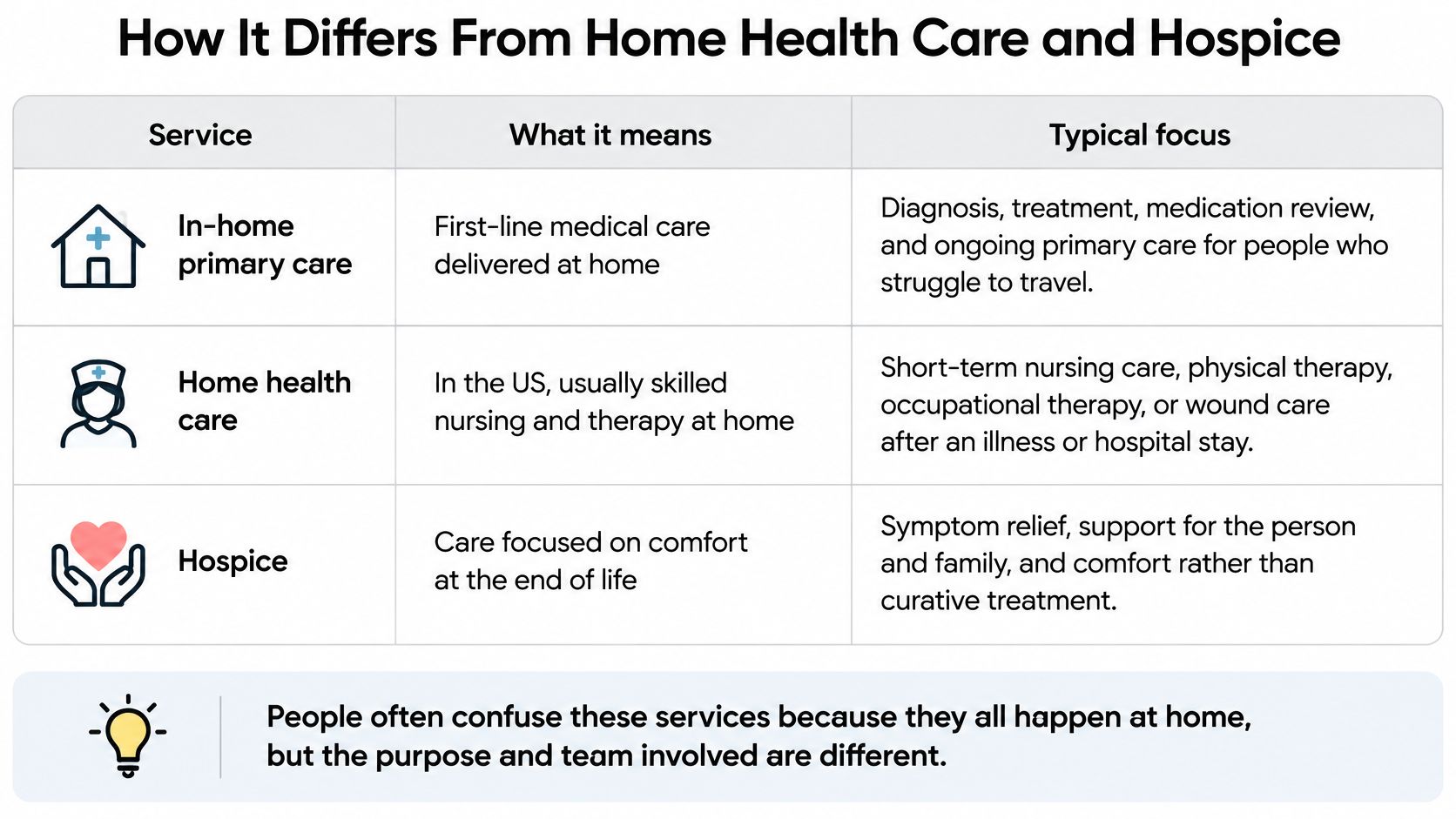
These services share an address, not a purpose. Think of them as different professionals visiting the same building: where they work doesn't tell you what they're responsible for.
The phrase home health care causes particular confusion because US websites commonly use it for skilled nursing and therapy. In UK conversations, home care usually means domiciliary support with daily living. Neither phrase reliably tells you that a doctor will assess a new medical problem.
Comfort care is not the same as withdrawing care
Hospice care at home supports comfort, symptom relief and planning, particularly towards the end of life. Palliative care is broader and can be offered alongside treatment intended to control the illness. A referral doesn't, by itself, mean that all active treatment will stop.
Ask what the particular team provides. Some services offer specialist advice and scheduled visits, rather than continuous bedside attendance, so families need a realistic plan for the hours between contacts.
Match the task and the funding route
The useful question is whether you need medical assessment, skilled treatment, help with daily living or specialist comfort care. It's reasonable to need several of these, and one referral may not arrange them all.
NHS GP and community nursing care is free at the point of use. Council-arranged social care normally involves an assessment of needs and, where applicable, finances, although rules differ across the UK. Private care is paid for separately.
Before agreeing to a plan, ask who coordinates it, which team handles changes in symptoms, and whom you should contact when the usual staff aren't available. Clear responsibility matters more than the label on the service.
Virtual Wards and Hospital-at-Home Care
A virtual ward is closer to bringing a hospital ward into the living room than arranging an ordinary doctor's visit. In England, it provides acute care in someone's usual residence, including a care home, as an alternative to an inpatient stay.
Common assumptions to test
A virtual ward is just a GP visit with an app.
NHS England's operational framework describes hospital-level staff, equipment, technology, medicines and clinical skills delivered at home, with minimum operating hours of 8am to 8pm, seven days a week, plus out-of-hours arrangements. That is a different level of responsibility from a routine practice appointment.
Anyone can choose it instead of hospital.
A clinician must assess suitability against admission criteria. Respiratory illness, heart failure and frailty-related deterioration are examples of the problems these pathways may manage, but a diagnosis alone doesn't establish eligibility.
Virtual means nobody visits.
Care can involve remote observations, telephone contact and multidisciplinary home visits. The team should explain which measurements the patient or carer must take, who checks them and how quickly concerns receive a response.
Agree the escalation plan before treatment starts, not when someone becomes frightened overnight.
Questions before admission
Overnight support: Who answers calls outside the team's usual hours, and what can they arrange?
Hospital transfer: Which changes trigger urgent reassessment or a return to hospital?
Equipment and access: What devices, phone connection or internet access are needed, and what happens if the patient can't use them?
Household support: What, if anything, is a relative expected to do, and what happens if they can't?
These are short-term acute pathways, not a replacement for every ongoing care need. Provision and terminology differ across the UK, so confirm the local service's arrangements.
Limits and Misunderstandings About Care at Home
The safest home-based care has clear limits. Familiar surroundings don't remove the need for tests, emergency treatment or honest conversations about what a household can manage.
Test the promise against the practical reality
A home visit means faster treatment. NHS visits are prioritised clinically and organised around travel as well as patient need. Waiting at home isn't safer if the person needs urgent hospital assessment.
A GP can do everything at home. A routine visiting GP doesn't arrive with a scanner or an operating theatre. Samples may be collected or further tests arranged, but laboratory analysis, imaging and specialist procedures often need another service.
Home is always less stressful. Some people feel more secure there; others become anxious about symptoms between visits. Relatives may find themselves managing medicines, equipment, observations and disturbed sleep.
Private care is automatically better. Speed is only part of good care. Record sharing, follow-up, access to investigations and coordination with existing clinicians matter too.
The same clinician will always come. Staffing and urgency may mean different visitors. Keep an accessible care plan and ask how each clinician will see the previous assessment.
Check whether the plan is usable
Before accepting home-based care:
Name the responsible team: Know who reviews progress and responds to concerns.
Check the workload: Be explicit about tasks the patient or carer cannot safely undertake.
Arrange accessible communication: Request an interpreter, written instructions or support with hearing, vision or understanding where needed.
Phone, video and digital monitoring can create barriers for people without reliable connections or confidence using devices. Tell the team about these difficulties before they design the plan.
Emotional strain also deserves attention, separately from the clinical decision. Feeling trapped, frightened or guilty about caring doesn't mean someone is unwilling to help. It can mean the arrangement needs more support, clearer boundaries or a different setting.
Confirm the Right Service Before You Book
Use the immediate need to choose the first contact. You don't have to identify every service the person might eventually need before asking for help.
Emergency symptoms: Call 999 rather than waiting for a visiting appointment.
Urgent advice when the GP is closed: Use NHS 111 to establish the appropriate route.
A medical problem that can't be assessed at the surgery: Request a home visit through the GP practice and explain the barriers to attendance.
Hands-on nursing: Ask the GP or hospital team about a community nursing referral.
Washing, dressing or meals: Contact the local council for a social care assessment, or explore privately arranged care.
Comfort and end-of-life support: Ask the GP or hospice team about appropriate palliative services.
Make room for the emotional impact
Illness can change relationships as well as routines. A partner may become a carer, an adult child may feel constantly on call, or the person receiving care may struggle with losing privacy and independence. Emotional support can sit alongside medical treatment without turning those reactions into another task to complete.
At Therapy with Ben, we offer online counselling across the UK, in-person sessions in Cheltenham and walk-and-talk sessions on request. Our conversations adapt to the individual rather than following a fixed treatment programme. Counselling doesn't replace a medical assessment.
Write down the symptoms, the questions you need answered and the names of everyone already involved, then make the first appropriate call. If you'd also like space to talk about illness, caring or the changes you're facing, call, text or WhatsApp Ben on 07462 291471 to discuss counselling.
Comments