


Psychodynamic Therapist Near Me in Cheltenham: A Guide
When you search for a psychodynamic therapist near me, are you looking for the nearest appointment, or somewhere you can begin to understand why the same feelings and difficulties keep returning? Location matters, especially when counselling needs to fit around everyday life. But so does finding a counsellor whose way of working feels right for you.
I'm an integrative counsellor in Cheltenham, combining a predominantly person-centred approach with psychodynamic ideas. That means we can explore your experiences and relationships without treating your life as a puzzle I already know how to solve.
Psychodynamic Counselling Options in Cheltenham
In Cheltenham, psychodynamic-informed counselling is available face to face, online and outdoors, and NHS Talking Therapies offers a separate route focused mainly on anxiety and depression. Each format changes how the work feels, so the choice is about more than a convenient appointment slot.
Local options for psychodynamic counselling in Cheltenham
Option | Where or how | Often suits | Cost |
|---|---|---|---|
Face-to-face counselling | Portland House, 4 Albion Street, Cheltenham, GL52 2LG | People who want a dedicated room and weekly in-person sessions | £60 per session |
Online counselling | Anywhere in the UK | People who find travel difficult or prefer talking from home | £60 per session |
Walk and Talk | Outdoors around Pittville Park, Cheltenham | People who find it easier to talk while moving side by side | £60 per session |
NHS Talking Therapies | Local NHS service through self-referral | Mainly anxiety and depression | Free, with waiting times set by the local service's availability |
My own counselling room is at Suite 1, Portland House, in central Cheltenham. A dedicated room can offer a clear separation from work and home, somewhere you don't have to manage anyone else's needs while you talk.
Online counselling removes the journey, but you'll need somewhere private where you won't be overheard or interrupted. Walk & Talk offers a different experience: you're alongside me rather than sitting opposite me. Sessions depend on the weather, and we can agree the route and where we'll talk beforehand so you know what to expect.
Choosing a setting and a route
In England's 2023/24 Adult Psychiatric Morbidity Survey, 20% of people aged 16 and over had experienced symptoms of a common mental health disorder during the previous week, according to the House of Commons Library's mental health statistics briefing.
NHS Talking Therapies is free and organised mainly around anxiety and depression. Private counselling is arranged directly and can offer space for less clearly defined concerns, including identity, loss and recurring relationship difficulties. Neither route is automatically the better choice. The right one depends on what you want to explore and how soon you'd like to begin.
If you search directories, you may come across listings such as the mushroom therapy counselling directory. Treat any directory as a starting point for names, not confirmation of a practitioner's qualifications or suitability.
Before you book, think about where you could most comfortably give yourself time to think: a dedicated room away from daily life, the privacy of your own home, or talking while moving outdoors. The setting shapes the conversation more than people often expect.
How Psychodynamic and Person-Centred Ideas Work Together
A person-centred relationship is the ground you stand on; psychodynamic thinking is a map that may help you notice where familiar paths have led before. The map can suggest possibilities, but it doesn't know your experience better than you do.
Person-centred counselling recognises you as the expert in your own life. My role is to offer warmth, acceptance and careful understanding, rather than decide what you ought to feel or how you should live.
Psychodynamic thinking adds curiosity about how earlier relationships and experiences may influence the present. Perhaps you expect criticism before anyone has criticised you, or feel responsible for keeping everyone comfortable. We might wonder together how those expectations developed and whether they still fit your circumstances.
The map is an invitation to explore, not a prescribed route.

Understanding what happens between us
Transference describes moments when feelings or expectations in the relationship with a counsellor echo those from earlier relationships. For example, you might worry that disagreeing with me will disappoint me, even when I haven't suggested that it would.
We can explore that experience if it feels useful. It isn't a diagnosis, and it doesn't mean your reaction is mistaken. Something I've said or done may also matter, and you're free to tell me.
I offer an understanding for us to test together, not a verdict you have to accept.
Psychodynamic work doesn't assume everything comes back to childhood. Current pressures, relationships, health and living circumstances deserve attention in their own right. My explanation of what psychodynamic theories are offers more background if you'd like to understand the ideas behind this approach.
Exploration rather than a rigid method
As an integrative counsellor, I adapt our conversations to you rather than follow one fixed model. Some sessions may focus on something happening now; others may involve memories, conflicting feelings or something difficult to put into words.
CBT and DBT can offer more structured, skills-focused ways of working, and many people find those approaches helpful. I don't practise them, and I'm not suggesting that exploratory counselling is universally better. The important question is what kind of support fits your needs and preferences.
Who Psychodynamic Counselling May Suit
You don't need a diagnosis, a clear explanation or a dramatic event to begin counselling. Sometimes the starting point is that something feels difficult, familiar or hard to understand.
I work with anxiety, depression, self-esteem, relationships, emotional difficulties, life changes, identity and neurodivergence. When considering psychodynamic therapy in Cheltenham, it can help to distinguish wanting space to understand yourself from needing a particular assessment, practical skill or urgent intervention.
Where psychodynamic counselling may fit and where it may not
Situation | What exploration may offer | When another route may fit better |
|---|---|---|
Recurring relationship patterns | Noticing how earlier relationships shape current ones | A specific, short-term skill is the only goal |
Feeling different or recently questioning neurodivergence | Space to explore shame, masking and self-concept without a diagnosis | A formal assessment is needed, which a counsellor can help you consider |
Ongoing low mood or anxiety with unclear roots | Understanding how past experiences connect with present feelings | Symptoms feel urgent or medical review is needed |
Crisis or risk to life | Not a crisis service | Immediate emergency help or urgent NHS mental health support is needed |
When you've begun to question neurodivergence
I have a particular interest in ADHD, autistic traits, late recognition of neurodivergence, masking, emotional intensity, shame and feeling different. You might be reconsidering experiences you previously understood as personal failings, or wondering how much effort you spend trying to meet other people's expectations.
Counselling can offer room to explore that emotional impact without requiring certainty about a label. I don't diagnose ADHD or autism. We can consider formal assessment where appropriate, while recognising that understanding your feelings and obtaining a diagnosis are different kinds of work.
Before starting, you can mention anything that would help conversations feel more manageable, such as needing processing time or finding broad questions difficult. You don't have to explain everything at once.
A useful distinction: Exploring why you feel ashamed isn't the same as assuming your difficulties are caused by your emotional history.
Recognising what you need now
Access matters too. In BACP's 2025 public perceptions survey, 35% of people who considered therapy but didn't attend cited cost, while 22% cited waiting lists. Those barriers are good reasons to discuss what's financially sustainable, not reasons to feel you're insufficiently committed.
Grief, identity questions and strong reactions to everyday situations can all be starting points for exploratory work. Equally, a medical review or focused practical support may be more useful at a particular moment.
If there's immediate danger or you can't keep yourself safe, seek emergency help rather than wait for a counselling appointment. Otherwise, notice which description feels closest to your situation, including where none quite captures it.
What You Might Explore and How Change Is Decided
Suppose you receive fairly ordinary feedback at work and spend the evening feeling that you've failed completely. This is a hypothetical illustration, not a client story. The question in counselling wouldn't be how to stop the feeling, but what the feedback seemed to mean to you.
Perhaps mistakes once brought criticism, or perhaps being capable became central to feeling accepted. There may also be something difficult about your current workplace. We wouldn't assume a single cause or overlook what's happening around you now.
I work with troubled thoughts, persistent self-criticism, low mood, depression, lack of motivation, relationship problems, life changes and feeling lost. What we explore comes from your experience, rather than a predetermined sequence of topics.
Recognising protection as well as difficulty
A habit can make more sense when we consider what it once helped someone manage. Staying quiet might have reduced conflict; anticipating everyone's wishes might have helped maintain closeness. In a different relationship, those same responses could leave someone unheard or exhausted.
Another hypothetical example is repeatedly finding yourself in relationships where your needs come last. Rather than deciding that you choose the wrong people, we might explore what happens when you want something, how you recognise disappointment and whether disagreement feels possible.
Understanding a pattern doesn't oblige you to blame anyone, excuse harmful behaviour or make an immediate change.
If you're also exploring trauma-related support, Interactive Counselling's page on trauma counselling in Kelowna offers a separate Canadian service context. It isn't a local referral route for Gloucestershire, and recognising a familiar pattern doesn't by itself establish that trauma is the explanation.
Making sense together
I might notice that your tone changes when you mention being angry, or that you quickly dismiss something painful as unimportant. You can agree with an observation, challenge it or leave it aside. An interpretation is only useful if we can consider whether it fits.
The NHS description of psychodynamic psychotherapy for depression emphasises speaking freely and becoming more aware of difficult feelings and recurring patterns in behaviour or speech; when this treatment is recommended for depression, it usually involves 8 to 16 sessions, depending on severity. That description isn't a timetable for every form of private counselling.
We agree the length and review the usefulness of our work together. Change might mean responding differently, reconsidering a relationship or becoming less harsh towards a feeling you previously found unacceptable. You decide what, if anything, you want to change, and outcomes vary.
Checking a Psychodynamic Counsellor Before You Book
A reassuring website isn't enough to establish professional competence. As CPCAB's guidance on going into practice explains, counselling isn't a legally regulated profession in the UK, and the title counsellor isn't protected. Checking credentials is a sensible part of choosing support.
The following checklist separates professional safeguards from the equally personal question of whether you feel comfortable with someone.
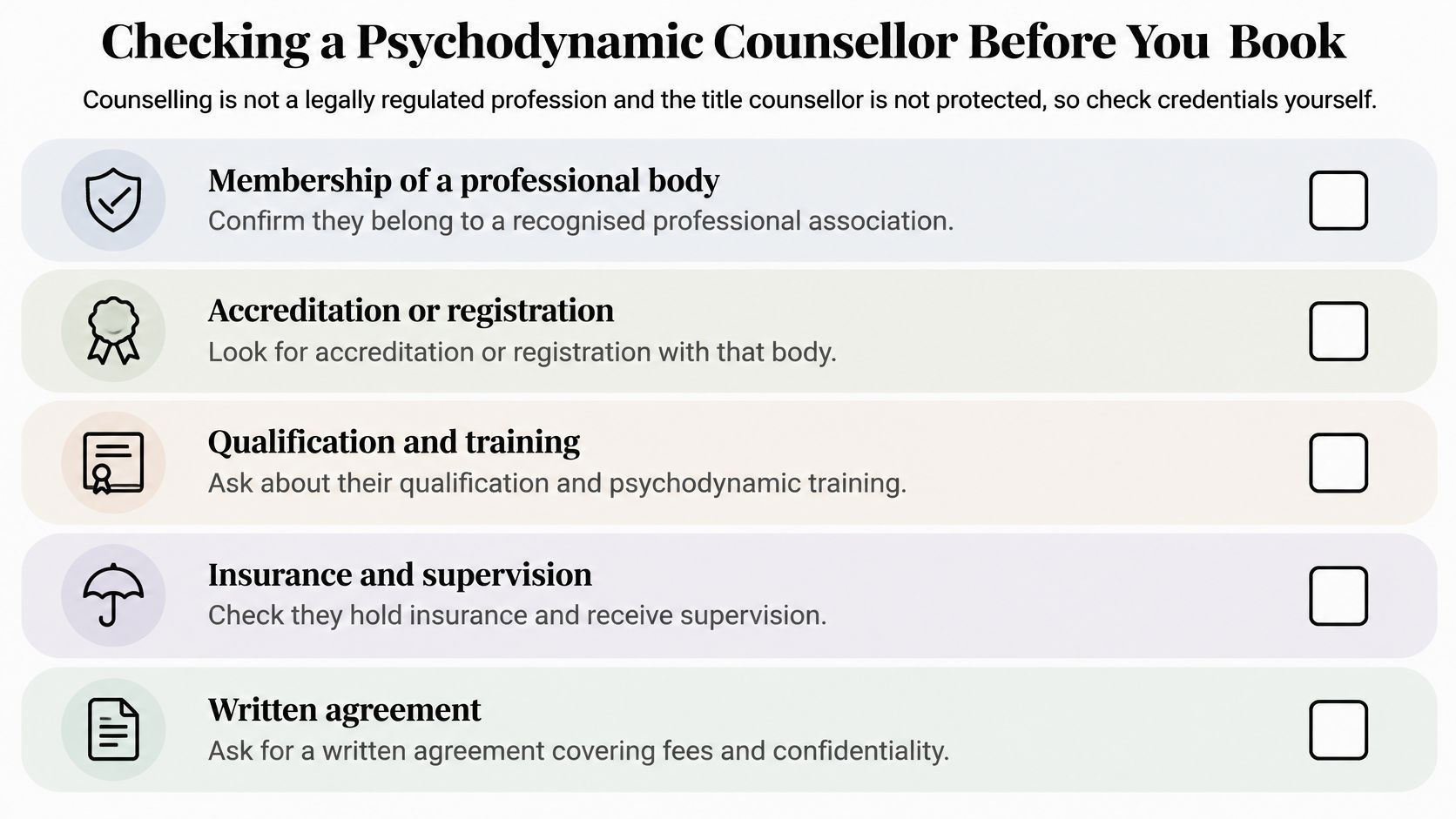
Professional safeguards to look for
Registration and membership. I'm a registered member of both the BACP and NCPS. Check a practitioner's entry directly on the relevant register rather than relying solely on a website claim.
Training and approach. I'm a fully qualified counsellor. When comparing practitioners, consider their core training, supervised placement experience and training relevant to psychodynamic work.
Insurance and supervision. I'm insured and receive regular clinical supervision. Clinical supervision provides an opportunity to reflect on my work, consider ethical questions and maintain professional standards, while protecting client confidentiality.
Ethics and written arrangements. Look for clear information about fees, boundaries, confidentiality and the professional ethical framework under which the counsellor works.
Accountability. I work within the ethical frameworks of my professional membership bodies, and information about their complaints procedures is available through the BACP and NCPS.
Feeling able to ask
Registration is a useful screening threshold, not proof that someone is the best match for you. When choosing a psychodynamic counsellor in Gloucestershire, you should also have room to consider how they listen and whether you feel able to disagree.
You might want to ask how psychodynamic ideas enter sessions, how risk is monitored, what supervision involves, how progress is reviewed or what happens if you feel worse. These are possibilities, not a compulsory interview checklist.
BACP's guidance on choosing a therapist and NHS descriptions of psychological therapies can provide useful background. My guide to finding a good therapist in Cheltenham also considers practical and relational fit. You don't need prepared questions to have a worthwhile introductory conversation.
From First Contact to Ongoing Sessions
Beginning counselling doesn't require a polished account of your life. You can start with uncertainty, a recent difficulty or a sense that you'd like somewhere to talk.
The journey from first enquiry to settled weekly sessions tends to follow a few broad stages. Knowing the shape of it can make each step feel less like a leap.
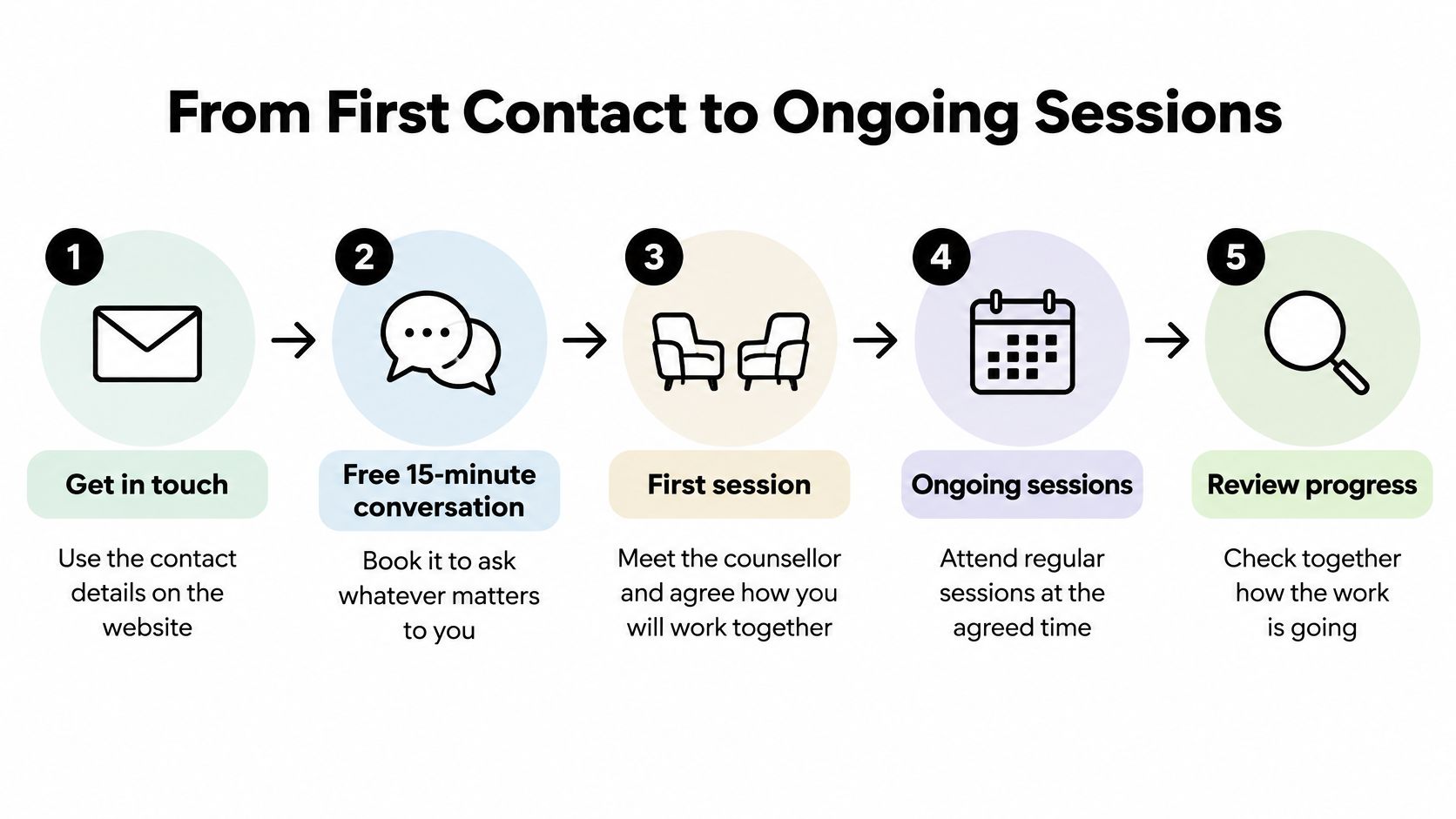
Taking the first steps
Get in touch. You can call, text or WhatsApp me on 07462 291471, or use the website's contact page. A first exchange gives you room to ask whatever matters, such as fees, format or availability, and to get a sense of how we might work together before you book anything.
Choose your format. We can meet face to face in my counselling room at Portland House in central Cheltenham, online anywhere in the UK, or outdoors for Walk & Talk sessions in Pittville Park. Each format feels different in the room, or out of it. Sitting opposite someone in a quiet space offers a contained, private setting. Walking side by side can take the pressure off sustained eye contact, though weather and outdoor privacy need weighing up. Online sessions remove the journey entirely and let you talk from your own space.
Begin with what brings you here. Early conversations can include what feels difficult, what you hope might shift and anything you'd rather not explore yet. My guide to what a first therapy session involves may help if the unfamiliarity feels daunting.
Agree how we'll work. The usual fee is £60 per session. We'll discuss confidentiality at our first meeting, including the limited circumstances in which it may be broken if someone is at risk of serious harm.
Continuing without a fixed script
Find a regular rhythm. Counselling focuses on exploring thoughts and feelings rather than receiving instructions. I can help you think through what you might like to do, without taking that decision away from you. Some weeks arrive with a clear topic. Others begin in silence, and both are workable starting points.
Review what's useful. We can discuss what you want to keep, change or stop, including anything uncomfortable about our conversations. If I can't offer the support you need, I may refer you on or signpost you elsewhere.
Private counselling is separate from NHS self-referral. The NHS Talking Therapies access guidance explains that you can self-refer for anxiety and depression and will be told about the wait; its formal waiting-time standards don't apply to every counselling or community mental health service.
You can also watch this video as you consider taking the next step.
The idea of exploring your own story might bring relief, curiosity or unease. You don't have to resolve those feelings before making contact.
I offer person-centred, psychodynamic-informed counselling in Cheltenham, online across the UK and through Walk & Talk sessions in Pittville Park. Visit Therapy with Ben to explore how I work and get in touch, so we can consider whether working together might be a good fit.


Comments