


Reclaim Your Identity: i dont know who i am anymore and Find Yourself Again
Updated: Aug 26
That feeling of looking in the mirror and thinking, "I don't know who I am anymore," is a deeply unsettling, yet surprisingly common, part of the human experience. If this is where you find yourself, the first thing to know is that you're not failing. Far from it. This sense of disconnection, often called an identity crisis, is actually a sign that you're evolving. It’s an opportunity to shed old layers and find a more authentic version of yourself. A Thought from me
Over the years I've noticed that people rarely lose who they are.
More often, they lose contact with themselves.
Sometimes that's because they've spent years looking after everyone else. Sometimes it's because anxiety, burnout or trauma have gradually pulled them away from the parts of themselves that once felt alive.
One of the most rewarding parts of my work is watching people realise that they aren't broken.
They're simply reconnecting with parts of themselves that have been buried for a long time.
Why You Might Feel Like You Don't Know Who You Are
If you feel like a stranger in your own life, please know you’re not alone. I often describe this feeling to my clients as an internal compass going haywire after navigating a major life storm. It's a profound signal that significant personal growth is happening under the surface, often triggered by big changes like a new career, burnout, or a major shift in a relationship.

That initial confusion is so often the very first step toward reclaiming a stronger, more grounded sense of self. It's life giving you an invitation to pause and ask some big questions: Who have I become? And, more importantly, who do I want to be from here? This feeling is frequently tangled up with a wider sense of being adrift, so exploring why do I feel stuck in life and how to move forward can offer some really helpful insights. One thing I often say in counselling is that we don't usually begin by trying to answer those questions.
Instead we become curious.
Curious about when you last felt like yourself.
Curious about what has changed.
Curious about whose expectations you've been carrying.
Often the answers emerge naturally once we stop trying to force them.
What This Experience Involves
An identity crisis can feel vague and hard to pin down, but it shows up in very real ways. You might find yourself second-guessing values that once felt solid, or struggling with decisions that used to be simple. The roles you once wore so comfortably—partner, parent, professional—might suddenly feel like they don't quite fit anymore, like a suit you’ve outgrown.
This experience isn't about losing yourself completely. It's more about the growing gap between the life you're living day-to-day and the person you feel you are deep down. Sitting with people every week, I've become less convinced that people truly lose themselves. More often, they've simply become disconnected from themselves for a while.
The end of a major life chapter often feels like losing yourself, but it's actually an invitation to rediscover who you truly are. It forces a necessary pause, creating space to reconnect with your core values and desires.
Just recognising this feeling for what it is—a call to look inward—is the first, most powerful step toward finding your feet again. To help with that, I’ve put together a quick guide below to make sense of what’s going on. It breaks down the dynamics of an identity crisis, from its triggers to its potential positive outcomes, offering a bit of hope for what can be a very disorienting time.
A Quick Guide to Understanding an Identity Crisis
This table provides a snapshot of what an identity crisis feels like, its common causes, and the potential positive outcomes.
The Feeling | Common Triggers | Potential Outcome |
|---|---|---|
Feeling disconnected, empty, or confused about your values and purpose. | Major life events (job loss, becoming a parent, relocation), burnout, trauma. | A stronger, more authentic sense of self and a clearer life direction. |
Struggling with decisions and feeling like you're just going through the motions. | Relationship changes (break-up, divorce), confronting neurodiversity (e.g., late ADHD/autism diagnosis). | Improved relationships and a lifestyle aligned with your true values. |
Intensely questioning past choices and future direction. | Chronic stress, unresolved grief, societal pressure to conform. | Increased self-awareness, personal resilience, and genuine fulfilment. |
Hopefully, seeing it laid out like this shows that while the experience is tough, it’s not a dead end. In fact, it's often the starting point for building a life that feels more like your own.
The Common Triggers Behind Losing Your Sense of Self
That feeling of "I don't know who I am anymore" rarely just appears out of thin air. It’s usually the emotional aftershock of a huge life event or a slow, creeping erosion caused by relentless pressure. Getting to the bottom of what triggered this feeling is a massive step towards finding your feet again and, just as importantly, showing yourself a bit of kindness.
Think of your identity as a house you've been building for years. Your career, relationships, beliefs, and routines are the bricks and mortar, the walls and the roof. A major life event can feel like an earthquake hitting those foundations, leaving you standing in the rubble, wondering what on earth is left.
Major Life Transitions
Life is a series of chapters, and the end of one can leave you feeling completely lost. These big shifts often force us to let go of the roles and routines that once told us who we were.
Relationship Changes: A divorce or the end of a long-term relationship isn't just about losing a person. You often lose the role of "husband," "wife," or "partner" that came with it. The future you were building together vanishes, and so does the version of you that existed as part of that "we." Finding your way back to "I" after years of compromise is a tough but common journey.
Becoming a Parent: The shift to parenthood is enormous. Suddenly, your time, energy, and what you care about are completely rewired around a tiny human. Many new parents find themselves grieving the loss of their old, more spontaneous self, even while completely loving their new role.
Career Shifts or Job Loss: For so many of us, our job is a huge part of our identity. Being made redundant, changing careers, or retiring can feel like having the rug pulled from under you. It strips away the purpose and daily structure we relied on, forcing us to ask, "Who am I without this job title?"
Grief and Loss: Losing someone you love changes the landscape of your life forever. The grief isn't just for the person you've lost, but also for the person you were when they were still here. Your world is fundamentally different, and so are you.
The Slow Burn of Stress and Burnout
Sometimes, losing yourself isn't a sudden crash but a gradual fade-out. Chronic stress and burnout are like a slow-acting poison, quietly dissolving your connection to your passions, your values, and that little voice inside. When you’re constantly in survival mode, just trying to get through the day, there's no energy left for the things that make you you.
Being stuck in that high-alert state silences your gut feelings and disconnects you from what really matters. Over time, you might look in the mirror and realise you’re just going through the motions, with no real sense of who's actually steering the ship. This is especially common for people who are used to putting everyone else's needs first. If that rings a bell, our guide on how to stop people pleasing and reclaim your life has some practical steps for setting healthier boundaries.
When we are so consumed by external demands and pressures, our inner world can become a stranger to us. The quiet voice of our true self gets drowned out by the noise of obligation and expectation.
The Influence of Mental Health
Feeling disconnected from yourself is deeply tangled up with your mental wellbeing. In England, one in five adults (20.2%) is living with a common mental health problem, and that number has been on the rise. For many, that feeling of "I don't know who I am anymore" is a direct symptom of this struggle.
Depression, for instance, can throw a grey filter over everything, making it almost impossible to feel like yourself. Anxiety can trap you in a non-stop cycle of worry that leaves no room for your authentic personality to come through. You can learn more about these mental health statistics and see just how widespread this experience really is.
The Unique Journey of Neurodiversity
For many neurodivergent people, this identity crisis comes from a completely different angle. Getting a late diagnosis of something like ADHD or autism can turn your world upside down. It suddenly reframes your entire life story, offering an explanation for struggles you may have spent years blaming yourself for.
This new insight is often a huge relief, but it also kicks off a period of intense questioning. You have to somehow reconcile the person you thought you were with this new, more accurate picture of how your brain works. It’s a journey of dismantling old, often negative, beliefs about yourself and building a new identity—one that truly embraces your authentic, neurodivergent self. This process takes patience, a lot of self-compassion, and often, the right support to figure out what it all means for you. Increasingly, I meet adults who arrive believing something is fundamentally wrong with them.
Only later do they begin to wonder whether ADHD, autism or years of masking might explain why they've always felt different.
For many people, discovering this isn't about finding another label.
It's about finally finding an explanation that allows them to stop blaming themselves.
Recognising the Signs of an Identity Crisis
So, how do you figure out if you're in the middle of a genuine identity crisis, or just stuck in a bit of a slump? The thought, "I don't know who I am anymore," can feel incredibly vague and overwhelming, but it usually starts to show up in specific ways—emotionally, mentally, and in your behaviour. Nailing these down can be a really powerful first step towards understanding what's actually going on.
It often creeps in subtly. Maybe you find yourself struggling to make decisions that used to be simple, from what to have for dinner to which path to take in your career. This isn't just about being indecisive; it points to a deeper uncertainty about what you truly want and prefer.
This feeling of being adrift is often made worse by a nagging sense of emptiness or just plain apathy. Hobbies and activities you once loved might now feel like a chore. You may find yourself pulling back from friends and social events, not because you're angry, but because you feel like you're just playing a part. The sense of being an imposter in your own life becomes a heavy weight to carry.
Emotional and Cognitive Red Flags
The internal chat during an identity crisis is often a relentless loop of questioning. You might find yourself re-evaluating your core values and beliefs, wondering if the life you’ve built actually reflects the real you. This isn't just a fleeting doubt; it's a profound re-examination of your very foundations.
A few common signs to look out for include:
A Feeling of Detachment: You might feel like you're watching your life from a distance, just going through the motions without any real emotional connection.
Constant Comparison: You may find yourself constantly comparing your life to others, feeling that everyone else has it all figured out while you're still lost.
Dramatic Shifts in Values: Beliefs that once felt central to your being—about your career, relationships, or purpose—are suddenly up for debate.
Lack of Motivation or Passion: The drive and enthusiasm you once had for your goals have been replaced by a pervasive sense of ‘what’s the point?’.
This nagging feeling that you don't know who you are is often tangled up with mental health challenges, which are on the rise across the UK. It’s a sobering thought that one in four adults in England faces a mental health problem each year, with conditions like anxiety and depression frequently shattering a person’s sense of self. Women, particularly those aged 16-24, are at the highest risk. These figures really highlight a widespread struggle for identity and wellbeing, but they also show just how vital it is to reach out for support when you feel lost. You can discover more insights into UK mental health statistics from Priory Group to understand the bigger picture.
This decision tree shows how major life events, burnout, or mental health challenges can lead to a lost sense of self.
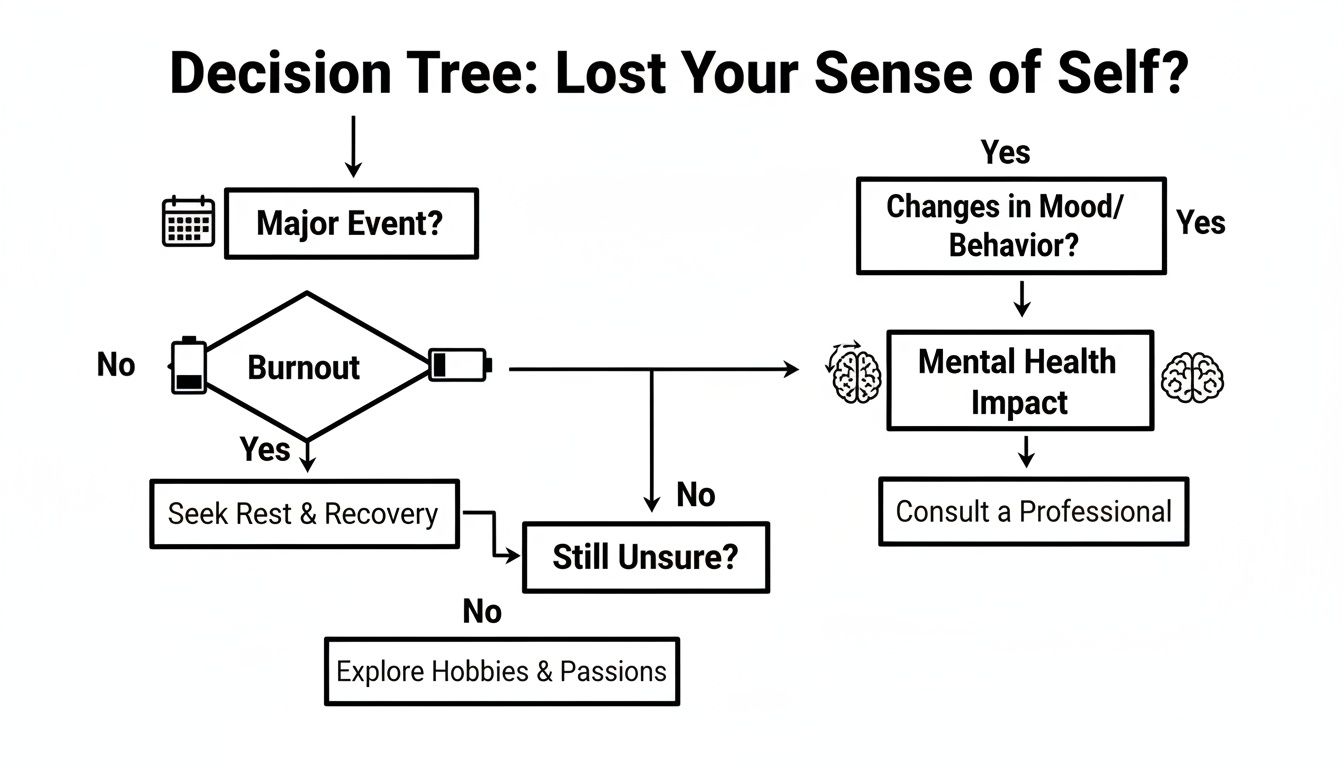
What this shows is that losing your identity is often a response to significant external pressures or internal struggles—it’s not a personal failing.
A Passing Mood vs An Identity Crisis What's the Difference?
It’s really important to distinguish between having a bad week and wrestling with a deeper identity struggle. While both can feel pretty awful, their duration, impact, and nature are very different. Recognising these differences can validate your experience and help you decide what to do next.
This table helps distinguish between temporary feelings of uncertainty and the deeper signs of a significant identity struggle.
Indicator | A Passing Mood or 'Bad Week' | A Potential Identity Crisis |
|---|---|---|
Duration | Lasts a few days and is often linked to a specific event (e.g., a stressful project). | Persistent feelings lasting for weeks or months, with no clear end point. |
Impact on Daily Life | You might feel 'off' but can generally function in your work and relationships. | Causes significant difficulty with daily decisions, work performance, and social engagement. |
Core Beliefs | Your fundamental values and beliefs remain stable and unquestioned. | You find yourself questioning everything you thought you knew about yourself and your life's purpose. |
Sense of the Future | You still have a general sense of your future direction, despite current frustrations. | The future feels completely blank, confusing, or overwhelming to think about. |
If the right-hand column is resonating a lot more with your experience, it might be a signal to take these feelings seriously. Naming what you’re going through as a potential identity crisis isn't about slapping a label on it; it’s about acknowledging the depth of your struggle. This recognition is the first, crucial step toward reconnecting with your true self and finding your way forward.
Practical Steps to Reconnect With Yourself
So, where do you even begin when you feel so disconnected from yourself? The journey back home, so to speak, doesn't require some grand, dramatic gesture. Honestly, it's quite the opposite. It starts with small, quiet steps—little moments where you intentionally create space to hear your own voice again.
Think of it less like a total reinvention and more like a gentle remembering. You're not trying to find a brand-new person. You're just dusting off the parts of yourself that got pushed aside or silenced by life's demands. This is about exploration, not performance. Each small action is designed to feel manageable, helping you slowly build back a sense of clarity and confidence.

Start with Mindful Reflection
The very first step is simply to tune in. To listen. Things like mindfulness and journalling are incredibly powerful for cutting through the external noise and just hearing your own thoughts without immediately judging them. They help you become an observer of your feelings, which can bring a surprising sense of calm and control.
Journalling, in particular, gives you a private space to untangle the messy knot of thoughts that often comes with an identity crisis. You don't have to write an epic novel; sometimes just a few sentences scribbled down can unlock a profound insight.
Stuck for what to write? Try these prompts to get the ball rolling:
When did I last feel completely like myself? What was I doing? Who was I with? Try to describe that feeling in detail.
What activities genuinely give me energy, and which ones completely drain me? Be brutally honest with yourself here.
What dreams or interests did I put on a shelf for someone or something else?
If I wasn't worried about what anyone else thought, what would I do differently tomorrow?
Re-engage with Hobbies and Interests
When we lose our sense of self, our hobbies and passions are often the first casualties. Bringing them back into your life is one of the most practical ways to inject a bit of joy and you back into your days. The crucial thing here is to let go of any pressure to be brilliant at it.
The goal isn't to become a master painter or a marathon runner overnight. It’s simply to remember what it feels like to lose yourself in something you enjoy. And if old hobbies no longer spark any joy? That’s perfectly okay—it's just a sign that you've changed. Take it as an opportunity to get curious and try something completely new.
"The end of a marriage often feels like losing yourself, but it's actually an invitation to rediscover who you truly are." – Joanna Nisioti, Divorce Recovery Coach
This insight applies to any major life change. That feeling of loss also creates space, and filling that space with things you choose to do—things you enjoy—is a powerful way of reclaiming yourself. It’s a reminder that your identity exists far beyond your roles and responsibilities. Our detailed post on how to be yourself with our guide to authentic living explores this in more depth.
Set Small, Meaningful Goals
When you feel lost, the future can look like a vast, intimidating fog. Setting small, manageable goals helps rebuild your sense of control and purpose, one step at a time. The key is that these goals are for you, not for external praise or validation.
So, instead of a massive goal like "get a new career," start with something tiny. Something like, "spend 20 minutes researching one field that sparks my curiosity." This approach breaks overwhelming ideas into doable actions, which is how you build momentum and confidence. Each little win is proof that you are capable of finding your way forward.
Curate Your Environment
The world around you—both physical and digital—has a huge impact on your sense of self. When you’re feeling vulnerable, constantly scrolling through social media and comparing your life to others' highlight reels is particularly toxic. It’s like trying to find your own path while staring at a map of someone else's journey.
Making a conscious effort to curate your environment is a vital act of self-care.
Digital Detox: Unfollow accounts that make you feel inadequate. Set limits on screen time and swap it for activities that ground you in your own life.
Social Circle Audit: Make a point of spending more time with people who make you feel seen and accepted for who you are right now—not who they think you should be.
Create a Safe Space: Your home should be a sanctuary that reflects your tastes and brings you a sense of peace, not a museum dedicated to a past version of yourself.
Embracing personal change is a huge part of this. You might find real inspiration in reading about the moment someone truly chooses themselves, as these pivotal moments often spark profound shifts. By taking these practical steps, you’re not just passively waiting to find yourself—you are actively creating the path back home.
When to Seek Professional Support for an Identity Crisis
Reading is a wonderful place to begin...
Articles like this can help us understand ourselves.
Sometimes they even help us feel less alone.
But understanding ourselves intellectually is only part of the journey.
Counselling offers something different.
It gives you the chance to slow down, notice patterns you may never have seen before, and explore your life with someone whose only agenda is helping you understand yourself more deeply. While exploring who you are on your own is a huge part of the journey, there are times when the most powerful and kindest thing you can do for yourself is to ask for help. It’s not a sign of weakness to admit you feel lost; think of it as a proactive investment in your own well-being.
Deciding to reach out often becomes easier when the struggle starts to spill into every part of your life. Maybe you’re finding it hard to get through the day, your relationships feel strained, or that constant confusion is tipping over into real anxiety or depression. If your own efforts just aren't shifting the fog, that’s a clear sign that a bit of expert guidance could make all the difference.
What Does Counselling for Identity Issues Involve?
Stepping into therapy isn't about having someone tell you who you are. It’s about creating a safe, completely non-judgemental space where you can explore that very question for yourself, out loud, maybe for the first time ever.
A counsellor acts as your guide. They'll help you spot the patterns in your thinking, dig into the roots of your feelings, and find new, healthier ways to cope. This is especially useful when you're grappling with the fallout from a major life change or coming to terms with a new neurodiversity diagnosis. A therapist can provide a steady hand, helping you make sense of the chaos and begin building a more resilient, authentic you.
Seeking therapy for an identity crisis is not a last resort; it's a courageous decision to stop struggling in isolation and start building a supportive partnership for your own healing and self-discovery.
Navigating a Strained System
Unfortunately, that feeling of being in limbo is often made worse by an overwhelmed mental health system. In 2024, England saw a record 5.2 million referrals to mental health services, a huge jump of 37.9% from 2019.
Despite this, millions are left waiting for support, with over one in three people reporting that their mental health gets worse while they wait. For many, this uncertainty just deepens the confusion. You can read the full analysis on mental health pressures from the BMA.
How Counselling Can Help You Find Your Way Back
People sometimes come to counselling saying that they no longer know who they are.
We don’t begin by trying to “fix” you or force an immediate answer. We begin by understanding what has happened, when you last felt connected to yourself, and whose needs or expectations may have gradually taken over.
Together, we can explore what matters to you now and what kind of life genuinely feels like yours. Therapy is not about someone else defining who you should be; it offers a supportive space in which you can reconnect with yourself and find your own way forward.
I offer counselling in several ways:
In-person counselling from my comfortable counselling room in central Cheltenham
Online counselling for people across the UK
Walk-and-talk therapy in Cheltenham for those who find it easier to talk while moving outdoors
I work with adults experiencing anxiety, low mood, relationship difficulties, neurodiversity and major life changes. Some clients also appreciate the option of speaking with a male counsellor, although I welcome adults of all genders.
You don’t need to understand exactly why you feel lost before seeking support. Sometimes counselling begins with nothing more than saying, “I don’t really know who I am anymore.”
One final thought
If you've read this far, there's a good chance this article resonated with you.
If so, I'd simply like to remind you of something.
You don't need to have everything figured out before asking for help.
You don't need to know exactly why you feel lost.
You don't even need to know what needs to change.
Sometimes counselling begins with nothing more than someone saying,
"I don't really know who I am anymore."
Your Questions, Answered
When you’re grappling with that feeling of "I don't know who I am anymore," it’s only natural for questions to bubble up. It's a confusing time. Here are some of the most common ones I hear from people starting this journey, along with some straightforward answers.
Is Feeling Lost the Same as Depression?
Not always, but they can definitely be linked. Think of an identity crisis as a period of deep, intense questioning about who you are. This can happen on its own, but the persistent confusion and sense of emptiness that often comes with it can also be symptoms of depression, or even lead to it.
A good counsellor can help you untangle the two and figure out what’s at the heart of it – whether it's primarily a struggle with your identity, depression, or a bit of both.
How Long Does an Identity Crisis Last?
There’s no set timeline for this, as it’s a completely personal journey. For some, it might be a few months of reflection after a big life event. For others, it could be a much longer process, especially if it's tied to something complex like coming to terms with a new neurodiversity diagnosis.
The goal of therapy isn't to rush you through it. It's about giving you the right tools and a supportive space to navigate the uncertainty, so you can come out the other side with a clearer, stronger sense of yourself.
What Is Walk and Talk Therapy?
It’s pretty much what it sounds like: counselling that happens outdoors, usually while we’re walking through a natural space like a park. Combining gentle movement with a therapeutic chat can be incredibly powerful.
Many people find it feels less intense than sitting face-to-face in a room, which can make it easier to open up. There’s also something about the forward motion that can metaphorically help you feel ‘unstuck’, offering up fresh perspectives on your path to rediscovering who you are.
Is Therapy a Good Fit for Men?
Absolutely. It’s a stubborn myth that therapy isn't for men, or that it's only for those who are comfortable talking about their feelings. The truth is, finding the right environment is what really matters.
Many men I work with find it helpful to speak with a male counsellor. Alternative approaches like walk and talk therapy can also feel less formal and more relaxed. My whole approach is centred on creating a supportive, non-judgemental space where you can explore what’s going on for you, at your own pace.
If you're ready to take that next step toward finding yourself again, Therapy-with-Ben is here to walk alongside you. Get in touch to see how walk and talk therapy or Online sessions could help. You can find out more at https://www.therapy-with-ben.co.uk.


Comments