


Self Esteem vs Self Confidence: What Is the Difference?
You can do your job well, answer questions in a meeting without much hesitation, and still spend the evening replaying a small comment as if it proved something about you. From the outside, that looks like a confidence problem. From the inside, it often feels different. It's not only, "Can I do this?" It's also, "What does struggling say about me?" That gap is where self-esteem vs self-confidence becomes worth untangling, not as a label to apply to yourself, but as a way of understanding why capable people can still feel not good enough.
Why Self Esteem and Self Confidence Get Mixed Up
Say you're known at work as reliable. You prepare carefully, speak when you have something useful to add, and colleagues come to you when something needs sorting out. Then you make an ordinary mistake, perhaps you miss a detail in an email, and the reaction inside feels out of proportion. You don't think you'll do it differently next time. You feel exposed, irritated with yourself, or convinced you've confirmed what people suspected all along.
The two terms get mixed up because they often appear together. Both are used in everyday conversations about feeling capable, feeling worthy, speaking up, and not shrinking back. Everyday language rarely separates them, so "I need more confidence" can mean anything from "presentations scare me" to "I don't much like who I am."
A simpler distinction helps. Self-confidence is about what we believe we can do. Self-esteem is about how we feel about ourselves as people. Someone might trust their ability to do their job, yet become extremely self-critical after a setback. Healthy self-esteem doesn't mean believing you're good at everything. It means a mistake or a period of struggling doesn't have to diminish your worth.
The two overlap, and they influence each other. But they're not interchangeable, which is why advice aimed at performing more confidently can miss a quieter difficulty with self-worth. As you read, you might notice which question feels closer to home. Is it mainly doubt about handling a particular situation, or is it a broader unease about your value as a person? Either answer is a starting point for reflection, not a diagnosis.
Self Esteem and Self Confidence Side by Side
Aspect | Self-esteem | Self-confidence |
|---|---|---|
Core question | Do I believe I am worthy as a person? | Can I handle this task or situation? |
Scope | Broad, across most areas of life | Specific to a role, task or setting |
Stability over time | Shifts slowly, shaped by long-term experience | Shifts with context, practice and feedback |
What it responds to | Relationships, shame, self-criticism and early experiences | Preparation, practice and past successes or setbacks |
The table draws a cleaner line than real life usually allows, but the pattern is useful. Self-confidence attaches to particular tasks, roles and settings. You might feel steady with close friends, capable in a familiar job, and lost when you join a new group where you don't yet know the unspoken rules. Nothing about your overall worth has changed between those rooms. What's changed is your sense of whether you can meet what's being asked of you there.
Self-esteem tends to travel with you. It colours how you interpret a quiet reply, a piece of feedback, or a social invitation that doesn't arrive. If your underlying view of yourself is reasonably kind, a difficult day can stay a difficult day. If it's harsher, the same day can feel like evidence about who you are.
Why confidence changes from room to room
That context effect shows up clearly in survey responses. The 2019 YouGov study of Britons found that 34% of people in Britain did not feel confident about their personality. Yet the figures moved a great deal by setting, with 47% not feeling confident at school, 23% lacking confidence within their existing social group, and 12% lacking confidence among family members.
Those differences make more sense if confidence isn't a single fixed trait. A familiar setting may offer predictable responses and a role you understand. School, work, or a new social situation can bring comparison, evaluation, and less control over how you're seen. Confidence responds to those demands fairly quickly.
Self-esteem usually moves more slowly because it's tied to a broader story you carry about yourself, often formed over many years. That doesn't make it permanent. It does mean one successful presentation, one compliment, or one difficult conversation rarely settles it either way. If you're exploring practical ways to grow steadier in specific situations, this guide on building self-confidence in everyday life looks at that side in more depth.
It's also worth holding the table lightly. You might recognise yourself in different rows at different times, or feel confident in an area where your self-esteem is still fragile. The value isn't in sorting yourself into a category. It's in noticing which part of the experience needs attention.
How Confidence and Self-Worth Play Out Under Pressure
The diagram below maps a loop many people recognise once they see it written down. A result goes well, confidence gets a brief lift, and then your underlying view of yourself decides what that result is allowed to mean.
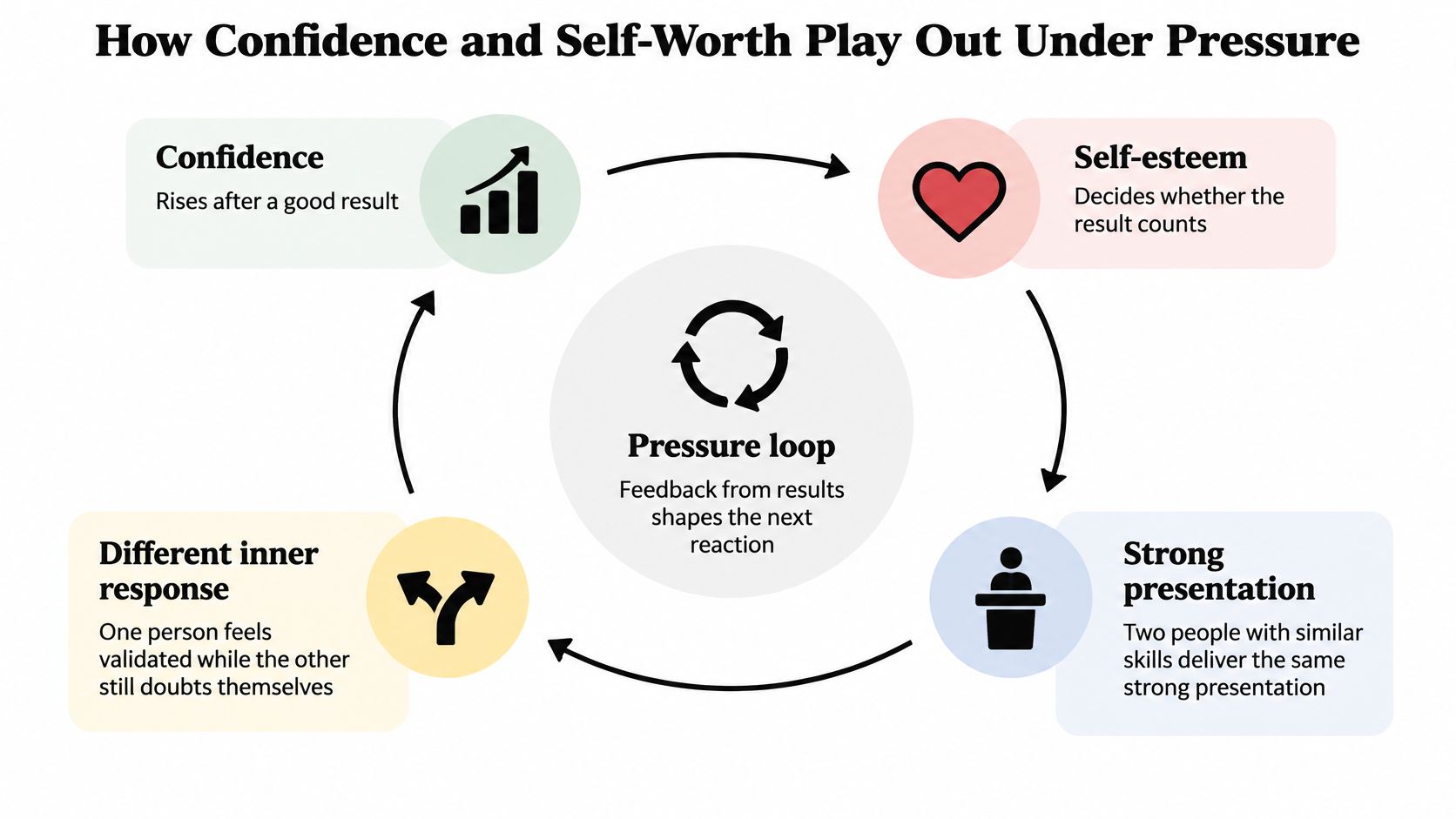
Take two people with similar skills who each deliver a strong presentation. They've both prepared, both answer questions competently, and both receive a few appreciative comments afterwards. On paper, they've had the same experience. Inside, it can land very differently.
The first person thinks, "That went well. I knew the material and people followed it." They notice one section they'd tighten next time, but the good result registers. When a similar meeting comes up the following week, they're a little nervous and broadly willing to speak. The experience has become usable evidence.
The second person goes home thinking about the one moment they stumbled. The praise is explained away quite quickly. People were being polite. The questions happened to be easy. It was luck, or a one-off, or proof only that they can perform when everything is controlled. By the next morning, they're not building on success. They're bracing for the time they'll be found out.
The filter that decides whether success counts
That contrast isn't really about presentation skills. Both people may be equally capable, and both may look confident to anyone watching. The difference lies in what happens after the event, when the mind starts sorting the experience into a story about ability and worth.
NHS inform's self-esteem self-help guide explains that self-esteem includes how people think and feel about themselves and how much value they believe they have as a person. It also notes that someone with low self-esteem is more likely to focus on failures than successes, which helps explain why a good result doesn't always change how someone feels.
Confidence may rise after successful practice, but self-esteem influences whether that success is accepted as meaningful evidence or quietly dismissed.
This is also why reassurance can feel helpful for an evening and hollow by the weekend. A friend says you did well, and for a moment you believe them. Then the older filter returns and starts looking for exceptions. The problem isn't a lack of positive comments. It's that the comments don't reach the part of you that doubts your worth in the first place.
If you'd like a spoken explanation alongside the diagram, the short video below walks through a similar distinction in plain language. It's best treated as another way into the ideas, rather than a test of which description fits you.
When confidence is partly a performance
Confidence can be genuine and well earned. It can also be supported by rehearsal, a polished online identity, a string of achievements, or careful attention to appearance. None of those things is dishonest in itself. Most of us prepare differently for a job interview than for a walk with a friend, and there's nothing wrong with wanting to present ourselves well.
The difficulty begins when the performance becomes the main source of feeling acceptable. You might collect evidence that you're productive, attractive, funny, or in demand, while privately fearing that none of it would survive a quieter, less impressive version of you. From outside, that can look like strong self-worth. Inside, it can feel like a standard you have to keep meeting.
That pressure starts early for many people. Girlguiding's 2025 Girls' Attitudes Survey, based on 2,640 girls and young women aged 7 to 21, found that 83% of 11 to 21-year-olds wanted to build self-confidence, while 53% said body image or weight was most likely to negatively affect their mental health. The same survey found 18% of 7 to 10-year-olds felt sad most of the time, compared with 7% in 2016.
Those figures concern children and young people, not adults. Still, they point to something adults often describe in a different language. When confidence becomes tangled with appearance, approval, or comparison, advice to "just be more confident" can sound like advice to monitor yourself more closely and produce a better performance. For someone already watching themselves through other people's eyes, that may deepen the problem rather than relieve it.
A different question to carry with you
There's a useful question hidden here. How do you build confidence without becoming dependent on compliments, productivity, appearance, or other people's approval? It doesn't have a quick technique attached to it, which is partly the point. Genuine self-trust tends to grow when approval is welcome but not required, and when a setback can be disappointing without becoming a verdict on you.
That may mean the aim isn't to feel confident all the time. Very few people do, and constant confidence can become another standard to fail. A steadier aim might be staying connected to your values and your sense of who you are when confidence temporarily falls. You can feel unsure about a conversation, a new role, or a creative risk, and still treat that uncertainty as a normal human response rather than evidence that something is wrong with you.
Notice, too, what happens in the hours after something goes well. Do you let it count, even partly? Or does your mind move straight to the next test you need to pass? That small moment often reveals more than how confident you appeared at the time.
Signs of Low and Healthy Levels
Area of life | Low self-esteem | Low self-confidence | Healthy balance |
|---|---|---|---|
After a mistake | Concludes it proves you are fundamentally not good enough | Doubts you could manage the same task again | Acknowledges the error and keeps a sense of worth intact |
Praise and approval | Feels valued only when others approve | Dismisses praise as luck | Takes praise on board without needing it constantly |
New situations | Expects rejection or being found out | Hesitates to start, even when prepared | Feels nervous but goes ahead with realistic expectations |
Work or study | Feels like an impostor despite clear evidence | Avoids tasks outside a comfort zone | Knows strengths and gaps without letting either define you |
Inner voice | Persistent criticism of who you are | Persistent doubt about what you can do | Critical thoughts appear but do not run the show |
Read the columns as tendencies, not boxes. A sign can appear in both directions because the two experiences often arrive together. Dismissing praise, for example, might reflect doubt about a particular skill on one day and a deeper belief that you don't deserve kindness on another. Context matters, and so does how long the pattern has been there.
The healthy balance column doesn't describe someone who never doubts themselves. It describes someone whose doubts have limits. They can feel nervous before a new situation without deciding they're inadequate for feeling nervous. They can recognise a gap in knowledge without turning it into a statement about their character. They may still want approval, as is natural, but they aren't relying on it to feel like a worthwhile person.
How common these patterns are
If several rows feel familiar, you're far from unusual. Arden University's UK Confidence Index reported that 62% of UK adults lacked confidence, 70% reported an 'inner critic' damaging self-esteem, and only 1 in 10 described themselves as highly self-confident.
Those are survey indicators rather than diagnostic benchmarks. They can't tell you how severe anything is for you, and they aren't prevalence rates for a mental disorder. What they do show is that self-doubt and a harsh inner voice are common parts of adult life, not personal failings that set you apart.
Two gentle questions may help you use the table without turning it into another form of self-judgement. First, which column feels closer to your experience most often? Second, does the difficulty stay within one area of life, such as work presentations or dating, or does it spread across friendships, family, work, and time alone? A difficulty contained in one setting may point more towards confidence in that situation. A pattern that follows you everywhere may be closer to self-esteem, and the page on what can shape low self-worth explores some of those roots.
You don't need a precise answer before seeking support. Noticing the pattern, even roughly, can be enough to start a different kind of conversation with yourself.
How Counselling Works with Each
Counselling for these difficulties isn't usually a fixed programme with separate modules for esteem and confidence. It's primarily relational and exploratory. Counselling focuses on exploring thoughts and feelings rather than giving advice, and the therapist can help you work out what you might like to do. That distinction matters, because being told to think positively or put yourself out there rarely reaches the reasons you doubt yourself.
With self-esteem, the conversation might turn towards your inner critic and the language it uses. Where did that voice learn to speak that way? You might explore early experiences, expectations you absorbed, and beliefs you've developed about your worth. You might also notice whether feeling acceptable has become dependent on achievement, being useful, or keeping other people pleased.
A helpful strand to follow is what happens to your sense of worth on an ordinary day, when there's nothing to achieve and no one to impress.
With self-confidence, the focus is often more specific. You might look at the situations where doubt appears, what you fear might happen, and how previous experiences have shaped those expectations. Perhaps a critical manager years ago still colours how you enter meetings now. Perhaps you learned to stay quiet in groups because speaking once led to embarrassment, and that lesson has generalised.
An integrative approach can hold both strands together. A person-centred stance offers acceptance and empathic understanding, so you can describe yourself openly without having to perform being fine. A psychodynamic lens may notice how patterns from the past repeat in the present, including in the counselling relationship itself. Neither is about excavation for its own sake. The aim is a kinder, clearer understanding of how you came to experience yourself this way, without abandoning accountability for your actions.
Where new experiences fit
Exploration doesn't rule out trying new things. NHS guidance on five steps to mental wellbeing identifies learning new skills as a route that can boost both self-confidence and self-esteem. The sequence is often the revealing part. Practising and mastering a skill can first create confidence in that particular activity, while repeated experiences of competence may gradually support a more positive sense of self.
Counselling can help you think about the emotional meaning attached to those experiences. If a new skill goes well, are you able to let it count? If it goes badly, does it stay a beginner's difficulty or become another item in a long case against yourself? Those responses often tell you more than the activity itself. The page on counselling for low self-esteem describes how that exploratory work may unfold.
In practice, the two are usually worked on together. A person may need space to understand shame and self-criticism, and also to think about why one particular situation feels so threatening. The counsellor adapts to the individual rather than treating self-esteem vs self-confidence as two entirely separate problems.
Deciding Where to Begin in Counselling
Situation | Likely focus | What counselling might explore |
|---|---|---|
Competent at work but privately feels inadequate | Often self-esteem | Where the sense of not being enough began and what the inner critic says |
Relaxed with friends but freezes in new groups | Often self-confidence | Specific situations, feared outcomes and past experiences of being judged |
Confidence depends on achievement or approval | Often self-esteem | Whether worth feels conditional, and what happens when success is absent |
Strong skills but avoids applying or speaking up | Often both, starting with confidence | The fears that shape action and whether self-worth is holding them back |
Autistic or ADHD traits, masking and years of adapting | Often both | How masking and misunderstanding have shaped self-worth and expectations |
Unsure which applies | Both, explored together | How the difficulty shows up across different areas of life |
Treat the middle column as a starting point rather than a verdict. A confidence-first lens may help when there's a recognisable skill gap or a specific feared situation, such as returning to study after a long break. A worth-first lens may matter more when shame or persistent self-criticism turns every attempt into a test of whether you're acceptable. Many people need both, in an order that only becomes clear once they start talking.
The masking row deserves a little extra care. If you've spent years adapting to fit environments that didn't quite fit you, low confidence in social or work settings may not be a simple lack of practice. It may reflect exhaustion, misunderstanding, and a long habit of hiding parts of yourself to get through the day. Counselling can make room for that complexity without assuming you need to become someone else.
A low-pressure first step
You don't need to arrive with a tidy explanation. Bringing one recent situation where the feeling showed up can be enough for a first conversation. Perhaps it was a meeting where you spoke well and still went home unsettled, or a social plan you cancelled because you couldn't face being the least interesting person there. A concrete moment gives you and the counsellor something real to think about together.
For practitioners reading alongside their own training, resources such as the PatientNotes setup guide show how first-session information can be organised clearly, which can leave more attention free for listening. As a client, though, your task isn't to prepare a perfect summary. It is to begin where you are.
At Therapy with Ben, sessions are available face to face in Cheltenham, online counselling is offered across the UK, and Walk and Talk counselling takes place in Pittville Park. The usual fee is £60 per session. Some people prefer the privacy of a room, some prefer speaking from home, and some find walking outdoors makes difficult thoughts easier to approach. The setting matters less than whether you feel able to speak openly in it.
Understanding your own pattern is a valid starting point, even if nothing changes immediately. You may leave a first session with language for something that has felt vague for years, and that can be a meaningful shift in itself.
One important note sits outside this reflection. Persistent low mood, panic, or thoughts of self-harm call for prompt support from a GP or NHS services rather than self-reflection alone.
If you're recognising yourself in the gap between looking capable and feeling good enough, Therapy with Ben offers integrative counselling where self-esteem vs self-confidence can be explored at your pace, face to face in Cheltenham, online across the UK, or while walking in Pittville Park. You're welcome to visit Therapy with Ben to read more about the approach and consider whether a first conversation might help.


Comments