


Sense of Self: A Clear Guide for Adults
Understanding who you are isn't a fixed discovery, it's a working sense you carry with you: what you value, what feels like you, and what you can trust your own judgement on. You've probably noticed this already. You walk into a family dinner or a meeting at work, say yes to something, and only recognise what you thought about it because someone else reacted first. Your sense of who you are can feel steady in one moment and completely out of reach in the next, which is why it's worth understanding properly rather than treating it as a fixed trait you either have or have lost.
What a Sense of Self Is
A sense of self is the everyday experience of knowing, at least roughly, what you value and what feels like you. It isn't a personality type or a single mood. It's an ongoing understanding of who you are, built from your identity, beliefs, values, memories, preferences, abilities and relationships. When your mood shifts, that understanding can stay recognisable. When it can't, you're probably running on other people's expectations instead of your own.
There's a practical difference between having a sense of self and scoring highly on a wellbeing measure. UK government data makes this distinction usefully concrete. In the Community Life Survey for 2021/22, adults in England reported an average self-worth score of 7.1 out of 10. Average life satisfaction sat at 6.9 out of 10, both unchanged from the previous year. Those are population-level indicators, not personal targets. They show that a person can evaluate themselves reasonably positively while still feeling uncertain about direction, relationships or authenticity. Self-worth captures whether you feel you matter. A sense of self is wider than that: it includes continuity, agency and personal meaning.
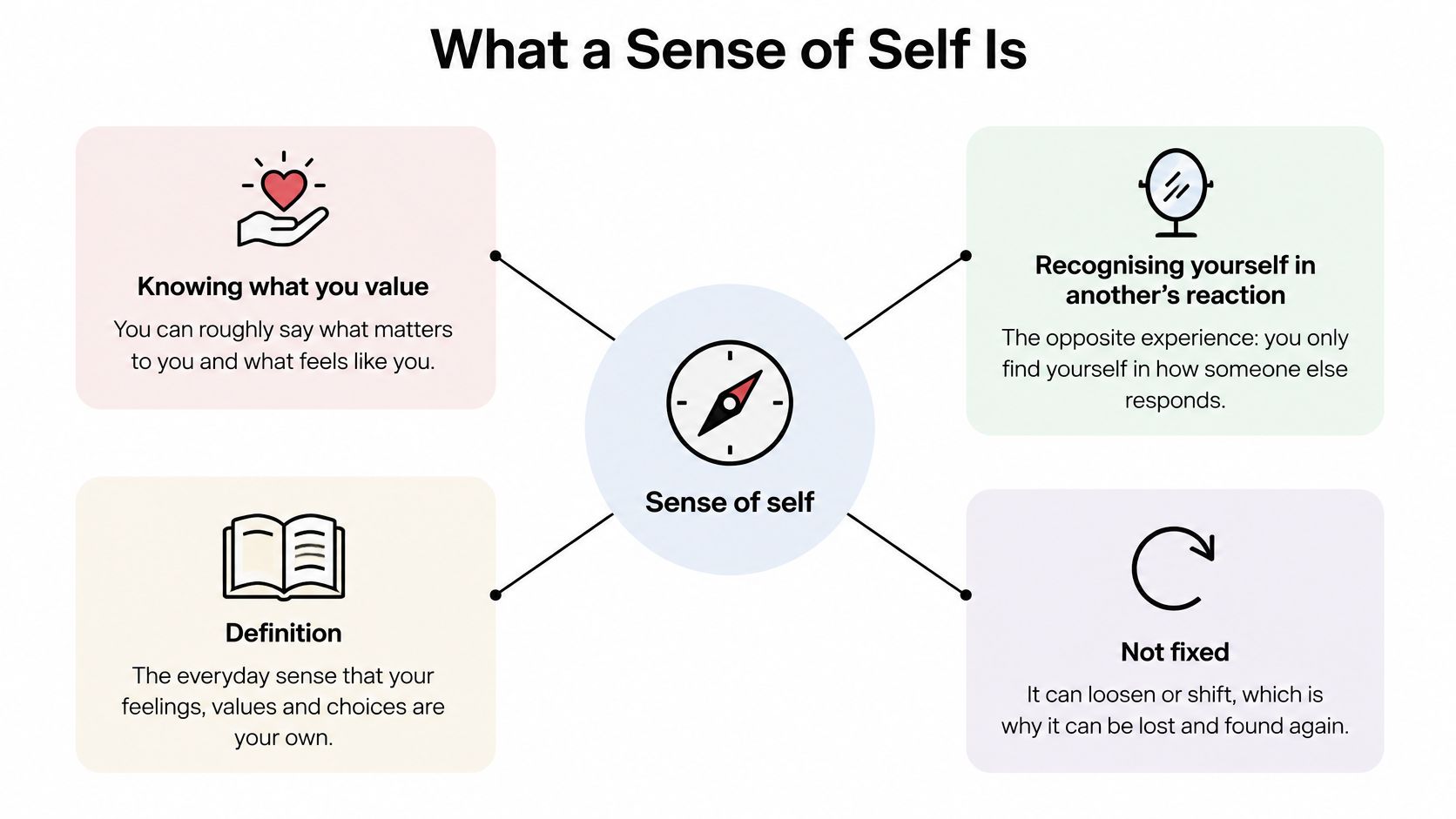
The easiest way to see the difference is to separate the terms people often use interchangeably.
Idea | What it refers to | What it is not |
|---|---|---|
Sense of self | An ongoing understanding of who you are, shaped by values, experiences and relationships | A fixed personality type or a single mood |
Self-concept | The picture you hold of yourself, including who you are and who you feel you should be | A score on a self-concept test |
Self-esteem | How positively you evaluate yourself | The whole of your identity |
Self-confidence | Trust in your ability in a particular situation | Proof that you know what you want |
Self-worth | Whether you feel that you matter | Proof that life feels authentic or continuous |
None of these terms describes the others. You can be confident at work, reasonably proud of yourself and still not know what you want from a relationship. You can have low self-esteem on a difficult day and still feel clear about your values. That's why I don't treat a sense of self as something to score or fix. It's more like a conversation you keep having with yourself, sometimes in a whisper, sometimes loudly, about what's yours and what you absorbed from someone else.
Here's a useful example of how the same person can have one thing without the other. Say someone functions well at work, has a partner who loves them and scores a 9 on any self-confidence measure you can name. Then a friend asks what they want from the next five years and they go completely blank. The question isn't whether they have value, they clearly do. The question is whether they've had space to form a view of their own.
This is also why the popular advice to "just be yourself" falls flat. If you're not sure who that is, the instruction doesn't help. If you're reading this because your main experience is "I don't know who I am anymore," I'd suggest spending time with a companion piece on reclaiming your identity when you no longer know who you are. If, instead, the question is whether counselling could help you understand yourself better, it might be worth exploring identity therapy options to get a sense of what support can look like. Either way, the starting point is the same: noticing what's yours.
How a Sense of Self Develops
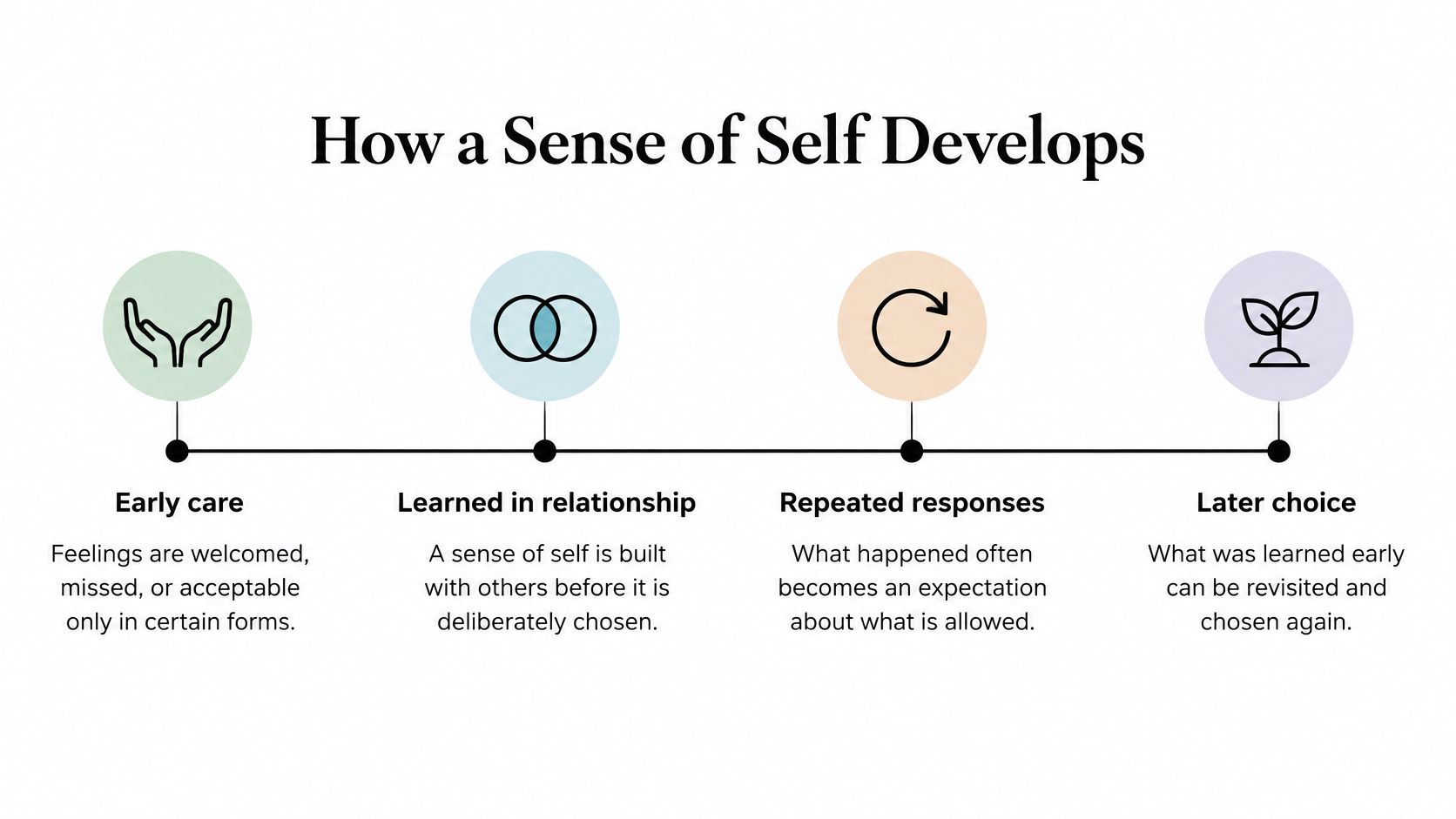
A person's sense of self takes shape in relationship long before they can describe it. Early responses teach what feelings are safe to show, which needs get met, and what kind of attention follows certain behaviour. A child repeatedly called “sensitive” when they cry may grow into an adult who treats sadness as a problem to manage, rather than information to understand.
Early care teaches more than safety. It gives a child a vocabulary for emotion, however accurate or limited that vocabulary is. If sadness received comfort and anger met fear or distance, anger may later feel unfamiliar or threatening, even when it is a legitimate signal. If cheerfulness kept the peace, being cheerful can become a role rather than a mood. Family positions form in the same way: the capable one, the peacemaker, the quiet one, the one who never needs help. Each position has a reason. It helped someone stay connected, useful or protected. The difficulty begins when that old position keeps directing adult life after the original conditions have gone.
Culture, class, gender, faith and social expectations add further instructions. Friends, partners and workplaces then reinforce or challenge them. Absorbing an expectation is usually easier than testing whether it fits, especially when belonging feels at stake. This is one reason a sense of self often develops through repeated adjustments, rather than through a single decision to become someone.
Carl Rogers, whose writing shaped Ben's work, described this process in terms that remain useful without academic padding. The real self is the person experiencing life. The ideal self is who someone feels they ought to become. Conditions of worth are the messages that love, respect or belonging depends on being a particular way. If a child learns that being funny earns approval while sadness makes adults uneasy, that is a condition of worth at work. If a teenager learns that hiding a difference keeps him safe at school, that is another. Incongruence is the strain of living towards an ideal while the experiencing self remains unrecognised. Rogers published this in On Becoming a Person. He did not offer a quick technique. He described a process of becoming more aware of what is happening in experience.
A UK study of help-seeking adults found that a poorly integrated or incoherent sense of personal identity was significantly associated with later psychological pain and hopelessness over a two-month follow-up, even after accounting for baseline levels, in a peer-reviewed article available through PubMed Central. The analysis also found that identity diffusion partly explained the link between reported childhood emotional abuse and later pain. That result should be held carefully. It supports a clinical question rather than a diagnosis: when continuity in values, goals and memories becomes difficult, stress may be harder to carry. The study was observational, so it cannot show that identity difficulty caused the later distress.
Development continues in adulthood. The past shapes what feels allowed. It does not fix who you can understand yourself to be now. Early care, repeated responses and later choices all belong on the same timeline. Attachment patterns, for example, influence how someone moves towards or away from closeness, and there is a fuller discussion of how attachment theory shapes you if you want to follow that thread. The practical point is that learning can be noticed without being denied. A person can recognise what was once necessary and still decide how they want to judge, choose and relate now. Therapy can support that kind of self-understanding while keeping responsibility for actions in view.
What Steadier and Uncertain Can Look Like
A steadier sense of self doesn't mean feeling sure about everything. It means you can name a few values, trust your judgement enough to choose, notice needs such as rest or interest and state a preference without launching a defence of it. An uncertain sense of self often shows up as waiting for approval before you know your own view, stalling on small decisions, adapting yourself to keep someone comfortable or feeling blank about what you want.
The contrast is easiest to see across ordinary parts of life.
Area of life | When it feels steadier | When it feels uncertain |
|---|---|---|
Values | You can name a few things that matter even if you cannot always act on them | Other people's approval decides what matters this week |
Decisions | You can weigh options and live with an imperfect choice | Small choices stall because you fear getting them wrong |
Needs | You notice rest, interest or discomfort and can say something about them | Needs stay vague until someone else is disappointed |
Preferences | You can say what you like without a long justification | The answer changes to suit whoever is asking |
Relationships | Closeness can include difference | You shrink, mask or agree in order to keep the peace |
People move between both columns, sometimes within the same afternoon. The rows aren't symptoms and they're not entry criteria for counselling. They're a way of noticing where you tend to stand.
Here's one short scene that captures the drift. You're at a family meal and someone proposes a plan for the weekend. You agree in the room, warmly, even enthusiastically. On the drive home the resentment arrives. Only then do you realise the yes belonged to the relationship, not to you. The agreement wasn't dishonest, it was automatic. You didn't check in with yourself because there wasn't time or because doing so felt unsafe. That's how an external sense of self operates: it borrows other people's preferences because it hasn't practised holding its own.
Self-evaluation moves in more than one direction, which is why a bad month doesn't mean you've lost yourself. In Relate and eHarmony's 2021 survey of 2,002 UK adults, 23% of UK adults said their self-esteem had decreased compared with before the pandemic. That included 30% of women, 15% of men and 27% of single people. At the same time, 20% of UK adults said they emerged from lockdown with increased self-esteem. The same event pushed people in opposite directions. Self-esteem is context-sensitive, and it's still not the same as knowing who you are. A person can feel better about themselves while remaining unclear about what they want.
If you're reading this because you feel more generally adrift, the article on finding yourself again sits alongside this one. Recognition is a place to look, not a label to apply. Notice where you agree automatically, where you stall and where you feel resentment after the fact. Those are the edges of something trying to speak.
Why You Can Lose Touch with Yourself
Slow drift is more common than a sudden break. A sense of self can fade when daily life keeps asking for adaptation and gives little room for reflection. A preference goes unspoken, then goes unnoticed. Over time, the practical question becomes: what did I want, and when did I stop checking?
A relationship can organise itself around one person's needs until the other person's preferences start to feel like noise. Decisions are made together, then mostly by one person, then as if the second person were not there. By the time the pattern becomes visible, even a small question such as "what do you want for dinner?" can feel strangely hard to answer.
A transition can remove the identity a role was supplying. Redundancy, separation, parenthood or leaving a career can take away the title that has been answering "who am I?" for years. The person underneath has not disappeared, but they may not have been consulted for a long time. That gap is often felt as uncertainty rather than grief, which is why it can be missed.
Prolonged stress leaves little spare attention for preference. When each day is triage, you stop asking what you would like and ask only what is urgent. Numbness in that context is a sign of load, not a personality type. The cost is practical: when everything is urgent, there is no space for judgement about what matters.
People-pleasing and masking become harder to notice once they are practised. Being easygoing, competent or unbothered can become the automatic setting. You may still know, intellectually, that you are adapting, but the felt sense of an alternative gets thinner. Authenticity includes choosing when to adapt. A stable sense of self depends less on finding one fixed "true self" and more on developing continuity across changing roles.
For neurodivergent adults, particularly those recognising ADHD or autistic traits later in life, this deserves more than a passing mention. The Acas neurodiversity at work report estimates that overall adult neurodivergence sits at approximately 15 to 20% when conditions are considered together. Many adults with ADHD traits are never formally diagnosed, and some spend years reading overwhelm, inconsistency, sensitivity or social adaptation as character flaws. That interpretation can be punishing. It can also keep people from asking what conditions would help.

Late recognition can bring grief, relief, anger and shame, often close together. There is also a risk of treating a new explanation as the whole self. A diagnosis, or a strong sense that one fits, is one thread in a larger fabric. I have a particular interest in ADHD, autistic traits, late recognition of neurodivergence, masking, emotional intensity, shame and the experience of feeling different. I value authenticity, fairness, curiosity, self-understanding, emotional honesty and personal responsibility, and I aim to support a kinder understanding of yourself without abandoning accountability for your actions.
The patterns people carry from earlier relationships often sit underneath masking and self-doubt. I have explored how family dynamics shape meaning in more detail elsewhere. The question is not which label explains everything. It is which forms of adaptation once made sense, which still do, and which now cost more than they give.
A sense of self is gradual and relational. It grows through repeated moments of noticing, choosing and taking responsibility for the choice. That makes it less like recovering a buried identity and more like building a workable relationship with your own values and judgement.
Your Own Judgement and a Self That Changes
Rogers made a distinction that still organises most of the confusion people bring to this topic. An internal locus of evaluation means checking a choice against your own values and felt sense. An external locus of evaluation means looking first to approval, status or someone else's disappointment. Neither is absolute. You'll always be influenced by other people, and a strong sense of self doesn't require needing nobody or never feeling unsure.
The shift from external to internal isn't binary. It's more like learning to listen for your own voice among several that are talking. Here's a way to test it. Take a belief about who you should be, something like "I must not need help" or "a good person never disagrees." Ask whose voice it sounds like. Ask when it began to feel necessary. Ask whether you would choose it now, knowing what you know. An inherited belief isn't false. It's just not automatically yours.
This connects to a second assumption worth questioning: that there's one fixed identity to discover or return to. People change through experience, often through the experiences they'd have avoided if they could. The task isn't to revive an earlier version of yourself. It's to understand who you are today, including what's been lost.
The UK study on identity derailment published in the British Journal of Guidance & Counselling puts some useful language around this. A perceived break between past and present identity was associated with greater vulnerability to depression, and self-criticism and self-reassurance helped explain that link. The research is correlational, so it guides questions rather than proving causes. Those questions can compare past and present values, relationships, abilities and priorities. What has changed? What remains continuous? Very often, more remains than the anxious part of you believes.
A question worth sitting with: If you compare who you are now with who you were five years ago, what would you want to keep, what would you grieve, and what has simply become clearer?
Self-reassurance in this context means a fairer reading of the evidence, not forced positivity. It's the difference between "I've failed" and "I made a decision that didn't work, and I can make a different one." I don't treat a change in someone's sense of self as a breakthrough that arrives in one session. Trust in your own judgement is usually gradual. And here's the part people sometimes miss: a kinder understanding of yourself doesn't mean abandoning accountability for your actions. You can hold both. You can see why you made a choice and still recognise its consequences.
If you want to sit longer with the question of what you value, the article on validation of self takes that thread further. The point for now is that continuity isn't sameness. It's the ability to recognise yourself across change.
Gentle Ways to Understand Yourself Better
A weekly hour can change how you notice yourself. Not through a grand exercise, and not through a standard question offered to everyone. Sessions explore what is happening now, and can include earlier experiences or recurring patterns when they feel relevant. The work is integrative, so it is adapted to each person rather than following one rigid method.
I draw particularly on person-centred and psychodynamic approaches because they help with different parts of the same question. What feels true now? What might be shaping how you feel, choose, or hold back? Counselling focuses on exploring thoughts and feelings rather than giving advice, though it can help you work out what you might like to do.
Here are five reflections you might try on your own, without any promise of insight from any of them.
What feels worth protecting this month?
Name one thing that matters even if nobody applauds it. It could be a weekly call with a friend, a quiet walk, or a book you are reading slowly. Notice whether naming it feels awkward. That awkwardness often shows that the thing is yours rather than borrowed.
Where do you feel most like yourself?
Pay attention to what is happening in that place: the pace, the company, and the freedom from performing. You are not looking for a fantasy of escape. You are looking for the conditions that let you breathe.
What situations leave you feeling restricted?
List them, then separate the cost of the task from the cost of the role you play in it. A difficult meeting is one kind of cost. Pretending to agree when you do not is another. They can be addressed differently.
Which belief about who you should be did you not choose?
Catch one. Write it down. Ask where it came from and whether it still fits. This matters especially where masking, late recognition of neurodivergence, shame, or the experience of feeling different have shaped how you present yourself. You do not need to tear the belief down. Just notice that it is there.
If something needs to change, what kind of change is it?
Is it a boundary, a different choice, another way of interpreting events, or greater acceptance of something that will not change? Naming the category makes the next step smaller. It also stops every difficulty being treated as a character problem when the practical issue may be workload, relationships, or a role that no longer fits.
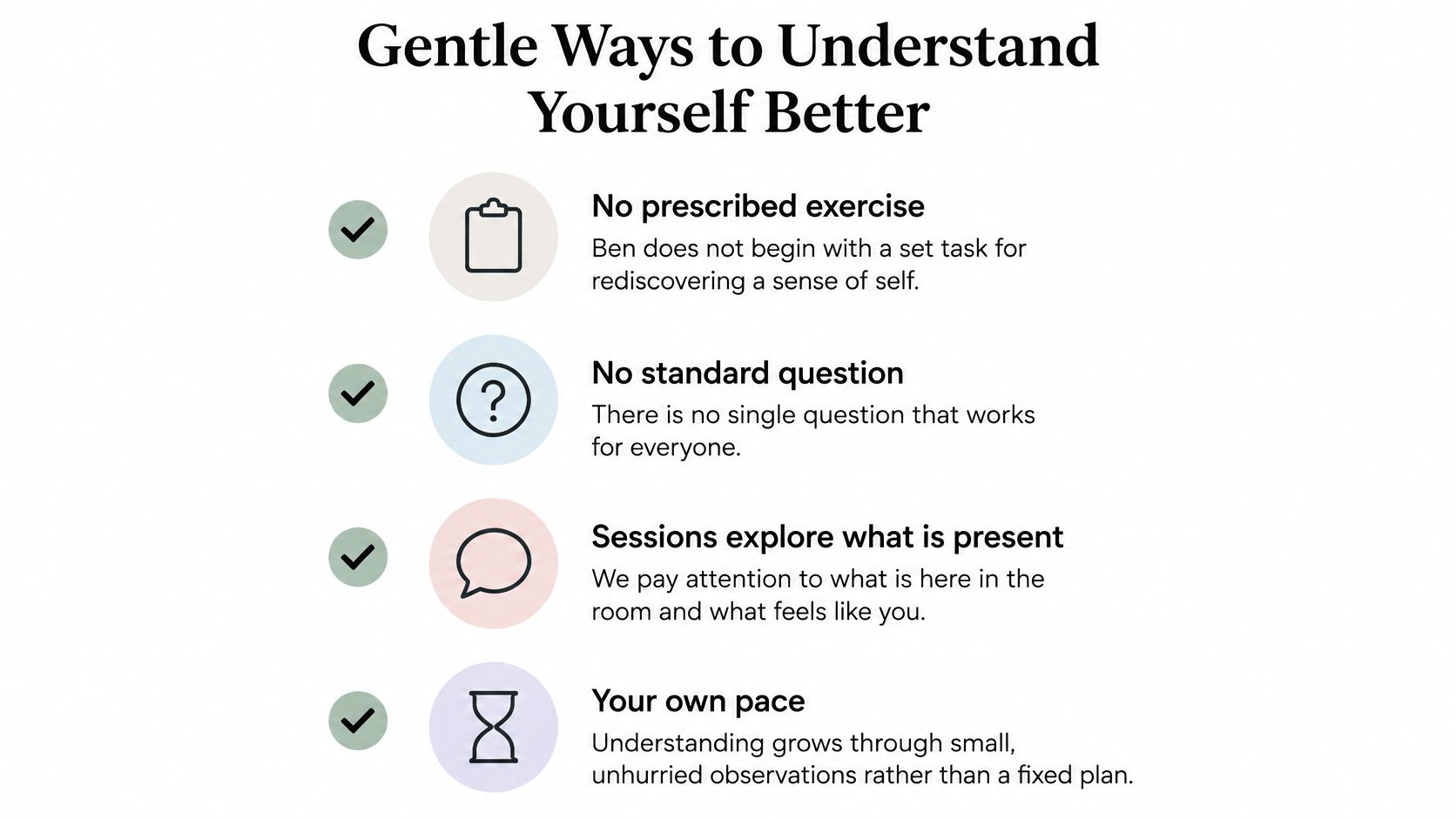
Journaling can help as a private way to slow down. It is not homework, and it is not evidence of progress. I do not use formal self-concept measurements. I prefer to notice whether the work still concerns what matters to the person and whether their priorities have shifted. A clever prompt is not a revelation. Sometimes a simple observation, offered at the right moment, does more than a list of questions ever could.
There is a trade-off here. Questions can make hidden preferences visible, but they can also turn self-understanding into another task to perform. Keep the questions small. Let them earn their place by helping you notice something you had not yet put into words.
Understanding yourself may also reveal that an external circumstance needs a practical change, not just a new interpretation. You can understand that a job is wrong for you and still need to find another one. Self-knowledge and action work together. A kinder understanding of yourself can sit alongside accountability for what you do next.
Some people explore self-discovery through the Ayahuasca.com retreat selection guide, while others prefer the steadier rhythm of ordinary weeks. For many people, self-knowledge develops in small, unhurried observations: what they protect, where they feel at ease, what makes them shrink, and which choices feel their own. The pace matters more than the setting. A slower pace often gives you room to notice what has been hiding in plain sight.
Questions People Ask Before They Decide
What does having a strong sense of self mean?
It means having enough understanding of your values and judgement to make choices and keep relationships that feel meaningful. You still take in other people's views, and you still meet uncertainty. A steady sense of self is not a fixed identity to recover, nor a high self-esteem score. It is a gradual, relational understanding of what matters to you, what you trust, and how you want to act when circumstances change.
Why do I feel like I don't know who I am when my life looks fine?
Because roles, approval and competence can run smoothly while values and preferences stay unexamined. The outside looks organised. The inside hasn't had a say in years. This can be especially familiar when you have adapted to inherited expectations, coped with difference, or learned to mask traits that felt harder to explain. The two can be true at once: life can function well, while the question of who you are beneath it all remains oddly quiet.
Is feeling disconnected from myself the same as dissociation?
Not usually. Nidirect, Northern Ireland's public health information service, describes dissociation as a way the mind may cope with overwhelming stress. People who dissociate may feel disconnected from themselves or the world. Episodes can last hours, days, weeks or months. Dissociative disorders can include feeling uncertain who you are, feeling like a stranger to yourself, or feeling there are different people within oneself.
Ordinary uncertainty about identity is not a disorder. Persistent or distressing disconnection from yourself warrants professional assessment rather than self-diagnosis. If you're at immediate risk, contact emergency help or the Samaritans.
How can counselling help?
Counselling gives you a steady place to notice what is happening now, and to consider earlier experiences or recurring patterns when they feel relevant. Therapy with Ben is integrative, drawing particularly on person-centred and psychodynamic approaches. That means the work is adapted to each person rather than following one rigid method.
The focus is on exploring thoughts and feelings rather than being told what to do. Advice can be useful in ordinary life, but a sense of self usually develops through understanding the pattern underneath the decision. What do you feel before you criticise yourself? Which relationships leave you more like yourself, and which leave you performing? What would change if your own judgement carried more weight?
There is no formula for finding an identity. Progress may look like greater self-awareness, clearer needs, more emotional honesty, or decisions that fit your values more closely. Ben values authenticity, fairness, curiosity, self-understanding, emotional honesty and personal responsibility. A kinder understanding of yourself can develop without abandoning accountability for your actions.
Sessions can also make room for practical concerns that sit close to identity: anxiety, depression, self-esteem, relationships, emotional difficulties, life changes, neurodivergence and masking. Ben has a particular interest in ADHD, autistic traits, late recognition of neurodivergence, masking, emotional intensity, shame and the experience of feeling different. For some people, the main work is learning which parts of life were built around other people's expectations. For others, it is noticing where responsibility has been avoided, and what repair might look like.
Is sense of self the same as self-esteem?
No. Self-esteem is how positively you evaluate yourself. A sense of self is the wider understanding of who you are, including what you value and what you trust your own judgement on. You can have one without the other. Self-confidence is trust in a particular ability, not proof that you know what you want. Self-worth is whether you feel you matter, not proof that life feels authentic or continuous.
That distinction matters because trying to "feel better about yourself" can miss the central question. Someone may think highly of their abilities and still feel lost after a relationship breakdown or major life change. Someone else may carry harsh self-criticism and still have a clear sense of what they value. Therapy can help separate those threads, so the work becomes more specific.
If you'd like to explore your sense of self through counselling, you can get in touch through Therapy with Ben about face-to-face sessions in Cheltenham, online counselling for adults across the UK, or Walk & Talk counselling locally.


Comments