


Setting Goals in Therapy: A Gentle, Client-Led Guide
Have you ever assumed you need to arrive at therapy with a clear target, a diagnosis or a plan for how to change? You don't. Sometimes a direction is already clear; sometimes the first useful step is finding words for what doesn't feel right.
What Goals Mean in Therapy and Why They Help
A therapy goal is a shared sense of what you'd like to explore or change. It doesn't have to be a target, a diagnosis or a plan with a deadline. You might hold it loosely, like a compass giving you a direction without mapping every road.
Type of goal | What it can sound like | What it may help with |
|---|---|---|
Symptom relief | “I want the panic to ease when I'm on the train.” | Reducing distressing symptoms that get in the way of daily life |
Relationship patterns | “I keep choosing partners who pull away.” | Noticing repeated dynamics and where they may have begun |
Self-understanding | “I don't know what I actually want any more.” | Clarifying identity, values and a sense of direction |
Practical change | “I want to say no at work without feeling guilty.” | Trying out and practising new ways of responding |
Keeping gains | “I want to stay steady after a difficult year.” | Recognising early signs of slipping back and protecting progress |
You may have more than one kind of aim in mind. Naming one can make a vague wish easier to talk about, without requiring you to settle on a formal goal. A shared reference point can help you and your counsellor notice what feels useful, and whether the conversations are still connected to what brought you in. If you're wondering how to recognise whether counselling is helping, these signs of counselling working may offer a helpful perspective.
Where a Goal Begins and How It Takes Shape
Some people arrive with a sentence they've rehearsed, such as wanting to stop freezing in meetings. Others only know that life feels heavier, or that they keep ending up in the same difficult place. Both are valid starting points. A feeling that's hard to explain can be useful material in itself.

A diagnosis isn't needed to start therapy. I work integratively, adapting the conversation to the person rather than following one rigid method. That means we can start with what's happening in your life, even if you can't yet name what you want to change.
Let the direction emerge
A goal may take shape gradually. You might begin with a recent conflict, a low week or a decision that feels stuck. From there, we can explore the thoughts and feelings around it without rushing to solutions. Sometimes earlier experiences or familiar relationship patterns become relevant; we can look at those if they feel useful to you.
As things become clearer, a direction might sound more like your own words: “I want to understand why I go quiet when I'm upset,” rather than “I should be more confident.” The shift from “I should” to “I want to” can be a sign that an aim is beginning to feel personally meaningful. At the same time, naming a goal too quickly can sometimes mean trying to please someone else, while having no sense of direction at all may leave you feeling unmoored.
The pace isn't fixed. Some people need time to explore what's happening before a direction feels clear; others know what matters from the outset. When it's helpful to think about how a person's strengths can shape practical support in another setting, turning student strengths into classroom supports offers a useful example of starting with the individual rather than a one-size-fits-all plan.
Before a first session, you might wonder: “What would be different if this eased a little?” or “What have I already tried?” You don't need polished answers. They're possible places to begin.
If you'd like a short introduction to goal-setting as a collaborative process, this video may be useful.
Small Aims for Low-Energy Weeks
Some weeks leave little room for ambition. Concentration may be patchy, work demands may take over, and getting to a session can be an effort in itself. In those moments, a small, manageable aim can keep a small but meaningful direction in view without turning it into another task to fail at.
Say your broader hope is to feel less cut off from the world. On a difficult week, that might become: “I want to get outside once, even briefly.” Or perhaps you'd like to be less harsh with yourself. A small aim could be noticing one moment of self-criticism and answering it a little more gently. If it's hard to remember what you want to bring to a session, you might jot down one thought, even if it's only half-formed.
This kind of aim can suit someone who finds fixed targets overwhelming, is exploring ADHD or neurodivergence, or needs flexible online support. It doesn't make the deeper work smaller. It gives you a place to begin when your energy, concentration or available time is limited.
You can bring the aim into a session and talk about whether it still fits. There's no need to score it, measure it or turn it into a formal plan. Often, a modest aim helps you notice what matters when the rest of life is crowded.
Finding the Needs Beneath a Stated Goal
What someone says | What may sit underneath | Possible focus in therapy |
|---|---|---|
“I always say yes and then resent it.” | A fear that saying no will cost me closeness | Understanding people-pleasing and what sense of safety it protects |
“I can't settle into anything.” | A long-standing belief that rest has to be earned | Exploring early expectations about effort and self-worth |
“I feel flat after every success.” | Difficulty trusting positive feelings or being genuinely seen | Looking at how praise and recognition were received earlier in life |
“I want to stop overthinking.” | Anxiety about being misunderstood, perhaps shaped by past criticism | Making sense of the self-criticism and where it came from |
“I want to leave my job.” | Exhaustion, or a need for meaning that work no longer offers | Clarifying values before deciding what comes next |
These are illustrative possibilities, not explanations that can be assumed to fit everyone. Wanting to leave a job may be exactly what it sounds like. Yet sometimes exploring the feelings around that wish reveals exhaustion, a loss of meaning or a need that has gone unspoken. The stated concern matters, even if it becomes a way into a deeper question rather than the final focus.
In my work, sessions explore what's happening now and can include earlier experiences or recurring patterns when they feel relevant. For instance, the same tension might arise with a manager, a partner and a friend. That repetition can invite curiosity about what feels familiar in those relationships, without suggesting that every situation has the same cause.
Earlier experiences can shape present expectations, such as anticipating criticism or feeling responsible for other people's comfort. But a possible connection isn't a fact about you just because a counsellor notices it. You decide whether it feels accurate and worth exploring.
Sometimes a need becomes clearer only when there's enough room to say something you hadn't planned to say. A goal can then change from “stop feeling anxious” to understanding what the anxiety is signalling, or what kind of support or boundary feels important. That shift can make the work more honest and less focused on fixing a symptom.
Why Some People Want Direction and Others Do Not
It's easy to assume that a person-centred approach means a counsellor should never offer direction. In practice, people differ in how much structure feels useful. Some welcome a gentle reminder of a theme they've asked to keep in view. Others may find direction intrusive, especially if they've spent a long time being told what to do.
A systematic review of idiographic goal measures reports that approximately 60% of people prefer goal-setting in therapy, around 20% don't want it, and a further 20% have no preference. The review also links attention to people's own goals and preferences with reduced dropout and improved outcomes. These findings support asking what feels helpful, rather than assuming one style suits everybody. The systematic review of goal measures for psychotherapy describes this variation in preferences.
I don't generally set formal goals for clients, but I do explore what they'd like to focus on and whether they'd appreciate some gentle direction. Counselling focuses on exploring thoughts and feelings rather than giving advice, though I can help someone work out what they might like to do. If a client has asked me to help them stay focused, I might say: “I'm conscious you mentioned last session that you wanted to focus on this, but it's entirely up to you what you'd like to explore today.”
That's an invitation, not an instruction. You might want direction about one issue and more freedom to explore another. If you'd prefer less guidance, you can say so; that preference deserves to be taken seriously too.
When Goals Change and How to Raise It
A goal can begin tentatively in the early sessions. As you understand more about what's happening, it may sharpen or soften. Later, a different priority might surface, perhaps grief, a changed relationship or a question about identity. Towards an ending, you might look at what has mattered and what feels different now.
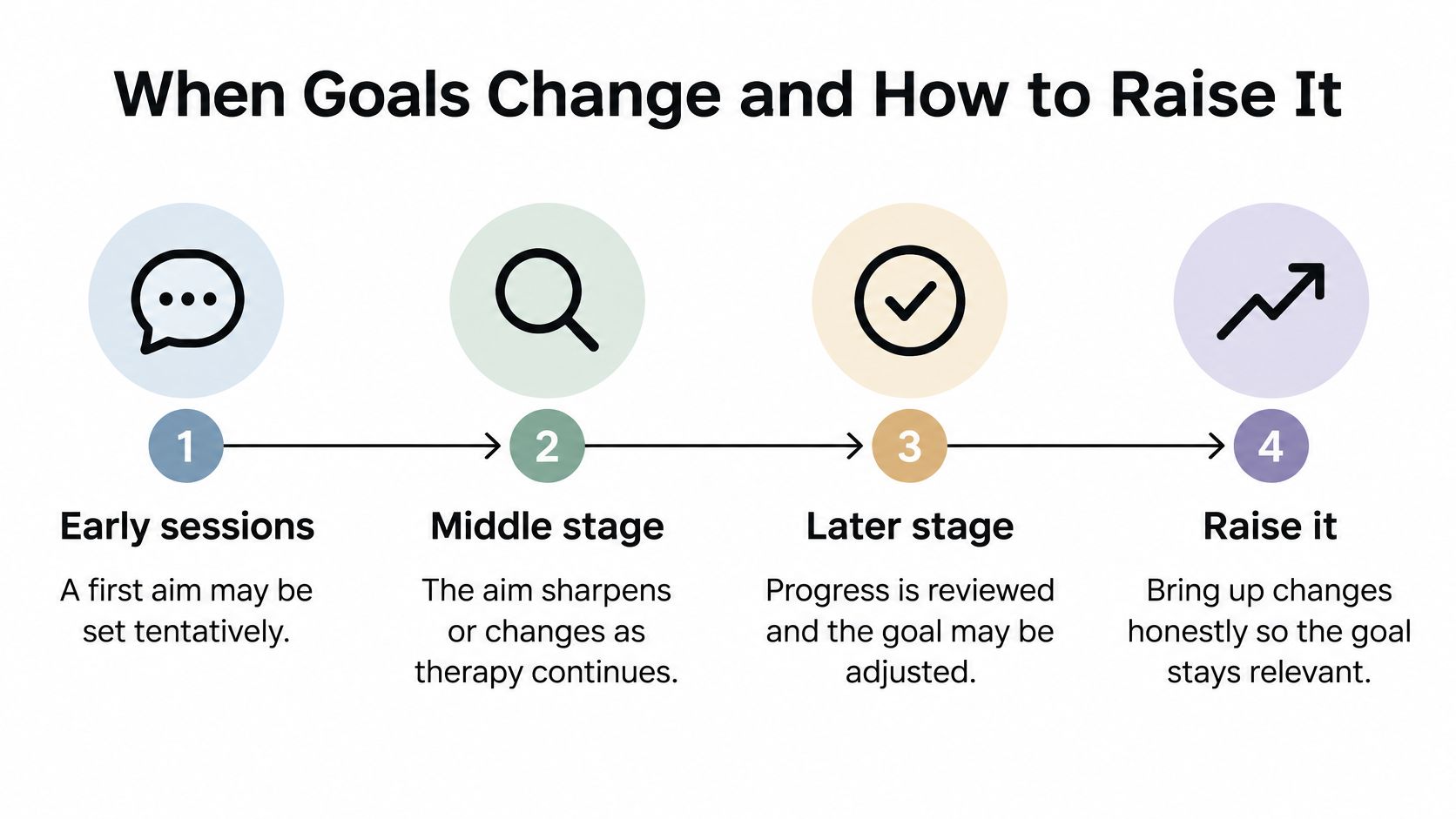
You don't have to wait until you can explain a change perfectly. You could say, “I'm not sure that's what I want to work on any more.” You don't need to justify the shift; we can make room to understand what feels important now.
Research involving 13 UK-based patients who had completed up to 24 sessions of collaborative-integrative psychotherapy found that clients could want a mix of leadership, challenge, input and space to explore. Their preferences sometimes changed over time, and not having a preference met was occasionally experienced as beneficial. This suggests it's better to talk together about what's helpful than to assume every client wants either firm direction or complete openness. The study of patient preferences in collaborative-integrative psychotherapy explored these changing preferences.
If you're unsure how to speak up when something in the work doesn't feel right, this article about disagreeing with your therapist may help you find a way to start the conversation. Revisiting an aim isn't a sign that you've failed to stick to it. It helps keep the work connected to what matters to you now.
Deciding Whether to Begin Your Own Therapy
You don't need a finished goal, a diagnosis or a carefully organised list of problems before getting in touch. A first conversation with me is an opportunity to talk about what has brought you to counselling, ask how I work and decide together whether you'd like to continue.
I'm an integrative counsellor whose work draws mainly on person-centred and psychodynamic approaches. I don't use fixed programmes or formal goal sheets. Sessions are available in person in Cheltenham, online across the UK, or as walk-and-talk sessions. Session days and times are agreed in advance. If you're wondering what to expect, how to prepare for a therapy session may help you feel more at ease.
You can call, text or WhatsApp me on 07462 291471. If I think another kind of support would serve you better, I'll say so and may refer you on or signpost you to someone else. You're welcome to bring whatever you're holding, even if you can't yet say what you want from therapy.
Therapy with Ben offers integrative counselling in person in Cheltenham, online across the UK and as walk-and-talk sessions. If you're considering setting goals in therapy, you're welcome to visit Therapy with Ben and get in touch about what you'd like support with.


Comments