


Therapy for Depression: Options and What to Expect
If you're looking for therapy for depression, why does choosing support so often feel like selecting whatever happens to be available, rather than what you need?
You might want practical structure, space to understand how you feel, or help making sense of recurring difficulties in relationships. Those aren't interchangeable needs. Knowing what different approaches involve, and what you're allowed to question, can make starting therapy feel less like stepping into an unknown process.
Therapy Options for Depression at a Glance
Therapy for depression isn't one treatment but a range of approaches. The right fit involves your symptoms, how much daily life is affected, your preferences and what's available locally. A useful starting point is whether you want a structured way of addressing particular difficulties, a more exploratory conversation, or some combination.
Main therapy approaches for depression
Approach | How sessions are structured | What it tends to focus on | Relevance to this practice |
|---|---|---|---|
Cognitive behavioural therapy (CBT) | Structured and often time-limited, with agreed goals and tasks between sessions | Specific thought and behaviour patterns | Not offered by Therapy with Ben |
Person-centred counselling | Open-ended or time-limited, paced by the client | Feeling understood and exploring current experience | Core part of the integrative approach used here |
Psychodynamic counselling | Usually open-ended, exploring patterns in feelings and relationships | Recurring reactions and how past experience shapes the present | Core part of the integrative approach used here |
Integrative counselling | Adapted to the individual rather than one fixed method | Whatever matters most to the person at the time | Approach used at Therapy with Ben |
Guided self-help | Structured materials with light support | Mild to moderate symptoms as an early step | Offered through NHS Talking Therapies in England |
What these differences mean in practice
With CBT, you might agree to examine a particular pattern, such as avoiding contact because you expect rejection, and work on it between appointments. Counselling usually leaves more room for what emerges in conversation, without requiring an agreed task each week.
Person-centred counselling trusts that your sense of what matters deserves serious attention. You don't have to arrive with a neat explanation of your difficulties. Feeling uncertain, numb or unable to find words can itself be something to explore.
Psychodynamic counselling pays attention to recurring feelings and relationship patterns. That might involve considering past experiences, but it doesn't mean every difficulty is explained through childhood. Present circumstances, including loss, financial strain or isolation, deserve attention in their own right.
Integrative counselling draws these perspectives together rather than asking everyone to follow the same method.
A helpful question isn't simply “Which therapy is best?” but “What would I need to feel able to take part?”
Therapy is also distinct from medical care, although they can sit alongside each other. For a US perspective on that distinction, Psychiatric nurse practitioners explain depression care at Integrative Psychiatry of America; its healthcare context differs from the UK.
Notice which description feels closest to what you need now. You're allowed to want structure, room to talk, or a clear explanation before deciding.
How Talking Therapy Helps With Depression
Depression can make life feel smaller and harder to read. You might struggle to tell whether you're exhausted, disappointed, angry or beyond caring. Therapy offers somewhere to slow down and put those experiences into words without having to make them immediately understandable.
A counselling conversation can begin with uncertainty, not a prepared account.
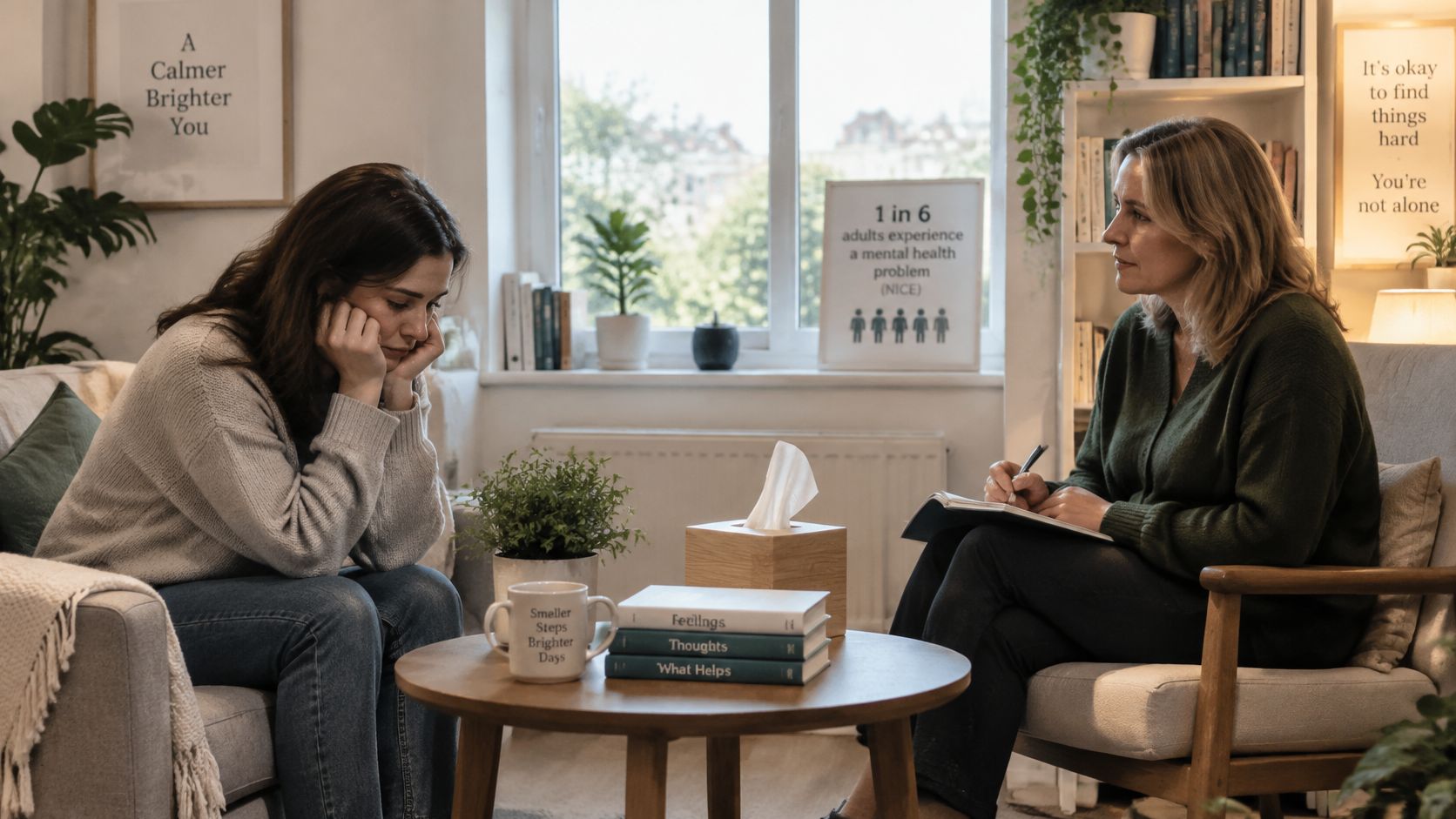
NICE's adult depression guideline estimates that 6% of adults in England experience an episode of depression in any given year, while more than 15% experience at least one episode during their lifetime. Support therefore matters beyond moments of acute crisis, including during recovery and when trying to understand recurring difficulties.
Understanding rather than being instructed
Being listened to without being hurried can help you distinguish feelings that have become tangled together. For example, persistent self-criticism might become easier to question when you notice how quickly disappointment turns into an accusation against yourself.
A person-centred stance means trying to understand your world from your point of view, then checking that understanding with you. It isn't about analysing every sentence, imposing an interpretation or telling you how to live.
Exploration can also include what happens outside sessions. My article on behavioural activation and depression discusses the relationship between activity and mood, without suggesting that doing more is a simple answer.
For another way of engaging with the topic, you can watch the video below.
What improvement can look like
Change may mean recognising a difficult day before it becomes a judgement on your whole life, or finding words for a need you previously dismissed. It can be gradual and uneven, rather than a succession of dramatic breakthroughs.
NHS Talking Therapies outcome benchmarks
Measure | Figure | Source |
|---|---|---|
Adults completing a course of treatment, July 2024 | 62,036 | |
Reliable improvement among completers, July 2024 | 66.9% | NHS England, same report |
Reliable recovery among completers, July 2024 | 47.3% | NHS England, same report |
Minimum outcome standard for reliable improvement | 69% | |
Minimum outcome standard for reliable recovery | 51% | NHS England, same standard |
Completing referrals moving from caseness to recovery, 2023/24 | 50.1% |
These are service-level figures for England, not predictions for an individual or outcomes for this practice. Reliable improvement means symptom changes exceed expected measurement error; reliable recovery also requires finishing below the clinical threshold.
Scores can help make change visible, but they don't capture everything. Therapy also doesn't replace medical assessment when symptoms are severe or safety is at risk.
Signs Therapy May Help and When to Get Urgent Support
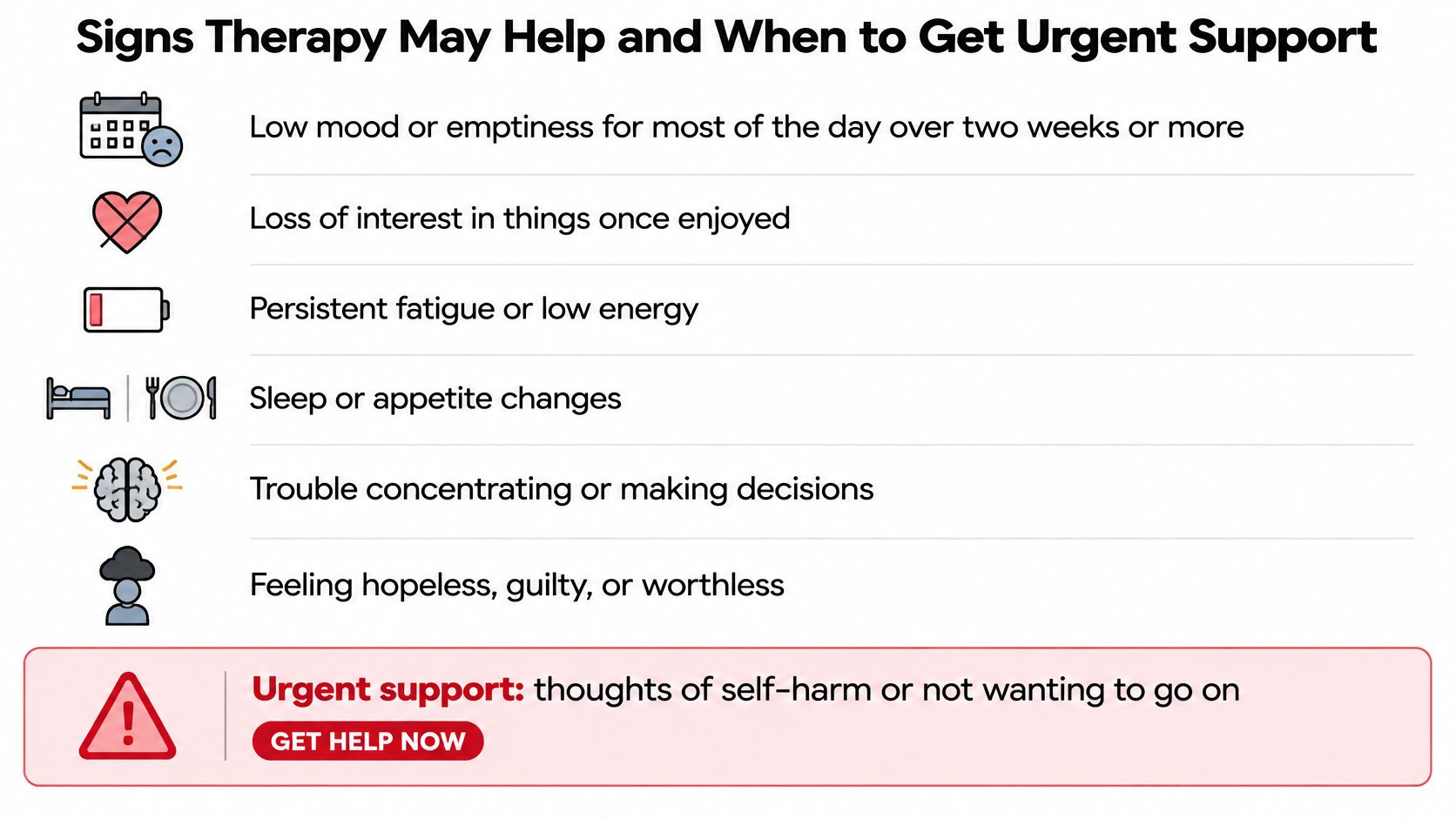
Low mood or emptiness for most of the day over two weeks or more can be a reason to seek an assessment, rather than continuing to manage alone.
Loss of interest in things once enjoyed may include feeling detached even when you still attend activities.
Persistent fatigue or low energy can make ordinary responsibilities feel unusually demanding.
Sleep or appetite changes are worth mentioning, even if emotional difficulties are harder to describe.
Trouble concentrating or making decisions may affect work, study or everyday tasks.
Feeling hopeless, guilty, or worthless deserves attention, particularly alongside constant self-criticism.
Withdrawing from people or feeling stuck can be enough reason to explore support.
Urgent support: thoughts of self-harm or not wanting to go on call for prompt help, not a routine counselling enquiry.
You don't need to identify with every item, and this isn't a diagnostic checklist. A diagnosis isn't needed to start therapy. You can begin by saying that something feels wrong, that daily life has become harder, or that you don't understand what's happening.
The visual below separates reasons to explore support from signs that require urgent attention.
Making a plan with your GP
According to NHS guidance on depression treatment, a GP who diagnoses mild depression may suggest monitoring symptoms and arrange a review after two to four weeks. The same guidance explains that waiting for talking therapy can take several weeks or months, and your GP can discuss the expected wait and what to do if symptoms worsen.
Monitoring should mean having a review plan, not being left to cope without knowing what happens next. Tell your GP about changes in sleep, appetite, concentration and everyday functioning, as well as your mood.
It can help to write down what you're finding difficult before the appointment. If speaking feels hard, you can give the GP that note rather than trying to remember everything under pressure.
When help needs to be urgent
If you're having thoughts of suicide or self-harm, seek urgent support through NHS 111 or an urgent GP appointment. You can also call Samaritans on 116 123 to speak to someone.
If you cannot keep yourself safe, have seriously harmed yourself, or there's immediate danger, call 999 or go to A&E. Don't wait for a therapist to reply to a message.
Practical rule: If symptoms are worsening or daily life is becoming unmanageable, speak to a GP rather than waiting to see whether things improve.
Choosing a Format and an Approach That Suits You
A 2025 review of NHS Talking Therapies found that guided self-help, counselling and CBT remained the most commonly delivered options, with little evidence of a broader range following the updated depression guideline. People also reported barriers around preferred treatments being unavailable and difficulty contributing to decisions.
Choice on paper isn't always choice locally. If your preferred approach isn't offered, ask what alternatives exist, whether another service provides it, and what accepting the available option would involve. You can ask for an explanation without rejecting help.
Choosing the setting
The format matters too. A room, a video call and an outdoor conversation each create different practical and emotional conditions.
Therapy formats and when each may suit
Format | What it involves | Often suits | Worth considering |
|---|---|---|---|
Face-to-face | Sessions in person in Cheltenham | People who prefer in-person contact and a settled routine | Travel time and having a private space to return to |
Online | Video sessions available across the UK | People who find travel hard or feel more at ease at home | A private room and a reliable connection |
Walk-and-talk | Sessions held outdoors while walking side by side | People who find sitting face-to-face intense or who enjoy being active | Weather, a route you feel comfortable with and your mobility |
My comparison of online and in-person therapy offers more help with that practical decision. No format is universally more effective or more comfortable for everyone.
Questions you can bring
My approach is integrative, with person-centred and psychodynamic foundations. We work collaboratively, adapting conversations to you rather than following a rigid treatment programme.
Before starting with any therapist, useful questions include:
Approach: What do you use, and why might it suit what I'm bringing?
Direction: How will we agree what I want from therapy?
Length: What might influence how long we work together?
Review: How will we notice whether it's helping?
Fit: What happens if I'm uncomfortable with the approach?
You don't have to know the professional terminology to ask these questions. Describing what you would find difficult, such as a lot of tasks or very little structure, is useful information.
For waiting times, NHS Talking Therapies standards and February 2025 reporting set targets of 75% receiving a first appointment within six weeks and 95% within 18 weeks; 90.8% of referrals completing treatment that month had accessed services within six weeks. These measure access to a first attended treatment appointment, not treatment length, and local waits differ.
What Happens in Your First Sessions
Starting counselling doesn't require you to tell your whole story immediately. The opening meetings are also a chance for you to understand how the therapist works and decide whether you feel able to continue.
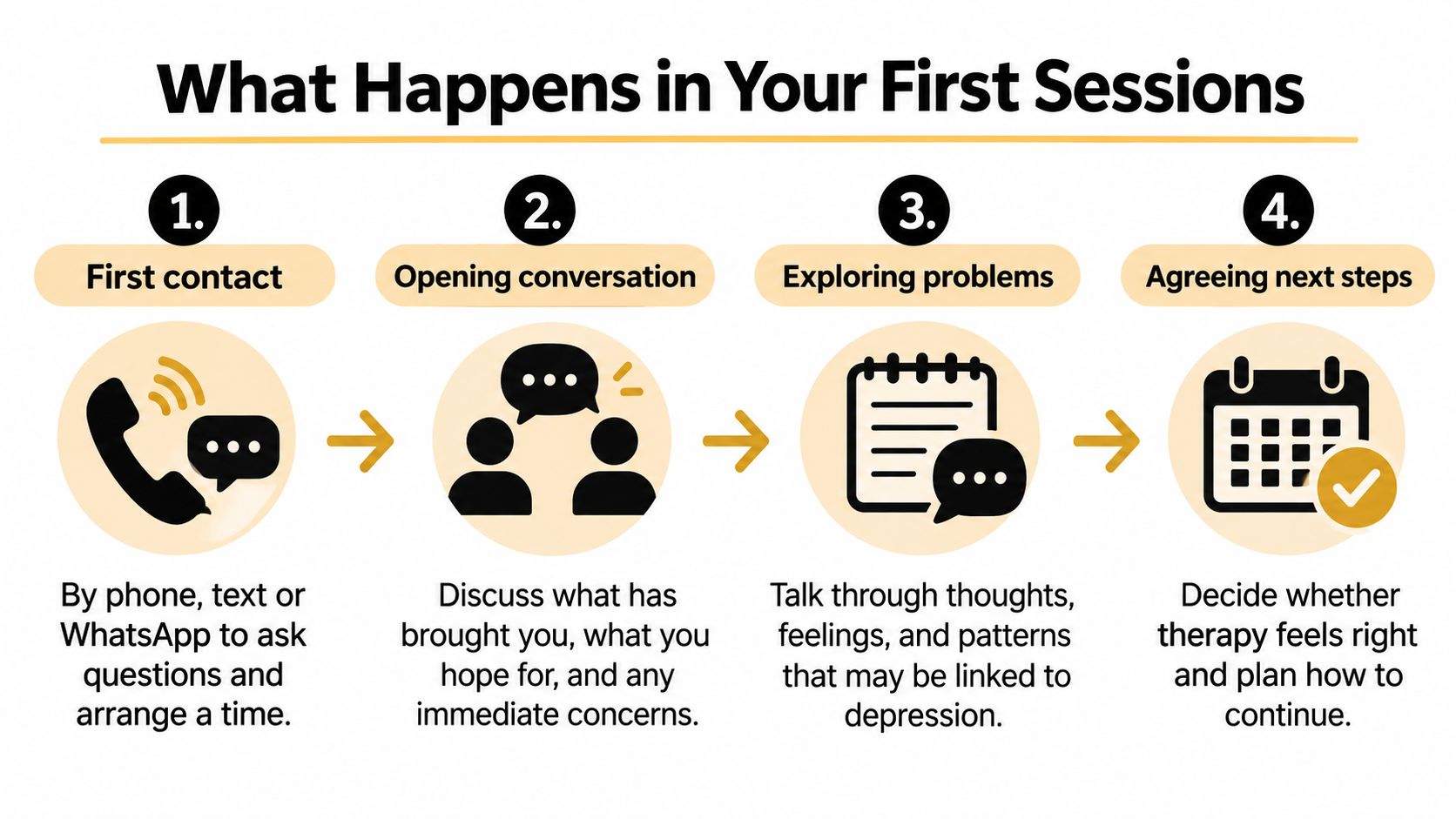
This visual gives a simple outline of the beginning.
From first contact to ongoing conversations
First contact. You can phone, text or WhatsApp to ask questions and arrange a time. You don't need to explain everything in that message.
An opening conversation explores what has brought you, what daily life looks like and what you hope might change. Immediate concerns matter more than producing a complete history.
Confidentiality is explained. Counselling is confidential, but confidentiality may be broken if someone is at risk of serious harm. We discuss this at the first meeting, and I would aim to talk with you before speaking to anyone else.
We agree how to work together. That includes what you want space for and whether to review progress after an agreed period. Uncertainty about your goals is something we can work with.
Regular sessions focus on exploring thoughts and feelings, rather than receiving advice. I can help you work out what you might like to do, without making that decision for you.
We review what feels helpful and what doesn't. You can mention feeling misunderstood, stuck or unsure about the direction. A review should allow us to reconsider the work, not require you to report improvement.
We consider an ending or onward support. Ending can include reflecting on what you understand differently and what support you may still need. If the work isn't the right fit, referral or signposting can be discussed.
How long might counselling take?
NICE guidance describes counselling for persistent subthreshold depressive symptoms or mild-to-moderate depression as typically involving 6–10 sessions over 8–12 weeks. That's a treatment range, not a promise, a deadline or a fixed programme for this practice.
The important question is whether the support remains appropriate to your needs. Marked difficulties functioning, increased risk or a lack of improvement may mean involving your GP or another mental-health service rather than continuing unchanged.
For preparation, my guide to your first therapy session explains what you might want to bring. You can also read Be Your Best Self & Thrive insights from Be Your Best Self & Thrive Counseling, PLLC, as another perspective on beginning a therapeutic conversation.
Before your first meeting, write down something you'd like to talk about. It can be a feeling, a question or an ordinary situation that has become difficult.
When Access, Waiting and Fit Make Therapy Harder
Getting into therapy is one hurdle. Finding therapy that fits you is another, and for some people the second hurdle is the higher one. NHS England's report on men accessing Talking Therapies describes lower use of these services among men, with stigma weighing particularly on Black, Asian and minority ethnic men, and lower access and completion among some ethnic groups. It also reports that nine in ten men who completed treatment in London described their outcome as life-changing.
Patterns like these describe whole groups. They cannot predict how any individual will respond, and they do not show therapy working less well for any particular person. What they do suggest is that a standard pathway, with its set format, fixed pace and assumptions about how people should talk about feelings, will never suit everyone equally. Fit sits at the centre of what makes therapy work, and it is something you are allowed to question and shape.
Adjustments you can ask for
Feeling uneasy in therapy does not automatically mean you are unwilling to engage. Sometimes you are working twice as hard, translating yourself across differences in culture, communication style or expectations, before the actual therapy can begin. Adjustments worth asking about include:
Cultural understanding: Ask how the counsellor approaches racism, identity, faith, family expectations or experiences they do not share.
Pace: Say if questions arrive too quickly, or if you need longer to find your words.
Communication: Ask about written summaries, clearer structure or time to process, and how any notes are kept confidential.
Masking: Explain if you spend sessions appearing comfortable or translating yourself into expected language, energy that could otherwise go into the work itself.
You do not need a diagnosis to raise any of these needs. They come up often when someone is exploring autistic or ADHD traits, and a good adjustment responds to the person in the room rather than a label on a form.
If what you want is hard to get locally, widen the search. Counselling online is available across the UK, and formats such as walking sessions suit people who find a chair and a quiet room harder than moving side by side. Asking a counsellor how they adapt their work costs nothing and tells you plenty.
If it still doesn't fit
My work covers anxiety, troubled thoughts, constant self-criticism, low mood, depression, lack of motivation, life changes, relationship problems, feeling lost, and neurodiversity and masking. Breadth like that still cannot guarantee I am the right counsellor for you. If a format or approach feels wrong, say so. We can change how we work, and where I cannot help I can refer you on or signpost you to someone better suited.
If you are weighing a mental-health assessment against ongoing counselling, the XO guide to private mental health assessments explains how that separate route works. The two serve different purposes, and enquiring about one never obliges you to take up the other.
Taking the First Step Towards Support in Cheltenham
You don't need to settle every question before making contact. A manageable starting point is to identify what you want help understanding, then check what kind of support would be appropriate.
A practical way to begin
Note what you'd most like to change or understand. That could be persistent self-criticism, feeling disconnected, or struggling to get through ordinary days. A few words are enough.
Put safety and medical needs first. If symptoms are severe, worsening or involve risk, speak to a GP or use urgent support rather than waiting to arrange routine counselling.
Choose a workable setting. Consider face-to-face counselling in Cheltenham, online sessions across the UK, or Walk & Talk counselling in Pittville Park. Think about privacy, travel and what would help you speak openly.
Make contact in a way that feels manageable. You can call, text or WhatsApp 07462 291471. A short enquiry is fine; you don't have to send a detailed personal history.
Use the conversation to ask practical questions. Discuss the approach, confidentiality, progress reviews, fees and current availability. Concessions are available for counselling students and people in financial difficulty.
Asking questions first is a reasonable part of choosing a counsellor, not a commitment to continue.
You're also allowed to take time after that conversation. If the work doesn't seem suitable, we can discuss whether someone else or a different kind of support would better meet your needs.
Therapy with Ben offers integrative counselling for depression and low mood, with space to explore your experience rather than follow a fixed treatment programme. Visit Therapy with Ben to find out about counselling in Cheltenham, online or outdoors, and ask whether working together might suit you.


Comments