


Therapy Gloucestershire: How to Find the Right Counsellor
If the counsellor with the longest list of letters after their name is the right one, why do so many people leave after a handful of sessions still feeling unheard? Qualifications and a short journey matter. They do not tell you whether you can say the difficult thing out loud. Choosing therapy in Gloucestershire is a question of fit: the route, the pace, and whether you can imagine being honest with this particular person.
I am an integrative counsellor in central Cheltenham. My work draws on person-centred and psychodynamic ideas, adapted to you rather than delivered as a fixed programme, because what helps one person can leave another cold. My in-person sessions take place in central Cheltenham, and I also offer online sessions across the UK and Walk & Talk around Pittville Park.
Choosing Between NHS, Face-to-Face, Online and Walk & Talk Options
Each route changes three things: the setting, the pace, and how structured the sessions are. The care you are owed as a person stays the same whichever you choose.
Option | How it works | Typical start | Often suits |
|---|---|---|---|
NHS Talking Therapies | Referral by GP or self-referral; structured programme of NICE-approved therapies for depression and anxiety | A phone assessment first, then a wait that varies by area | Anxiety or depression where a structured programme is wanted |
Face-to-face counselling, central Cheltenham | Regular sessions in a private counselling room near the main bus stops | Arranged after a free introductory conversation | People who want a steady weekly room and in-person contact |
Online counselling across the UK | Video or phone sessions from home or another private space | Arranged after a free introductory conversation | People who cannot travel easily or prefer their own space |
Walk and Talk around Pittville Park | Outdoor sessions, walking alongside the counsellor | Arranged after a free introductory conversation | People who find sitting opposite someone difficult |
Face-to-face from Gloucester or nearby towns | The same counselling room in central Cheltenham; the journey is the trade-off | Arranged after a free introductory conversation | People outside Cheltenham who want in-person work |
The honest trade-off sits between cost and control. Private sessions with me are £60 each, and in return you pick the format and start when you are ready. The NHS route asks for patience, but it delivers a proven programme once you reach the front of the queue.
Three questions narrow this faster than another evening of searching.
Programme or open exploration: Do you want a structured course with a set focus, or room to follow what comes up, including relationships, identity and change?
Getting there: Does travel, shift work or mobility make a weekly room hard to reach?
Where you settle: Do you feel more at ease in a counselling room, at home, or outdoors while moving?
Sessions with me are available in person, online nationwide, and as walk-and-talk sessions. Plenty of people use a mix, moving between the room, a screen and the park as life changes. NHS support can run alongside private counselling, and either can be the first step. If you want to see what the large national platforms offer before deciding, a commercial roundup of top-rated online therapy services lists the main providers. The practical difference with a local counsellor is continuity: you meet the same person every week, in whichever format suits you.
Practical rule: Write down your top two preferences before you contact anyone. Then read the part of this page that matches that route, rather than trying to hold every option in your head at once.
Why People in Gloucestershire Start Counselling
Say you have had the counsellor's number saved for months. Work feels tight in your chest, evenings are flat, and a relationship keeps circling the same argument. Or the trigger is a bereavement, a house move, or a new role that looked fine on paper. Some people arrive with one problem they can name. Others only know that life is not going as well as they want, and that putting it off has stopped feeling tolerable.
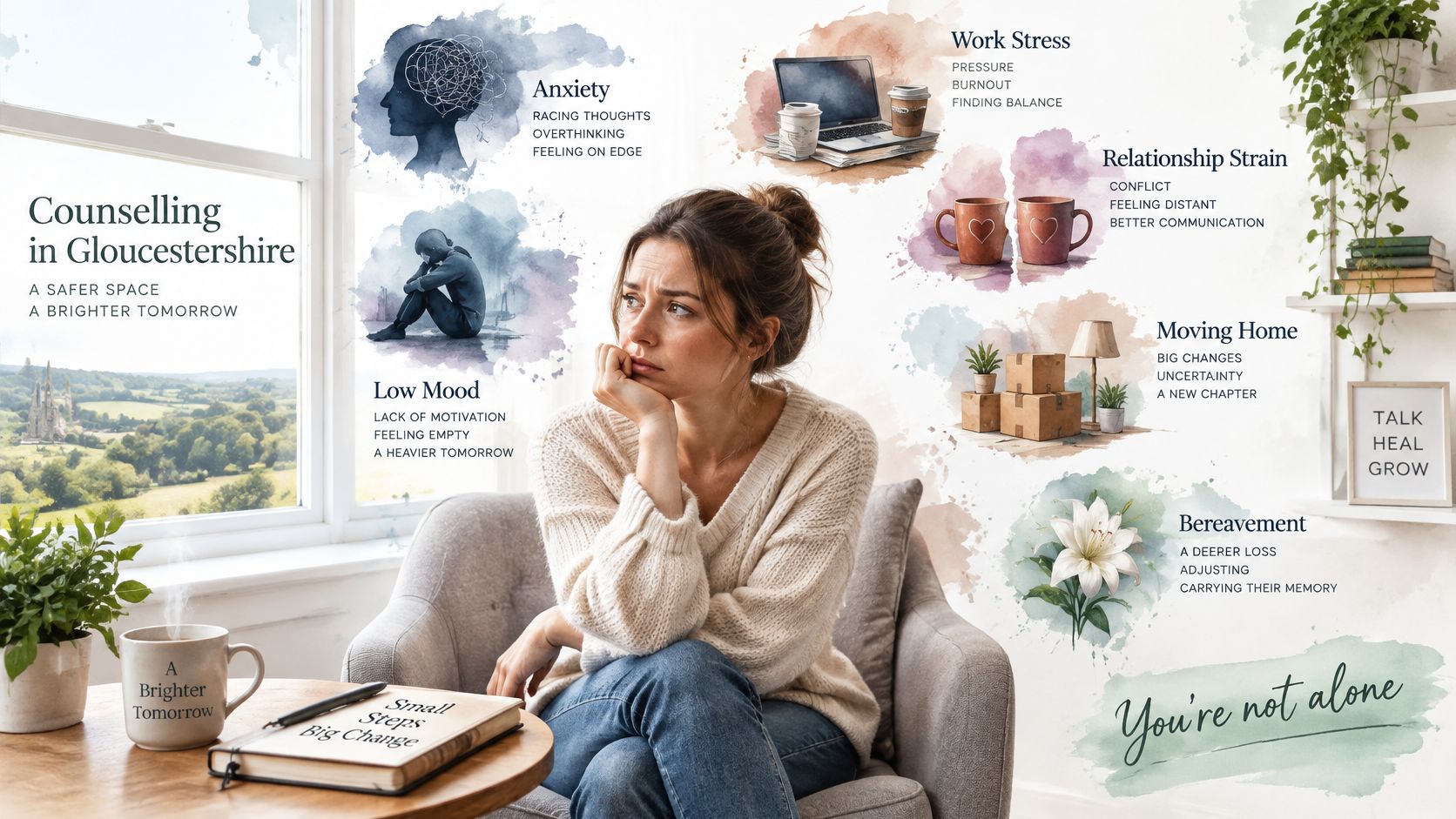
The reasons I hear most often are anxiety, low mood or depression, work stress, relationship difficulties and life changes. Since I started practising, more adults have also got in touch because they recognise possible ADHD traits in themselves and want to understand how those traits show up at work, at home and in close relationships.
Overlap is ordinary
That mix is common across the county, not a sign you have left it too late. Gloucestershire's 2020 Adult Mental Health Needs Assessment estimated that about 70,000 residents aged 18 to 64 had a common mental disorder such as anxiety or depression, and that 26,600 people in that age group had two or more psychiatric disorders. Anxiety often sits beside low mood and a sense of being stuck. For a wider look at how these patterns are counted, Statlyst's sourced mental health figures set local experience next to national reporting.
You do not need a formal diagnosis, and you do not need to be in crisis, before counselling is a reasonable step. A short film on what talking therapy can feel like is here if a voice helps more than another paragraph.
Before you compare counsellors, write down what brought you to this page in your own words. That description, not a label, is the starting point for choosing the kind of help that fits.
NHS Talking Therapies and Private Counselling
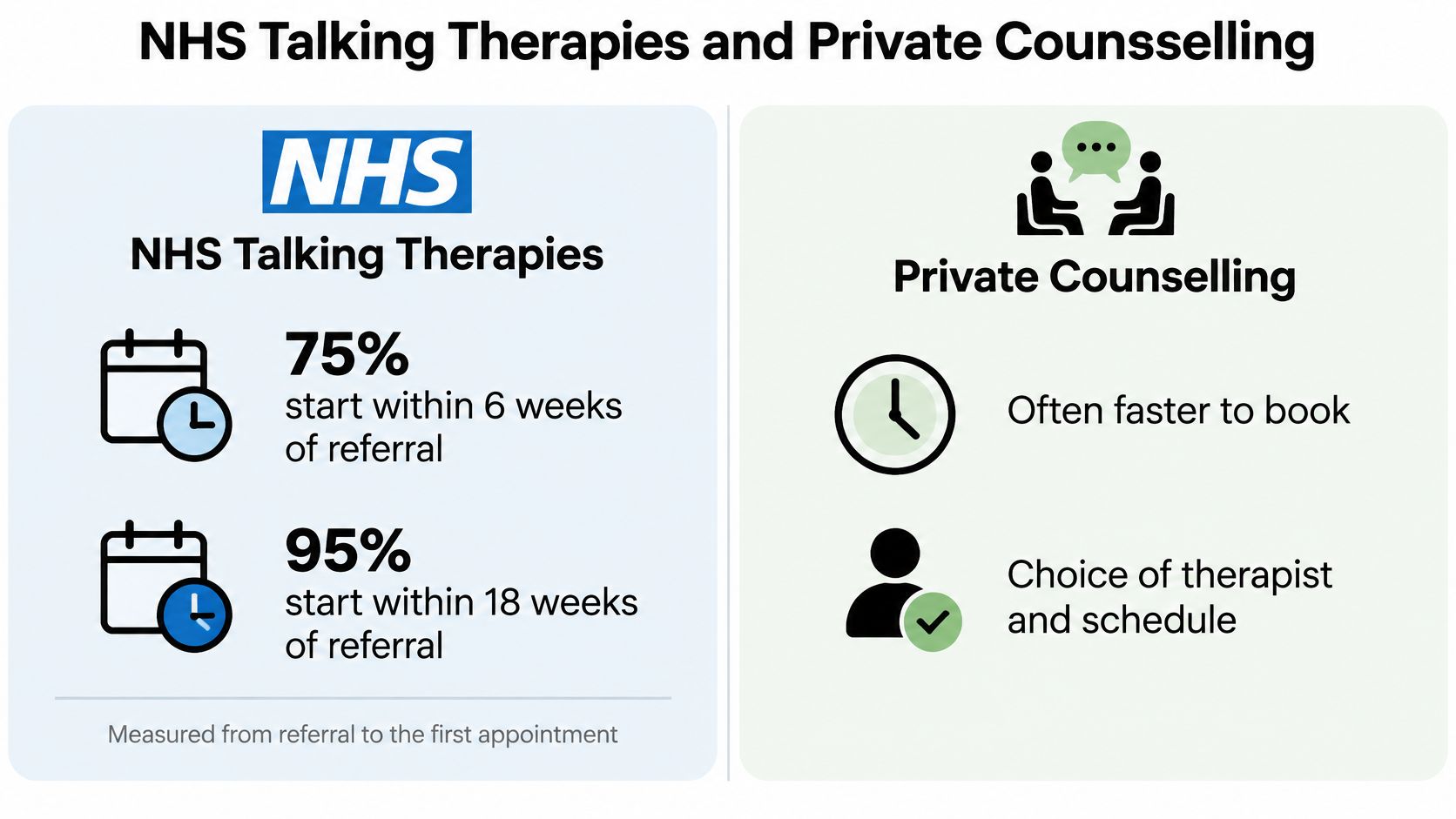
NHS Talking Therapies uses published waiting-time standards, measured from referral to the first attended treatment appointment. The standard is that 75% of people completing a course should start within six weeks, and 95% within 18 weeks. In 2024–25, 91.6% began within six weeks and 98.7% within 18 weeks, above both thresholds, according to the Department of Health and Social Care annual report. Those figures describe the national NHS programme. They are not the waiting time for every private counsellor in Cheltenham or Gloucestershire.
Measure | Standard | 2024–25 result |
|---|---|---|
Start within six weeks of referral | 75% | 91.6% |
Start within 18 weeks of referral | 95% | 98.7% |
What each route is built to do
NHS Talking Therapies is for depression and anxiety and offers NICE-approved therapies, usually as a structured programme. On outcomes, the NHS England 2023–24 annual report recorded 1.83 million referrals and 671,648 completed courses, with 50.1% of eligible completed courses moving from "caseness" to recovery. That is a benchmark for a questionnaire-led service. It is not a promise I can make about integrative counselling, and a change in score does not prove counselling alone caused it.
Private counselling tends to suit a different aim. You might want an individual pace, time for relationship patterns or a life change, or space to think about neurodivergence without being reduced to a diagnosis. I do not prescribe a method or assume everyone needs the same shape of work. NHS Talking Therapies is free at the point of use. Private counselling is paid, so the fee should be plain before you begin. If you are unsure whether you want therapy or something closer to goal-setting, this piece on how coaching differs from therapy draws that line clearly. I have also written about mental health support in the UK if you want the wider picture of what is on offer.
Ask any provider, including me, the same practical questions.
Start and rhythm: How soon can sessions begin, and how often would we meet?
Format: In person, online, or outdoors, and can that change?
Money: What is the fee, and what are the cancellation terms?
Risk: What happens if you become more at risk between sessions?
If I cannot help with what you bring, I may refer you on or signpost you to someone else. Urgent risk of harm is not a waiting-list decision. Contact emergency services or a crisis line rather than booking routine counselling. For everything else, the choice turns on urgency, how much structure you want, and what you can afford.
Walk & Talk Counselling Around Pittville Park
A Walk & Talk session generally starts at my office in central Cheltenham. From there we walk towards Pittville Park and around the park. The counselling is the same work I would do in the room. Confidentiality, boundaries and a person-centred pace stay in place. Only the setting changes.
Some people prefer walking alongside someone to sitting opposite them. Movement can make restlessness easier to bear, and the path gives natural pauses, so silence does not have to be filled. Others think more freely once they are not holding eye contact for fifty minutes. That is a preference, not a superior method, and it will not suit everyone.
What to settle before you go out
Traffic, noise, rain, mobility, physical health and being overheard all matter. I would not suggest this format if talking where other people might pass feels exposing. Agree three things before the first walk.
Weather: What we do if it is wet or very cold, including whether we move indoors.
Stopping: Where you can sit or pause if you need to, without having to explain yourself at length.
Review: How you will tell me if the setting stops suiting you, so we can change it without awkwardness.
Between November 2023 and November 2024, 89.8% of Gloucestershire residents took part in some form of walking, according to the county's physical activity profile. That figure is about everyday movement. It is not evidence that walking treats anxiety or depression, and I would not offer the park as a technique imposed on you.
Walk & Talk sits beside face-to-face sessions in central Cheltenham and online work. You can start with one and revisit it. The useful test is whether the setting helps you speak, not whether it looks like a good idea on a dry afternoon.
Exploring ADHD Traits and Neurodivergence in Counselling
Counselling is not an assessment, a diagnosis or a route to medication, and it does not treat ADHD. Those decisions sit with your GP and specialist pathways, which can be slow and uneven. You can still use therapy to look at overwhelm, masking, shame about feeling "too much" or "not enough", emotional regulation, and relationships in which you feel misunderstood. You can do that before a diagnosis, during a long wait, or without ever seeking one.
NHS Gloucestershire's 2025 health inequalities report notes higher inpatient rates for people who are learning-disabled or autistic in the most deprived local areas, and local planning includes a 0 to 25 mental-health and neurodiversity board with a "no wrong door" approach for children and young people. That system work matters. It does not answer the adult question of where to talk while assessment is pending or not wanted. Much local signposting still points to specialist NHS provision or CBT-based Talking Therapies.
Adapting the hour, not correcting the person
I work with anxiety, low mood, life changes, relationship problems and neurodiversity, including autism, ADHD and masking. The stance is collaborative. There is no assumption that you should become more organised, less sensitive or more like everyone else. A psychodynamic thread can link today's patterns with earlier experience when that is useful, without turning every session into a search for childhood causes.
Raise practical needs in the first conversation so I am responding to you rather than guessing. People often ask for a clearer session shape, a short written summary afterwards, a slower pace, or attention to lighting and seating. Online sessions or a walk can reduce the strain of a formal room. I have written separately about finding a neurodivergent therapist if you want to think that choice through before you book.
Bring two questions to any first meeting. What does this counsellor understand about neurodivergence, and how would they change the session if it started to feel overwhelming?
Finding a Counsellor You Feel Comfortable With
Training and travel time narrow the field. Comfort decides whether you can talk about the things you usually keep private. A sense of trust, from a website or from a short first conversation, is worth taking seriously. If you cannot imagine speaking openly with this person, a strong CV will not fix that.
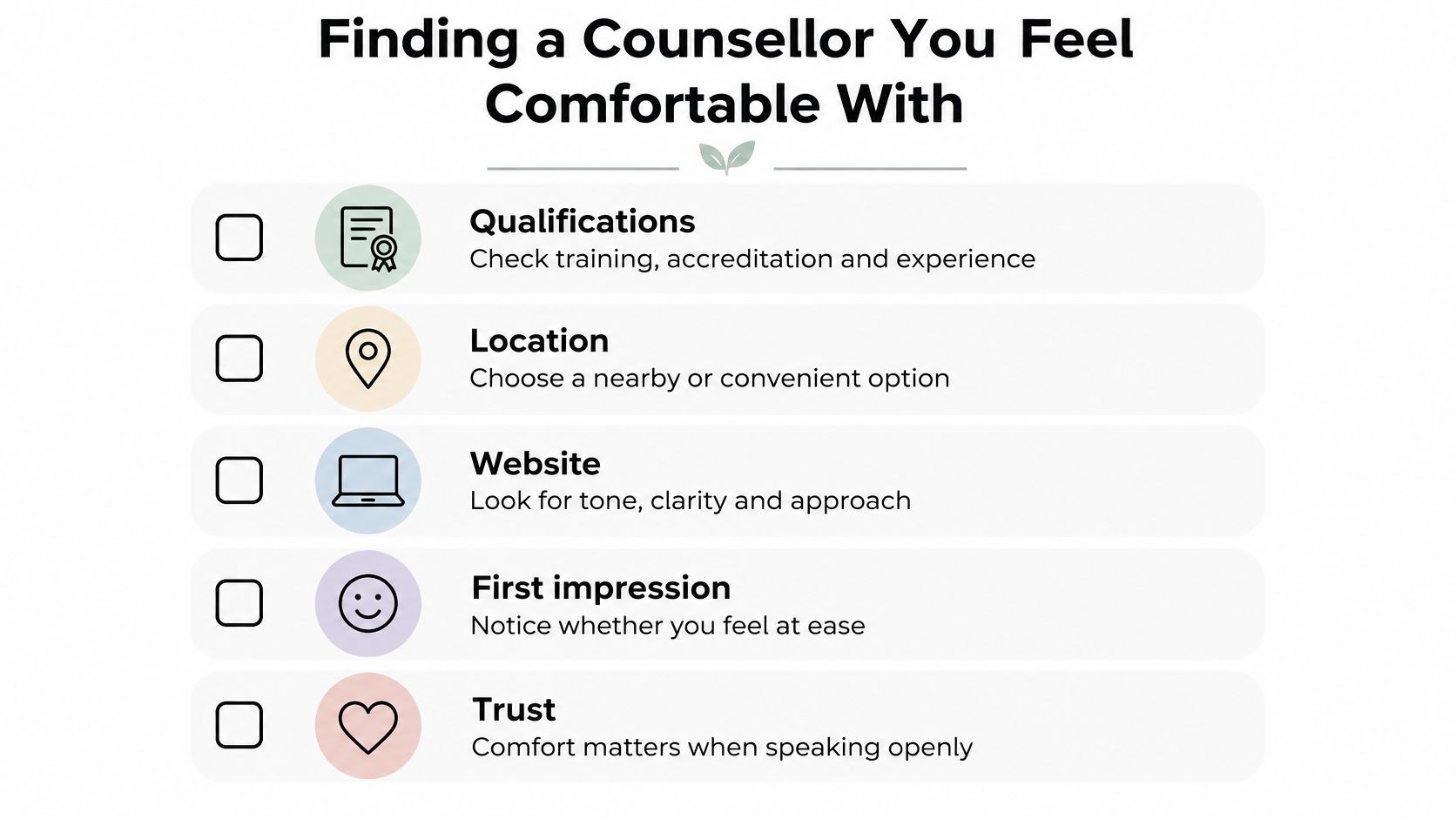
Use this as a filter, not a scorecard.
Plain language: Can they describe their approach without jargon, so you know what working together would involve?
Collaboration: Do they adapt the conversation to you, or are you being fitted into a fixed programme?
Pace: Will they let you help set the direction, including weeks when you need to go slowly?
Edges: Are breaks, endings and what happens if risk increases explained before you rely on the space?
Terms: Are fees, cancellation rules and the session format stated before you commit?
I am a registered member of both the BACP and the NCPS, and I am fully qualified and insured. Check a practitioner on the register of the body they name, rather than trusting a sentence on a homepage. The therapeutic alliance, the working relationship between you and the counsellor, is what makes the rest of the work possible.
If a few sessions do not feel right, say so. A good counsellor will welcome that conversation.
If something about my work troubles you, raise it with me first. Unresolved concerns can go to the BACP, my professional body. I also have regular supervision, and my supervisor would not know who you are. If someone else would suit you better, I can refer you on. Leaving is allowed. Staying out of politeness rarely helps.
Arrange a Free Introductory Conversation in Cheltenham
You can call, text or WhatsApp me on 07462 291471. A free introductory conversation is a chance to ask questions, say what brought you here, and notice whether working together feels possible. There is nothing to prepare and nothing to get right.
In that call we can look at face-to-face sessions at Suite 1, Portland House, 4 Albion Street, Cheltenham, GL52 2LG, near the main bus stops, online sessions across the UK, or Walk & Talk around Pittville Park. The usual fee is £60 per session, so the cost is clear before you commit to anything. I work with adults aged 18 and over, and anything you share when you first get in touch is recorded for initial contact purposes only, in line with GDPR.
You do not need to know which format suits you, or have a tidy account of the problem, before you reach out. People often think about counselling for a long while. There is no correct moment, and the decision to begin stays yours.
If you are at risk of harm, contact emergency services or a crisis line now rather than waiting for a reply. Otherwise, decide whether you would rather start in a room, on a walk or online, write down one question you want answered, and send a message when you are ready.
Therapy with Ben offers integrative counselling for adults, face to face in central Cheltenham, online across the UK, and as Walk & Talk around Pittville Park, with the relationship and the fit put ahead of a fixed programme. If you are weighing therapy in Gloucestershire and want a counsellor you can talk to, visit Therapy with Ben and arrange a free introductory conversation when it feels right.


Comments