


What Is Trauma Response? Signs, Patterns and Support
A colleague sighs loudly during a meeting, and your chest tightens. You start rehearsing an apology, defending yourself or looking for a reason to leave, even though nobody has criticised you. Afterwards, you wonder why such a small moment felt so uncomfortable.
If you're asking what is trauma response, that gap between what's happening and how threatening it feels can be a useful starting point. It deserves curiosity, not an automatic diagnosis.
What a Trauma Response Actually Means
A trauma response is a psychological and physical reaction to something threatening or overwhelming. It can happen during an event or afterwards, including when something in the present reminds your mind or body of earlier danger.
In the meeting example, the colleague's sigh might mean nothing more than tiredness. But for someone who learnt that a change in another person's mood could precede anger, it might feel like a warning. Their reaction may seem out of proportion to the immediate situation while making sense in the context of their history.
Distress at work isn't always visible in the same way.

An alarm that has learnt to be careful
Think of a smoke alarm that becomes particularly sensitive after a fire. Burnt toast now sets it off. The alarm isn't inventing the smoke, but it can't always distinguish a minor disturbance from serious danger.
That's an analogy, not a complete explanation of the nervous system. It helps describe how an understandable protective response can become uncomfortable or restrictive in a different setting.
NICE's PTSD guidance describes relevant symptoms including intrusive memories, avoidance, heightened alertness, emotional numbing, dissociation and changes in mood or thinking. Dissociation means feeling disconnected from yourself or your surroundings. Assessment also considers how symptoms affect everyday functioning, rather than relying on one reaction alone.
A useful starting point: What does this reaction mean to this person, in this situation?
Not every strong reaction is trauma-related. Anxiety, grief, exhaustion, and sensory overload can create similar feelings, and someone may withdraw because they need quiet. Understanding involves considering these possibilities rather than searching for an earlier trauma that must explain everything.
The concern is less whether you recognise an isolated symptom and more whether a recurring response is making relationships, work or caring for yourself difficult.
Fight, Flight, Freeze and Fawn Side by Side
Fight, flight, freeze and fawn describe protective patterns, not personality types. They can happen automatically, before someone has had time to think through what they want to do.
A person might become defensive in one relationship and unusually accommodating in another. These patterns can also overlap, so the categories are useful descriptions rather than separate boxes everyone fits into.
Fight, flight, freeze and fawn in everyday life
Pattern | What it can look like | Everyday example | What it may be protecting |
|---|---|---|---|
Fight | Arguing, snapping, pushing back, bracing to confront | Hearing a raised voice and immediately defending yourself | A sense that standing your ground is the only safe option |
Flight | Leaving, avoiding, restless energy, a strong need to escape | Walking out of a meeting because the tension feels unbearable | Distance from a perceived threat |
Freeze | Going blank, becoming still, struggling to speak or act | Being unable to reply to a difficult email from a manager | Shutting down when neither fighting nor escaping seems possible |
Fawn | Pleasing, over-apologising, agreeing to keep the peace | Saying it's fine when you're hurt by a sudden change of plans | Reducing conflict, which may once have kept you safer |
The response that can look like being agreeable
UK Government trauma-informed practice guidance includes fawn alongside fight, flight and freeze as a form of self-preservation. Fawning generally means trying to reduce danger by appeasing someone or putting their needs first.
It can be easy to miss because the person may appear helpful or relaxed. Internally, they might feel frightened of disappointing someone, conceal anger or apologise before they know whether they've done anything wrong.
Fawning isn't evidence of manipulation or a character flaw. Someone may have learnt that keeping another person calm helped them stay safer. However, ordinary generosity and compromise aren't automatically fawning; the fear, pressure and context matter.
Understanding a protective pattern also doesn't excuse hurtful behaviour. Someone can recognise why they snap during conflict while taking responsibility for its effect on others.
Rather than asking which response is wrong, you might ask which feels familiar, when you notice it and whether you remember needing it earlier in life. There's no need to force an answer.
How Past Experiences Shape Present Reactions
Early experiences can influence how readily someone detects danger. UK Government material on adversity and relationships describes brain scans showing increased activity in the amygdala, an area involved in detecting threat, in children exposed to adverse childhood experiences and trauma.
A child who hides, daydreams or becomes unable to move may be preparing for danger rather than deliberately refusing to cooperate. That possibility changes how an adult might respond, though the behaviour alone doesn't establish its cause.
This diagram illustrates the connection without suggesting that everyone follows an identical pathway.
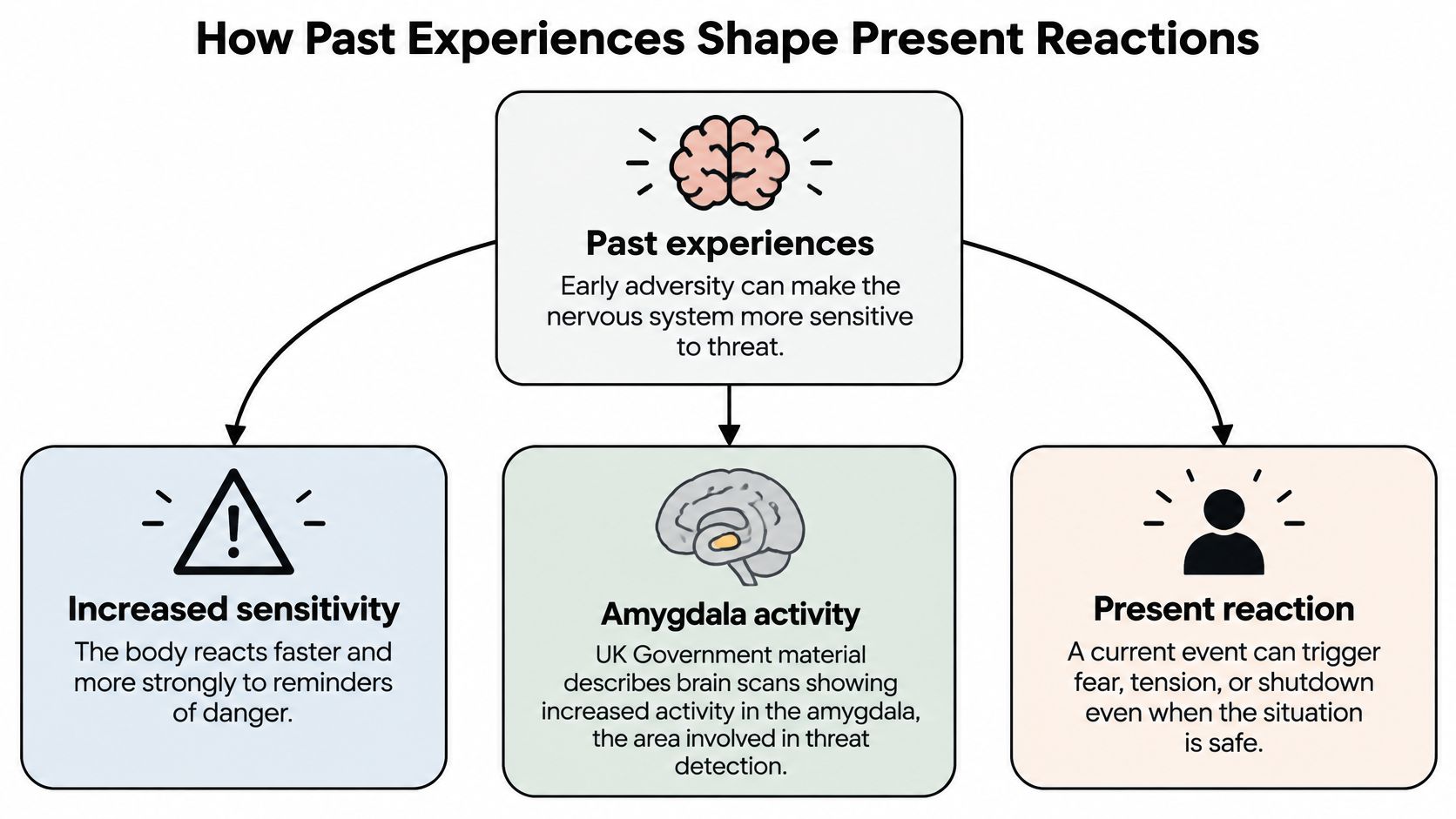
Experience influences expectations, not destiny
Earlier relationships can influence what silence, disagreement or closeness means. Someone who stayed quiet to avoid conflict may find another person's silence frightening, while someone else welcomes the same silence as breathing space.
Evidence submitted to the UK Parliament reported that approximately half of adults in England had experienced at least one form of adversity during childhood or adolescence. In a narrower sample, HM Inspectorate of Probation describes a 2021 study of 200 children exploring serious youth violence in which two-thirds had experienced five or more adverse childhood experiences. That finding shouldn't be generalised to all children or treated as a prediction of someone's future.
Dr Gabor Maté's compassionate perspective invites us to consider how earlier experiences shape coping. It offers a way of asking what a behaviour helped someone manage, rather than assuming something is wrong with them.
The following video offers another opportunity to reflect on these themes.
Bessel van der Kolk's The Body Keeps the Score is an influential account of trauma, the body and the nervous system. The broad relationship between trauma and physiology is supported by established evidence, but specific explanations and claims about particular body-based therapies remain debated. Neither author's framework should replace an individual assessment.
Our guides to issues explored in counselling offer other starting points for understanding distress without assuming a single cause.
Signs, Timing and When It May Be PTSD
You might notice distress physically before you can put words to it: a racing heart, shallow breathing, shoulder tension or stomach discomfort. Someone else might feel numb, disconnected or unusually exhausted.
No particular sensation proves that you're having a trauma response. New, severe or unexplained physical symptoms deserve medical attention rather than being assumed to be psychological.
Signs by area and what else can cause them
Area | Signs to notice | Can also be linked to |
|---|---|---|
Body | Racing heart, shallow breathing, chest tightness, shoulder or stomach tension, disturbed sleep | Stress, anxiety, illness, caffeine |
Emotions | Irritability, numbness, sudden tearfulness, feeling constantly on edge | Low mood, grief, burnout |
Thinking | Intrusive memories, rumination, difficulty concentrating | Worry, overthinking, lack of sleep |
Behaviour | Withdrawing, avoiding places or conversations, defensiveness, over-accommodating others | Shyness, conflict style, boundaries learnt in family or work |
Relationships | Difficulty trusting, fear of conflict, feeling unsafe when voices are raised | Past rejection, differences in communication, ordinary disagreement |
Duration matters, but it isn't the whole assessment
London Fire Brigade guidance describes acute reactions such as irritability, poor concentration, sleep difficulties, flashbacks and hypervigilance as usually subsiding within one to five days, with PTSD considered when relevant symptoms continue for 30 days or more. That's a guide to recognising persistent difficulties, not a deadline for recovery or a diagnosis based on duration alone.
Hypervigilance means remaining unusually alert to possible danger, perhaps watching other people closely or startling easily. Avoidance can bring immediate relief, but repeatedly staying away from safe situations may prevent someone from discovering that the feared outcome won't happen.
In the NHS Adult Psychiatric Morbidity Survey, 5.7% of adults in England screened positive for PTSD in 2023–24, compared with 4.4% in 2014, approximately 1 in 18 adults in the later survey; reported re-experiencing was 36.6% among 16- to 24-year-olds, compared with 17.6% among those aged 65 to 74 and 17.9% among those aged 75 and over. These are different measures: re-experiencing isn't equivalent to PTSD.
The survey used the PCL-C questionnaire. A positive screening result isn't a confirmed clinical diagnosis, and distress in younger adults may need exploring even when it presents as anxiety, withdrawal or disrupted sleep rather than recognised flashbacks.
Can a response appear much later?
Yes. Brewin's review of traumatic memories discusses delayed onset as a possible pathway, including how later everyday stressors may add to an existing burden. Delayed distress doesn't establish a particular cause, but it doesn't make an earlier experience insignificant either.
Many people recover without formal treatment. Others benefit from support, whether difficulties appeared immediately or much later.
Fiction can give language to distress, but it isn't a diagnostic reference. If that distinction interests you, MEB Books' unsettling reads for psychological thriller fans offers literary exploration rather than clinical guidance; choose carefully if intense material leaves you unsettled.
Useful questions are:
Has this lasted? Notice whether the pattern persists or keeps returning.
Does it limit daily life? Consider sleep, relationships, work and self-care.
Does it connect with the past? Allow uncertainty rather than searching for a memory that must explain it.
Coping That Steadies You Without Rushing the Past
Say you leave a tense conversation feeling shaky and immediately begin composing an apology. Before deciding what to send, you could pause long enough to notice what happened: were you criticised, or did disagreement itself feel dangerous?
Coping can create room to choose. It doesn't have to mean resolving the whole history behind a reaction in that moment.
Make the present more manageable
You might feel your feet against the floor and look around the room, noticing where you are. If focusing on breathing feels comfortable, allowing a slower, unforced out-breath may help; if it makes you more anxious, leave it and try something external, such as describing nearby objects.
Later, a brief note can separate the event from your interpretation: what the other person said, what you felt and what you feared would happen. The aim isn't to prove your feelings wrong, but to understand the difference between a feeling and a prediction.
You don't have to revisit the most painful memory to take care of yourself today.
If your automatic response is agreement, a sentence such as “I'd like to think about that” can give you space to notice what you want. Where it feels safe, letting a trusted person know you're unsettled can also reduce the pressure to explain everything perfectly.
Choose support, not another demand
A steady waking time and less screen use before bed may support rest, but no habit suits everyone. Keep a short note of what helps and what leaves you feeling worse rather than measuring yourself against an ideal routine.
If you're considering an app, KeenVerdict's independent reviews of meditation tools can help compare options, though product reviews aren't evidence that meditation will suit you. Evidence for individual techniques varies, and inward attention isn't comfortable for everyone.
For people who prefer conversation while moving, our walk and talk therapy in Cheltenham offers a different setting for exploration, not a requirement to feel calm outdoors.
Deciding Whether Counselling Could Help You
Counselling may be worth considering when reactions keep returning, affect daily life or leave you wanting to understand yourself more clearly. You don't need a diagnosis to start therapy, and you don't need to arrive certain that trauma is the explanation.
These prompts can help you decide whether you'd like support.
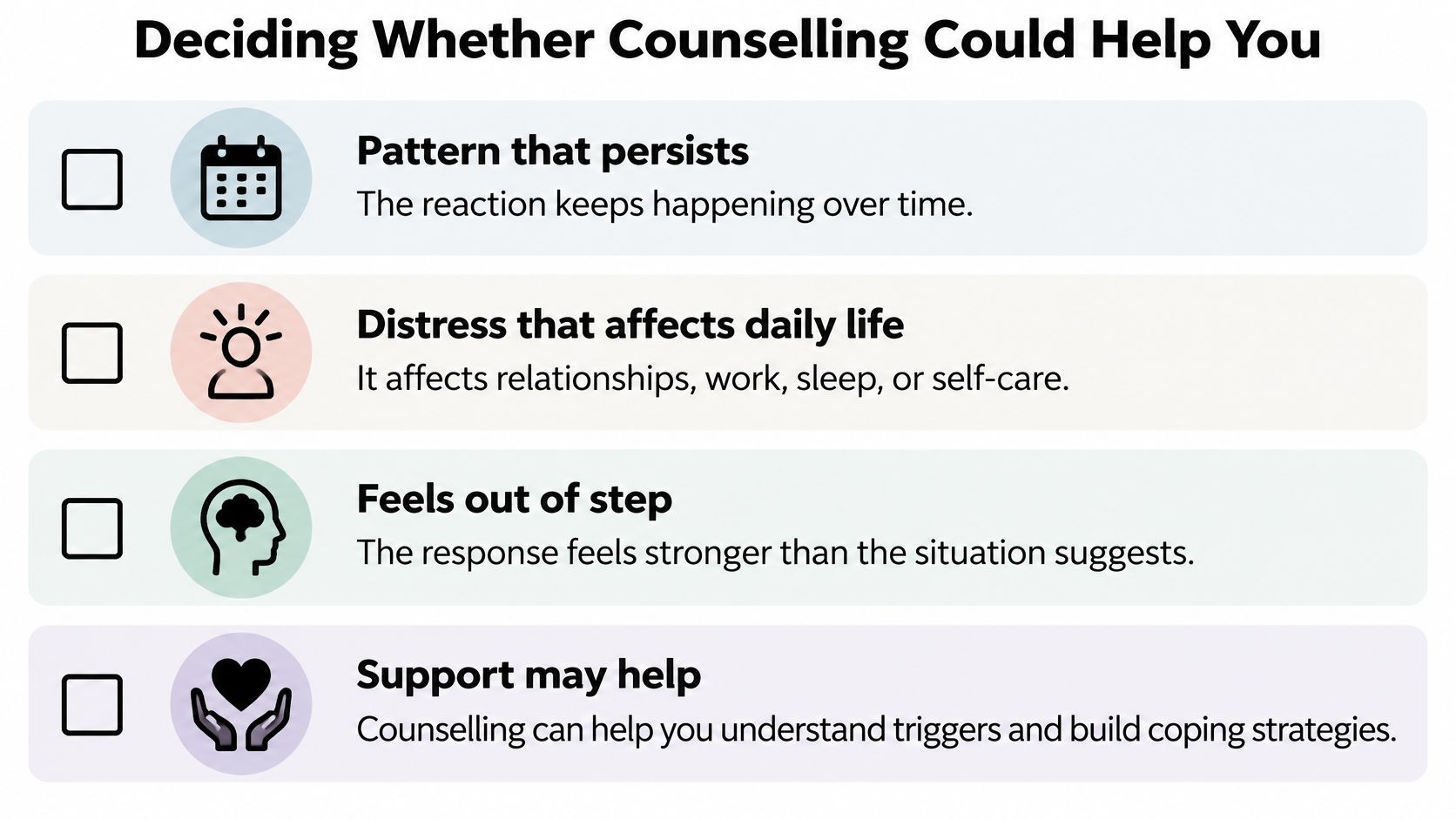
A relationship with room for uncertainty
My approach is integrative, drawing primarily on person-centred and psychodynamic counselling. Therapy is adapted to each person rather than following one rigid method; we explore what's happening now and may consider earlier experiences or recurring patterns when they feel relevant.
The therapeutic relationship matters, including whether you can disagree with me or say that an interpretation doesn't fit. Warmth helps, but trust also depends on consistent boundaries, transparency and respect for your choices.
UK Government guidance on trauma-informed working describes how inconsistent understanding can lead services to label people difficult, exclude them or re-traumatise them. Trauma-informed support therefore needs to attend to power, consent and pace, not just kindness.
Your choice matters: You can decline a question, pause or change direction. You don't have to tell the whole story.
Finding an appropriate fit
Some people benefit from specialist trauma-focused approaches, such as EMDR, which I don't provide. An initial conversation can help clarify whether my way of working fits what you need or whether specialist support would be more appropriate.
If you're curious about counsellor reflections, including mirroring, bring that question to a conversation; our counselling FAQs are another starting point. For readers comparing remote support across countries, Aroma Warehouse's Canadian counselling guide offers a Canadian perspective, though its local arrangements shouldn't be assumed to apply in the UK.
You can call, text or WhatsApp me on 07462 291471. A first message can name one pattern you've noticed and ask whether we could explore it together.
Therapy with Ben offers integrative, person-centred and psychodynamic counselling to help you explore difficult reactions without reducing you to a label. Visit the website to learn about working together and take a first step at a pace that feels manageable.


Comments