


Why Is Personal Growth Important for Real Wellbeing
Personal growth matters because UK wellbeing is tracked through life satisfaction, whether life feels worthwhile, happiness and anxiety, and about 9% of adults in Great Britain report a low sense that what they do is worthwhile. That figure is not about productivity or earning more. It's about whether your days feel connected to something that matters to you.
You might be functioning well on the surface and still feel that gap. You get through work, answer messages and keep appointments, yet the week feels flat or strangely pointless. Or a change in a relationship, your health or your understanding of yourself has left you asking who you are now.
That's often where the question of why is personal growth important stops being abstract. Growth, in the sense used here, isn't a project to fix yourself. It's the slower work of understanding your feelings, clarifying what you value and making choices that fit the life you're living.
Why Personal Growth Matters for UK Wellbeing
Personal growth matters because it affects whether life feels satisfying, worthwhile and emotionally manageable. Those aren't vague aspirations in the UK. They're measured.
The Office for National Statistics personal wellbeing methodology asks four questions, each scored from 0 to 10, covering life satisfaction, whether the things you do feel worthwhile, happiness and anxiety. In Great Britain, around 9% of adults reported low levels of feeling that the things they do in life are worthwhile, rising to 14% of people aged 16 to 29 and 11% of those aged 30 to 49.
The UK tracks these measures alongside economic indicators rather than treating income alone as progress. That matters because it recognises something many people already know from experience. A capable, busy life can still feel empty.
What the Four Measures Look Like in Ordinary Life
Measure | What it asks | Recent UK signal | What growth can change |
|---|---|---|---|
Life satisfaction | How satisfied are you with life nowadays, scored 0 to 10 | 5.3% reported low life satisfaction in Oct to Dec 2024, up from 4.5% in the same quarter of 2019; late 2023 average 6.9 | A life that fits your values more closely, not a higher output target |
Life feels worthwhile | Whether the things you do in life feel worthwhile, scored 0 to 10 | About 9% of GB adults low; 14% aged 16 to 29; 11% aged 30 to 49; late 2023 average 7.2 | Clearer purpose during transitions, identity questions or career change |
Happiness | How happy you felt yesterday, scored 0 to 10 | Late 2023 average happiness 7.0 out of 10 | More room for enjoyment once distress and self-criticism ease |
Anxiety | How anxious you felt yesterday, scored 0 to 10 | Late 2023 average anxiety 3.9 out of 10 | Less avoidance and a kinder response to worry, without expecting anxiety to vanish |
Life satisfaction might dip when work you're good at no longer fits who you've become. You're not failing at it. You just notice a quiet mismatch between your days and your values, and that mismatch gradually drains energy.
Worthwhileness is different. It's the sense that what you do has point or meaning, even on ordinary days. If you're exploring questions of direction, the Life Purpose App on purposeful living explores why that sense of purpose shapes how people experience their lives, which can be a useful companion to reflecting on your own values.
Happiness yesterday is more immediate. A relationship running on habit, where you're polite but rarely honest, can leave little room for actual enjoyment. Anxiety yesterday can shrink a day before it starts, as you rehearse conversations, avoid emails or cancel plans you'd otherwise want.
Growth Is Not Forcing Every Score Upward
A worthwhile life isn't a score to chase. It's a direction you can begin to notice.
Growth during identity formation, career decisions, changing relationships or discovering you may be neurodivergent rarely looks like steady improvement. It can mean becoming more authentic, understanding yourself more accurately and making one manageable change that restores a sense of direction.
Notice which of the four measures feels most alive for you right now. You don't need to rate yourself precisely. Just noticing whether it's satisfaction, worthwhileness, happiness or anxiety that pulls at you gives growth a starting point grounded in your experience, not someone else's target.
What Growth Looks Like and Where It Stalls
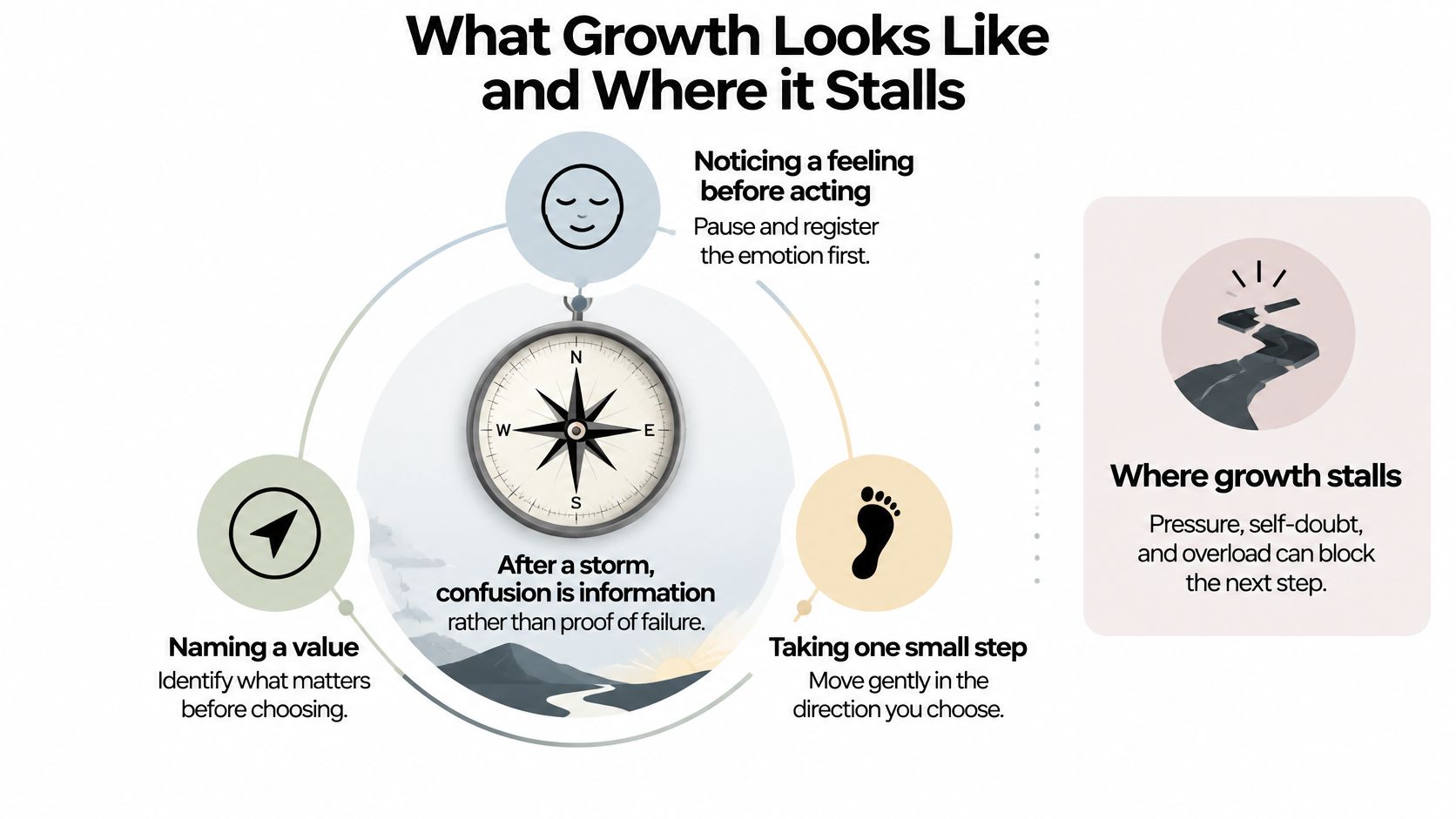
Think of a compass after a storm. The needle still moves, but you can't yet read it clearly, and the confusion itself is information rather than proof you've failed. Many people arrive at personal growth in exactly that state, not broken, just unable to tell which way is theirs.
Growth usually begins in quiet layers. First, you notice a feeling before acting on it, perhaps recognising irritation as tiredness before you send a sharp reply. Then you name a value or tell the truth about a limit, such as admitting you can't take on another commitment without resentment building.
The second layer is becoming more accepting and authentic rather than performing a better version of yourself. The third is harder to spot. It's recognising when self-improvement has become avoidance, when reading endless advice replaces grieving, resting or having a difficult conversation you've been putting off.
The visual below maps those quiet layers and where the path can break.
Two Very Different Responses to Feeling Behind
Say someone feels behind in life. One response is to add another habit, a stricter routine, a new app, because standing still feels shameful. The effort looks like growth, but it's driven by pressure, and each missed day becomes further evidence against them.
Another person pauses after burnout or a relationship shift and asks what matters now. That pause can look like doing nothing from the outside. In practice, it's often where honest change begins, because the question comes before the plan.
The Office for National Statistics wellbeing and loneliness dataset measures wellbeing through life satisfaction, happiness, anxiety and whether life feels worthwhile, not productivity alone. That supports a useful test you can apply to yourself. Are you growing, or pressuring yourself to perform better?
If you're weighing up different ways of thinking about mindset, the Pretty Progress growth mindset guide sets out how people approach learning from setbacks, which sits alongside the more reflective question of whether your definition of success is actually yours.
Signs Beside the Barriers They Can Hide
Experience | May be a sign of growth | May be a barrier |
|---|---|---|
Feeling lost after a life change | Curiosity about who you are becoming | Shame that you should already have the answer |
Life feels less worthwhile | Values and direction are being questioned | Endless advice used to avoid grief, rest or feeling |
Loneliness | A clearer need for safer connection | Treating a lack of connection as personal failure |
Constant self-criticism | Awareness of an old pattern of pressure | Demanding perfect progress or a better version of yourself |
Exploring autism or ADHD traits | Reframing masking and unmet needs | Blaming yourself for needs the environment did not meet |
Feeling lost and life feeling less worthwhile are the rows people confuse most. Both can signal that old values no longer fit, which is a beginning. They become barriers when shame takes over and you treat not knowing as a personal defect rather than a stage in working something out.
Loneliness works similarly. Recognising you need safer, more honest connection is growth. Interpreting loneliness as proof you're unlikeable tends to close you down further, when the need itself is ordinary and human.
Constant self-criticism can mean you're finally hearing an old pattern of pressure clearly enough to question it. It stalls growth when the critic sets the terms, demanding perfect progress before you allow yourself any credit. Questioning that inner voice is closely tied to reclaiming a sense of identity that isn't organised around self-attack.
For someone exploring autism or ADHD traits, growth often involves reframing years of masking or struggling in unsuitable environments. The barrier is continuing to blame yourself for needs that were never properly met or understood.
When Growth Looks Like Stopping
Growth can look like resting, saying no or allowing yourself to grieve something properly. It can also stall for reasons that have nothing to do with effort, because anxiety, depression or difficult circumstances remove the capacity you'd need to change.
Progress is uneven. People often notice it through shifts in distress, day to day functioning and self-understanding rather than through mood alone. If one row in the table fits you, hold onto it. It's a more honest starting point than a general resolve to improve everything at once.
Benefits for Mood Confidence and Daily Life
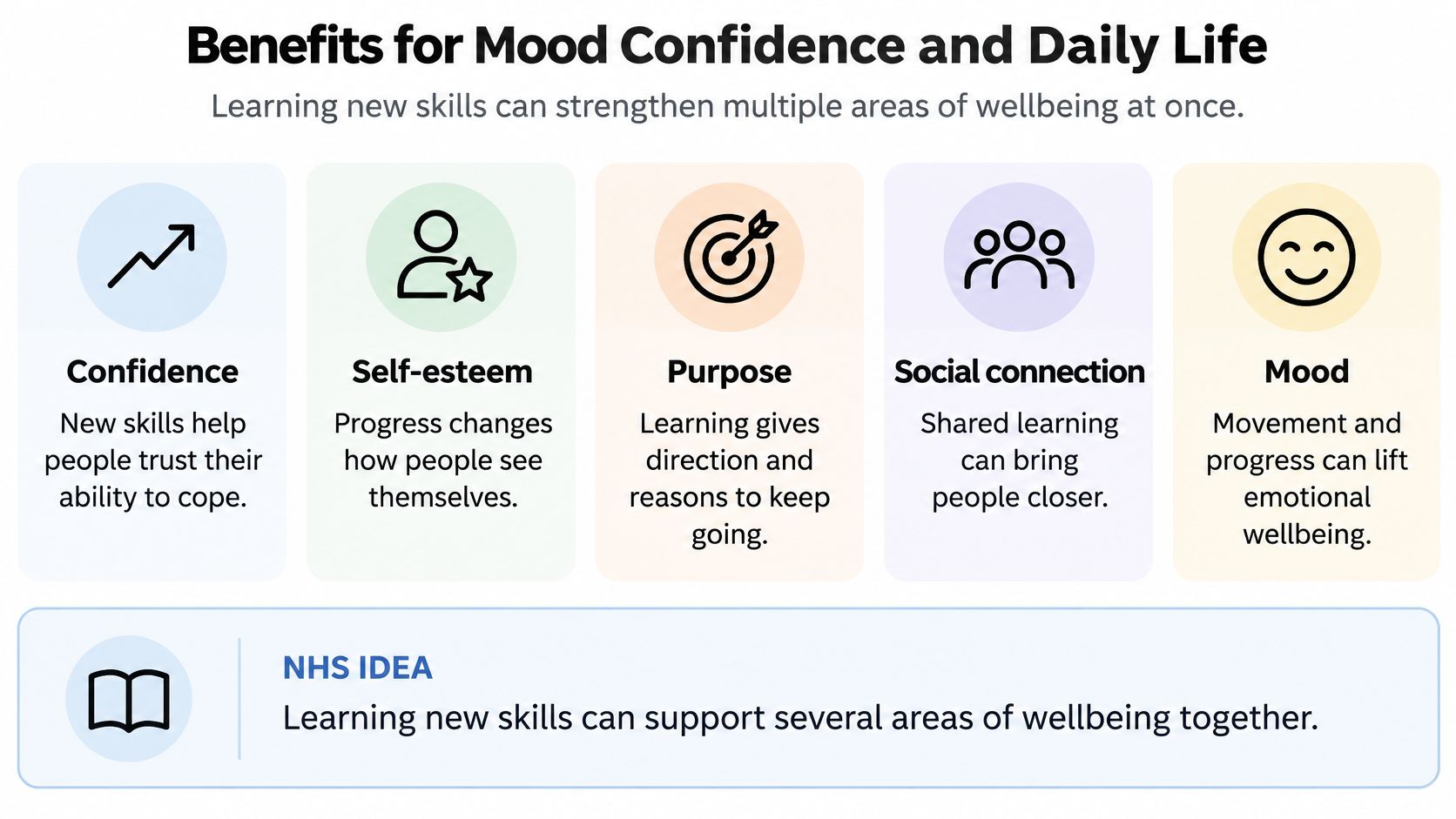
Learning something new is one of the clearest ways growth becomes tangible. The NHS five steps to mental wellbeing guide explains that learning new skills can improve mental wellbeing by increasing confidence and self-esteem, creating a stronger sense of purpose and helping people connect with others.
The pathway is straightforward. A manageable skill gives you evidence that you can cope with something unfamiliar. That evidence makes the next challenge feel less threatening, and engaging with it can lift your mood.
The panels below show how those benefits tend to arrive together rather than one at a time.
Small Targets Beat Vague Improvement
A small routine: Getting up, eating or walking at roughly the same time, kept deliberately modest so it survives a bad week.
Naming emotions: Pausing to say, even privately, whether you're anxious, flat, angry or ashamed, instead of just feeling bad in general.
One boundary: Stating a single limit clearly, such as not answering work messages after a set time.
An unfamiliar activity: Trying something low stakes where being a beginner is expected and nothing rides on performing well.
You can track these privately without turning them into another performance. Note how often you practised, rate your confidence from 0 to 10, and notice whether avoidance is shrinking or purpose feels slightly stronger. If confidence is the thread you keep pulling at, this reflection on building a quieter kind of confidence explores how self-belief grows from experience rather than affirmation alone.
Why Functioning Matters Beyond Mood
A useful sign of growth: slightly more choice in your day, and slightly less self-blame when the day goes badly.
The stakes are practical, not just emotional. A UK government independent review into mental health conditions, ADHD and autism reported that the proportion of adults aged 16 to 64 meeting criteria for a common mental disorder rose from 15.5% in 1993 to 22.6% in 2024. The same review identified approximately one million people aged 16 to 24 who were not in education, employment or training, and among young people in that group the share reporting a work-limiting health condition rose from 26% in 2015 to 44% in 2025.
Those figures don't mean personal growth fixes structural problems, and growth isn't a substitute for medical or professional care. No statistic promises the same result for everyone. They do show why rebuilding participation in work, learning, relationships or community life is a real benefit, not a bonus.
For anxiety, that might mean attending something you'd normally avoid. For low mood, ADHD related difficulties or a major life change, it might mean one realistic goal completed without the usual spiral afterwards. These gains still depend heavily on the people and circumstances around you.
Growth That Depends on Other People
How do you grow when your environment, relationships or mental health keep draining the capacity you'd need to change? It's the question most personal growth advice avoids, because habits alone don't answer it.
The image below captures that moment of standing at a fork while life continues around you.

Confidence and fulfilment aren't created in isolation. The Office for National Statistics bulletin on measuring progress and wellbeing beyond GDP reported that in January 2026, 23% of adults in Great Britain said they felt lonely often, always or sometimes, rising to 27% among 16 to 29 year olds and 28% among 30 to 49 year olds. It also reported that 24.6% of UK adults experienced some evidence of depression or anxiety between January 2023 and December 2024, up from 19.7% in 2018 to 2019.
Three Relational Moments That Count as Growth
Asking for a conversation instead of performing fine. Saying you're struggling to one trusted person can feel riskier than any new routine. It also changes the relationship, because the other person finally has something true to respond to. Thinking about what you actually value in relationships can help you notice which connections leave room for that honesty.
Noticing a family pattern still running your choices. Perhaps you learned early that love had to be earned through being useful, quiet or impressive. As an adult, you might still shape yourself around whoever is in the room. Seeing the pattern doesn't remove it overnight, but it creates a gap where a different response becomes possible.
Reframing masking as a response, not a defect. An adult exploring autism or ADHD may have spent years copying social cues, hiding overwhelm and then collapsing at home, interpreting all of it as personal failure. Understanding those experiences in relation to unmet needs can lift a longstanding burden of shame, including the low self-esteem that often grows around feeling different and not knowing why.
The short video below offers another angle on how change happens between people, not just inside one person's head.
A useful beginning is often recognising a limit, seeking one safer connection or interrupting a repeating pattern once. It isn't forcing positivity. Money, health, discrimination and loneliness all change how much change is possible at any given time, and pretending otherwise helps no one.
Being understood by another person is itself part of growth. It gives your experience a witness, and that can make it easier to believe your own perceptions.
How Therapy Helps You Notice Real Change
Therapy isn't a programme that installs growth in you. It's a place to understand your experience more clearly, with someone alongside you while you work out what it means.
Ben is an integrative counsellor whose work draws particularly on person-centred and psychodynamic approaches, adapted to the person rather than following one rigid method. He doesn't offer CBT, DBT or a menu of techniques. The work is collaborative, and it follows what feels relevant to you.
What Sessions Are and Are Not
Counselling is not about analysing every sentence, imposing interpretations or telling you how to live. You're free to agree with something, correct it or set it aside if it doesn't fit. That freedom matters, because growth that depends on pleasing your counsellor isn't really yours.
Sessions explore your thoughts and feelings, what's happening now, and earlier experiences or repeating patterns when those feel relevant. Sometimes being accurately reflected back to yourself, having your experience mirrored without distortion or judgement, is what allows you to hear your own feelings clearly for the first time.
You can develop a kinder understanding of yourself without abandoning accountability for your actions.
That stance runs through the work. Self-compassion and responsibility aren't opposites. Understanding why you react as you do can make it easier, not harder, to choose differently next time.
Three Ways of Meeting
Face to face in Cheltenham: A steady room and a regular time, which some people find containing when life feels chaotic.
Online counselling: Sessions that fit around changing schedules, and a way of starting that can feel less exposed if walking into a room feels like too much.
Walk and talk therapy: The conversation happens outdoors while you move, which some people find easier than sitting still and being looked at.
None of these is ranked above the others. Each is just a different setting for the same underlying work, being accompanied while you test what feels authentic, notice relational patterns as they happen and gradually reduce the shame attached to them.
People bring many kinds of difficulty into that space, including anxiety, low mood, self-criticism, relationship problems, feeling lost, life change and questions around neurodivergence. Those are contexts for exploration, not promises about outcomes. Change tends to show itself first, in a pause before an old reaction, or a sentence you finally say out loud.
Choose a First Step That Fits Your Life
You don't need a full plan. You need one step that's honest about your current capacity.
Pick the wellbeing question that mattered most. Satisfaction, worthwhileness, happiness or anxiety. Note what was happening the last time it dipped, including who you were with and what you'd been avoiding. If writing helps you think, this guide on how to write useful journal entries offers a simple structure for getting those observations down without it becoming another chore.
Name what's using up your capacity. Choose one relationship, limit or repeating pattern rather than a new self-improvement target. This is the row you marked earlier, the one that fits.
Decide who you want alongside you. You might reflect alone for now, perhaps reading further about developing a growth mindset in everyday life, or you might want a counsellor. Consider which setting feels possible, face to face in Cheltenham, online or walk and talk.
If you want company with the work, ask. Contact Therapy with Ben to ask about a first conversation. A first conversation is a chance to see how it feels, not a commitment to a programme.
Ben works with anxiety, depression, self-esteem, relationships, emotional difficulties, life changes, identity and neurodivergence. Counselling focuses on exploring your thoughts and feelings rather than giving advice, and the work helps you work out what you might like to do.
Growth can be slow, and that's not a failure of effort. Mental health difficulties may also need a GP or other care alongside any reflective work. If you're not ready, that's useful information too, and it deserves the same honesty as any other step.
If you'd like support making sense of where you are and what might help life feel more worthwhile, Therapy with Ben offers integrative counselling in Cheltenham, online and through walk and talk sessions, at a pace shaped around you. You're welcome to get in touch to ask about a first conversation and see whether working together feels right.


Comments