


Adult ADHD and Anxiety: Overlap, Diagnosis and Support
You meant to pay that bill yesterday. The meeting started without you. Now it's past midnight, and you're replaying both moments, sure you've let everyone down again. If that loop feels familiar, adult ADHD and anxiety may be tangled together rather than sitting as one neat problem.
The bill might have slipped because starting dull admin is hard, or because opening the envelope felt too loaded to face. The lateness might come from a weak sense of time, or from putting off a room where you expect to be judged. Sleep might fail because your mind won't park, or because dread keeps scanning tomorrow.
You don't have to decide which story is the only story tonight. You do need a way to tell the patterns apart, and a way to get support while clearer answers are still some way off.
What Adult ADHD and Anxiety Actually Are
ADHD is a neurodevelopmental difference in attention, activity and impulse control. It begins in childhood and shows up across home, work and relationships, not only in a classroom. Anxiety is a threat-detection system that has become overactive. It brings worry that's hard to switch off, avoidance, muscle tension and disturbed sleep.
A useful picture is a car. ADHD resembles a car with a very sensitive accelerator and weak brakes. You speed into a task, then struggle to stop, switch or park. Anxiety is the warning light that keeps flashing even when the engine is running fine. Both can leave you late, restless and exhausted, for different reasons.
Three words come up often, and each has a plain meaning.
Executive function: the mental skills that help you start, sequence, remember and finish ordinary tasks.
Rumination: replaying a worry without reaching a decision or a next step.
Hyperarousal: a body that stays tense and easily startled long after the demand has passed.
One pattern can intensify the other. A missed deadline feeds shame, shame feeds avoidance, and avoidance makes the next deadline harder to face. You may need to understand both before you decide what to change.
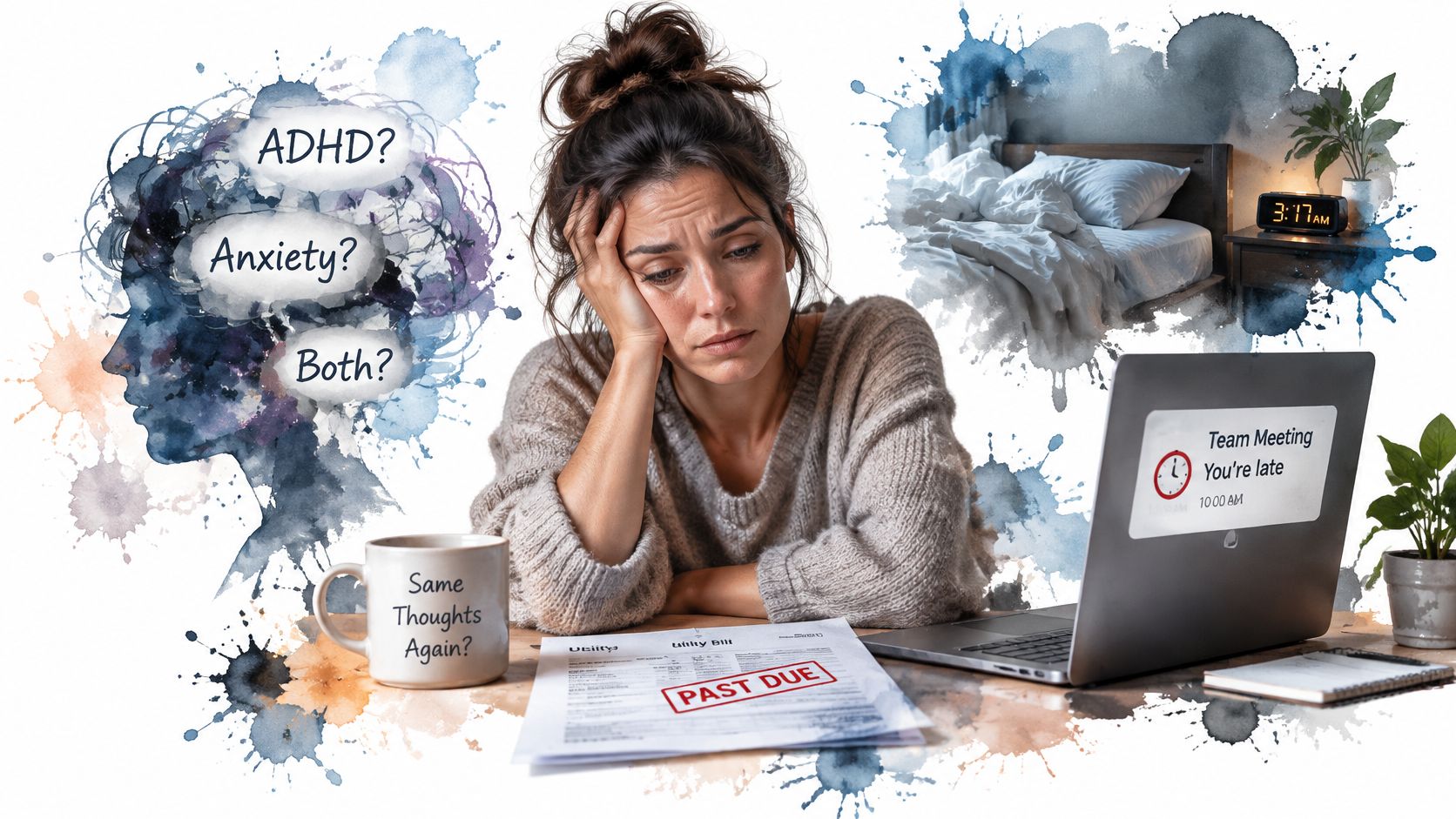
Which feels closer to your week, the accelerator that won't ease off, or the warning light that won't go dark? The comparison below is a reading aid for that question, not a diagnosis.
Telling ADHD Traits From Anxiety Symptoms
Several everyday experiences can come from ADHD, from anxiety, or from both at once. The table is a way to read your week more carefully. It is not a checklist you can tick and call a diagnosis.
Experience | Often Points Towards ADHD | Often Points Towards Anxiety | Useful Question to Ask |
|---|---|---|---|
Losing focus during routine tasks | Lifelong pattern that appears even when calm and interested | Focus fades mainly when worried or scanning for threat | Did this start in childhood, and does it happen when you feel calm? |
Restlessness | Constant need to move or fidget, present for years | Tension or shakiness that eases with reassurance or a change of setting | Does it settle when you feel safe, or only in certain situations? |
Sleep problems | Difficulty winding down with racing thoughts, present across most of adult life | Worry-driven insomnia or waking with dread, often linked to a stressful period | Has sleep always been difficult, or did it change with a specific event? |
Lateness and missed deadlines | Repeated across school, work and home, linked to poor time sense and difficulty starting tasks | Avoidance driven by fear of judgement or failure | Do the same slips happen when there is no pressure? |
Feeling overwhelmed by tasks | Overload from many small demands and difficulty deciding where to start | Dread that grows as a task feels more threatening | What happens to the task when the worry is removed? |
Three discriminators worth testing
Clinicians often look past the symptom name and ask three harder questions.
Onset. ADHD traits were there in childhood, even if nobody named them. Anxiety linked only to a later stress, such as a new job or a bereavement, has a different history.
Consistency. ADHD difficulties show up at home, at work and with other people, including on calm days when you care about the task. Anxiety is usually strongest under threat or scrutiny, and it often eases when you feel safe or reassured.
What happens when worry drops. If concentration returns once the fear is gone, anxiety may be doing most of the work. If you still can't start, sequence or finish the task when you feel settled, an attention pattern may be sitting underneath.
Keep a short diary for one or two weeks. Note the context, the time of day, and what actually helped. Take that page to your GP or assessor rather than a verdict you've already written about yourself.
How Often ADHD and Anxiety Overlap
Plenty of adults arrive at a GP surgery convinced they have an anxiety problem and leave with a referral that also mentions ADHD. The numbers help explain why. Likely adult ADHD is far more common than the diagnoses written into English GP records, and that gap matters if your concentration, restlessness and overwhelm have always been filed under "just anxiety".
The NHS England independent ADHD Taskforce puts likely adult ADHD prevalence at 2–3% of the population, while 2018 English primary-care records documented ADHD in only 0.74% of men and 0.20% of women. Those figures are not the same kind of number. One estimates how many adults are likely to have ADHD. The other counts diagnoses that were recorded. The distance between them suggests many adults live with ADHD-related difficulties without a formal label, particularly women and older adults.
The England Adult Psychiatric Morbidity Survey for 2023/24 asked adults directly about their experiences. In that survey, 1.8% of adults said they had received a professional ADHD diagnosis, 5.8% believed they had ADHD, and 13.9% screened positive on the Adult ADHD Self-Report Scale, including 14.9% of women and 12.4% of men. A positive screen is not a diagnosis. It does show a wide gap between the symptoms people recognise in themselves, the scores screening tools produce, and what ends up in formal records.
Source | Figure | What It Measures |
|---|---|---|
NHS England Independent ADHD Taskforce | 2–3% of the population | Estimated likely adult ADHD prevalence |
English primary-care records, 2018 | 0.74% of men and 0.20% of women | Recorded ADHD diagnoses |
Adult Psychiatric Morbidity Survey, 2023/24 | 1.8% of adults | Adults reporting a professional ADHD diagnosis |
Adult Psychiatric Morbidity Survey, 2023/24 | 5.8% of adults | Adults who believed they had ADHD |
Adult Psychiatric Morbidity Survey, 2023/24 | 13.9% of adults | Adults screening positive on the Adult ADHD Self-Report Scale (14.9% of women and 12.4% of men) |
OpenSAFELY primary-care data, 2024/25 | 1.3% | Recorded ADHD across the UK, up from about 0.4% in 2016/17 |
Ulster University study, 2024 | 59.7% | UK university students diagnosed with or probably meeting criteria for ADHD who met criteria for anxiety |
Institute for Global Change analysis of the 2023 Annual Population Survey | 23% | Working-age UK adults reporting high levels of anxiety |
Why these figures can't be added together
OpenSAFELY primary-care data show recorded ADHD across the UK rising from about 0.4% in 2016/17 to 1.3% in 2024/25. That rise describes coded diagnoses, not a new headcount of everyone who has ADHD. It does help explain why more adults now arrive at a GP or a counsellor with anxiety and a question about attention.
Anxiety figures come from different groups and different measures, so they can't prove how often the two conditions share a life. In a 2024 Ulster University study, 59.7% of 191 UK university students diagnosed with ADHD, or meeting probable ADHD criteria, also met the study criteria for anxiety. Separately, Institute for Global Change analysis of the 2023 Annual Population Survey found that 23% of working-age UK adults reported high levels of anxiety. One figure describes students already close to an ADHD description. The other describes working-age adults in general.
For you as an individual, the population maths matters less than the order of events. Sometimes anxiety sits alongside ADHD as a separate condition. Sometimes it grows out of years of unrecognised executive-function struggle: the forgotten plans, the last-minute scrambles, the slow accumulation of moments where things went wrong and nobody could say why. If your anxiety is high, it's reasonable to ask whether lifelong difficulties with attention or organisation are part of the picture too, rather than assuming anxiety explains every late email and unfinished task.
Why an Adult ADHD Assessment Takes Careful Judgement
An adult assessment looks at your history as well as the week you're having now. A current checklist of worry, restlessness and poor sleep isn't enough on its own, because those experiences overlap.
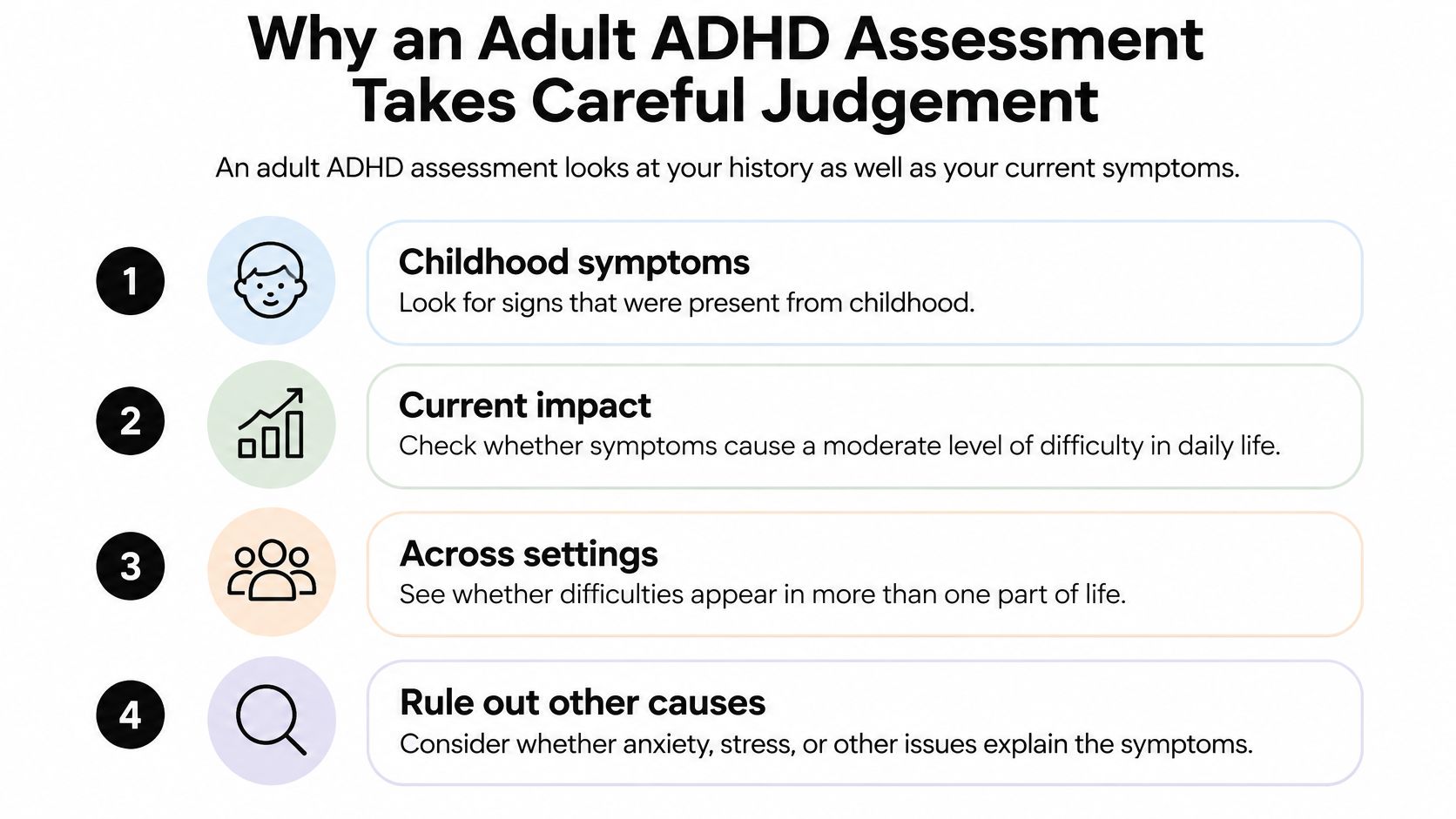
UK diagnostic information from Dudley Council's neurodivergence guidance sets out four conditions. Symptoms must have been present from childhood, cause a moderate level of impairment, affect more than one area of life, and not be better explained by another condition, including an anxiety disorder. For adults aged 17 and over, five symptoms in either the inattentive or the hyperactive-impulsive domain may meet the symptom threshold, rather than the six required for children.
Worry, poor concentration, restlessness and broken sleep can belong to either pattern. Assessors therefore ask when the pattern began, and whether it appears across home, work and social life, not only in the hours when you feel under threat.
Many adults, particularly women, are recognised late. Traits were masked, or they were filed under anxiety or perfectionism for years. Ben has a particular interest in ADHD, autistic traits, late recognition of neurodivergence, masking, emotional intensity, shame and the experience of feeling different. That interest shapes how we listen, but it doesn't turn a counselling conversation into a diagnosis. If you're weighing routes, our notes on a private ADHD assessment set out what that pathway involves.
A short film on how anxiety and ADHD can be told apart is worth watching before you try to summarise your whole history in one appointment.
What helps an assessor see the pattern
Bring what you can, not a perfect file.
School reports and early memories: comments about daydreaming, lateness, unfinished work or constant movement.
A family observation: someone who knew you as a child, if that's safe and available.
A timeline of anxiety: when worry became constant, and what else was happening then.
Sleep, alcohol and other substances: patterns that can mimic or worsen both sets of difficulties.
Previous treatment: what you tried, and whether attention problems remained when anxiety eased.
An assessment describes a pattern of difficulty. It is not a judgement of your character, your effort, or your worth.
Coping With Waiting and Everyday Overwhelm
UK ADHD waits are long enough to become part of the problem. The UK Government's independent review reports that waits vary from under two months to more than 1,000 days, depending on where you live. The Independent Taskforce found waits of around two years were common in many areas, and substantially longer in others. The same review cites national evidence that the proportion of people whose difficulties worsen rises from about one in four among those waiting less than two weeks to more than seven in ten among those waiting longer than six months. That doesn't prove waiting causes every person's anxiety. It does show why uncertainty and delayed answers can matter clinically.
Each unanswered month invites another worry, and many people start to fear they'll be dismissed. Use the wait to gather evidence, not to prosecute yourself. Write two or three concrete examples of how difficulties affect work, relationships or sleep. Prepare a few questions for the GP, such as what the local pathway is and what support you can use meanwhile. Treat online screening tools as a conversation starter, not a verdict.
Anxiety may be a separate condition, a response to years of unmanaged executive-function difficulty, or both. Easing it confirms nothing and rules nothing out about ADHD. Ideas for the anxious side of the wait sit in our piece on how to manage anxiety naturally. They are supports, not a substitute for assessment.
Six supports for an overloaded week
Move tasks onto one visible list. Working memory overloads quickly, and a list outside your head stops you from holding the whole week at once.
Start with a first step of ten minutes or less. A smaller opening shrinks the dread that blocks starting. You can stop when the ten minutes end.
Lengthen your out-breath when worry spikes. A slower exhale eases the body's sense of threat, which makes the next decision slightly easier.
Keep a fixed wake-up time, and stop screens an hour before bed. Sleep that drifts later each night makes both focus and worry worse the next day.
Set fixed times for decisions you rehearse endlessly. Rumination often masquerades as planning. A ten-minute slot on Tuesday and Friday is a boundary, not a failure of care.
Tell one trusted person which tasks are hardest. Help that arrives before a crisis is more useful than sympathy after one.
These work best when you adjust them. If impairment at work, at home or in relationships stays severe, that is a reason to seek assessment or therapy, not a sign you should try harder alone.
If thoughts of self-harm or suicide arise during a long wait, contact your GP, NHS 111, or Samaritans on 116 123 without delay.
Therapy and Treatment Options Compared
A useful way to compare options is to ask which job each one is doing. Counselling gives you a steady place to examine thoughts, feelings and long-standing patterns, including shame, identity and the coping habits built across years of unrecognised difficulty. Medical care handles diagnosis, prescribing and the physical side of treatment. The two often work best side by side, with medication decisions left to the prescriber.
Option | Suits | What It Involves | Practical Note |
|---|---|---|---|
People who want an in-room space and a regular weekly session | Exploring thoughts, feelings and long-standing patterns with a counsellor | Travel time and room availability vary | |
People who prefer sessions at home or live outside Cheltenham | Video or phone sessions following the same counselling approach | Needs a private space and a reliable connection | |
People who find it easier to talk while moving | Sessions held outdoors while walking together | Weather and terrain shape the route | |
GP review of medication | People who suspect ADHD or already have a prescription | Discussing symptoms, reviewing prescriptions and arranging referral | Changes must be made with the prescriber; shortages can disrupt supply |
Specialist ADHD assessment and treatment | Adults seeking a formal diagnosis and treatment plan | Clinical assessment followed by treatment options | Waits can be long; check local pathways early |
When medicine and talking do different jobs
A Cheshire and Merseyside NHS prescribing statement describes a national shortage of ADHD medication that began in September 2023, with limited supplies of modified-release methylphenidate and intermittent regional disruption. If anxiety, irritability, sleep or day-to-day functioning worsen while a prescription is unavailable, changed or paused, tell the prescriber. That shift does not prove the medicine caused anxiety, and it is not a problem to solve by adjusting doses alone. It may reflect rebound symptoms, lost routine, poor sleep, uncertainty, or the return of untreated overwhelm.
Commercial pages about CBD use for ADHD symptoms can sound confident while sitting outside prescribed care, so any question they raise belongs in a medication review rather than self-experimentation.
I work an an integrative therapist, so therapy is adapted to each person rather than following one rigid method. It draws particularly on person-centred and psychodynamic ways of listening, which suits adults whose anxiety has grown alongside years of masking, self-criticism or feeling different. More on that sits in my article on counselling for ADHD. Walk and talk can suit people who find a chair hard to stay in; some clients definitely find talking while walking much easier than sitting in a room.
Frequently Asked Questions About Counselling
Do I need a diagnosis before counselling?
No. You can seek support for anxiety now. A counsellor can work with the pattern you describe while assessment proceeds separately.
Will counselling tell me whether I have ADHD?
No. Counselling explores thoughts, feelings and long-standing habits. Diagnosis runs through your GP or a specialist pathway.
What if my medication runs short and my anxiety rises?
Tell your prescriber promptly rather than stopping or changing doses alone. Counselling can help with the emotional load, while medical decisions stay with the prescriber.
Is walk and talk therapy suitable if I struggle to sit still?
Often yes. Many people find it easier to talk while moving, and the session can follow a pace that fits you.
Is online counselling a real option?
For many people it is, provided you have a private space, a reliable connection, and you can attend consistently. The work is the same conversation, not a lesser version of it.
How long will I need to attend?
That depends on what you want to explore. You can review it with your counsellor at any point, including early on.
What if I'm not sure this is the right approach?
Say so in the first session. A good counsellor will explain how they work and refer you on if they can't help. Counselling focuses on exploring thoughts and feelings rather than giving advice, and together you can work out what you might like to do.
Choose Your Next Step Towards Support
The step you can take this week is a GP appointment. Bring your symptom diary and two or three concrete examples of how life is affected at work, at home or in relationships. Ask what the local ADHD pathway looks like, and what support you can use while you wait.
You don't have to hold off on counselling until a clinic writes a label. Look for a counsellor who is used to adults with anxiety, ADHD or other neurodivergence, who can explain their approach in plain language, and who will refer you on if they aren't the right fit. At a first meeting, ask how they work with uncertainty, and what happens if you need a medical review alongside the talking.
We offer face-to-face sessions in Cheltenham, online counselling across the UK, and walk and talk therapy for adults aged 18 and over. Choose the option that fits your life now, and revisit it as your understanding of your own pattern grows.
Therapy with Ben offers counselling for adults living with anxiety alongside possible or diagnosed ADHD, in person in Cheltenham, online across the UK, and outdoors as walk and talk. The work is a place to make sense of overwhelm, shame and long waits, alongside whatever your GP or assessor is doing medically. Visit Therapy with Ben when you want to talk through which kind of session would fit.


Comments