


Counselling Depression and Anxiety: How It Can Help
It's late, the lights are off, and your mind is still running through tomorrow. By morning the energy has gone, so the tasks you worried about sit untouched, and that unfinished list becomes another reason to feel useless. If that loop sounds familiar, you're not looking at two neat, separate problems. Low mood and anxiety often arrive at the same time, and it can be hard to say where one ends.
Counselling for depression and anxiety doesn't start by ranking them. I don't see my role as diagnosing which difficulty is primary, or as deciding that one must be causing the other. What matters is your experience: how you feel it, what it does to sleep, work, relationships and self-esteem, and what might make ordinary days more manageable.
Understanding can open choices. It doesn't make change automatic, and it isn't the same thing as a guaranteed recovery.
How Depression and Anxiety Overlap in Everyday Life
Worry and low mood often trade places in the same week. You lie awake rehearsing a conversation, then feel too flat the next day to have it. Avoiding the anxious moment can deepen the low mood, and the low mood makes the next invitation feel impossible. I don't try to decide which one is driving the other.
Relationships and self-esteem carry a lot of this. A partner or colleague may notice you withdrawing before you have a name for it. A harsh inner voice turns a normal mistake into apparent proof that you're failing, so you hold back, and the criticism gets louder.
Many people don't ask for help because it all feels too ordinary. Tiredness, overthinking and a shorter fuse can look like a busy personality. Irritability is part of that picture, and I've written about how anxiety and irritability affect close relationships.
The Adult Psychiatric Morbidity Survey for England, 2023-24 found that 20.2% of adults had a common mental health condition. Generalised anxiety disorder affected 7.5% of adults, and 3.8% had a depressive episode. The same survey found that 18.3% of adults had symptoms at a level likely to benefit from acknowledgement and possible intervention. You don't need a crisis, or a formal diagnosis, before this is worth discussing.
How one experience can feed the next
A steady inner commentary can turn an ordinary setback into apparent proof of failure.
Experience | How it can show up | Possible effect on daily life |
|---|---|---|
Persistent worry | Racing thoughts, tension, checking and seeking reassurance | Poor concentration, disrupted sleep, avoiding situations |
Low mood | Flatness, loss of interest, tearfulness, slowed thinking | Withdrawing from friends, reduced motivation at work or at home |
Shame or self-criticism | Harsh inner commentary, feeling not good enough | Holding back at work, strain in relationships, lower self-esteem |
Sleep disruption | Difficulty falling asleep, early waking, unrefreshing sleep | Fatigue that intensifies both worry and low mood |
Avoidance | Declining invitations, postponing tasks, staying at home | A narrowing of life that can deepen anxiety and low mood |
How Counselling Helps You Recognise Patterns
Counselling looks at the person rather than a checklist of symptoms. Across sessions, certain reactions start to repeat in ways you can finally see: going quiet when criticised, pushing through exhaustion, assuming other people are already disappointed in you. Anxiety and low mood tend to share these underlying habits, so loosening one often shifts something in the other. Neither has to be ranked above the other before the work can begin.
The image below is one way of thinking about that movement, from a first telling of the story toward a clearer sense of the pattern underneath it.

I focus on exploring thoughts and feelings, and I can help you work out what you might like to do. The direction comes from what you discover in the room, so sessions stay shaped around you rather than a fixed programme.
Take a hypothetical, drawn from common experience rather than anyone's actual therapy. Every time a manager gives feedback, you go very still and agree with everything. In the room we might slow that moment down. The stillness may once have kept you safe from shame, and seeing it that way changes what the moment means. Then we can ask what it costs you now.
Where change can start
When change comes, it usually sits in one of three places.
Circumstances: a job, living arrangement or relationship that steadily drains you, where staying may be costing more than you have admitted.
Relationships: how you ask for what you need, how you handle conflict, and whether a boundary is something you can keep.
Ways of thinking: the inner voice that treats every mistake as a verdict on the whole of you.
Recognising a pattern and shifting it are two different jobs, and they run on different timescales. Insight can arrive in a single conversation, while the habit of going quiet may take much longer to loosen. A response that shows up less often, or releases its grip a little sooner, still counts as real progress. Part of the work is understanding why the pattern persists, including what it once made bearable.
The aim is more deliberate choices, made at a pace you can actually keep.
Between sessions, some people find it useful to keep a few practical emotional wellbeing habits in view, such as sleep, movement and small routines that make the day less harsh. Those habits support the talking. The pattern itself gets understood in the conversation.
If you want a feel for how an exploratory conversation sounds, this short film gives a reasonable sense of it.
What Happens in a First Counselling Session
A first session is a beginning, not a demand that you explain your whole life. People arrive with very different comfort in talking about feelings. Some speak fluently. Others have rarely had the space, and nobody is expected to disclose everything at once. You don't need a diagnosis to start.
This is the shape of that hour in outline.
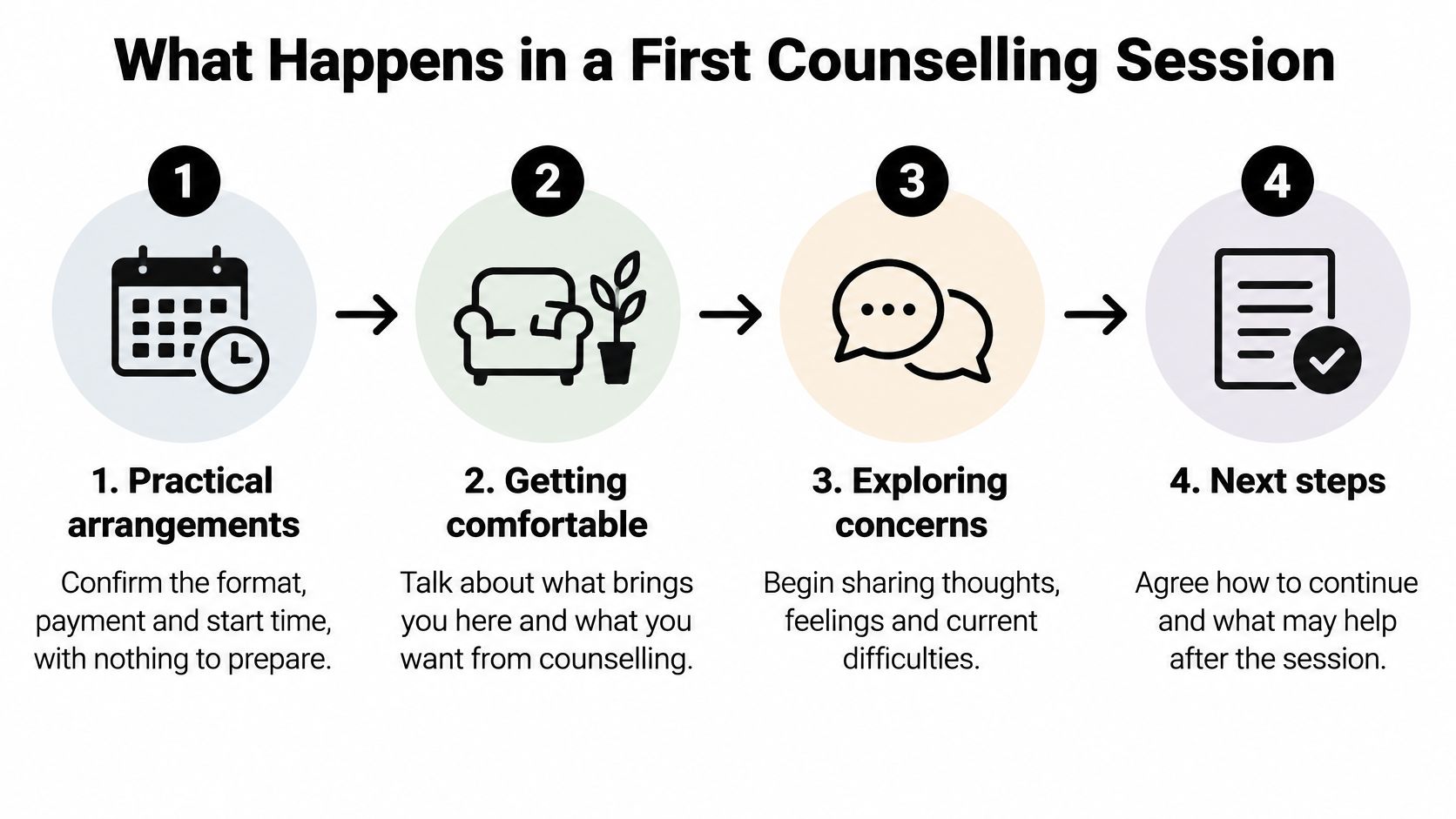
Practical arrangements. We confirm whether we'll meet face to face, online or while walking, along with payment and the start time. You don't need notes or a prepared speech. Knowing the frame lets you use the time for what brought you.
Confidentiality. I explain how confidentiality works, and where it may be broken if someone is at risk of serious harm. That limit is part of the first meeting so you know what the privacy covers before you decide how much to say.
What brought you. You describe what has been happening and why now, in whatever words you have. A vague sense that things have been getting smaller is a valid place to begin.
Context. We look at work, relationships, sleep and recent changes, and at any earlier experiences you choose to mention. Present concerns matter as much as anything from the past. I won't steer the hour toward childhood unless that's where you want to go.
Hopes. We talk about what you'd like to be different, even if that starts as feeling less alone with it. A hope gives us something to return to later, when it isn't clear whether the work is helping.
Fit. Both of us notice whether we can talk together, and you can ask questions at any point. If the conversation feels workable, you leave with a clearer sense of what you want to look at. If it doesn't, that is useful information too.
A realistic sense of length
NHS Talking Therapies annual figures for 2023-24 recorded 1.83 million referrals, and people who received treatment attended an average of 8.2 sessions. That average is a population figure, not a promise about you. In private integrative work I would rather agree review points, and what would make the therapy feel useful, than assume one standard length.
How an Integrative Approach Compares with CBT
My work is integrative, drawing particularly on person-centred and psychodynamic ideas. Person-centred work treats you as the best guide to your own experience, and it relies on being understood accurately rather than directed. Psychodynamic work pays attention to how past relationships, unspoken feelings and recurring dynamics show up in everyday life, and sometimes in the relationship with me.
The style is exploratory and collaborative, less directive than structured cognitive behavioural therapy. I don't analyse every sentence, impose interpretations or tell you how to live. I adapt the conversation to you rather than following a rigid programme, and the pace is one we set together.
I don't offer CBT or other manualised techniques. That isn't a criticism. CBT has a substantial evidence base and suits many people, especially if you want agreed goals and a planned set of skills. A structured CBT programme usually involves agreed goals, homework-style practice between sessions and a set sequence of techniques. You can see that structure plainly in material written for other problems: this practical CBT guide for recovery, written for people working on addiction, shows how a course of CBT lays out its steps. It isn't the way I practise.
Because depression and anxiety so often arrive together, the question is rarely which label deserves the more serious treatment. It is which kind of conversation fits the way you think. Some people use a structured approach and a more exploratory one at different points in their lives. Neither is universally better, and progress in either can be partial and still count. Feeling less self-critical, or getting through the week with more energy, is real movement even when some symptoms remain.
Side by side
Area | Integrative, person-centred and psychodynamic | Structured CBT |
|---|---|---|
Main focus | The person's experience, relationships and how they make sense of it | Specific thoughts, beliefs and behaviours linked to the problem |
Structure | Shaped by what emerges, with pace set collaboratively | Usually planned around agreed goals and a set sequence of techniques |
Between sessions | Reflection on what came up, with no fixed exercises | Often includes practice tasks such as monitoring or thought records |
Role of the past | Explored where it helps explain present patterns | Generally focused on current problems and what maintains them |
Typical goal | Greater self-understanding and more options for change | Reducing specific symptoms and building practical skills |
If you want a programme of exercises, say so early. If you want room to explore, that preference is just as legitimate.
I would start by asking yourself whether you want more structure or more room. That answer usually tells you more than a comparison of brand names.
What Progress in Counselling Can Look Like
A common assumption is that counselling only counts if the symptoms disappear. The figures from routine NHS outcome monitoring tell a more ordinary story, and a more hopeful one.
In September 2024, NHS Talking Therapies performance data showed that 67.8% of referrals finishing a course of treatment had reliable improvement, while 47.2% reliably recovered. By April 2025, NHS Talking Therapies monthly statistics put reliable improvement at 68.7% and reliable recovery at 48.4%. These figures describe that NHS programme, not private counselling, and they are not a forecast for any one person.
Reliable improvement means symptom scores changed by more than the expected measurement error. Reliable recovery means meaningful improvement and finishing below the clinical threshold. Many people improve without crossing that line. Partial change is clinically meaningful, and it is a sound reason to ask what deeper work might still help, not evidence that you have failed.
Outcome measure | What it means | September 2024 | April 2025 |
|---|---|---|---|
Reliable improvement | Symptom scores changed by more than the expected measurement error | 67.8% | 68.7% |
Reliable recovery | Meaningful improvement and finishing below the clinical threshold | 47.2% | 48.4% |
What you might actually notice
Progress often looks quieter than a score. You might catch a pattern sooner, feel less flooded by an ordinary Tuesday, reconnect with someone you'd been avoiding, make a decision with more clarity, or speak to yourself with a little less contempt. I've written about signs counselling is working when the shifts are easy to miss.
It is rarely a straight line. An anniversary, a bout of stress or a major transition can bring a setback that doesn't erase earlier gains. Some changes only become visible after you've lived with them for a while.
We can review this together and decide whether to continue, pause or look for extra support. Counselling is not the right or sufficient response where there is serious risk, a sharp deterioration, or an urgent clinical need. In those situations, other services need to be involved alongside, or instead of, talking therapy.
Choosing a Counsellor and the Questions to Ask
Start with who is accountable for the work. I'm a registered member of both the BACP and the NCPS, and I'm a fully qualified and insured counsellor. Membership matters because unresolved concerns about a counsellor's work can be taken to their professional body. In my case, that route is the BACP.
The checklist below is the short version of what to look for before you talk about feelings at all.
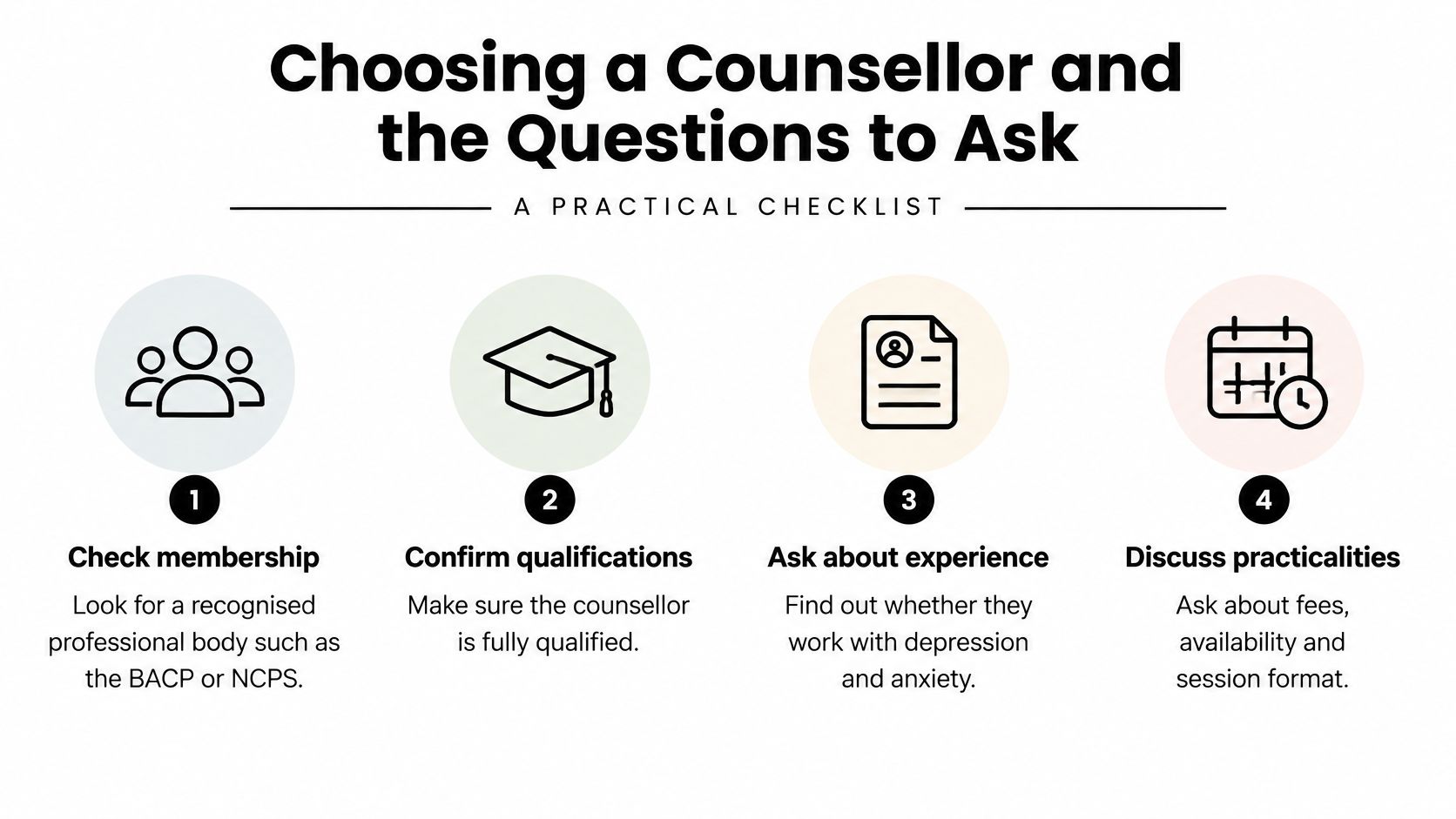
A first conversation is a good place to test the fit, not a test of how well you explain yourself. These are the questions I would want answered if I were sitting in the other chair.
Way of working: ask what the counsellor does in the room, and what a typical session feels like, not just the name of the approach.
Limits of privacy: ask how confidentiality is handled and the situations where it ends.
Rhythm: ask how sessions are scheduled, and when you'll review whether the work is helping.
Your concerns: ask whether they have experience with what you're bringing, such as anxiety, low mood, relationship strain or neurodivergence.
If they can't help: a clear answer should include referral or signposting, which is what I do when I'm not the right person.
Why the relationship carries more than the method
People tend to continue when they feel understood and can speak without performing. Trust won't appear in a checklist, but its absence shows up quickly as dread before the session or a sense you are editing yourself. If you're comparing counsellors, including when you're looking for an anxiety therapist in the UK, notice who you can be slightly more honest with, not who sounds most impressive.
Low energy, poor concentration and particular communication needs can make booking and attending the hard part. Face-to-face, online and walk-and-talk formats can reduce that friction for some people. I wouldn't claim one setting is clinically better. Choice of setting is about whether you can engage, not about a superior treatment.
Counselling is not an ADHD assessment. If you need a diagnostic assessment, or medication, a GP or a specialist service is the right route, and the two can sit alongside therapy rather than compete with it. NHS Talking Therapies, for anxiety and depression, can be reached by self-referral or through a GP, so private fees are not the only way in. A GP can discuss medication. I can't prescribe it.
Deciding Whether to Book a First Session
Waiting until depression or anxiety feels “bad enough” rarely gives a clear answer, especially as the two overlap. If they have been affecting daily life, relationships or self-esteem for a while, a first session is a reasonable next step. You do not need a diagnosis or a tidy explanation.
Counselling gives you space to explore thoughts and feelings and work out what you might like to do. Progress can mean less dread, more energy or a clearer sense of what keeps a pattern going. Partial improvement is meaningful.
Choose the format you can comfortably use. Face-to-face sessions are in my counselling room at Suite 1, Portland House, 4 Albion St, Cheltenham, GL52 2LG. Online counselling is available across the UK, and Walk & Talk counselling takes place in Pittville Park. Concessions are available for counselling students and people in financial difficulty.
To ask a question or book, call, text or WhatsApp me on 07462 291471, or use the contact page. Counselling is confidential, but confidentiality may be broken if someone is at risk of serious harm. These limits are explained at the first meeting.
If you are at immediate risk of harm, contact NHS 111 or the emergency services instead of waiting for a session.
If depression and anxiety have been narrowing your days, Therapy with Ben offers integrative counselling for adults in central Cheltenham, online across the UK and through Walk & Talk. Visit Therapy with Ben to ask a question or arrange a first appointment.


Comments