


Male Therapist vs Female Therapist: How to Choose
Many people receiving NHS psychological therapy say they have a preference about their therapist's gender. That preference can shape whether they feel ready to start or continue counselling.
It helps to separate two questions. Availability is about who you can find; fit is about who helps you feel safe enough to be honest. Gender may affect access to a therapist, but it does not tell you whether that person will be a good fit. Like two separate doors, access gets you into the room, while trust helps you speak once you're there.
Male and Female Therapists Side by Side
The short answer is this. The gender of your therapist rarely decides on its own whether therapy works, but it can shape how easily you find someone and how safe you feel once you're in the room. Both of those matter, and both are worth planning around rather than leaving to chance.
Here's how the two compare on the criteria people weigh.
Consideration | Male therapist | Female therapist | What it means for you |
|---|---|---|---|
UK NHS talking-therapy workforce (2022) | About 17% of staff were men (NHS Talking Therapies Workforce Census 2023) | About 80% were women | Male therapists are harder to find in NHS services, so start your search early |
Evidence on overall effectiveness | No consistent general advantage | No consistent general advantage | Judge fit with the individual, not the gender group |
Reasons clients may give for preferring one | Some clients want to discuss shame, emotional restraint or masculinity with a man | Some clients want to discuss body image, abuse or relationships with a woman | Preferences are personal and worth naming |
Effect of an unmet gender preference | Included in a national NHS finding of lower reported helpfulness | Included in the same finding, which didn't report the two directions separately | Raise your preference early and ask how it will be handled |
Question to ask yourself | Does this person help me feel safe enough to be honest and continue? | Same question | The test is identical whatever the gender |
Read the first row as a map, not a scoreboard. Those figures describe who is employed in NHS talking-therapy services, not who is skilled. A smaller pool of male practitioners means a client who wants a man may need to look harder, wait longer, or accept a less convenient slot.
The second row is the one people skip past. Nothing in the workforce or outcome evidence suggests that men or women, as groups, produce better therapy. What varies is the individual: their training, their manner, and whether the two of you can build something workable.
The third and fourth rows are where preference lives. Wanting to talk about shame or masculinity with a man, or about body image or an abusive relationship with a woman, is a reasonable starting instinct. It's information about what would help you speak freely, which is exactly what a preference is for.
Your first move is simple. Decide whether gender matters to you, then use the remaining rows to test whether a specific therapist meets your needs, rather than assuming the answer from a job title.
Which Gender Assumptions Hold Up
The most common assumption about male therapist vs female therapist is that men want a man. It sounds obvious. It's half right at best.
A 2025 BACP survey of 5,000 UK adults found that men were less likely than women to have tried therapy, 29% against 41%, and more likely to perceive stigma around it, 47% against 38% (BACP, June 2025). That's a real gap, and it's worth taking seriously.
The waiting room is where most of this gets decided, long before anyone sits down.

Now read the second half of the same survey. Among people who had received counselling or psychotherapy, men and women reported almost identical experiences: 73% in each group said therapy was helpful, 73% of men and 72% of women found it comfortable, and recommendation rates were 76% for men against 75% for women.
What the numbers support: men are less likely to start therapy, not less likely to benefit from it once they do.
That distinction matters when you're choosing. The barrier most men describe sits at the front door, not in the room. A male counsellor can lower that barrier for some people, particularly where shame, emotional restraint, relationships or masculine identity are part of the conversation. It doesn't guarantee a better outcome, and it won't suit every man who walks through the door.
Generalisations that fail on contact with a person
Two more assumptions circulate widely. The first is that women are naturally more empathic. The second is that men are more practical or direct, as though a therapist's manner came from their gender rather than their training, supervision, temperament and the way they've learned to work.
Both fall apart the moment you meet individuals. You'll find warm, slow, attentive male therapists and brisk, structured female ones, and the reverse, in roughly equal measure. Gender tells you nothing reliable about how someone will sit with you, how they handle silence, or whether they'll notice when you've drifted away from what you meant to say.
The useful reframe is a question you can answer in a first conversation rather than one you resolve in advance. Not "male or female therapist?" but "which therapist helps me feel safe enough to be honest and keep coming back?" Comfort, format, availability and approach all feed into that, and gender is one input among several rather than the deciding one.
When Gender Preference Is Met or Missed
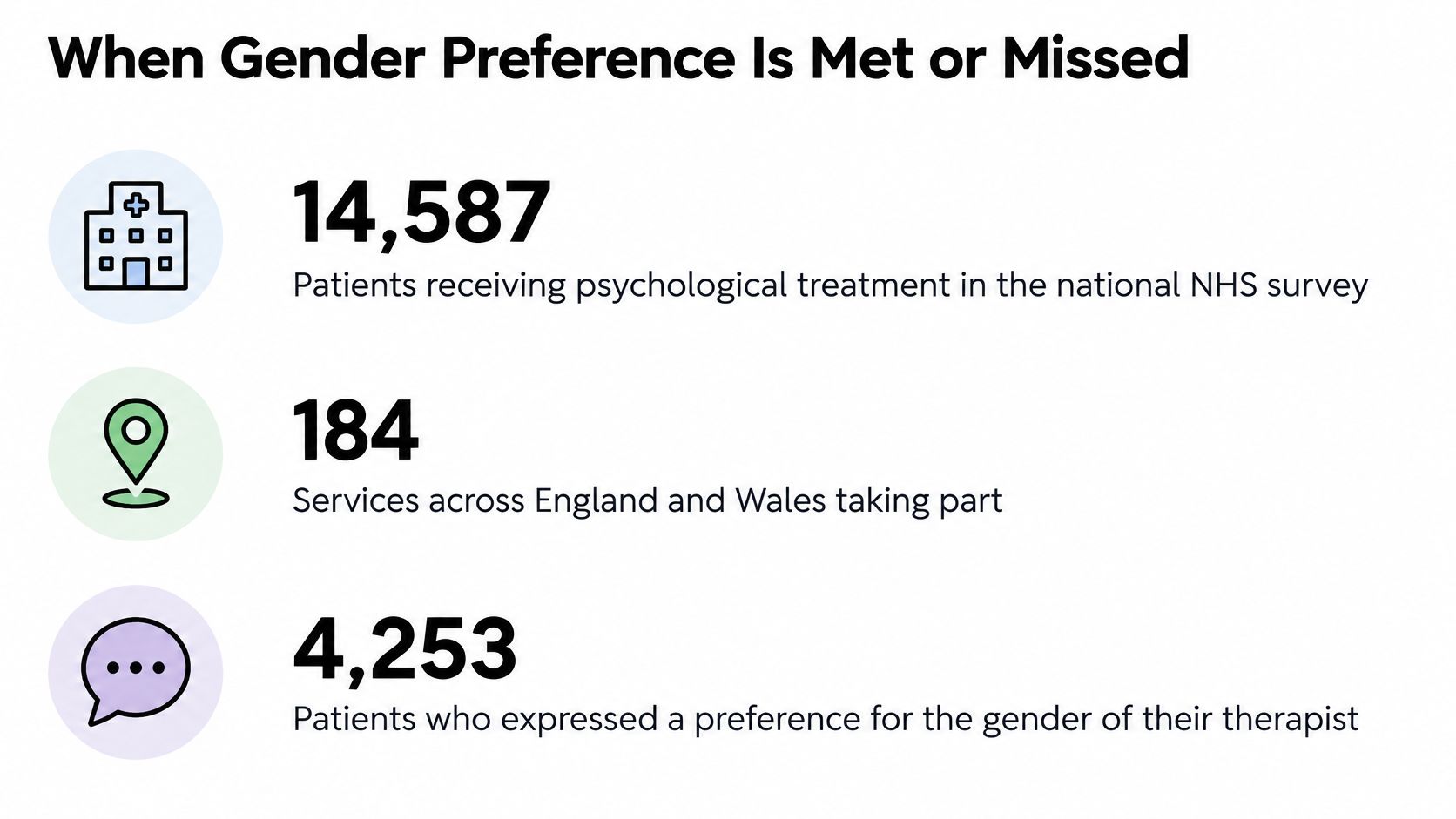
A preference about who your therapist will be is one of the most ordinary things a client can bring. In a national survey of NHS psychological-therapy patients, 13,954 people receiving psychological treatment through services in England and Wales were asked about their preferences, and 86.0% expressed one. Many people who walk into a therapy service already have a sense of what they hope for.
Those preferences are not always met, and the gap matters. The same research found that patients whose preference went unmet were less likely to say therapy had helped them. An unmatched preference wasn't a neutral administrative detail. It tracked alongside people reporting that the treatment hadn't worked for them.
Before reading too much into that, hold two limits in mind. The outcome was self-reported helpfulness rather than a controlled measure of symptoms, so the finding shows association, not proof that gender itself changed the results. And a preference often carries more than gender inside it: expectations about safety, being understood, or how a session will feel. What the evidence does support is narrower and more useful. When what a client hopes for lines up with what they get, they are more likely to stay engaged, and engagement is where therapy earns its results.
That is also where gender finds its proper place in the decision. It says little about how skilled a therapist will be. It says more about whether a particular client will drop their guard enough to say what is going on, and whether they will come back next week. Preference is an access and fit question, not a verdict on competence.
Turning that into a question you can ask
A preference that can shape how useful therapy feels belongs near the start of the process, not in an afterthought. Before a first session, say plainly whether gender affects your comfort, how much you feel able to disclose, any cultural or religious expectations you carry, relevant history, and whether you would keep attending if the match felt wrong.
A good counsellor welcomes that conversation. Ben is an integrative counsellor and therapist in Cheltenham who works with adults of all genders, and the practical version of the question is simple: what would let you speak openly, and what would get in the way?
If your preference is strong, ask for a clear description of a therapist's approach and experience so you can judge fit before committing. If a particular match isn't possible, a reasonable provider will say so and help you towards an alternative, including referring you on or signposting you to someone else, rather than fitting you into something that doesn't feel right.
How Availability Shapes Your Options
In the NHS Talking Therapies workforce, about 80% of staff were women and 17% were men in 2022, according to the NHS Talking Therapies Workforce Census 2023. These figures describe the workforce, not the quality or effectiveness of individual therapists. They help explain why someone seeking a male therapist may have fewer local options or appointment times to choose from.
Availability and fit are separate questions. Availability is about who you can find, where and when. Fit is about whether you feel able to speak openly with that person. A gender preference can make the search narrower, but it may also affect whether you start or continue counselling.
Online counselling can widen the search beyond your local area. Ben offers online counselling across the UK, while in-person sessions depend on where you live. Comparing online and in-person therapy can help you decide which format suits your circumstances.
A practical way to compare options is to note your gender preference, location, preferred format and how soon you hope to begin. Use the same list when contacting providers, so you can see which choices are available without losing sight of what would help you feel comfortable. If Ben cannot help, he may refer you on or signpost you to someone else.
Counselling Approach Often Matters More Than Gender
Two therapists of the same gender can practise so differently that the sessions feel like different services. One waits for you to find your own words. Another asks what you noticed in your body when you said that. A third hands you a worksheet.
Approach shapes the hour far more than the practitioner's gender does.
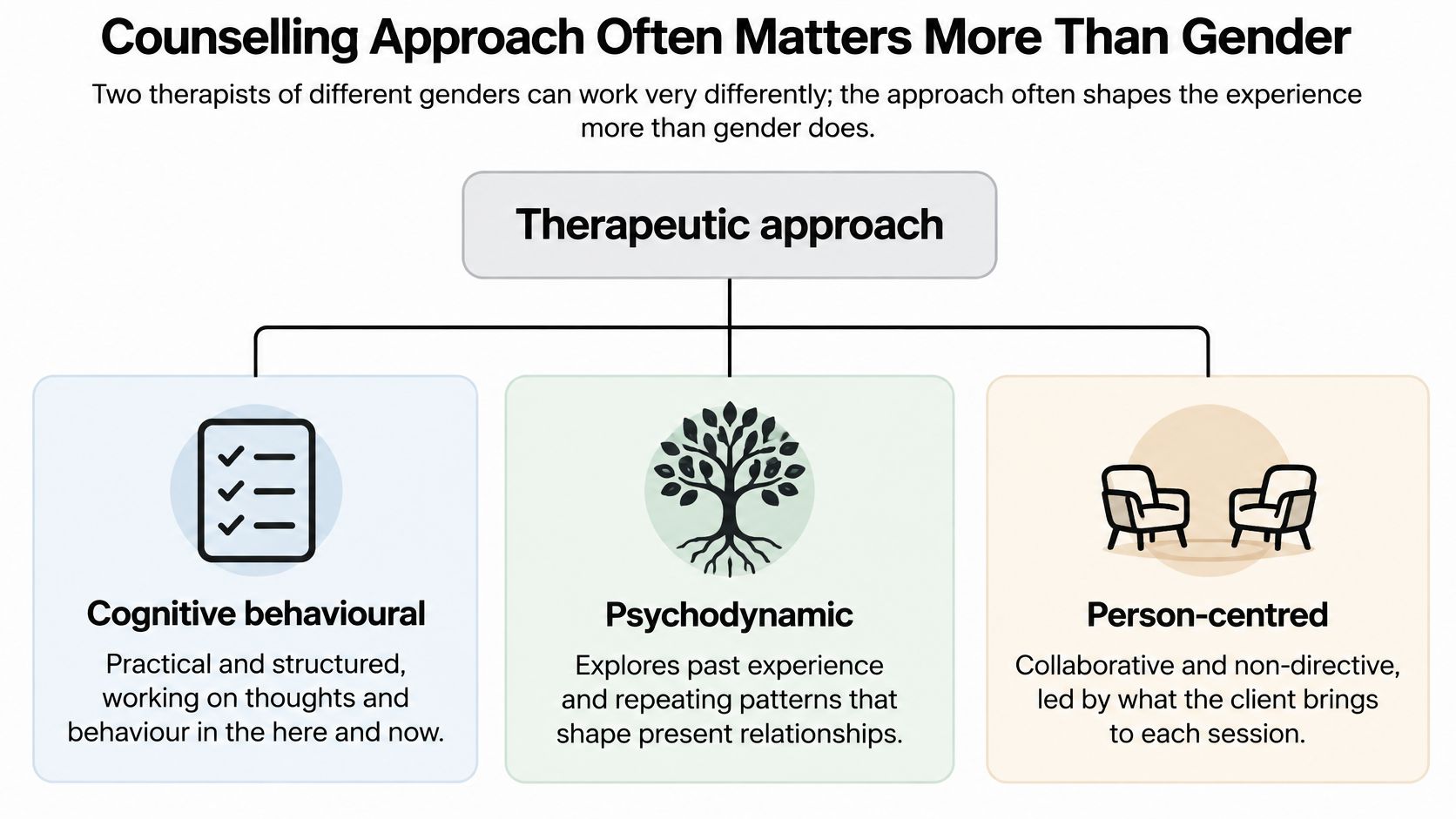
Three approaches and what each session feels like
Cognitive behavioural work is structured and present-focused. You'd leave with tasks, a shared formulation of the problem, and something to practise between sessions. It suits people who want a clear plan and a defined endpoint.
Psychodynamic work looks backwards to understand forwards. It asks where a pattern started, why the same relationship keeps failing, and what you might be bringing from earlier experience into the room with your therapist.
Person-centred work is non-directive and led by what you bring. The therapist's job is to offer genuineness, acceptance and close attention, and to trust that you'll find your own direction when the conditions are right. People often describe it as the first time they've been properly listened to.
None of these is better in the abstract. They suit different problems, different temperaments and different stages of life.
What UK ethics require, regardless of gender
Professional standards are clear that gender assumptions aren't therapeutic facts. The BACP's equality, diversity and inclusion guidance sets out that members should promote equality, value diversity and avoid unfair discrimination, naming sex and gender reassignment among the protected characteristics in the Equality Act 2010 framework. It also states that counsellors shouldn't let personal views about gender, age, disability, race, sexuality, culture or beliefs prejudice professional relationships.
For you, choosing between a man and a woman, that translates into a sharper question. Can this individual offer a respectful, psychologically safe relationship and work appropriately with what you're bringing? Not, do all men or all women share one style.
Why an integrative approach adapts to you
Ben's work draws particularly on person-centred and psychodynamic approaches, and the approach is integrative, so therapy is adapted to each person rather than following one rigid method. Counselling focuses on exploring your thoughts and feelings rather than handing out advice, and the therapist can help you work out what you might like to do.
That flexibility matters when your reasons for wanting a particular therapist are layered, for example wanting a man for the initial comfort while also needing depth work on patterns you've carried for years. Ben is a fully qualified and insured counsellor, which means being able to explain his training and how he works is part of the job.
If you're still working out which orientation suits you, this comparison of which type of counselling is right for you is a sensible next read before you book anything.
Comfort, Fit and Trust Checklist
Gender is one signal among many. Before you commit to anyone, test comfort and fit directly, and listen as much to how someone answers as to what they say.
Question to ask | Why it matters | What a good answer looks like |
|---|---|---|
Can I raise my worries without feeling judged? | Disclosure depends on feeling safe enough to be honest | They explain how they respond to difficult or embarrassing topics |
How does confidentiality work, and when can it be broken? | You need to know the limits before you speak openly | A clear explanation of serious-risk situations, and whether they would talk to you first |
Do you have regular supervision? | Supervision supports the therapist's practice and client safety | Yes, with confidential supervision that protects your identity |
How do you choose and adapt your approach? | Fit depends on whether the style suits you | They describe their modality and how they tailor sessions to you |
What happens if you cannot help me? | You shouldn't be left stuck without alternatives | They offer referral or signposting to another service |
Notice the difference between reassurance and explanation. "Don't worry, it's all confidential" is reassurance. A therapist who tells you that counselling is confidential but that confidentiality may be broken if someone is at risk of serious harm, and who explains that at the first meeting, is giving you something you can use.
Ben talks about that limit openly at the first meeting, and if confidentiality does need to be broken, the aim is to discuss it with you first before anyone else is spoken to.
Supervision is the other answer worth listening for. The therapist has regular supervision, and the supervisor would not know who the client is. That protects your identity while keeping the work checked by someone experienced.
Practical rule: hesitation, defensiveness or a vague answer is information. You're not being difficult by noticing it.
How the conversation feels is part of the answer
Content and tone carry equal weight here. Someone who answers warmly and precisely, and who can say "that's a good question" without flinching, is showing you how they'll handle the harder material later.
Compare answers across two or three practitioners before deciding. The differences are usually sharper than anything gender alone predicts, and they tell you who you'd be sitting with each week.
If you want to understand why this matters so much, the therapeutic alliance and how it drives therapy success is worth reading before your first call.
Choose the Therapist Who Fits Your Situation
Start with the decision rule rather than the shortlist. Choose based on the factor that most affects your willingness to open up and keep going, then check everything else against it. For some people that's gender. For plenty of others it's format, cost, location or the manner of the first conversation.
Your situation | What to prioritise | Starting point |
|---|---|---|
Strong preference for a male or female therapist | Honouring the preference and checking availability early | Ask providers directly about gender and format |
No strong preference about gender | Approach, format and how comfortable you feel in the first session | Compare two or three approaches and formats |
Past experiences make you wary of men or women | Safety, control over pace and the option to change therapist | Ask how a therapist handles concerns and whether you can switch |
Want a particular format or location | Format, location and flexibility | Check which formats the provider offers, such as in person or online |
Need to start soon | Availability, waiting times and referral options | Ask about first available appointments and whether they can refer you on |
A strong preference deserves honouring, full stop, so check availability before you get attached to a particular route. If gender matters little to you, spend your energy on approach, format and how the first session felt.
Where past experience has left you wary of men or of women, safety and control over pace outrank everything else. Ask directly how a therapist handles concerns raised about them, and confirm you can change therapist without a difficult conversation.
Practicalities matter too. Therapy with Ben offers in-person sessions in Cheltenham and walk and talk sessions outdoors in Pittville Park, as well as online work, so the format question has more than one answer. Clients can call, text or WhatsApp 07462 291471 to ask about gender, approach, format and availability before booking. The usual fee is £60 per session, and a diagnosis is not needed to start therapy.
Confirm details directly rather than assuming them. Then notice how you felt after that first exchange, because it's usually the clearest signal you'll get.
Common Questions About Therapist Gender
Can I switch therapists if the first one doesn't feel right
Yes. Changing therapist is a normal part of finding your footing, and it's reasonable to ask in a first session how a switch would be handled and whether a referral could be arranged. Raising it early is easier than raising it after six months.
Does gender matter for LGBTQ+ or trans clients
The ethical guidance for UK counsellors asks practitioners to respect your identity and avoid discriminatory practice, so the more useful question is whether a particular therapist has the understanding and respect you need. Ask directly about their experience of working with your identity and whether it changes how they'd work with you. A clear answer is more informative than a general promise of open-mindedness.
Can I change my preference once therapy has started
Yes. Preferences shift as trust builds, or as you learn more about what you need from the work. If your wish for a male or female therapist changes partway through, say so, because a therapist can discuss the options with you rather than leaving it unspoken.
If you'd like to talk through whether a male counsellor is the right fit before committing to anything, Therapy with Ben offers integrative counselling in Cheltenham and online across the UK, shaped around what you bring rather than a fixed programme. You can call, text or WhatsApp 07462 291471 to ask about gender, approach, format, the usual £60 fee, or how the first session works. When you're ready, Therapy with Ben has the rest of the details.


Comments