


Online Counselling for Mental Health: What to Expect
You're sitting on the sofa with your phone in your hand, perhaps late in the evening, wondering if talking to someone might help. The thought of travelling across town, finding parking and walking into an unfamiliar building feels like a lot. Talking from home sounds easier, but also a bit strange. Will it feel real? Will you be overheard? Will you know what to say?
Those are sensible questions. Online counselling for mental health isn't a lesser version of counselling, and it isn't automatically right for everyone either. It is a different setting for the same kind of conversation, and the setting matters more than people often realise. The room you're in, the noise outside the door, the strength of your connection, all of that becomes part of how safe and settled you feel.
How Online, In-Person and Walk and Talk Sessions Compare
A session can happen on a sofa, in a counselling room or outdoors. Each setting shapes the conversation in a different way, rather like changing the lighting in a room: the work is still counselling, but some things may feel easier to notice or say.
Online counselling takes place by video or phone, usually from a space you choose. In-person counselling offers a separate room for the conversation, while walk-and-talk sessions let you speak side by side as you move. In each format, counselling can involve exploring present feelings and noticing patterns, including ways past experiences may still affect you.
Three Ways of Meeting
Sessions with Ben are available in person, online across the UK, and as walk-and-talk sessions. The comparison below can help you consider what the setting might mean for you.
Format | Where you talk | Often suits | Main limits |
|---|---|---|---|
Online by video or phone | A space you choose, such as your home | People who prefer to talk from home or need to fit sessions around travel, work or caring commitments | Privacy, interruptions and connection quality depend on your surroundings |
In person | A counselling room in central Cheltenham | People who want a separate space away from home | Travel and fitting the journey around daily life |
Walk and talk | Outdoors, walking side by side | People who find it easier to talk while moving or away from a room | Weather, public spaces and less control over privacy |
Walking side by side can feel less intense than sitting face to face. Ben offers Walk & Talk counselling in Pittville Park. The outdoors also brings practical considerations: weather can change, and other people may pass nearby.
What Satisfaction Figures Can Tell You
Research on UK primary-care patients suggests that people can be satisfied with remote care, while face-to-face appointments are generally rated more highly. That helps put preference in perspective: online counselling is a valid option, but it is not the setting everyone prefers.
The setting changes the feel of the conversation. Your surroundings, comfort and privacy all play a part in how easy it is to speak.
A sofa may feel reassuring, or a shared flat may make it harder to speak freely. A spotty connection can interrupt a thought just as you are finding the words. These are not side issues: the room and the conditions around you become part of the session. It is reasonable to try one format and change later if another setting seems a better fit.
What Online Counselling Does Well and Where It Falls Short
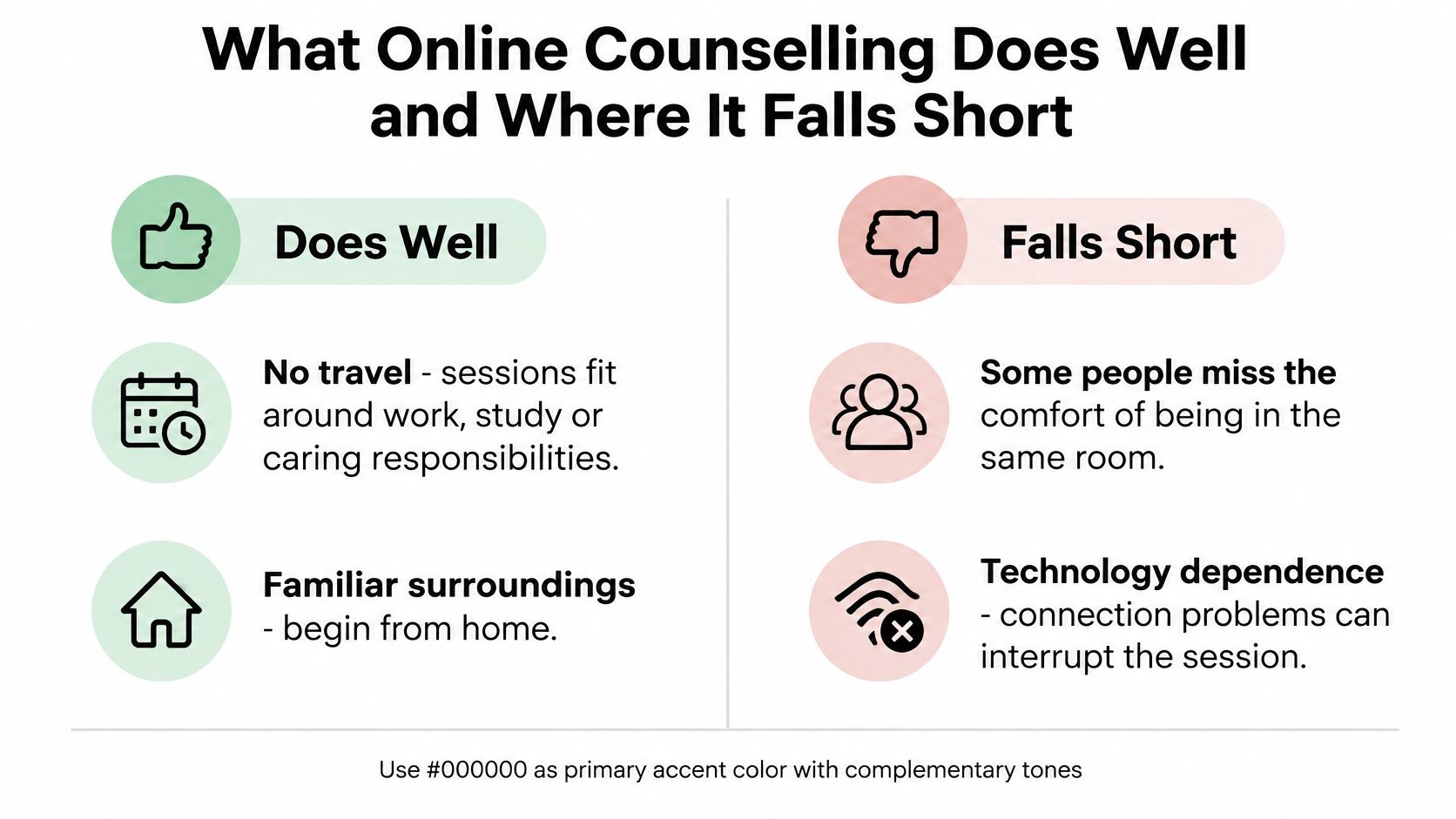
The practical benefits are real. There's no travel, so a session can fit around work, study or caring responsibilities without an hour lost either side. You can begin from familiar surroundings, which some people find far less daunting than walking into an unfamiliar building when they already feel anxious.
That familiarity can lower the barrier to starting at all. If getting to a room is the thing that stops you, then removing that step matters. Parents weighing up remote support for their family may also find a California parent's guide to telehealth a useful starting point for thinking about access, even though services and rules differ in the UK.
Where the Limits Show Up
The limits are just as real. Connections drop at the worst moment. A screen shows less of someone's posture and body language than a room does, so a counsellor has fewer small cues to notice. And when a session ends at the kitchen table, there's no walk home to help you settle. You close the laptop and the washing up is still there.
Here's the central point worth sitting with. Online removes travel barriers while creating digital, environmental and emotional barriers at home. The same feature helps one person and hinders another. Being at home may feel safe if you've got a quiet room and a steady connection. It can feel tense if you're in a shared flat, listening for a housemate in the hallway.
Online as One Part of a Wider Picture
Demand for support is high across the board. The NHS Talking Therapies dashboard recorded 148,668 referrals in March 2025, with 90.5% accessing treatment within six weeks, alongside 39,694 internet-enabled therapy sessions. Those figures show online delivery as one part of a wider pathway, not a universal solution.
Whether something counts as a benefit or a limit, then, depends less on the format itself and more on your circumstances. That's not a weakness in online counselling. It's the question to ask before you begin.
Choosing an Online Counsellor You Can Trust
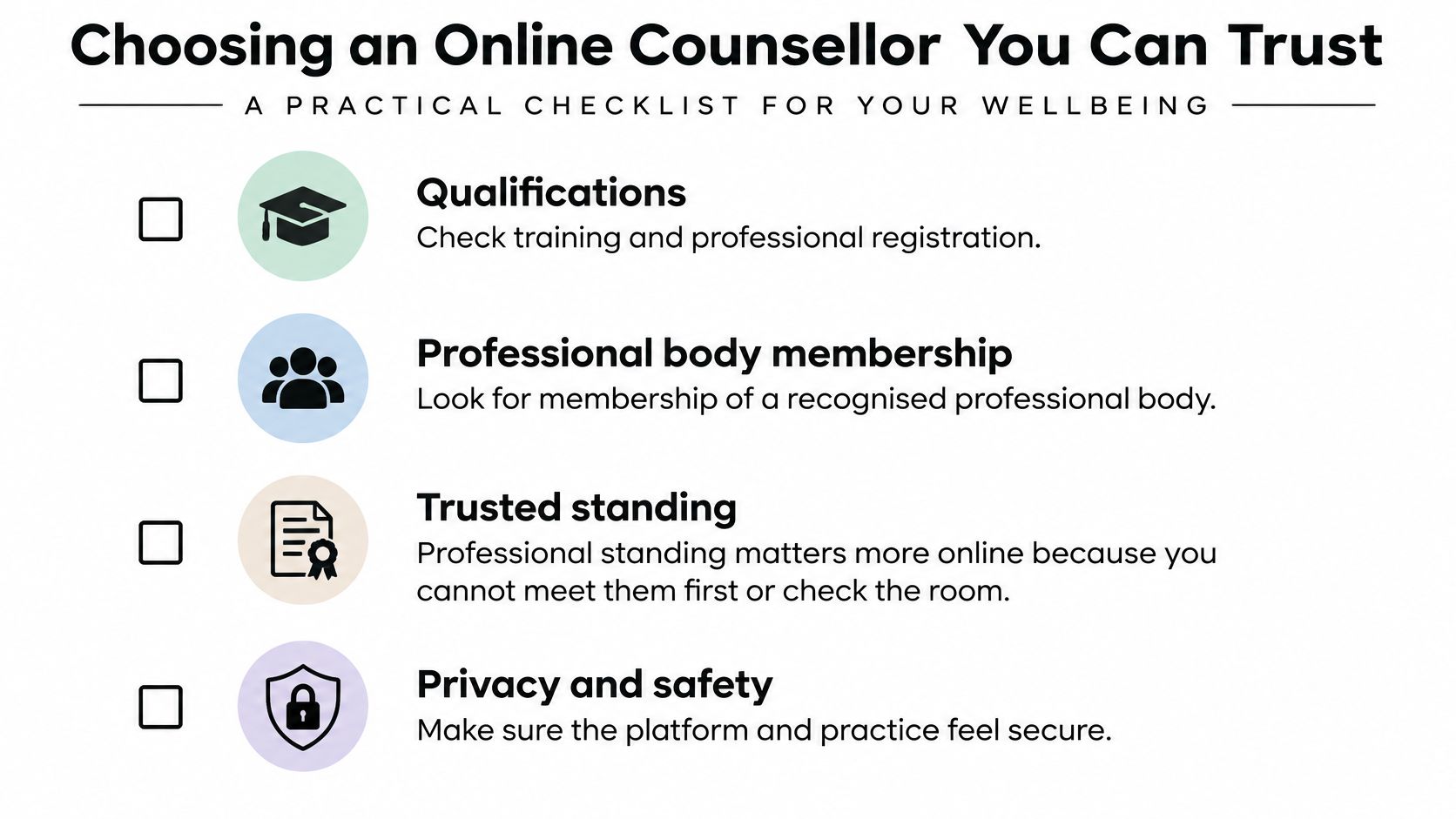
When you meet someone online, you can't see their room, shake their hand or get a feel for the place first. That makes their professional standing matter more, not less. A few straightforward questions at first contact will tell you a great deal.
You're not being suspicious by asking. A counsellor who works carefully will expect these questions and answer them plainly.
Questions Worth Asking
Are you fully qualified and insured: This is the basic professional footing. We are a fully qualified and insured counsellor, and you should be able to confirm the same with anyone you consider.
Which professional body do you belong to: Look for membership of a recognised body such as the BACP or NCPS. We are a registered member of both the BACP and the NCPS, which means working to an ethical framework you can read for yourself.
Do you have regular supervision: Supervision is where a counsellor discusses their work with an experienced colleague. We have regular supervision, and the supervisor would not know who you are, so your identity stays protected.
How do complaints work: Ask before you need it. Unresolved concerns about our work can be taken to the BACP, our professional body.
How They Actually Work
Ask for a clear account of their approach, in plain language. Our work is integrative, drawing particularly on person-centred and psychodynamic ideas. In everyday terms, that means paying close attention to how you feel now, and gently exploring how earlier experiences may have shaped the way you relate to yourself and other people.
It isn't advice giving, and it isn't a fixed programme with steps to complete. It also isn't about analysing every sentence or telling you how to live. The aim is greater self-understanding, so that you have more choice in how you respond to things.
Ask, too, whether they have experience with what you're bringing, whether that's anxiety, low mood, self-esteem, relationships, life changes or neurodivergence. And ask what happens if they can't help. A good counsellor may refer you on or signpost you elsewhere rather than press ahead regardless.
For readers outside the UK comparing routes into care, resources that help you find free online doctors in Canada show how differently systems are organised. In the UK, checking professional body membership is usually the clearest place to start.
Setting Up Privacy, Technology and Safety at Home
A shared flat, a thin wall or a noisy street can shape an online counselling session as much as the screen does. Before you begin, consider what someone else might hear and whether you can speak without being interrupted. A private, comfortable spot can make it easier to talk freely.
Headphones reduce the chance of the counsellor's voice carrying, though they do not muffle your own. If the space is shared, you might agree a time when it is available and let others know you need privacy. The room does not have to be perfect; it helps to notice what might make speaking difficult and make practical adjustments where you can.
Small Practical Steps
Test beforehand: Check your camera, microphone and connection before the first session, so you have time to sort out basic problems.
Position your device: Prop it at a comfortable height on a shelf or a stack of books rather than holding it.
Ask about technical problems: Before starting, ask the counsellor which platform they use, how it protects privacy and what you can do if the connection fails. Some platforms or home networks may work less reliably than others.
Keep the basics close: Water, tissues and a charger can save you from having to leave mid-thought.
You can also ask how contact details and notes are handled. Therapy with Ben records contact made with the therapist for initial contact purposes only, and the site complies with GDPR requirements. A page about coaching privacy at Acheloa Wellness offers another example of the kinds of privacy questions someone might consider asking a provider.
Why Suitability Is Checked First
A review of remote consultations in UK primary care found that patients were generally satisfied, while also describing how the suitability of remote care depends on the circumstances. For online counselling, those circumstances can include having enough privacy to speak, feeling able to use the technology and being able to take part without frequent interruptions. A spotty connection or a busy shared room may affect how easy it is to stay with a conversation.
Think about what would help you feel safe enough to take part. If online sessions do not seem suitable, a counsellor may refer you on or signpost you to someone else.
Please note: Online counselling is not an emergency service. In an emergency, call 999, contact NHS 111, or call Samaritans on 116 123.
What a Typical Online Session Looks Like
Feeling nervous before a first session is common, and the first few minutes can seem awkward. You see your own face on screen, you're unsure where to start, and there is a silence that seems longer than it really is. All of this is completely normal and typically passes.
Knowing the shape of things helps. Here's how it tends to unfold.
Getting Started
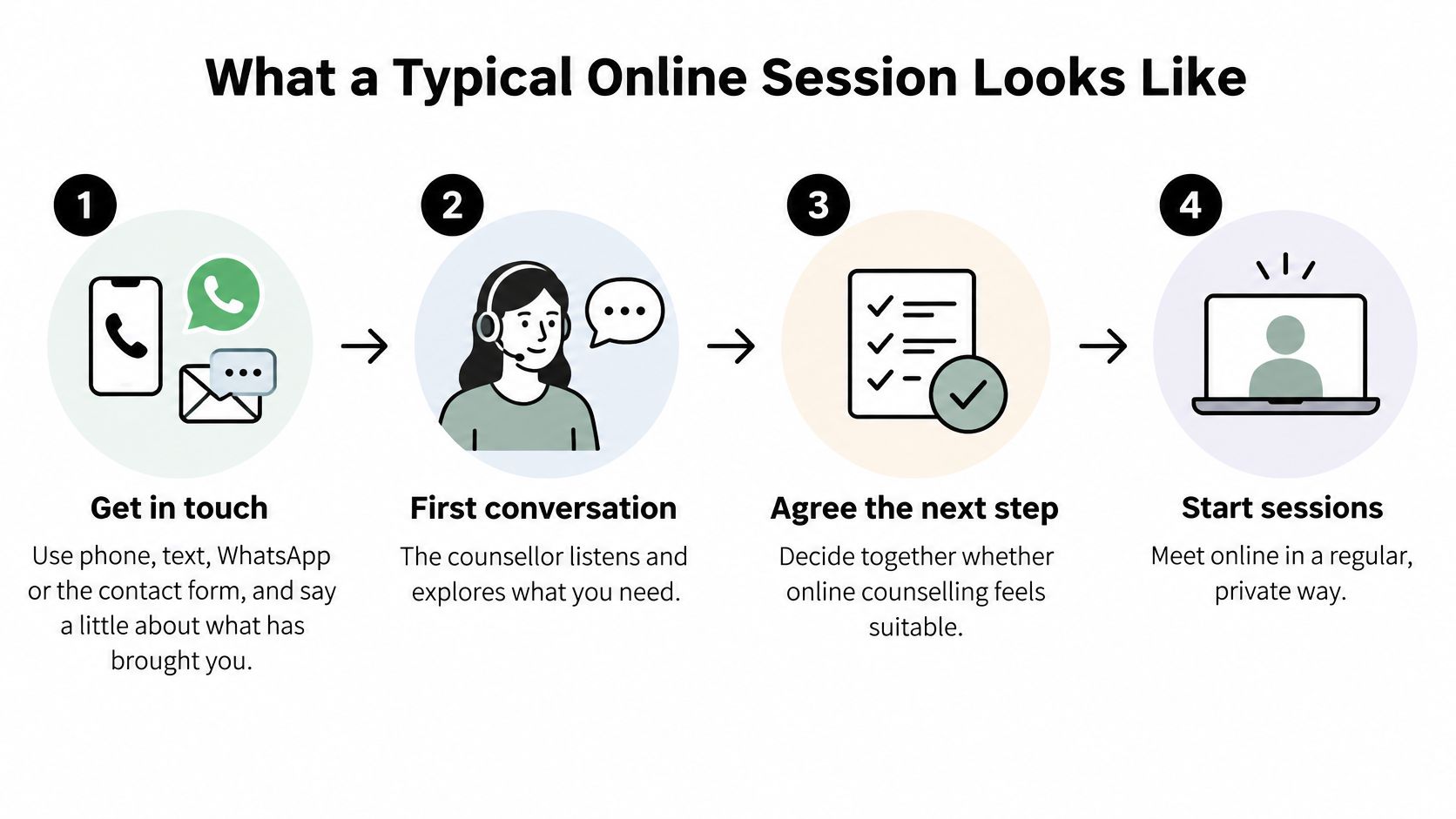
Get in touch: You can call, text or WhatsApp us on 07462 291471, or use the contact form, and say a little about what's brought you. A few sentences are enough.
Have a first conversation: We explain confidentiality and its limits. Counselling is confidential, but confidentiality may be broken if someone is at risk of serious harm, and this is explained at the first meeting.
Agree the practicalities: Format, session times, and what happens if the connection drops.
Begin the first session: You settle in and talk about what you'd like to bring, at whatever pace feels manageable.
If you'd like to read more about that early stage, this piece on what happens in your first therapy session walks through it in more detail.
Inside the Conversation
Expect listening and reflecting, rather than instruction. Counselling focuses on exploring thoughts and feelings rather than giving advice, though we can help you work out what you might like to do. Sometimes a counsellor will reflect your words back to you, which can help you hear your own thoughts more clearly. There's a fuller explanation in this guide to mirroring in therapy and how it works.
This short video gives a general sense of how an online conversation can feel in practice.
Sessions usually continue weekly, so themes can be returned to and the relationship can develop at its own pace. It isn't a set course with homework. Check your set-up in advance, and the first session can be about you rather than the technology.
Judging Progress Without Expecting a Quick Fix
Change in counselling is often slow, personal and quieter than people expect. There's rarely a single dramatic moment where everything clicks. More often, someone notices they feel a little less stuck, or they catch a familiar pattern in a relationship as it's happening rather than afterwards.
You might treat yourself with slightly more patience. You might make a different choice in a situation where you'd usually react on autopilot. These shifts are real, but they don't always show up as a number.
Improvement and Recovery Are Not the Same Thing
The NHS draws a useful distinction here. The NHS Talking Therapies service standards set expectations for people who complete a course of treatment, defined as two or more sessions.
Measure | What it means | NHS standard for people completing a course |
|---|---|---|
Reliable improvement | Score changes by more than the measurement error of the scale | At least 69% should reliably improve |
Reliable recovery | Reliable improvement plus moving from above to below the clinical threshold | At least 51% should reliably recover |
These are service-level standards, not promises to any individual. They're useful because they show that feeling somewhat better and no longer meeting a clinical threshold are two different things. Both can matter, and neither tells the whole story.
Feeling understood, gaining insight or becoming more able to cope may not register on a symptom measure at all. The other side is also true. A person can attend regularly and still feel little has changed, and psychodynamic work can bring difficult feelings to the surface before things ease. That's worth knowing in advance, so a hard few weeks don't automatically feel like failure.
Progress is something we talk about together, not something measured at you.
We work collaboratively, adapting conversations to the individual rather than following a rigid treatment programme. So we'd check in with you about what's changing, what feels unhelpful, and whether the work still feels useful. To tell, this article on signs counselling is working explores the quieter markers people often notice first.
Common Questions About Online Counselling
Is online counselling as effective as face-to-face work
UK evidence suggests remote therapy can be clinically suitable for many people, while satisfaction may differ from in-person work. No format is guaranteed to work better for everyone. Fit, privacy and how comfortable you feel talking through a screen all play a part.
Can I have counselling by phone only
Some services offer telephone sessions, and phone can suit people who find being on camera distracting or tiring. It's worth checking at first contact, and saying what you'd prefer. There's no wrong answer here.
Is what I say confidential
Yes, within clear limits that are explained at the start, including the rare situation where someone is at risk of serious harm. You can also ask how notes and contact details are stored. A counsellor should be able to explain this clearly.
What if I am in distress between sessions
Counselling isn't emergency care, and there will be times when your counsellor isn't available. Contact your GP, call NHS 111, dial 999 in an emergency, or call Samaritans on 116 123 at any time. Please don't wait for your next session if things feel unsafe.
Can I switch from online to in-person later
Yes. Needs change, and so can the format. Some people start online because it feels more manageable, then move into a room later. Others do the opposite when work or caring responsibilities shift.
Does it work for every concern
Not always, and not for every person at every moment. Where online work doesn't seem suitable, or where a different kind of support would help more, a good counsellor may refer you on. That's a sign of care, not rejection.
How long will it take and what does it cost
There's no fixed length, because the work is open-ended and shaped around you rather than a set number of sessions. It's worth discussing as things develop, including whether it still feels useful. Fees are confirmed when you first get in touch, so you can decide with the full picture.
Deciding Whether Online Counselling Suits You
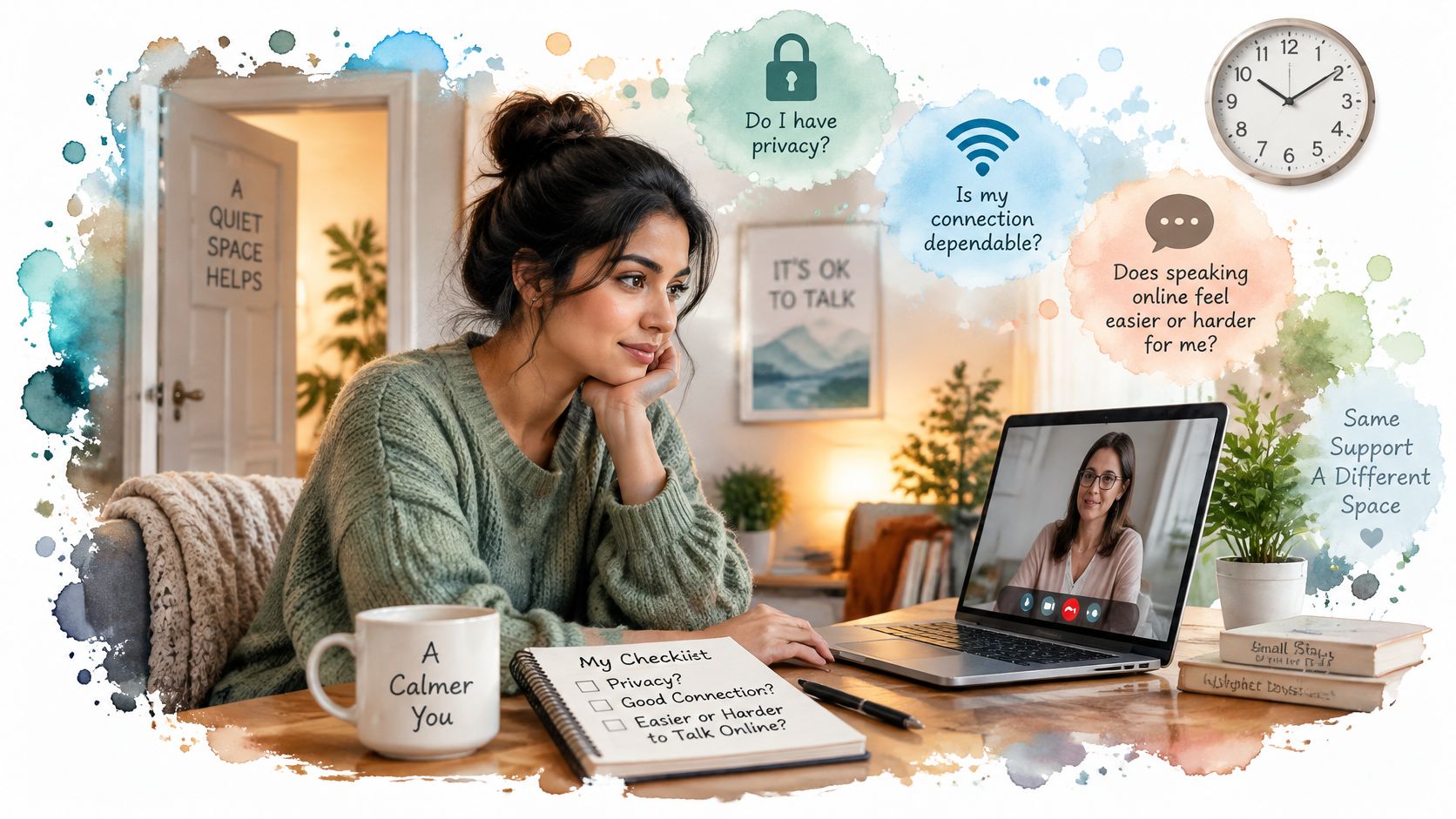
You may have found a quiet corner for a video session, only to hear a housemate come in or notice the connection faltering. These details matter: the room you speak from, the noise around you and the quality of the call all shape how easy it feels to concentrate and talk openly.
Ask yourself what would help you feel at ease. Some people find it easier to speak from home, with a little distance from the counsellor. Others feel more settled in the same room, while walking side by side can make talking feel less formal. There is no single right format.
If you're in immediate crisis, contact a GP, NHS 111 or emergency services. Counselling is not a substitute for urgent care.
Your Options and Next Step
Therapy with Ben offers online counselling across the UK and in-person sessions in Cheltenham. Walk & Talk counselling is available in Pittville Park. Concessions are available for counselling students and people in financial difficulty.
You can call, text or WhatsApp Ben on 07462 291471, or use the contact page. You do not need to have a clear goal or know which format you prefer before getting in touch. An initial conversation can help you decide whether the approach feels right for you.
Online counselling may feel comfortable and focused, or you may find that interruptions and connection problems make it harder to speak freely. Those experiences are useful information, not a test you have to pass. Progress can mean feeling more able to understand or talk about what is happening; it does not always show up as an immediate change in symptoms or daily life.
Therapy with Ben provides integrative counselling for adults, drawing particularly on person-centred and psychodynamic approaches. Sessions are available online, in person in Cheltenham and as Walk & Talk counselling in Pittville Park. Visit Therapy with Ben to learn more or get in touch.


Comments