


Reclaim Your Identity: i dont know who i am anymore and Find Yourself Again
That moment of looking in the mirror and thinking, "I don't know who I am anymore," can feel deeply unsettling. It can also feel very lonely. Many people I work with have found themselves in this place at some point, often after stress, loss, burnout, or a big life change. If this is where you are, you are not failing. Sometimes this kind of disconnection, often described as an identity crisis, is a sign that something in you needs attention, care, and honesty. It is not usually about becoming someone completely new. More often, it is about finding your way back to a version of yourself that feels more real, more grounded, and more like home.
Why You Might Feel Like You Don't Know Who You Are
If you feel like a stranger in your own life, you are not alone. One thing I have noticed through my counselling work is that this feeling often shows up after a person has been carrying too much for too long, or after life has changed in a way they have not yet had time to catch up with emotionally. It can happen after burnout, a relationship change, becoming a parent, grief, a career shift, or simply years of trying to cope.

Sometimes this confusion is the first sign that something needs to change. It can be an invitation to pause and ask some honest questions. Who have I become? What have I been carrying? What matters to me now? That process can feel uncomfortable, but it can also be the beginning of a more authentic and settled sense of self. This feeling is often tied to a wider sense of being stuck, so exploring why do I feel stuck in life and how to move forward can offer some helpful insight.
What This Experience Involves
An identity crisis can feel vague at first, but it often shows up in very real ways. You may recognise a growing uncertainty about values that once felt clear. Decisions that used to feel manageable may suddenly seem difficult or overwhelming. The roles you have held for years, partner, parent, professional, carer, may no longer fit in the way they once did.
This does not usually mean you have lost yourself entirely. It is more often a sign that there is now a gap between the life you are living day to day and the person you feel yourself to be underneath it all. Sometimes that gap has been there for a long time and only becomes noticeable when life slows down, or when something changes.
The end of a major life chapter can feel like losing yourself, but it can also create space to reconnect with your values, needs, and direction.
Simply recognising this feeling for what it is can be an important first step. Rather than judging yourself for feeling lost, it can help to get curious about what your mind and body may be trying to tell you. To make that a little easier, I have included a quick guide below. It sets out some common parts of an identity crisis, including what can trigger it and what can sometimes come from working through it.
A Quick Guide to Understanding an Identity Crisis
This table provides a snapshot of what an identity crisis feels like, its common causes, and the potential positive outcomes.
The Feeling | Common Triggers | Potential Outcome |
|---|---|---|
Feeling disconnected, empty, or confused about your values and purpose. | Major life events (job loss, becoming a parent, relocation), burnout, trauma. | A stronger, more authentic sense of self and a clearer life direction. |
Struggling with decisions and feeling like you're just going through the motions. | Relationship changes (break-up, divorce), confronting neurodiversity (e.g., late ADHD/autism diagnosis). | Improved relationships and a lifestyle aligned with your true values. |
Intensely questioning past choices and future direction. | Chronic stress, unresolved grief, societal pressure to conform. | Increased self-awareness, personal resilience, and genuine fulfilment. |
Seeing it laid out in this way can be reassuring. The experience is painful, but it is not pointless. Sometimes it is the beginning of understanding yourself more clearly than before.
The Common Triggers Behind Losing Your Sense of Self
That feeling of "I don't know who I am anymore" rarely appears out of nowhere. It is often the emotional aftermath of a major event, or the result of a long period of pressure, stress, or self-neglect. Understanding what may have contributed to it can bring a bit more clarity and self-compassion.
It can help to think of identity as something built over time. Our work, relationships, values, routines, and hopes all become part of how we understand ourselves. When one or more of those things changes suddenly, or stops feeling secure, it can shake that sense of who we are.
Major Life Transitions
Life moves in chapters, and the end of one chapter can leave us feeling uncertain about the next. Big transitions often ask us to let go of familiar roles, habits, and expectations.
Relationship Changes: A divorce or the end of a long-term relationship is not only the loss of another person. It can also be the loss of the version of you that existed within that relationship. Many people find that after years of thinking as part of a "we," it takes time to reconnect with who "I" am now.
Becoming a Parent: Parenthood can bring love, meaning, and connection, but it can also change daily life beyond recognition. Many parents quietly grieve parts of their old identity, even while deeply loving their child. That does not make them ungrateful. It makes them human.
Career Shifts or Job Loss: For many people, work is closely tied to purpose, routine, confidence, and identity. Losing a job, changing careers, or retiring can leave people wondering who they are without that role or title.
Grief and Loss: Losing someone important changes more than the shape of your days. It can alter how you understand yourself and your future. Grief often brings the loss of a relationship, a role, a routine, and a familiar sense of self, all at once.
The Slow Burn of Stress and Burnout
Sometimes losing your sense of self is not sudden at all. Sometimes it happens gradually. Chronic stress and burnout can slowly pull you away from your own needs, values, and preferences. When life becomes about getting through the day, there is often very little room left for anything else.
It can be tempting to think this is just what adulthood looks like, especially if you are used to coping quietly or putting everyone else first. But over time, living in constant survival mode can leave you feeling flat, disconnected, or strangely absent from your own life.
Being in that state for too long can make it difficult to hear your instincts. You may stop noticing what you enjoy, what you need, or what no longer feels right. If that sounds familiar, our guide on how to stop people pleasing and reclaim your life offers some practical ways to begin setting healthier boundaries.
When your energy is constantly going outward, it can become harder to stay connected to your inner world. Over time, you may stop hearing your own voice beneath the noise of pressure and expectation.
The Influence of Mental Health
Feeling disconnected from yourself is often closely linked with mental health. In England, one in five adults (20.2%) is living with a common mental health problem, and that number has been rising. For some people, the feeling of "I don't know who I am anymore" is part of that struggle.
Depression can make everything feel distant, heavy, and unlike you. Anxiety can keep your mind so busy with worry that it becomes hard to feel grounded in yourself. Sometimes the question is not really "Who am I?" but "Why do I feel so unlike myself lately?" You can learn more about these mental health statistics and see how common these struggles have become.
The Unique Journey of Neurodiversity
For some neurodivergent people, this experience comes from a different place. A late diagnosis of ADHD or autism can change how you understand your whole life. Difficulties that once felt confusing, shameful, or personal may suddenly make more sense.
That can bring relief, but it can also bring a lot of questions. Many people I work with describe it as having to re-read their whole story with new information. You may need time to make sense of what was masking, what was coping, what was burnout, and what feels genuinely like you.
It is not about reducing yourself to a diagnosis. People are always more than that. What often matters more is learning how to work with your brain rather than constantly against it, and building a life that fits you more honestly. That process can take time, patience, and support.
Recognising the Signs of an Identity Crisis
So how can you tell whether you are dealing with a deeper identity struggle or simply going through a difficult patch? The feeling of "I don't know who I am anymore" can seem hard to define, but it often shows up in recognisable ways, emotionally, mentally, and behaviourally.
Sometimes it begins quietly. You may notice you are finding decisions harder than usual, even small ones. It may not be simple indecision. It may be that you no longer feel clear about what you want, what matters, or what fits.
You may also notice a sense of emptiness, numbness, or apathy. Things you once enjoyed may start to feel flat. Socialising can become tiring. You may pull away from people, not because you do not care, but because you feel as though you are performing a version of yourself rather than living as yourself.
Emotional and Cognitive Red Flags
The inner experience of an identity crisis often involves repeated questioning. You may find yourself rethinking values, choices, goals, beliefs, or relationships that once seemed certain. Sometimes this can feel unsettling, but it can also be an attempt to bring your life back into alignment.
Some common signs include:
A Feeling of Detachment: You may feel as though you are watching your life from the outside, carrying on without much emotional connection.
Constant Comparison: You may find yourself comparing your life to other people's, and feeling as though everyone else knows who they are while you do not.
Shifts in Values: Beliefs that once felt settled, around work, relationships, lifestyle, or purpose, may begin to feel less certain.
Loss of Motivation or Passion: Things that once mattered may feel harder to care about, and a sense of meaning may be more difficult to find.
This feeling of not knowing who you are can also overlap with wider mental health struggles. In England, one in four adults experiences a mental health problem each year, with anxiety and depression often affecting a person's sense of self. Women, particularly those aged 16-24, are at especially high risk. These figures show that this kind of distress is more common than many people realise, and they underline the importance of support. You can discover more insights into UK mental health statistics from Priory Group to understand the wider picture.
This decision tree shows how major life events, burnout, or mental health challenges can lead to a lost sense of self.
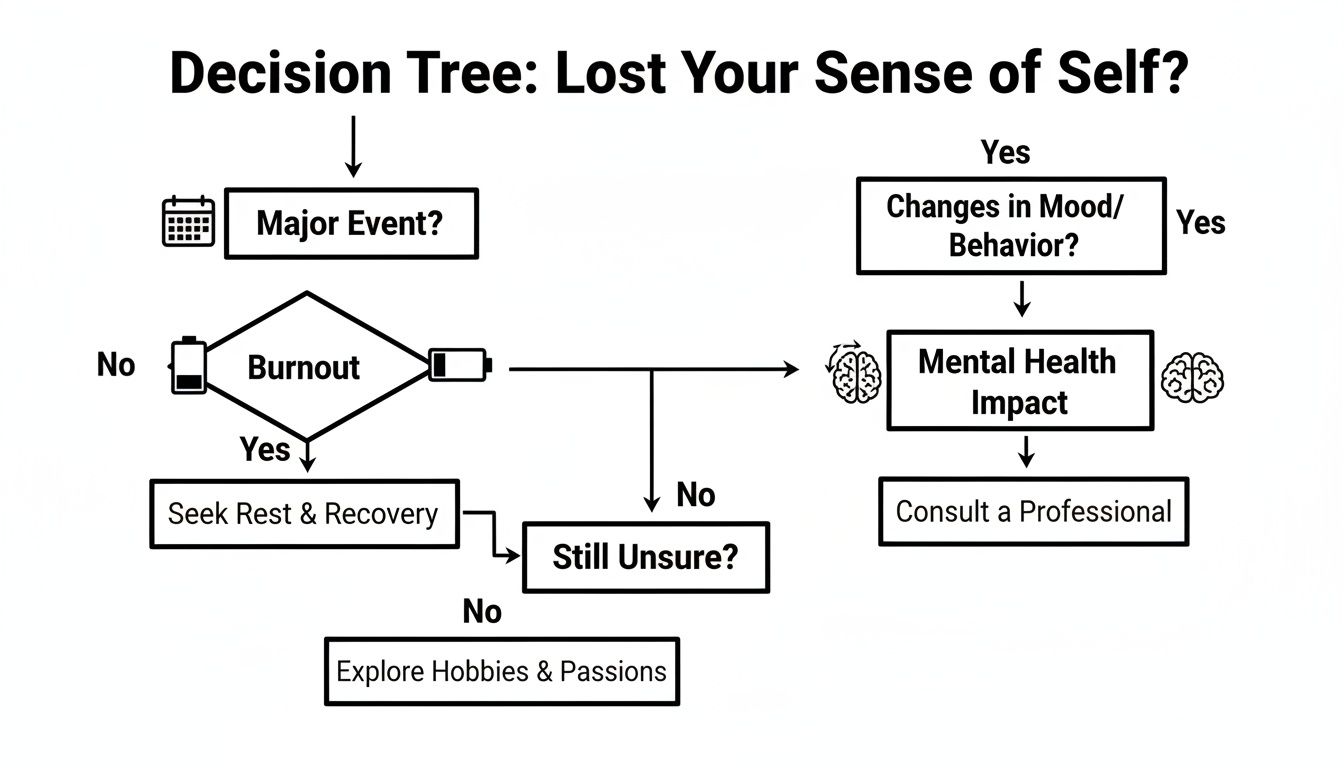
What this highlights is that losing your sense of self is often a response to pressure, pain, or prolonged strain. It is not a personal failing.
A Passing Mood vs An Identity Crisis What's the Difference?
It can help to distinguish between a difficult week and a deeper identity struggle. Both can feel unsettling, but they are not the same. The difference often comes down to how long the feeling lasts, how much it affects daily life, and whether it reaches into your core sense of self.
This table helps distinguish between temporary feelings of uncertainty and the deeper signs of a significant identity struggle.
Indicator | A Passing Mood or 'Bad Week' | A Potential Identity Crisis |
|---|---|---|
Duration | Lasts a few days and is often linked to a specific event (e.g., a stressful project). | Persistent feelings lasting for weeks or months, with no clear end point. |
Impact on Daily Life | You might feel 'off' but can generally function in your work and relationships. | Causes significant difficulty with daily decisions, work performance, and social engagement. |
Core Beliefs | Your fundamental values and beliefs remain stable and unquestioned. | You find yourself questioning everything you thought you knew about yourself and your life's purpose. |
Sense of the Future | You still have a general sense of your future direction, despite current frustrations. | The future feels completely blank, confusing, or overwhelming to think about. |
If the right-hand column feels much closer to your experience, it may be worth taking these feelings seriously. Naming it as a possible identity crisis is not about labelling yourself. It is about recognising the depth of what you are dealing with, so you can respond with care rather than dismissal.
Practical Steps to Reconnect With Yourself
So where do you begin when you feel disconnected from yourself? Usually, not with a dramatic reinvention. More often, it starts with small and steady steps that create a bit more space for you to hear your own thoughts, notice your own feelings, and reconnect with what matters.
It is not about becoming a new person. It is about gently returning to parts of yourself that may have been pushed aside, hidden, or exhausted. Small changes often help more than grand plans, especially when you already feel overwhelmed.

Start with Mindful Reflection
A helpful first step is simply to slow down enough to notice what is going on inside. Mindfulness and journalling can help create that pause. They do not have to be complicated. The aim is not to clear your mind or write something profound. It is simply to make room for honesty.
Journalling can be especially useful because it gives shape to thoughts that may otherwise stay vague or tangled. You do not have to write pages. A few quiet sentences can be enough.
If you are not sure where to begin, you could try questions like these:
When did I last feel most like myself? What was I doing? Who was I with? What felt different?
What tends to give me energy, and what tends to drain it? Try to answer without judging yourself.
What interests, hopes, or parts of me have been put on hold?
If I were less worried about other people's expectations, what might I do differently this week?
Re-engage with Hobbies and Interests
When people lose touch with themselves, hobbies and interests often disappear first. Reconnecting with them can be one practical way to rediscover enjoyment, preference, and personality.
It is not about being impressive or productive. You do not need to turn a hobby into a side project or be especially good at it. Sometimes what matters more is simply doing something because it feels enjoyable, absorbing, or quietly nourishing.
And if old hobbies no longer fit, that does not mean you are doing it wrong. Sometimes people change. Sometimes interests change too. You may need to approach this with curiosity rather than judgement and allow yourself to try something new.
"The end of a marriage often feels like losing yourself, but it's actually an invitation to rediscover who you truly are." - Joanna Nisioti, Divorce Recovery Coach
That idea can apply to many kinds of transition, not only relationship endings. Loss can create space, even when it does not feel like it at first. Filling some of that space with things you choose for yourself can be a meaningful way to reconnect with who you are. Our detailed post on how to be yourself with our guide to authentic living explores this in more depth.
Set Small, Meaningful Goals
When you feel lost, it can be hard to imagine the future clearly. Small goals can help restore a sense of direction and steadiness.
The key is to make them personal and manageable. Rather than setting a huge goal such as "change my whole career," you might start with something like "spend 20 minutes researching one area that interests me." That kind of step may seem small, but it counts. You do not have to solve everything at once.
Each small action can help rebuild trust in yourself. Over time, those small choices often matter more than one big breakthrough.
Curate Your Environment
Your surroundings, both physical and digital, can affect how connected you feel to yourself. If you already feel uncertain or vulnerable, constant comparison can make things harder.
Social media, for example, can pull you away from your own experience and into everyone else's edited version of life. It can be helpful to notice what leaves you feeling steadier and what leaves you feeling smaller, more pressured, or more confused.
Making changes to your environment can be a simple but important form of self-care.
Digital Detox: Unfollow accounts that regularly leave you feeling inadequate. Limit time spent scrolling and replace some of it with something that grounds you.
Social Circle Audit: Spend more time with people who allow you to be yourself, rather than people around whom you feel you have to perform.
Create a Safe Space: Let your home reflect who you are now, not only who you used to be or who you think you should be.
Embracing change is part of the process. You may find some encouragement in reading about the moment someone truly chooses themselves, as moments like these can open the door to important shifts. By taking small practical steps, you are not waiting passively to find yourself. You are beginning to create the conditions for reconnection.
When to Seek Professional Support for an Identity Crisis
Trying to understand yourself on your own can be valuable, but sometimes support really does help. Reaching out is not a failure. It is often a thoughtful response when things have started to feel too heavy, too confusing, or too difficult to carry alone.
You may want to seek support if this struggle is affecting your day-to-day life, your relationships, your sleep, your work, or your mental health more broadly. If the fog is not lifting, or if anxiety and depression are becoming more pronounced, it may be a good time to talk to someone.
What Does Counselling for Identity Issues Involve?
Counselling is not about someone else telling you who you are. It is about having a calm, thoughtful space where you can begin exploring that question more honestly.
A counsellor can help you notice patterns, make sense of what has shaped you, and gently untangle some of the confusion. That can be especially helpful after major life changes, burnout, grief, or a late diagnosis of ADHD or autism. Sometimes what helps most is being able to speak openly, without needing to edit yourself or hold everything together.
Seeking therapy for an identity crisis is not a last resort. It can be a compassionate and courageous step towards understanding yourself more clearly.
Navigating a Strained System
Unfortunately, many people seek help at the same time as services are under pressure. In 2024, England saw a record 5.2 million referrals to mental health services, a rise of 37.9% since 2019.
Long waits can leave people feeling stuck at the very point they are trying to ask for help. For some, that uncertainty makes things worse. You can read the full analysis on mental health pressures from the BMA for more detail.
How I Can Help in Cheltenham
This is one reason timely support matters. Here in Cheltenham, I offer counselling in a way that aims to feel calm, grounded, and human. The focus is on creating a space where you can speak openly and feel heard. We can work together in a format that suits you:
Face-to-face sessions: A private space where we can talk things through in person.
Online counselling: Flexible support that fits around your life and location.
Walk-and-talk therapy: A different approach that combines conversation with the calming effect of being outdoors, which many people find helps thoughts move more freely.
As a male counsellor, I support people with anxiety, depression, relationship issues, neurodiversity, and major life changes. If you are feeling lost, counselling can offer a space to understand what is happening, and to begin finding your way back to yourself.
How Counselling in Cheltenham Can Help You Find Your Way Back
Feeling like "I don't know who I am anymore" can be a painful place to be. It can also feel isolating. Support can help, not by giving you all the answers, but by offering a steady space in which to explore the questions.
That is how I see counselling. Not as fixing you, but as walking alongside you while you make sense of what feels confusing, painful, or unsettled.

Finding a Therapy Style That Suits You
Not everyone wants the same kind of counselling experience. Feeling comfortable matters, so I offer a few ways of working together.
Face-to-Face Sessions: If you prefer a traditional and private setting, we can meet in a quiet space here in Cheltenham.
Online Therapy: This can make counselling easier to fit around work, family, or travel, while still giving you dedicated support.
Walk and Talk Therapy: A popular option for people who find it easier to open up while walking outdoors rather than sitting in a room.
The Unique Power of Walk and Talk Therapy
There can be something very helpful about moving while talking. For some people, walking side by side feels less intense than sitting face to face. That can make it easier to speak freely, especially if you are not used to talking about difficult things.
The movement itself can help too. Sometimes thoughts that feel stuck indoors begin to shift once you are outside and walking. Nature can also have a calming effect, which may make it easier to reflect, regulate, and feel a little more grounded. You can explore more about this focus on personal growth in our article on what is humanistic therapy and how it can be a path to self-discovery.
Therapy is not about being handed the answers. It is about having the support and space to find your own.
As a male counsellor, I support people navigating anxiety, depression, major life changes, relationship issues, and neurodiversity. My aim is to offer accessible, thoughtful support that helps you understand yourself more clearly. If you feel ready to take that first step, you are welcome to get in touch. You do not have to figure it all out alone.
Your Questions, Answered
When you feel unsure of who you are, it is natural to have questions. Here are some of the ones that come up most often.
Is Feeling Lost the Same as Depression?
Not always, but the two can overlap. An identity crisis usually involves deep questioning about who you are, what matters to you, and how your life fits together. Depression can sometimes sit alongside that, or make it harder to feel connected to yourself.
Sometimes the key question is not whether it is one or the other, but what kind of support would help you make sense of it. A counsellor can help you explore whether you are dealing with identity questions, depression, or a mixture of both.
How Long Does an Identity Crisis Last?
There is no fixed timeline. For some people it may last a few months after a significant change. For others it may take longer, especially if it is linked to grief, burnout, trauma, or a late diagnosis.
It is not about rushing yourself through it. What often matters more is having the space and support to understand what this period is asking of you, and what might help you move through it more steadily.
What Is Walk and Talk Therapy?
Walk and talk therapy is counselling that takes place outdoors, usually while walking in a natural setting. Many people find it feels less formal than sitting in a room, which can make opening up a little easier.
The movement can also help create a sense of forward motion. For some, that makes it easier to think, reflect, and feel less stuck.
Is Therapy a Good Fit for Men?
Yes, absolutely. Therapy is not only for people who find it easy to talk about feelings. It is for anyone who wants support in understanding themselves, coping differently, or making sense of what they are carrying.
Many men I work with say it helps to have a space that feels straightforward, non-judgemental, and at their pace. Approaches like walk and talk therapy can also feel more natural for some people. The most important thing is finding a setting where you feel able to be honest.
If you're in the Cheltenham area and feel ready to take that next step toward finding yourself again, Therapy-with-Ben is here to walk alongside you. Get in touch to see how walk and talk therapy or online sessions could help. You can find out more at https://www.therapy-with-ben.co.uk.


Comments