


Imposter Syndrome ADHD: Overcome It with Confidence (imposter syndrome adhd)
Updated: Feb 24
Posted by Therapy-with-Ben
If you have ADHD, feeling like a fraud is an incredibly common, yet often hidden, part of the experience. It’s not just a fleeting moment of self-doubt. It’s a deep-seated belief that any success you have is a fluke, something you don't really deserve, which kicks off a nasty cycle of anxiety and trying way too hard to prove yourself. Wondering if you might have ADHD?
Before you dive in, you can try a set of standardised ADHD screening questions. This quick, confidential self-test uses widely recognised criteria to help you spot some of the common signs and patterns associated with ADHD.
If you’re considering a formal diagnosis but worried about the cost, check out my practical guide: Navigating ADHD Assessments – A Personal Perspective. It’s packed with tips for finding a more affordable private ADHD assessment in the UK, based on my own experience and research.
Feel free to explore these resources as you read—my aim is to make the ADHD journey a bit less confusing and a lot more accessible.
The Hidden Struggle Connecting ADHD and Imposter Syndrome
Have you ever felt like you're running a race but your shoelaces are untied? You might still cross the finish line, maybe even ahead of a few people, but the sheer effort it took—the constant focus on not tripping over your own feet—makes the victory feel like a total accident.
That analogy really gets to the heart of what it’s like for so many people with ADHD. The huge amount of mental energy you spend just to manage focus, get organised, and keep your emotions in check means that when you do succeed, it often feels unearned. A lucky break, rather than the result of your actual ability.
This feeling has a name: imposter syndrome. It’s that internal voice convinced you aren't as competent as everyone seems to think you are. It’s a nagging fear that you’re about to be exposed as a fake, even when you have concrete proof of your achievements. For someone with ADHD, this isn’t just some vague anxiety; it’s a direct result of having a neurodivergent brain in a world that wasn’t really built for it.
Why Neurodiversity and Self-Doubt Go Hand-in-Hand
The link between imposter syndrome and ADHD isn't a coincidence. The core traits of ADHD create the perfect breeding ground for self-doubt.
Executive Function Challenges: When you struggle with planning and time management, you often end up relying on last-minute, high-pressure bursts of productivity. You might produce brilliant work, but the chaotic process behind it makes you feel like you've just "fooled" everyone, rather than actually succeeding through skill.
Emotional Dysregulation: ADHD can ramp up your emotional responses, especially sensitivity to criticism. A bit of constructive feedback can feel like a devastating confirmation of your worst fear: that you’re simply not good enough.
Inconsistent Performance: The "on" days and "off" days are a hallmark of ADHD. This natural inconsistency makes it incredibly difficult to trust your own abilities. When things go well, you credit luck or other people. When they don't, you blame yourself entirely.
Imposter syndrome is the shadow that follows success. For those with ADHD, that shadow can feel particularly long and dark because the effort required to achieve that success is often invisible to others.
While anyone can feel like an imposter, it's a widespread issue in the UK. Studies show that somewhere between 50-58% of UK adults have experienced it. Interestingly, it seems to affect women more, with 54% of women reporting these feelings compared to 38% of men. It also seems to hit younger generations the hardest.
This isn’t just a simple lack of confidence. It’s a fundamental disconnect between what you achieve on the outside and how you feel on the inside. Recognising this connection is the first, most important step to untangling these feelings. If you'd like to explore the foundations of the condition itself, you might find our guide to understanding adult ADHD helpful.
How Your ADHD Brain Can Fuel Feelings of Being a Fraud
To really get to grips with the powerful link between imposter syndrome and ADHD, you have to look at the 'why'. Feeling like a fraud isn't a personal failing or some deep-seated lack of confidence; for many, it’s an almost predictable outcome of having an ADHD brain in a world that wasn't built for it. It's a feeling cooked up from a mix of your unique neurological wiring and the coping strategies you've had to learn along the way.
This concept map shows a really clear line from common ADHD characteristics straight to the self-doubt and extra effort that are the hallmarks of imposter syndrome.
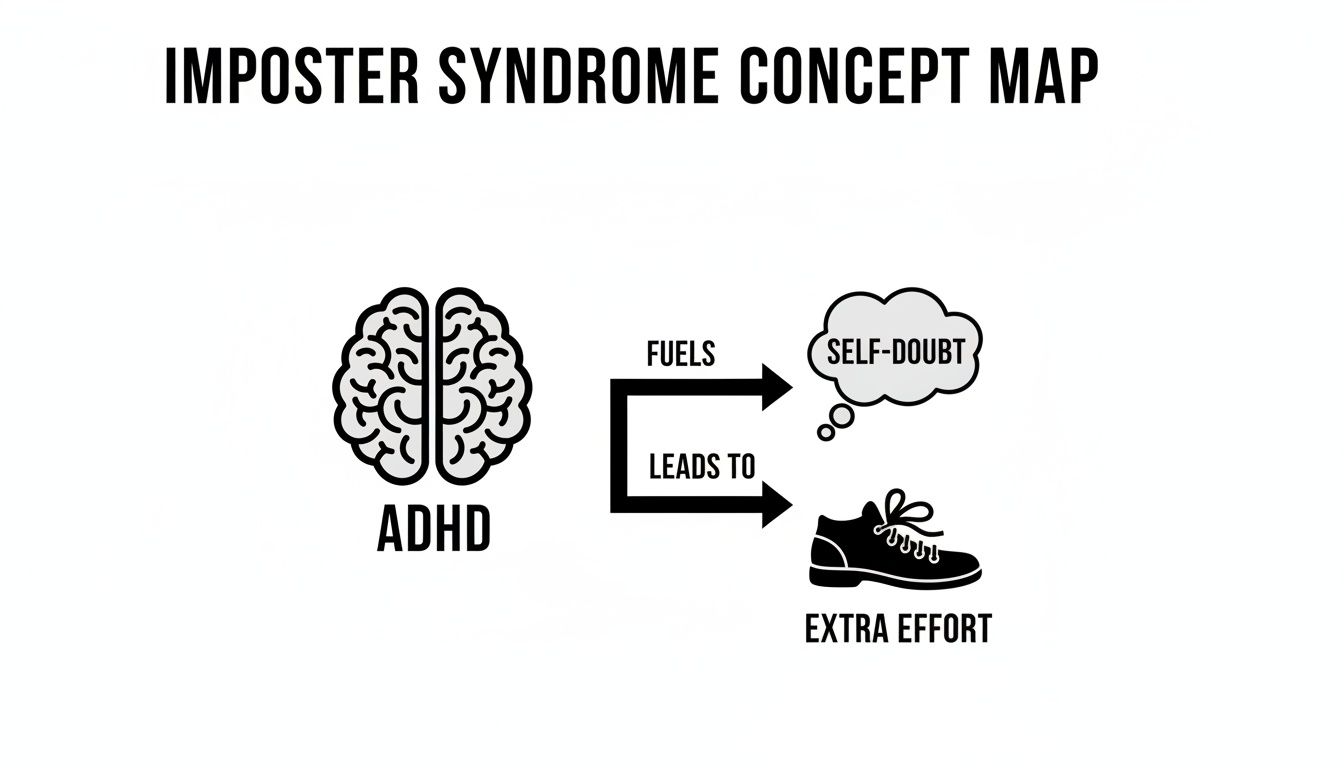
As you can see, it paints a picture of a structural challenge, not a personal flaw. Let's break down the key things that drive this connection.
Executive Function Hurdles and Unearned Wins
Think of executive functions as the management team in your brain. They handle planning, organising, managing time, and just getting started on things. With ADHD, this team isn't always reliable. This often leads to a familiar pattern: procrastinating for ages, followed by a mad, last-minute burst of hyperfocus to hit a deadline.
You might pull off something incredible – a fantastic presentation or a brilliant report – but because the process felt so chaotic and stressful, the success feels like a fluke. Instead of seeing the achievement as proof of your talent, you chalk it up to just "getting away with it" this time. The positive result feels totally disconnected from your sense of self because the journey to get there was so disorganised.
This cycle of frantic effort and surprising success creates a powerful internal conflict. On one hand, you believe you're disorganised and chaotic. On the other, the evidence shows you're successful. The brain’s quickest fix for this contradiction is to conclude, "I must be a fraud."
This whole pattern reinforces the idea that you don't deserve your wins. It feels less like skill and more like a desperate sprint where you just happened not to trip at the finish line.
Rejection Sensitive Dysphoria: The Fear of Being Found Out
Rejection Sensitive Dysphoria (RSD) is a term that really resonates with many people who have ADHD, even if it's not an official diagnosis. It describes an incredibly intense emotional sensitivity and pain triggered by the perception of being rejected or criticised. It's not just feeling a bit stung; it's a crushing, overwhelming wave of emotion.
This heightened sensitivity means that even mild, constructive feedback can feel like a devastating confirmation of your deepest fear: that you are incompetent and simply don't belong.
This emotional intensity is like pouring petrol on the imposter syndrome fire:
You're always on high alert: Living with a constant, low-level dread of making a mistake that will "expose" you.
You misread feedback: A simple question from a manager like, "Can you walk me through your process on this?" is heard as, "I don't trust your work and I think you've messed up."
You play it safe: The potential emotional fallout from failing is so huge that you might dodge new challenges or opportunities, sticking to what you know to avoid being judged.
The sheer emotional weight of RSD makes it incredibly difficult to absorb and internalise your successes. The fear of being criticised is always there, casting a shadow over any sense of achievement.
The Exhausting Work of Masking
Masking is the name for all the effort that goes into hiding your ADHD traits to fit in with neurotypical expectations. It's the huge amount of energy you spend trying to appear organised, focused, and on top of everything, even when you feel like you're barely holding it together inside.
This could be re-reading an email ten times to catch a typo, rehearsing conversations over and over in your head, or staying late to finish work you couldn't concentrate on during the day. This constant performance is mentally draining and builds a profound sense of being inauthentic. You start to feel like the person everyone else sees isn't the 'real' you.
This disconnect is the very essence of feeling like an imposter. You worry that if people saw the real, unfiltered you – the one who struggles with deadlines, forgets important things, or needs total silence to think – they would write you off. So, while masking can feel like a necessary survival tool, it directly fuels that feeling of being a fraud. This often goes hand-in-hand with perfectionism, a topic you can learn more about overcoming to find balance in our dedicated post.
How to Spot Imposter Syndrome When You Have ADHD
Knowing why imposter syndrome and ADHD are so often linked is one thing, but spotting it in your own day-to-day life is where you can really start to make a change. These feelings are sneaky. They can weave themselves so tightly into your thoughts that you start accepting them as cold, hard facts. The first real step is building the self-awareness to catch these patterns as they pop up.

Because an ADHD brain can lead to dips and peaks in performance, that imposter feeling often roars to life right after a big win. Instead of feeling proud, you might feel a sudden spike of anxiety, just waiting for the other shoe to drop. That isn't humility – it's a deep, gut-level fear of being found out.
Common Signs and Symptoms
Imposter syndrome doesn’t look the same for everyone with ADHD, but there are definitely some recurring themes. It often shows up as a draining cycle of procrastination and perfectionism. You either over-prepare for something to a ridiculous degree, or you avoid starting at all because you're terrified of failing.
Do any of these feel familiar?
Putting Success Down to Luck: You get a promotion or some praise for a project, and your first thought is, "Well, I just got lucky," or "They must have missed all my mistakes." You chalk your successes up to external forces, as if your own skills had nothing to do with it.
The Fear of Being Exposed: There's this constant, humming anxiety in the background that someone is about to discover you’re not as smart or capable as they think. It can make you clam up in meetings or shy away from taking on anything new.
Brushing Off Achievements: When someone compliments your work, you deflect it instantly. You might say, "Oh, it was nothing," or "Honestly, anyone could have done that." Actually accepting the praise feels deeply uncomfortable, almost like you're lying.
Overworking to 'Catch Up': You feel this relentless pressure to work harder and longer than everyone around you, just to prove you deserve to be there. It's often a way to try and make up for the things you struggle with because of your ADHD, like focus or organisation.
These feelings are incredibly common across the UK. It turns out that age plays a huge role. Research shows 12.88% of 16-24 year-olds feel like an imposter every single day, but that number drops to just 3.47% for those over 55. It seems to be a particular struggle for younger people finding their feet in their careers. You can read more about these UK imposter syndrome statistics on Microbizmag.co.uk.
A Few Questions to Ask Yourself
Sometimes, a few direct questions can cut through all the mental clutter. Taking a quiet moment to answer these honestly can shine a light on the subtle ways imposter syndrome might be running the show.
Self-reflection is the first step toward self-compassion. Recognising the pattern is how you begin to break it.
Think about these the next time that familiar wave of self-doubt hits:
Do I back away from new challenges because I’m worried I won’t be good enough?
When I make a tiny mistake, does my brain tell me it's proof that I’m completely incompetent?
Do I find it hard to take a compliment without feeling like I’ve somehow fooled the person?
Am I convinced I need to be a world-class expert on something before I’m allowed to have an opinion?
When I finally finish a really tough task, do I feel relief instead of pride?
Answering these honestly might feel a bit uncomfortable, but it’s a powerful exercise. It gives you the awareness you need to start challenging those thought patterns and begin the real work of trusting yourself again.
Practical Strategies to Reclaim Your Confidence
Knowing the link between your ADHD brain and imposter syndrome is a brilliant first step, but the real change happens when you move from understanding to doing. Reclaiming your confidence is all about building a toolkit of practical, ADHD-friendly strategies you can actually use to challenge that nagging self-doubt and start owning your successes.

Let's be realistic: the goal isn’t to get rid of self-doubt forever. It's about preventing it from being the loudest voice in your head. It’s about learning to work with your unique brain, not constantly fighting against it.
Cognitive Reframing for the ADHD Brain
That persistent voice of imposter syndrome gets its power from twisted, distorted thoughts. Cognitive reframing is simply the practice of catching these negative thoughts in the act and actively challenging them. For an ADHD brain, which can often default to harsh self-criticism, this is an absolutely vital skill to learn.
A fantastic starting point is to create an evidence file—or what I’ve heard clients call a "success bank" or a "wins jar." Because ADHD can mess with working memory, it's incredibly easy to forget past achievements, no matter how significant they were. A physical collection of your accomplishments acts as undeniable proof to shut down those feelings of being a fraud.
Document Everything: Keep a note on your phone, a physical journal, or even just a folder on your computer for positive feedback. This could be anything from a nice email from a colleague to a thank-you note from a client, or even your own reflections on a job well done.
Be Specific: Instead of writing "Finished the report," get detailed. Try, "Successfully completed the Q3 report and got great feedback on the data analysis." Specifics make the success feel more real and much harder for your inner critic to dismiss.
When the thought "I'm a total fraud" pops into your head, your first instinct can become consulting your evidence. You’re not just ignoring the feeling; you’re actively fighting it with cold, hard facts.
This practice slowly retrains your brain to see and acknowledge your own competence, making it that much harder for imposter syndrome to get a foothold. Building this evidence base is a massive part of learning how to get over low self-esteem and build real confidence.
ADHD-Friendly Organisation Systems
Chaos and disorganisation are like petrol on the fire for imposter syndrome. When you finish a task in a last-minute, heart-pounding panic, it doesn't feel like a skilled achievement; it feels like you just got lucky. Putting systems in place that are designed for the ADHD brain can cut through that chaos and help you feel a genuine sense of accomplishment.
The secret here is to focus on progress, not perfection. Forget those complicated, multi-layered planning systems you see online that require constant upkeep. For the ADHD brain, simple is almost always better.
Break It Down: Use the "one-task-at-a-time" approach. Instead of a huge to-do list item like "Plan event," break it down into tiny, concrete steps: "Email venue," "Draft guest list," "Choose date." Ticking off each small win gives you a little dopamine hit and builds momentum.
Use Visual Reminders: Get it out of your head. Post-it notes, a whiteboard, or digital tools like Trello can be brilliant for externalising your tasks. Seeing your plan laid out in front of you reduces the mental load and stops things from slipping through the cracks.
Set Realistic Deadlines: Always add a "buffer" to your time estimates. If you think a task will take an hour, schedule ninety minutes. This simple trick reduces the stress of racing the clock and helps avoid that frantic rush that feeds imposter feelings.
By creating a bit of structure, you develop a more consistent way of working. This consistency helps you see that your successes are down to your own deliberate actions, not just a fluke.
Mindfulness and Self-Compassion
Living with ADHD can be utterly exhausting, and it’s so easy to be hard on yourself, especially on days when the symptoms feel overwhelming. Self-compassion is simply the practice of treating yourself with the same kindness you’d offer a good friend.
It means accepting that making mistakes is a normal part of being human, and an almost inevitable part of having ADHD. So, instead of beating yourself up over a mistake, try a more mindful approach.
Name the Feeling: Just say it to yourself, "This is imposter syndrome," or "I'm feeling a lot of self-doubt right now." Simply naming it helps create a bit of distance, reminding you that it's a feeling, not a fact.
Practise Mindful Pauses: When you feel that overwhelm creeping in, just stop. Take a moment. Focus on your breath for 30 seconds. This tiny break can be enough to interrupt the downward spiral of negative self-talk.
Alongside therapy, some people with ADHD also explore how certain nootropic supplements for enhanced cognitive performance might support their focus and mental clarity, which can help with the executive function challenges fuelling these feelings. Combining these different strategies helps you build resilience, giving you the tools to manage imposter syndrome and start reclaiming your sense of self-worth.
When Is It Time to Call in a Professional?
The self-help strategies we've talked about are genuinely powerful tools. Honestly, they can make a world of difference. But sometimes, they just don't feel like enough.
If you’ve been trying these things consistently but still feel like you're spinning your wheels, stuck in that same old cycle of self-doubt, it might be time to get some professional support. And let’s be clear: that isn't a sign of failure. It's a sign that you know yourself well enough to recognise when you need a different kind of tool.
Think of it like this: you can fix a leaky tap with a wrench and a YouTube video, but if the problem is a burst pipe behind a wall, you call a plumber. The roots of imposter syndrome and ADHD can be so tangled up that having a trained professional to help you unpick it all is the wisest move you can make. It’s about building a foundation of self-worth that won’t spring a leak later on.
Knowing When to Make the Call
Figuring out the right time to ask for help is tough, especially when the voice in your head is telling you that you should be able to handle it all by yourself. But there are some clear signs that imposter syndrome has gone from being an annoying background hum to a major roadblock in your life.
Does any of this sound familiar?
Constant Anxiety or a Pervasive Low Mood: That fear of being "found out" isn't just a fleeting thought anymore. It's a constant, draining presence that colours your whole day.
Your Career Has Stalled: You find yourself actively dodging promotions, shying away from interesting new projects, or even putting off job applications. The fear of not being good enough has become louder than your ambition.
Your Relationships Are Feeling the Strain: All the pressure you put on yourself to overwork and prove your worth is spilling into your personal life. You’re left with very little energy for your friends, family, or partner.
You're Simply Burnt Out: The non-stop effort of masking your ADHD and overcompensating for what you see as your flaws has left you feeling completely and utterly exhausted.
If you’re nodding along to these points, getting professional support could offer the structure and guidance you need to make a real, lasting change. It gives you a dedicated space to unpack all of this without any judgement.
Why Neurodiversity-Informed Counselling Matters
Working with a counsellor who genuinely gets neurodiversity is a game-changer. ADHD isn't just a list of symptoms to be ticked off and managed; it's a fundamental difference in how your brain is wired. A therapist who understands this can help you see that the imposter syndrome and ADHD connection isn't some personal failing. It’s a completely understandable outcome of trying to navigate a world that wasn't built for you.
Therapy isn't about "fixing" your ADHD. It's about learning how to thrive with it. It’s about understanding your unique strengths and building personalised strategies to manage the challenges, including that relentless inner critic.
This is where I can help. Here at Therapy with Ben, I provide a safe, empathetic space specifically for exploring these complex feelings. There's no one-size-fits-all solution here. I use solid, evidence-based approaches like Cognitive Behavioural Therapy (CBT) and Acceptance and Commitment Therapy (ACT), but I always adapt them to your unique neurodivergent brain.
My goal is to help you untangle the thoughts fuelling your imposter syndrome, build genuine self-compassion, and develop practical skills to work with your ADHD, not against it. Together, we can work on turning down the volume on that inner critic so you can finally own your achievements with the confidence you deserve.
If you feel ready to take that next step, please get in touch.
How Counselling Can Help You Build Genuine Self-Belief
Deciding to work with a professional can feel like a big step, but it’s often the most direct way to build a real, lasting sense of self-belief. At Therapy with Ben, my entire way of working is built around creating a supportive, comfortable space where you feel truly seen and understood—especially when it comes to that complicated tangle of imposter syndrome and ADHD.
My goal is pretty simple: to help you get past just ‘coping’ and start genuinely thriving. I offer a few different kinds of counselling, all designed to fit into your life and meet your specific needs, so you can find a style that actually works for you.
Finding the Right Fit for You
I know that one size definitely doesn't fit all when it comes to therapy. That’s why I offer different ways to connect, taking away some of the usual barriers and making the whole process feel more approachable.
Face-to-Face Counselling in Cheltenham: For anyone who prefers a traditional, in-person connection, my practice here in Cheltenham provides a calm, confidential space where you can explore what’s on your mind without any distractions.
Online Therapy Across the UK: If you need a bit more flexibility or live further afield, online sessions offer the same level of quality support from the comfort of your own home. It’s an ideal format for weaving therapy into a busy schedule.
Walk and Talk Therapy: A Unique Approach for the ADHD Brain
One of the most effective options I've found for people with ADHD is Walk and Talk therapy. This simply means we take our sessions outdoors, into the natural surroundings of Cheltenham. For a brain that often feels restless or overwhelmed in a quiet room, this can be a complete game-changer.
The gentle physical act of walking can do wonders. It helps channel that excess energy, making it much easier to focus your thoughts and process feelings more clearly. So many of my clients find that moving their body helps to quieten the anxious chatter in their head, which allows for deeper and more productive conversations. It’s just a less intense, more natural way to do therapy.
For many people with ADHD, the simple act of walking while talking reduces the pressure of direct eye contact and the struggle of sitting still, creating the perfect conditions for opening up and finding clarity.
Taking that first step is usually the hardest part, but I’ve tried to make it as simple as possible. Your journey towards authentic confidence and finally quietening that inner critic can start today.
To find out more, or to book an initial, no-obligation chat, just head over to my contact page and send me a message. Together, we can start building the self-belief you deserve.
Frequently Asked Questions
It’s completely normal to have questions swirling around when you're trying to make sense of ADHD and imposter syndrome. I’ve put together some straightforward answers to the questions I hear most often, hopefully giving you a bit more clarity.
Can ADHD Treatment Help with Imposter Syndrome?
Yes, it really can. Getting a good handle on your ADHD often makes a massive difference to those feelings of being a fraud. When therapy, coaching, or medication helps you manage core symptoms like a wandering focus or trouble getting started, your work and general performance tend to become much more reliable.
That consistency is key. It helps you build up a bank of genuine, real-world successes that your inner critic can’t just write off as a fluke or ‘good luck’. By steadying your ability to do the things you set out to do, you start to dismantle that nagging belief that you don't really deserve your achievements.
Is Imposter Syndrome a Recognised Mental Health Condition?
This is a great question. Officially, imposter syndrome isn't listed as a standalone diagnosis in the DSM-5 (the big manual used to classify mental health disorders). However, it's an incredibly real and widely recognised psychological experience that can cause a huge amount of distress and anxiety.
It often travels with diagnosed conditions like anxiety and depression. A good therapist can help you work through these powerful feelings and the impact they have on your life, with or without a formal label. The important thing is tackling the distress it causes, not what it's called.
It’s important to remember that the absence of a formal diagnosis does not invalidate your experience. The feelings are real, their impact is real, and effective support is available.
How Is Walk and Talk Therapy Different?
Walk and Talk therapy is exactly what it sounds like – we take the proven benefits of traditional counselling and combine them with gentle movement in a natural, outdoor space. For a lot of people with ADHD, the idea of sitting still in a quiet office for an hour can feel like a real challenge, even a bit unnatural.
Walking side-by-side can help channel that restless energy, making it easier to focus your thoughts and talk through what’s on your mind. It creates a more relaxed, dynamic space where conversations often flow more freely, without the intensity of constant eye contact. It’s still proper therapy, just in a setting that might feel more comfortable for you.
At Therapy-with-Ben, my aim is to offer a supportive, non-judgemental space where we can explore these challenges together and help you build a more solid, lasting sense of self-belief. If you feel ready to start quieting that inner critic, you can find out more and get in touch at https://www.therapy-with-ben.co.uk.


Comments