


Counselling for Relationship Problems: Individual Support
Yes, individual counselling for relationship problems works without your partner attending, and it's available to adults of all genders. You don't need both people in the room to make sense of what's happening or to change how you respond.
Maybe you're lying awake replaying the same argument for the third time this month. Perhaps you feel lonely beside someone you've lived with for years, or you've started dreading phone calls from a parent or sibling because every conversation leaves you tense and second-guessing yourself. A relationship can begin to feel like a room with one dim switch. You may keep trying the same door, hoping the light will change, while your own needs stay hidden in the corner.
Many people assume that relationship support always means sitting side by side with a partner in couples therapy. In reality, relationship counselling for individuals gives you private space to look at your own needs, values, and recurring patterns, whether you live in Cheltenham, elsewhere in Gloucestershire, or further afield. Counselling focuses on exploring thoughts and feelings rather than giving advice, and the therapist can help work out what you might like to do. Even if the other person has no interest in therapy or refuses to shift, you can still change your own boundaries, communication, and self-understanding.
What Individual Relationship Counselling Involves
Starting counselling for relationship difficulties on your own means the focus stays squarely on your lived experience. I work one to one with adults aged 18 and over who want to explore strain in a romantic partnership, a friendship, a family bond, or a working relationship.
People sometimes walk into a first session expecting to be interrogated, handed worksheets, or told who's right and who's wrong. In practice, counselling isn't about analysing every sentence, imposing interpretations, or telling you how to live. My role is to listen closely, reflect what I hear, and help you notice what you've been carrying, so you can work out what you'd like to do next rather than following advice from me.
Imagine checking a map you have relied on for years. When familiar roads keep leading you back to the same dead end, a counsellor doesn't grab the pen and draw a new route for you. Instead, we lay the map out on the table together, trace where the turns keep catching you out, and look at other paths you might choose.
Counselling works best as a steady, collaborative conversation where you can hear yourself think without being judged, rushed, or told what the right answer ought to be.
Waiting until things feel serious enough
Across Cheltenham and neighbouring Gloucestershire towns, people frequently put off booking a session because they wonder whether their difficulties count as bad enough. You don't need a formal diagnosis or a full-blown crisis to start therapy.
That hesitation is remarkably common across the UK. A 2025 survey of 2,000 UK adults reported by the Mirror found that only 10% of couples had ever sought counselling, while 24% of people who had considered therapy without pursuing it felt their problems weren't serious enough. Waiting until resentment has hardened often makes conversations heavier than they needed to be.
Confidentiality from the first conversation
Confidentiality is an important part of counselling, particularly when you are exploring difficulties involving people you love, live with or work alongside. Under the British Association for Counselling and Psychotherapy confidentiality guidance, counsellors maintain the privacy of what you share, disclosing information only with your consent, when required by law, or where it's necessary and proportionate to prevent or reduce serious harm to an adult.
As part of my professional practice, I also undertake regular clinical supervision with another experienced counsellor. This provides an opportunity to reflect on my work while protecting the identity and privacy of my clients. My contract, also explains this.
Common Reasons People Seek Relationship Counselling
Relationship distress rarely boils down to a single bad evening. Research from a large UK client-demographic study hosted by the Open University repository) shows how frequently communication, conflict, and wider emotional strain arrive together.
Reason | What it often looks like | Reported by participants in the study |
|---|---|---|
Communication difficulties | Conversations stall, misfire or end in silence | 79.7% |
Frequent arguments | The same argument returns in slightly different form | 68.9% |
Managing conflict | Disagreements escalate quickly or are avoided altogether | 67.8% |
Emotional distance | Feeling unseen, like housemates rather than partners | Not separately reported |
Broken trust | Lingering suspicion after lies, secrecy or betrayal | Not separately reported |
Jealousy | Constant checking, comparison or fear of losing the other person | Not separately reported |
Differing expectations | Disagreement about closeness, money, children or the future | Not separately reported |
Resentment | Small grievances building up over months or years | Not separately reported |
Uncertainty about the future | Wondering whether to stay, or whether the relationship will end | 65.1% |
Concerns about a partner's behaviour | Behaviour that worries, confuses or hurts | 63.8% |
Mental health concerns alongside the relationship | Low mood, anxiety or stress affecting how the relationship feels | 24.5% |
Communication sits at the top of that list, with 79.7% of UK clients naming it as an issue causing difficulty and a further 13.6% viewing it as possibly relevant. Rows and arguments (68.9%) and managing conflict (67.8%) sit closely behind, showing that the typical client isn't struggling with one isolated flare-up. The same disagreement tends to return in a fresh disguise, whether it's about household chores, weekends, or tone of voice, leaving a little more hurt behind each time.
The quieter strains behind the figures
Several of the heaviest relationship struggles don't show up in shouting matches at all. Emotional distance creeps in gradually until two people run a household smoothly yet feel more like flatmates than partners. Broken trust after secrecy, dishonesty, or infidelity can leave you scanning every pause or delayed reply, while jealousy can turn ordinary social plans into exhausting cycles of checking and comparison.
Differing expectations around intimacy, finances, children, or how much time you spend apart often sit unspoken for years until resentment takes hold. Notice too how strongly doubt and personal wellbeing overlap with conflict: 65.1% of clients worried about whether the relationship would end, 63.8% reported difficulties linked to their partner's behaviour, and 24.5% identified mental health problems alongside their relationship distress (with another 19.6% saying they were possibly relevant).
Because these strands pull on one another, individual counselling looks at the wider pattern rather than isolating one row. Recognising several items in the table doesn't mean your relationship is broken beyond repair; it just suggests there's something worth understanding more clearly.
Relationship Problems Beyond Romantic Partnerships
When people hear the phrase relationship counselling, they usually picture a romantic couple. Yet some of the most draining relational knots happen outside romance altogether, and counselling for family relationship problems or strained friendships brings just as many adults into the therapy room.

Every non-romantic bond carries its own quiet rules and expectations, which can make tension harder to talk about openly.
Friendships that feel one-sided: You might realise you're always the one organising meet-ups, absorbing someone else's crises without space for your own, or sitting with an unspoken falling-out and wondering whether it's worth repairing.
Parents and adult children: Even decades into adulthood, a throwaway remark from a parent can shrink you back into feeling criticised, overly responsible, or unable to meet unspoken expectations.
Sibling dynamics: Old childhood labels, quiet comparisons, and sudden practical pressures like sharing care for ageing parents often reawaken rivalries that seemed long buried.
Extended family and in-laws: Weddings, holidays, and Sunday lunches can bring subtle loyalty tests and commentary that are awkward to challenge without feeling like you're causing a scene.
Work colleagues and managers: Being undermined in meetings, navigating a hostile colleague, or trying to satisfy shifting managerial demands can eat into your evenings and self-confidence.
Spotting a pattern across different rooms
Consider a hypothetical scenario. Suppose someone grew up as the dependable fixer in their family, smoothing over tension between relatives whenever tempers rose. Years later, they notice they're staying late to absorb a colleague's missed deadlines, swallowing irritation with a friend who cancels at short notice, and feeling guilty whenever they turn down a family invitation.
The people around them are completely different, yet the exhausted role feels identical. Individual counselling gives you space to examine what you bring into each bond, what you really want from it, and what you're willing to accept, without painting the other person as a villain. From there, you can decide whether to shift how you show up or step back altogether.
What Lies Beneath Recurring Arguments
Few couples or families fall out purely because a mug was left beside the sink. When a minor everyday friction sparks a disproportionate row, the surface topic is usually carrying far heavier emotional freight.
The diagram below shows how a routine disagreement over household chores often rests on deeper unspoken feelings.
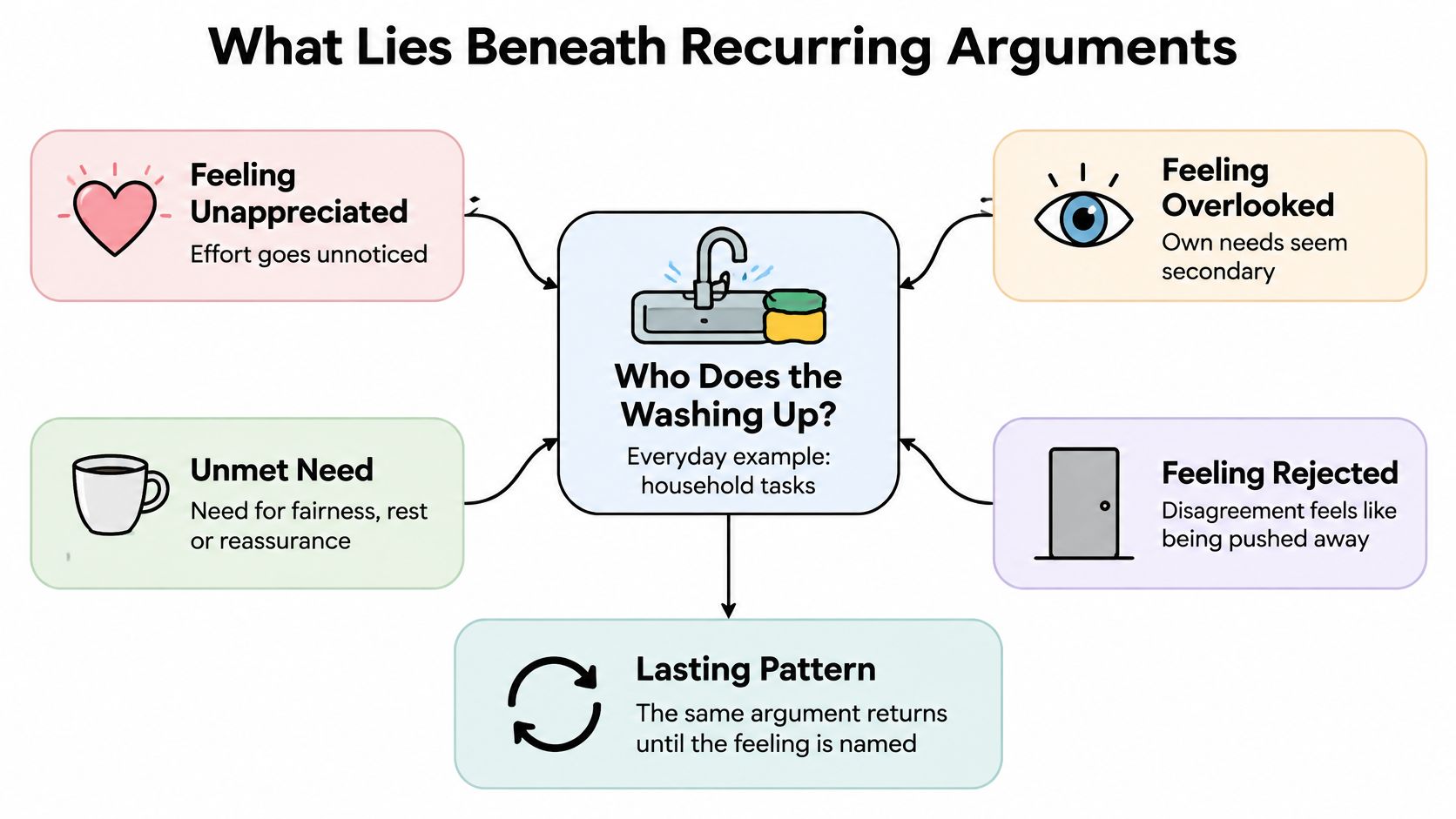
An argument about washing up can in fact be about feeling unappreciated when quiet effort goes unnoticed, feeling overlooked when your needs seem secondary, or feeling rejected when a partner sighs and walks away. Underneath the frustration sits a plain human need for fairness, rest, or reassurance.
One common dynamic is the pursue-withdraw cycle. One person senses distance and presses for conversation or reassurance, often sounding sharper than they mean to; the other feels criticised or overwhelmed and shuts down to keep the peace. Each person reacts to the other's defence as proof that they aren't cared for, and the loop tightens.
How mood and everyday strain feed conflict
Not every repeating row traces back to deep history. Heavy workloads, financial pressure, poor sleep, chronic pain, or persistent low mood shorten anyone's fuse and shrink the headspace needed to listen well.
Clinical guidance reflects how closely mood and relational strain interact. According to NICE guidance on depression in adults, relationship-focused psychological treatment such as behavioural couples therapy may be considered when adults experience both depression and partner-relationship difficulties, alongside evidence that counselling and short-term psychodynamic psychotherapy can help in some contexts. Conflict and emotional disconnection can keep low mood going by eroding day-to-day support, while depression itself can blunt warmth, energy, and problem-solving.
Because of that two-way pull, I don't hand out predetermined scripts or rigid communication exercises to stop rows. Instead, drawing on person-centred and psychodynamic ideas, we explore what an argument means to you, which feelings it stirs, and how your wider mood is faring. If you'd like to read further on navigating tricky conversations, you can explore this article on how to communicate better in relationships.
The short video below explores how unspoken emotional needs often drive recurring disagreements between partners.
Success in this kind of work isn't measured by eliminating disagreements altogether. Differences of opinion belong in any honest relationship; what changes most is gaining enough clarity and steadiness to choose how you respond.
How Earlier Experiences Shape Current Relationships
We learn our earliest rules about closeness, disagreement, and safety from the people who raised us. Long before we have the words to describe it, we absorb whether anger feels dangerous, whether sadness gets comforted or mocked, and whether asking for help is welcomed or treated as a burden.
Those early family roles often carry over into adult life without anyone noticing. Someone who played the peacekeeper at home might panic at the slightest hint of tension with a partner and rush to apologise just to restore calm. Someone whose feelings were routinely brushed aside may struggle to admit they're hurt until resentment spills over sideways.
Attachment patterns and past relationship hurts
Psychologists often describe these relational habits through attachment patterns, and you can read a fuller introduction in my guide on what attachment theory is and how it shapes you. In plain terms, some adults feel anxious when someone they care about goes quiet and seek reassurance urgently, while others value self-reliance so strongly that emotional closeness starts to feel suffocating.
Previous adult relationships leave their own blueprints too. Imagine someone whose former partner hid serious financial problems for years. In a brand-new relationship, a perfectly innocent pause over a bank statement can set off an immediate wave of alarm, even though the new partner has done nothing to warrant distrust.
A useful reality check: Earlier experiences can explain why a reaction feels so intense, yet they never account for everything happening in the room today.
Avoiding the trap of blaming everything on childhood
It's tempting to hunt for a single childhood origin behind every adult struggle, but that shortcut can be misleading. Present-day realities matter enormously: genuine differences in values, sheer exhaustion, or another person's unkind behaviour can hurt painfully regardless of how secure your upbringing was.
In individual counselling, we don't force your story into a neat theory about the past. You explore possible links at your own pace, noticing which reactions feel like echoes of an older chapter and deciding whether they still serve the person you are now.
Boundaries, Self-Worth and Approval in Relationships
Many people hear the word boundaries and picture high brick walls or cold ultimatums. In practice, healthy personal boundaries are closer to clear signposts: knowing what you're comfortable with, how much time and energy you genuinely have to offer, and what you'll do if a line keeps being crossed.
Confusion often creeps in around the difference between compromise and continual sacrifice. When two people compromise, both give a little ground and both still feel respected. Continual sacrifice looks very different: you repeatedly bend to keep the peace, absorb the inconvenience, and walk away feeling drained or quietly resentful, often while the other person hasn't even realised there was a cost.
Learning to say no usually begins in the body before it reaches your voice. Pay attention to the quick knot in your stomach, the tight shoulders, or the sudden flicker of dread when someone asks for a favour. Those physical cues often tell you your honest answer before politeness talks you out of it.
People-pleasing and Carl Rogers' ideas on self-worth
When saying no feels almost impossible, people-pleasing is rarely just about being nice. It's often a learned survival strategy: scanning other people's moods closely, smoothing over awkward silences, and apologising for having preferences at all. If that sounds familiar, my post on people-pleasing and how therapy can help unpacks how those habits take root.
As an integrative counsellor drawing on person-centred and psychodynamic approaches, I often find two ideas from psychologist Carl Rogers helpful here:
Conditions of worth: The unspoken belief that you're only lovable, safe, or acceptable when you meet certain terms, such as staying agreeable, putting others first, or never showing anger.
Internal locus of evaluation: Gradually shifting from measuring yourself through other people's approval towards trusting your own feelings, values, and judgement.
Developing that internal compass doesn't happen overnight, and I won't tell you which boundaries to set. What counselling offers is space to test your own perspective without pressure. Even when another person refuses to change a single habit, clarifying your own self-worth and limits can still transform how you experience the relationship.
Individual, Walk & Talk and Couples Counselling Compared
Deciding which format fits your situation starts with looking candidly at who wants support, what feels safe, and how you talk most comfortably.
Format | Who attends | Main focus | Often suits people who |
|---|---|---|---|
Individual face-to-face | You alone, in central Cheltenham | Your feelings, choices and patterns | Want to work on themselves, or whose partner will not attend |
Walk & Talk | You alone, walking around Pittville Park | The same individual focus, with movement and fresh air | Find it easier to talk on the move |
Online counselling | You alone, from a private space across Gloucestershire and the UK | The same individual focus | Find travel difficult or prefer a home setting |
Couples counselling (not offered here) | Both partners together | The interaction and shared patterns between the two people | Both want joint work, and it is safe to attend together |
Choosing between individual formats
Individual face-to-face counselling offers a quiet, predictable room where you can pause without household interruptions. It works well if your partner won't attend, if you're unsure what you want from the relationship, or if you're working through family, friendship, or workplace strain.
Walk & Talk counselling My Walk & Talk counselling sessions take place outdoors around Pittville Park in Cheltenham and follow the same integrative approach as my face-to-face and online sessions.
Some people find talking side by side while walking feels more comfortable and natural than sitting opposite someone in a counselling room. Others prefer the privacy and familiarity of an indoor setting.
It is very much an individual preference, and we can discuss which format might suit you during our introductory conversation.
Online counselling brings the same one-to-one space to your screen anywhere across Gloucestershire or the wider UK. It removes commuting time and fits around shift patterns, childcare, or health limitations, provided you have a genuinely private room where you won't be overheard.
When couples counselling fits better
Couples counselling puts the interaction between both partners at the centre of the room. Evidence suggests it can benefit both the relationship and personal wellbeing: a 2017 UK naturalistic study indexed on PubMed followed 877 people who completed at least two sessions of psychodynamic couple therapy and found a large reduction in psychological distress (d = -1.04) alongside a medium improvement in relationship satisfaction (d = -0.58). Because that study wasn't a randomised controlled trial and looked only at people who attended at least two sessions, those outcomes aren't guaranteed for every couple, though they offer encouraging support when both partners sincerely want to engage.
Neither individual nor couples work is universally better. I don't offer couples counselling or joint therapy sessions, and I don't practise CBT. If joint sessions turn out to be what you need, I know trusted counsellors I can suggest you contact so you aren't left starting from scratch.
Separation and the Stay or Leave Question
People often feel blindsided by grief after ending a relationship they chose to leave. Relief and heartbreak can sit in the same chest. Alongside losing a partner, a separation dismantles daily routines, shared plans for the future, mutual friendships, and a familiar sense of who you were as half of a pair, leaving ordinary evenings feeling unexpectedly hollow.
That kind of loss is bringing more people into therapy. In the BACP Mindometer 2025 survey of almost 3,000 counsellors, 23% reported an increase in clients presenting with divorce and separation issues over the previous year. Whether you're looking for counselling after a breakup in Cheltenham or trying to rebuild confidence online from home, recovery usually unfolds steadily rather than in one neat breakthrough.
Navigating the uncertainty of staying or leaving
Sitting on the fence can feel just as exhausting as a breakup itself. One morning you're mentally packing boxes; by Friday evening you remember why you fell for them and feel guilty for doubting.
Individual counselling gives you neutral ground to explore what you value, what you fear, and what you've been tolerating without fully admitting it. My job isn't to push you towards staying or nudge you towards the door. Staying isn't a failure to leave, and leaving isn't a failure to make things work; the goal is reaching a choice that feels honest to your own needs and values.
When safety comes before repairing the relationship
Sometimes relationship distress isn't mutual miscommunication at all. Updated research from the Office for National Statistics estimated that 5.9% of people aged 16 and over in England and Wales experienced abuse by a current or former partner in the year ending March 2024, while UK government figures on support in domestic-abuse safe accommodation in England recorded 76,850 people supported in safe accommodation during 2024 to 2025, alongside a 20% drop in counselling and therapy provision and rising calls to national helplines (174,562 contacts to the National Domestic Abuse Helpline and 43,548 to the Respect Men's Advice Line in the year ending March 2025).
Abuse, coercive control, and intimidation are not communication problems, and personal safety always comes before trying to repair a relationship.
Joint couples sessions can be unsafe when fear or unequal power is present, because speaking openly in front of an abusive partner can invite retaliation or create false symmetry between harm and ordinary disagreement. Individual counselling can offer private space to name what's happening, though therapy isn't a substitute for specialist risk assessment or emergency help. If confidentiality ever had to be broken because someone was at risk of serious harm, I'd aim to discuss that with you first before speaking to anyone else.
If you feel frightened, controlled, or unsafe, confidential specialist UK support is available:
National Domestic Abuse Helpline: Call 0808 2000 247 (free, 24 hours a day, run by Refuge).
Respect Men's Advice Line: Call 0808 801 0327 for confidential support for men experiencing domestic abuse.
Emergency services: Call 999 if you or someone else is in immediate danger.
Counselling for Relationship Problems in Cheltenham and Gloucestershire
Finding the right therapist matters at least as much as deciding to start. Before you commit to anyone for counselling for relationship problems in Gloucestershire, it helps to know what kind of fit you are looking for. A good starting point is whether you want individual counselling, where the work focuses on your own thoughts, feelings, boundaries and choices, even if the other person will not change. Relationship counselling does not always mean couples counselling, and individual work can help you understand your part in a pattern without turning every conversation into a verdict on who is right.
A few practical checks can make the choice clearer. Check that the counsellor belongs to a recognised ethical body such as the BACP or NCPS, holds full insurance, and explains how concerns can be raised if you are ever unhappy with the work. Ask whether they work with individuals or couples, how they handle confidentiality, and whether their style feels collaborative rather than prescriptive. Confidentiality is central to counselling, but it may be broken if someone is at risk of serious harm, and this should be explained at the first meeting. Some clients specifically look for a male counsellor, while others prefer a female therapist or do not mind either way. Both preferences are valid, and noticing who you feel most comfortable opening up to is a sensible starting point.
Neurodiversity can also be an important consideration when exploring relationship difficulties.
Differences in communication styles, emotional needs, sensory experiences and expectations can sometimes contribute to misunderstandings within relationships, particularly when one or both people are neurodivergent.
I work with many adults who are exploring their experiences of ADHD, neurodivergence and masking. Counselling is not about teaching someone to mask more effectively or suggesting that they need to change who they are to maintain a relationship.
Instead, we can explore how a greater understanding and acceptance of yourself might influence your relationships, communication and personal boundaries. You do not need a formal diagnosis to explore these experiences in counselling.

Working together at Therapy with Ben
I am a fully qualified and insured male integrative counsellor, working with adults aged 18 and over. I am a member of both the British Association for Counselling and Psychotherapy (BACP) and the National Counselling and Psychotherapy Society (NCPS).
My approach draws particularly on person-centred and psychodynamic counselling, adapting our work to you as an individual rather than following a rigid therapeutic programme.
I believe that developing a greater understanding of ourselves, our values and our emotional needs can help us navigate our relationships with greater confidence and authenticity.
I offer individual relationship counselling from my own counselling room at Suite 1, Portland House, 4 Albion Street, Cheltenham, GL52 2LG.
My central Cheltenham location is convenient for people living locally or travelling from Gloucester, Tewkesbury and the surrounding areas of Gloucestershire.
Alongside face-to-face counselling, I offer Walk & Talk counselling around Pittville Park and online counselling across the UK.
Sessions cost £60 for 50 minutes, with concessions considered depending on individual circumstances. I also offer a free 15-minute introductory conversation so we can explore whether working together feels right for you (button at top of page).
You are welcome to contact me through my website or call, text or WhatsApp me on 07462 291471.
If recurring arguments, strained family relationships, a painful separation or uncertainty about the future of a relationship are affecting your wellbeing, we can explore these difficulties together.
You do not need to have reached a decision about your relationship before coming to counselling, and you do not need the other person to attend.
If you would like to find out more about how I work, you are welcome to get in touch with me at Therapy with Ben.
Comments