


How to Rebuild Trust After Betrayal or Broken Promises
Something shifts in a room the moment trust breaks. You might be sitting across from a partner whose words no longer match their actions, staring at a message from a close friend who shared something meant to stay private, or trying to stay professional with a colleague after a promise fell through without warning.
Whether you're the one who was hurt or the one who caused the harm, figuring out how to rebuild trust rarely feels straightforward. There isn't a single roadmap that works for every person or every relationship. Understanding what broke, what you're feeling and what you really want next is usually a steadier place to begin than rushing to fix things.
Why Trust Matters and What Damages It
At its simplest, trust is the reasonable expectation that another person will be honest, reliable and respectful of your boundaries. It's the quiet groundwork that lets you speak openly, show vulnerability and feel emotionally secure without constantly scanning for hidden motives. When it's intact, you barely notice it; when it fractures, even ordinary conversations can start to feel tense or uncertain.
Trust can be damaged in romantic relationships, friendships, family ties and workplaces alike. Sometimes it breaks in a single unmistakable moment, and sometimes it erodes slowly until you realise you no longer feel safe relying on the other person.
Single Breaches and Deeper Patterns
Not every rupture calls for the same response, so it helps to recognise what kind of damage has taken place:
Dishonesty and betrayal: An affair, a hidden friendship, or a deliberate lie about money or whereabouts can shake your sense of what was real.
Broken promises and inconsistency: Warmth one week followed by unexplained distance the next leaves you unsure which version of the person will show up.
Repeated boundary crossings: Brushing aside your limits, sharing personal confidences without permission, or dismissing your feelings chips away at emotional safety over time.
A one-off mistake followed by genuine honesty feels very different from an ongoing pattern that never changes. How easily someone trusts is also shaped by what they've lived through before. Previous relationships, unreliable caregiving, a fear of abandonment, low self-esteem or habits of people-pleasing can all make opening up feel riskier. Still, not every difficulty with trust traces back to childhood; sometimes guardedness is a direct, sensible response to what's happening right now.
UK public data illustrates how specific trust is. In the Office for National Statistics 2023 Trust in Government Survey, 70% of people in the UK trusted other people in general, while only 27% trusted the UK Government and 12% trusted political parties. Institutions with clearer roles fared better, with 62% trusting the courts and judicial system and 56% trusting the police. Historical findings from the British Social Attitudes survey show a similar split: confidence that banks were well run fell from 90% in 1983 to 19% after the 2008 financial crisis, yet the share saying people could generally be trusted moved far less, from 43% in 1981 to 39% in 2012.
Distrust in one relationship doesn't mean you've lost the capacity to trust altogether. People distinguish between general goodwill and a specific breach, which is why repair works best when it stays focused on the concrete behaviour that caused harm.
So can broken trust in a relationship be rebuilt? Sometimes it can, provided both people are willing, behaviour changes consistently over time, and the person who was hurt has space to judge whether that change is genuine. Equally, reconciliation isn't always possible, desirable or safe, and recognising that early protects you from forcing a repair that isn't right.
Working Out Where You Stand
Before you decide whether to repair a relationship, pause to look squarely at which side of the breach you're standing on. The questions that matter most look quite different depending on your role.
If you've broken someone's trust, your focus needs to be on what led to your behaviour, how your actions affected the other person and what taking responsibility looks like in practice. If someone broke your trust, the core questions are different: what you need from the relationship now, whether their behaviour has genuinely shifted, and whether you want to rebuild from real hope or out of guilt or obligation.
Your position | What to do first | What repair usually depends on |
|---|---|---|
You broke someone's trust | Name the specific harm without minimising or adding 'but'; ask what the other person needs now rather than pushing for forgiveness; reflect on what contributed to your behaviour | Whether your change lasts beyond the apology, and whether the other person has space to respond without being pressured |
Someone broke your trust | Pause before deciding; identify what you need and set one boundary; seek a trusted outside perspective | Your own needs and boundaries, plus consistent action from them over time |
Trust broke both ways | Stop any ongoing harmful behaviour first; each person owns their part; agree on a pause if either needs one | Mutual willingness and an end to ongoing harm |
Trust broke at work | Use a reliable reporting route or trusted manager; document what happened and what would feel safer | Structural accountability, non-retaliation and consistent responses, as well as individual effort |
Making Sense of Your Role
When you're the one who caused hurt, the urge to rush past the discomfort is strong. Saying sorry and immediately hoping things will return to normal usually leaves the other person feeling unheard. Starting with plain acknowledgement gives them room to respond candidly rather than managing your guilt.
When you're the one who was let down, you don't need to decide the future of the relationship straight away. Naming one clear boundary and talking things over with a grounded friend, family member or counsellor helps you steady yourself before making bigger commitments.
When trust has frayed on both sides, trying to keep score rarely moves anything forward. Repair only starts when ongoing harm stops and each person looks at their own part rather than waiting for the other to move first.
Workplace breaches sit slightly apart from personal ones. Trust at work doesn't only live between two individuals; it also depends on your team, your manager and the organisation around you. Clear reporting channels and accountable responses matter just as much as personal goodwill.
A Starting Point Before You Decide
If your thoughts feel tangled, take ten quiet minutes with a notebook. Write down what happened in a single plain paragraph, sticking to facts rather than interpretations. Underneath, jot down three short lines: what you're feeling right now, what you think you want from this relationship, and what you're still unsure about. You can reflect on those notes alone or bring them into counselling as a starting point.
Taking Responsibility When You Have Broken Trust
Many people assume a heartfelt apology should be enough to put things right. Yet words on their own rarely settle a rupture, because the other person is watching for proof that something has actually changed.
A University of Bath study on repairing trust breakdowns illustrates why. Researchers found that an apology didn't repair trust immediately; it only restored trust when the person who caused harm went on to cooperate in a later interaction. A separate forgiveness-focused intervention restored trust both directly after the offence and later on, highlighting that verbal repair and follow-through do very different jobs.

Real accountability starts with naming the specific behaviour and its impact without shrinking it down or slipping a "but" into the middle of the sentence. Saying what you did plainly shows the other person you're willing to face reality alongside them, rather than asking them to soften the blow for you.
Explaining Without Making Excuses
Understanding what sat behind your behaviour matters, because without that insight it's easy to repeat the same pattern under pressure. Stress, avoidance, a fear of conflict or habits picked up in earlier relationships can all play a part in why someone hides the truth or breaks a commitment.
At Therapy with Ben, we believe people can develop a kinder understanding of themselves without abandoning accountability for their actions. There is a clear line between explaining and excusing. Explaining says, "I hid the debt because I was ashamed and scared of how you'd react, and lying to you was my choice." Excusing tries to shift the weight off your shoulders by implying you had no other option.
What Accountability Sounds Like in Practice
Meaningful apologies aren't about reciting a polished script, because people quickly sense when words are rehearsed. Still, seeing the contrast between defensive language and accountable language can help you notice where you might slip:
Name the harm directly: Try something like, "I lied about where I was. I know that hurt you, and I want to understand what you need now."
Drop defensive phrasing: Phrases such as "I'm sorry you feel that way", "I didn't mean to hurt you" or "Can we just move on?" shift focus onto your discomfort instead of the other person's reality.
Hear the reaction without arguing: If the other person is angry, tearful or sceptical, resist the urge to correct their memory or remind them of everything you've done right in the past.
After the conversation, consistency carries the weight. Answer questions truthfully even when the truth feels awkward, keep small everyday promises, and let the other person move at their own pace. Most difficult of all, accept that they don't owe you forgiveness or a return to the relationship. Offering real change while respecting their right to choose is part of taking responsibility.
Caring for Yourself When Your Trust Has Been Broken
Say you discover that someone close to you has been hiding something important for months. In the first days afterwards, your mind might swing from anger to numbness, from grief to sharp confusion, and even brief flashes of relief that your uneasy hunch finally makes sense. Alongside the hurt, self-doubt often creeps in: wondering why you didn't spot the signs sooner, or worrying that you're overreacting.
Nothing is wrong with you for feeling all of that at once. When a bond you relied on shifts without warning, your emotional world needs time to catch up. If you're navigating infidelity specifically, reading more on how to get over getting cheated on and start healing can offer a steadier frame for those early weeks.
Questions Worth Sitting With
Rather than forcing yourself into a quick decision about how to trust someone again, give yourself room to sit with a few honest questions:
What do I really need from this relationship now? Consider emotional honesty, space, transparency or practical reliability, rather than what you think you're supposed to ask for.
Has their behaviour truly changed, or only their words? Notice whether they respect your feelings when it's inconvenient, not just during an emotional apology.
Why do I want to rebuild this? Check gently whether the pull comes from sincere care and realistic hope, or from fear of being alone, guilt or pressure from family and friends.
Setting clear personal boundaries protects you while you work out those answers. That might mean stating what you will and won't accept, what information you need to feel grounded, or how much space you need each week. Pay close attention to what happens next: someone committed to repair may feel uncomfortable with your boundaries, yet they'll respect them anyway.
Look after your day-to-day stability while emotions are raw. Talk to one person you genuinely trust, protect your sleep and basic routines, and avoid making irreversible life decisions during acute distress whenever you safely can. Remember too that forgiveness, trust and reconciliation are three separate choices. You can choose to let go of bitterness for your own peace of mind without restoring closeness, access or dependence.
When Rebuilding Is Not the Safe Choice
Not every breach is a relationship problem to work through together. In England and Wales, the UK Government's Controlling or Coercive Behaviour Statutory Guidance Framework defines controlling or coercive behaviour as a repeated or continuous pattern directed at an intimate partner or family member that can isolate someone from support, exploit their resources, restrict independence or regulate everyday life. The Domestic Abuse Act 2021 statutory guidance also recognises that abuse can include manipulating a person's anxieties or beliefs and using hostility or silent treatment to create fear.
Under section 76 of the Serious Crime Act 2015, the Crown Prosecution Service prosecution guidance confirms that repeated or continuous controlling or coercive behaviour towards an intimate partner or family member is a criminal offence requiring specialist support and safety planning. If fear, monitoring or control are present, rebuilding trust isn't your task; safety and independent support come first.
Sign | May be a trust issue if | Needs safety first if |
|---|---|---|
Fear and hypervigilance | You feel wary after a specific hurt, but the person is open to hearing you and adjusting | Fear, isolation, monitoring or control are ongoing, and any attempt to raise it increases fear or retaliation |
Dishonesty | It was a one-time lie or concealment followed by accountability and changed behaviour | Lying is repeated and part of a pattern that regulates your behaviour, friendships, money or movement |
Broken promises | The person misses occasional commitments but can discuss it without blame | Promises are used to manage you; breaks are followed by blame, silence, punishment or escalating control |
Conflict | You disagree, feel hurt and can raise it without retaliation | You avoid raising anything because of retaliation, humiliation, surveillance or threats |
Safety check: Before asking whether a relationship can be repaired, ask whether you are genuinely free to disagree, seek outside support and make your own decisions without fear of punishment.
Practices, Timelines and Setbacks When Rebuilding Together
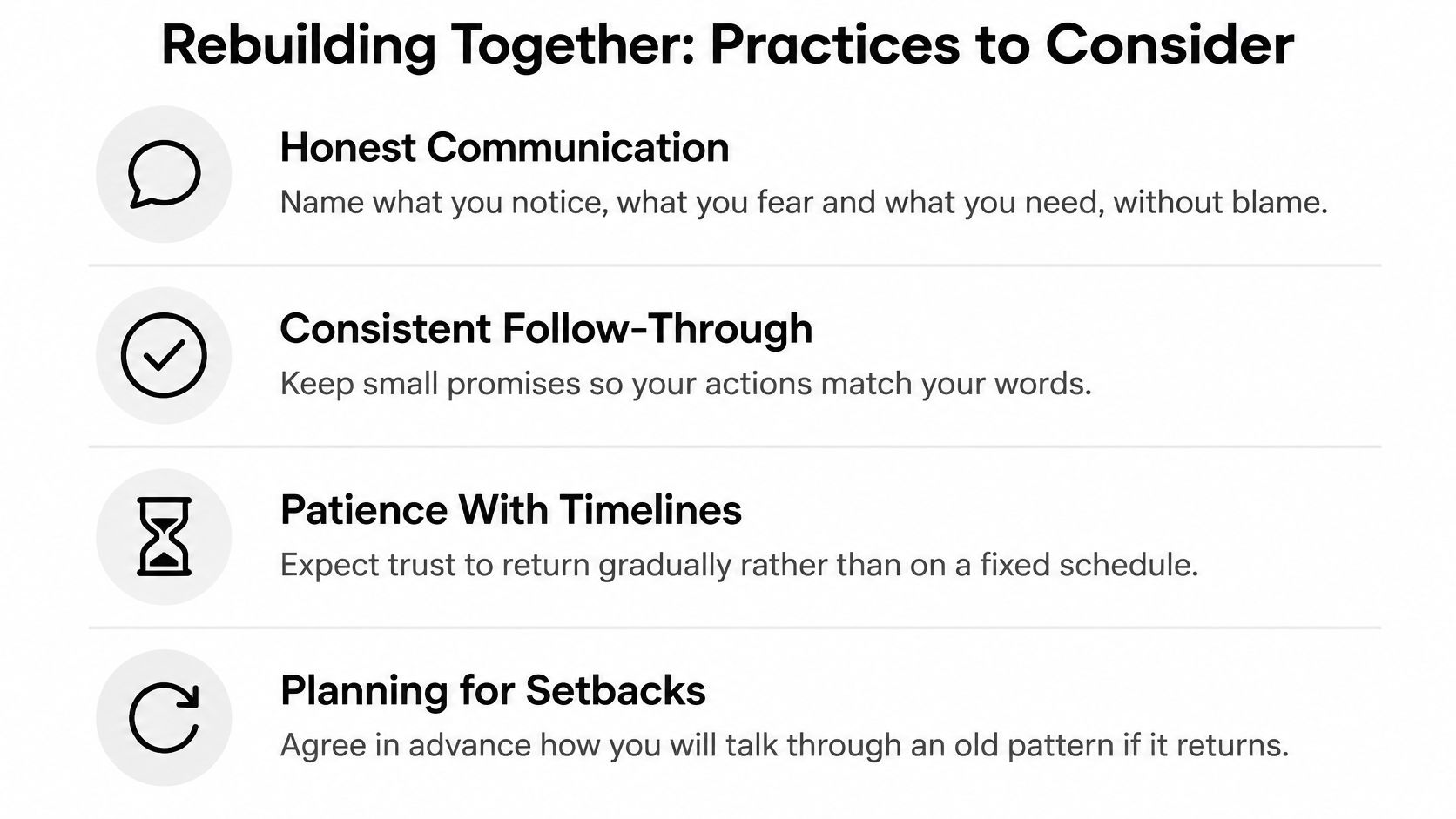
When both people sincerely want to repair trust after betrayal and the relationship is safe, it helps to think in terms of ongoing practices rather than a rigid checklist. Honest communication sits at the centre of that work: naming what you notice, what you fear and what you need, instead of hoping the other person will guess. Exploring practical ways to communicate better in relationships can make those conversations feel less charged and more constructive.
The visual below gathers four core considerations that people often return to when rebuilding side by side.
Building Consistency Without a Fixed Clock
Realistic expectations spare both people unnecessary despair. Trust almost always returns in layers rather than all at once, and progress is rarely neat. One calm, connected week doesn't erase every moment of wariness the following week, and a flash of old pain doesn't mean you've gone right back to the start.
Consistency between words and actions provides the clearest evidence over time. Alongside everyday follow-through, couples, friends and family members often find a few gentle habits helpful:
Agreed check-ins: Setting a predictable time to talk about how things feel keeps painful topics from ambushing every meal or quiet evening, while reassuring the hurt person that the breach hasn't been swept aside.
Returning to unfinished conversations: If a talk gets heated and you pause, coming back to finish it shows reliability far better than pretending the argument never happened.
Small repair rituals: A regular walk, a cup of tea without phones, or a brief weekly review of what's working helps build fresh, steady memories alongside the harder talks.
People naturally ask how long rebuilding takes, yet there's no universal timeframe. Progress depends on what happened, how the relationship functioned beforehand and whether meaningful change holds up under everyday stress. Rather than watching the calendar, notice quieter shifts: less checking, less hair-trigger reactivity, easier honesty about needs and clearer day-to-day decisions.
For another perspective on how accountability and consistent communication support repair over time, this short video offers useful food for thought.
Handling Setbacks and Workplace Trust
Setbacks are part of the terrain. An anniversary, a forgotten commitment, or an exhausting week can pull old hurt right back to the surface. When that happens, name the setback early rather than letting resentment simmer. Distinguish a single ordinary lapse from a repeating pattern, take a brief pause before the conversation escalates, and revisit your agreements calmly once both of you can listen.
In professional settings, repair often needs structural support as well as individual effort. In a 2024 Reward Gateway survey of UK workers, 47% said they weren't afraid to take risks or make mistakes because their organisation didn't have a blame culture. While 56% felt comfortable sharing personal struggles and feelings with their manager and 54% with colleagues, only 42% felt safe going to HR about problems involving a manager or colleague. You can trust one teammate while reasonably staying guarded with the wider organisation; lasting repair at work relies on dependable reporting routes, non-retaliation and managers who respond consistently when mistakes happen.
Learning to Trust Yourself Again
When someone lets you down, or when you've acted in a way that goes against your own values, the relationship with the other person isn't the only thing that takes a knock. Learning to trust yourself again is often the quietest and most important part of recovery.
Self-trust doesn't mean certainty or never making another mistake. It means having enough confidence in your own feelings, judgement and decisions to act on them, knowing you'll be able to handle the outcome even if things turn out differently from what you hoped.
When self-trust is shaky, it's easy to start outsourcing every choice. You might check with three friends before sending a simple reply, change your opinion the moment someone disagrees, override an uncomfortable gut feeling to keep the peace, or feel completely adrift when nobody validates your view.
The image below captures that shift from looking outwards for permission to finding your own sense of direction.

Developing an Internal Compass
The humanistic psychologist Carl Rogers described this shift as building an internal locus of evaluation. Instead of measuring your worth and your choices mainly against other people's approval or criticism, you gradually learn to check in with your own values, feelings and needs first. Listening to trusted perspectives still matters, yet the final compass sits inside you rather than outside.
A psychodynamic lens adds another helpful layer. Sometimes persistent self-doubt isn't just about one recent betrayal; it echoes older relationship patterns where your feelings were minimised, ignored or treated as inconvenient. Noticing how an old habit of shrinking yourself gets triggered in the present creates a small pause where you can choose differently.
Self-kindness and accountability aren't opposites. Being gentle with yourself when you've made a misjudgement makes it far easier to stay honest about what happened and learn from it.
Small Ways to Strengthen Self-Trust
You don't build confidence in your own judgement overnight, and it rarely comes from forcing big, dramatic leaps. A few quieter practices can help you reconnect with your own voice:
Notice feelings before explaining them away: When something jars, pause for a moment and register the feeling before telling yourself you're being silly or over-sensitive.
Test your judgement on small decisions: Choose what you want for dinner, how you want to spend a Saturday morning, or when you're ready to end a phone call, then notice afterwards how that choice felt.
Tolerate a little uncertainty: Sitting with not knowing every outcome right away trains you to see that discomfort isn't the same as danger.
Treat mistakes as information: Getting something wrong doesn't prove your judgement is broken; it gives you clearer data for next time.
Exploring related themes like self-esteem, your sense of self, personal boundaries and self-acceptance can deepen this work over time. The goal isn't to banish doubt forever, just to reach a steadier place where you recognise your own needs and trust yourself to respond to them.
Deciding Your Next Step and Whether Counselling Could Help
Whether you choose to stay and rebuild slowly, end the relationship, forgive from a distance or keep contact limited, each of those is a legitimate choice. The right direction depends on your needs, whether genuine change is happening and whether you feel safe, not on what others expect of you.
If you're wrestling with that decision, individual counselling can give you a steady, private space to think clearly. At Therapy with Ben, I offer individual counselling for adults aged 18 and over who are navigating relationship difficulties, rather than couples counselling. If you're weighing up whether joint sessions or individual space suits you better, reading about how couples counselling works in relationships can help clarify the difference.
How Individual Counselling Works at Therapy with Ben
My practice is integrative, drawing particularly on person-centred and psychodynamic counselling rather than CBT or structured behavioural programmes. I work collaboratively, adapting our conversations to you as an individual rather than following a rigid treatment programme. That means I won't tell you whether to stay, leave or forgive, and I don't use predetermined questions, prescribed trust-building exercises or formal scoring systems to measure your progress.
Instead, we explore your emotions, recurring relationship patterns, self-awareness and what moving forward genuinely means to you, checking in regularly about how you're feeling and whether our work continues to be helpful. Everything we discuss is confidential, though confidentiality may be broken if someone is at risk of serious harm, and I explain that clearly at our first meeting and would aim to talk it through with you first.
I offer face-to-face counselling in central Cheltenham, Walk & Talk counselling around Pittville Park, and online counselling across the UK. Sessions cost £60 for 50 minutes, and I offer a free 15-minute introductory conversation so you can get a sense of whether working together feels right for you.
If broken trust has left you feeling unsettled, conflicted or unsure how to move forward, individual counselling can offer a calm, unhurried space to make sense of what's happened and reconnect with your own judgement. Whether you prefer meeting in central Cheltenham, walking outdoors around Pittville Park or talking online from anywhere in the UK, you're welcome to arrange a free 15-minute introductory conversation through Therapy with Ben.


Comments