


Hierarchy of Needs: Maslow's Five Levels and Their Limits
Why does the idea that you can't work on your confidence until your rent is sorted feel true in theory and wrong in practice? The people I sit with are dealing with both at once. The rent worry keeps them awake, and the confidence question is still the one that brings them through the door.
Abraham Maslow's hierarchy of needs gives us a shared vocabulary for that tangle. It's one of the most recognised ideas in psychology, published in the 1940s and reprinted in textbooks ever since. It's also one of the most misunderstood, largely because of a drawing Maslow never made.
A hungry person thinks about food, not friendship. That's the plain version, and there's something honest in it. But the everyday version of the theory, the one that says you must complete each level before the next one matters, doesn't hold up well against real lives. Needs don't queue politely.
What follows is a grounded tour. The five levels and what each covers. Where the pyramid came from, and why that matters. How several needs press on a person at once. Where the model helps and where it oversimplifies. And how counselling can explore needs without turning anyone into a project.
What Maslow's Hierarchy of Needs Means
Abraham Maslow was an American psychologist whose 1943 paper "A Theory of Human Motivation" set out five categories of human need and argued that people are usually driven by whichever need feels most pressing at the time. In simple terms, he proposed that human motivation shifts. When food, rest or safety feel uncertain, they take up most of the room. When those feel more settled, connection, recognition and growth move into focus.
A comparison makes it land. Someone who hasn't eaten properly for two days isn't indifferent to friendship. But the friendships aren't what occupies them at four in the afternoon. A person worried about losing their home isn't uninterested in meaning and purpose, but the meaning can wait until the letter arrives. Neither state tells you anything about the person's values. It tells you where their attention is going.
That's the core of the theory, and it's easy to see why it spread. It gives teachers, managers, counsellors and individuals a shared way to ask a useful question: what might be missing here? Schools use it to think about whether a child who can't concentrate has had breakfast. Workplaces borrow it when they're wondering why a well-paid team still feels flat. Personal development writing uses it as a prompt for reflection.
The hierarchy is a way of thinking about motivation, not a test anyone can pass or fail.
One thing worth saying plainly, because it shapes everything that follows. The theory describes tendencies, not laws. It offers a rough account of which concerns tend to dominate when several are present. It doesn't sort people into categories, and it doesn't tell you what someone at a particular level needs next. Used that way, it becomes a blunt instrument that misses what's going on.
The rest of this article covers the five levels in plain terms, explains where the familiar pyramid came from and why it's not Maslow's own drawing, shows how needs overlap in ordinary situations, and is candid about the evidence. The model has real limits. Knowing them makes it more useful, not less.
The Five Levels at a Glance
Here are the five levels from the base upwards. The questions in the last column are prompts for reflection, not a diagnostic checklist.
Level | Typical needs | Everyday example | Question to ask |
|---|---|---|---|
Physiological | Food, water, sleep, warmth and shelter | Running on little sleep during a difficult month | Are my basic body needs being met most days? |
Safety | Physical security, financial stability, health and predictability | Worrying about rent, job security or an unpredictable relationship | Where do I feel uncertain or at risk? |
Love and belonging | Friendship, family ties, intimacy and being accepted | Feeling lonely in a busy office or missing close friends after a move | Who do I feel close to, and who can I be myself with? |
Esteem | Self-respect, confidence, recognition and competence | Feeling dismissed at work or doubting your abilities after criticism | Where do I feel capable, and where do I need more recognition? |
Self-actualisation | Personal growth, creativity, meaning and developing potential | Wanting a change of career, learning a skill or feeling that life lacks purpose | What matters to me that I am not yet expressing? |
Deficiency needs and growth needs
Maslow drew a distinction between the bottom four levels and the top one. The lower four are sometimes called deficiency needs. When they're met, you often don't notice; when they're not, the deficit becomes hard to ignore. Hunger works like this, and so does feeling unsafe, or going weeks without a conversation that lands.
The fifth level sits differently. Self-actualisation is described as a growth need, tied to developing potential rather than filling a gap. It doesn't produce the same urgent discomfort when absent. It produces something quieter, closer to restlessness or a sense that something isn't being used.
That distinction is useful, but it's also where the model gets slippery. People can pursue growth while deficiency needs are unmet, and they often do.
A map, not a position
The table describes concerns, not people. Nobody occupies level three. A person can be sleeping badly, worried about money, missing a close friend and questioning their career in the same week, and that's ordinary rather than disordered.
A note on the questions: treat them as starting points for curiosity. If one of them produces an uncomfortable answer, that's information worth following, not a verdict.
The five levels are best read as five kinds of concern that can all be present at once. Which one dominates shifts by the day.
Where the Pyramid Came From
The pyramid wasn't Maslow's. He introduced the theory in 1943 and gave it fuller treatment in his 1954 book Motivation and Personality, but he never drew the stepped triangle that appears on classroom walls. A 2019 historical analysis in the Academy of Management Learning & Education traced the pyramid to later management education and popular business writing, rather than to Maslow's own publications.
That origin matters, because the shape changed the message. A pyramid implies a staircase. Each block rests fully on the one below, and each level must be complete before the next becomes available. Maslow's writing described something looser: needs that are more or less dominant, with plenty of room for individual variation.
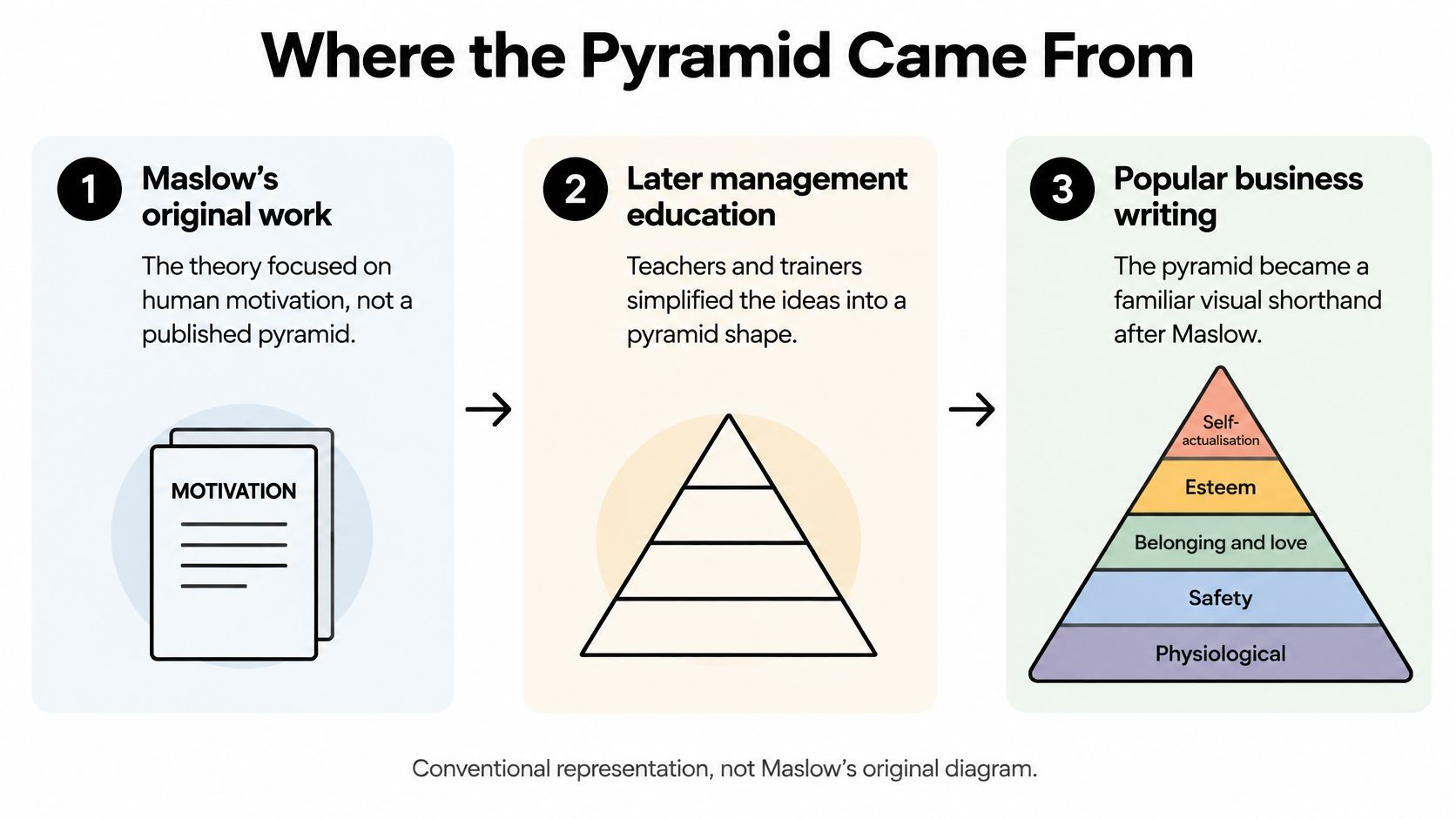
He acknowledged that some people place esteem above love, and others put creativity above security. Character, upbringing and circumstance shift the order. A person raised in precarious circumstances may prioritise stability for decades. Someone absorbed in a craft may tolerate considerable insecurity to keep doing it.
The convention is now so familiar that it helps to name it clearly: the pyramid is a conventional representation of the theory, a memory aid rather than a diagram Maslow published.
The distinction has practical weight. Across the UK, many households live with material hardship while also needing connection, self-respect and room to grow. Those pressures do not wait their turn on separate steps. They arrive together, and Maslow's own account leaves space for that in a way the rigid triangle does not.
The video below covers the model's history and how it's usually taught.
Where does that leave the pyramid? As shorthand. Useful for remembering five kinds of concern, misleading if you read it as an instruction manual for being human.
How Several Needs Overlap in Everyday Life
Real life rarely presents one need at a time. A single situation usually touches several, and the way they interact is what makes it hard to untangle.
Situation | Needs most likely involved | How the needs interact |
|---|---|---|
Strain with a partner | Belonging, safety, esteem | Conflict can threaten both closeness and the sense of being safe to speak |
Long hours and little rest | Physiological, esteem, self-actualisation | Exhaustion can erode confidence and make personal interests feel out of reach |
Loneliness after a move or retirement | Belonging, esteem | Lost routines can take away both company and a sense of being recognised |
Financial insecurity | Safety, physiological, belonging | Money worries can affect sleep, food and willingness to socialise |
Family expectations | Belonging, esteem, self-actualisation | Wanting approval can pull against developing an identity of one's own |
Bereavement or redundancy | Safety, belonging, meaning | Loss can unsettle practical stability and the sense of purpose at once |
Flat sense of fulfilment | Self-actualisation, esteem | Lack of growth can coexist with secure finances and close relationships |
Belonging is not a headcount
Take loneliness. It's tempting to measure connection by how many people someone sees in a week, and that measure misses most of what matters. The Community Life Survey 2023/24 found that 7% of people in England, around 3.1 million, felt lonely often or always. In the same survey, 94% of adults agreed that if they needed help there were people who would be there for them, and 92% agreed they had people to contact for company.
Both things are true at once. Someone can have a phone full of contacts and still feel unseen, because the question isn't whether people exist but whether any of them know what is going on. A person can be surrounded and lonely. A person can be largely alone and not lonely at all.
When one pressure pulls on another
The interactions in the table run in both directions. Money worry affects sleep, and poor sleep affects mood and patience, which affects a relationship, which affects confidence. Family expectation sets belonging against esteem: wanting approval from people you love can pull directly against developing a sense of who you are.
Major change often disturbs several levels at once. A move, a redundancy or a bereavement removes routines, income, identity and company together, and the sense of self can take time to catch up. There's more on that in rebuilding a sense of self after a change.
The table isn't a ranking. It's a reminder that someone's difficulty rarely comes from one unmet need in isolation.
What Unmet Needs Can Look Like
An unmet need works like a fuel warning light: the signal is real, but it points to something missing rather than to a flaw in the person. The patterns tend to show in behaviour before they reach words, and people often read them in themselves as personality defects instead of responses to circumstances.
Irritability and poor concentration: short sleep, missed meals or a cold flat all narrow what someone can tolerate. A person who snaps at a colleague over nothing may be running on five hours a night.
Withdrawal or numbness: when belonging has felt unsafe, stepping back protects rather than rejects. Someone who goes quiet after a difficult conversation is often managing risk as they see it.
People-pleasing and conflict avoidance: where acceptance has felt conditional, agreement becomes a way of staying safe. The effort stays invisible until it collapses into resentment.
Self-criticism and perfectionism: fragile self-esteem produces high standards and harsh internal commentary, and the two feed each other. Here it helps to know how self-esteem differs from self-confidence: a person can perform capably at work while privately feeling worthless, because confidence in a skill and esteem for the self draw on different needs.
Restlessness or flatness: when growth stalls, life can look fine on paper and feel thin. Hard to name, easy to dismiss.
The material end of the scale
The physiological level isn't abstract. In an Office for National Statistics study covering Great Britain from October 2023 to January 2024, 4% of adults said they or someone in their household had run out of food and couldn't afford more in the previous two weeks. Among adults who struggled to keep their homes warm, 59% also reported difficulty meeting housing payments, and 24% said cutting back on energy use had negatively affected their mental health.
Those figures don't reduce emotional distress to a heating bill. They show why low mood or poor concentration can carry a practical component that talking alone won't shift, and why a good conversation about wellbeing asks about sleep, food, warmth and money rather than treating the whole picture as psychological.
In practice: practical stabilisation and emotional work can run alongside each other. Counselling doesn't replace medical, financial or housing support, and no amount of insight warms a cold room.
What the model can't explain
An unmet need is one thread among several, not the whole story. Anxiety and depression have many contributing factors, including biology, trauma, genetics, grief and events nobody could have anticipated. If the hierarchy only ever asks what's missing from your circumstances, it will eventually miss the point.
Where it earns its keep is in loosening self-blame. Noticing that a need has gone unmet is a starting point for reflection. It isn't a character report.
Strengths and Limits of the Model
The model earns its place for three reasons. It offers accessible language for something people struggle to describe. It invites reflection on what matters to a person rather than what should. And it insists that material conditions shape emotional life, which any honest conversation about wellbeing has to hold.
The evidence for a fixed order is thin
A critical academic review of Maslow's hierarchy notes that Maslow's account of self-actualisation rested on a small, selectively chosen group of people he judged to meet the description, a method vulnerable to subjectivity and cultural bias. Research supports the existence of broadly recognisable human needs. It doesn't consistently support the claim that those needs arrive in a rigid five-level sequence.
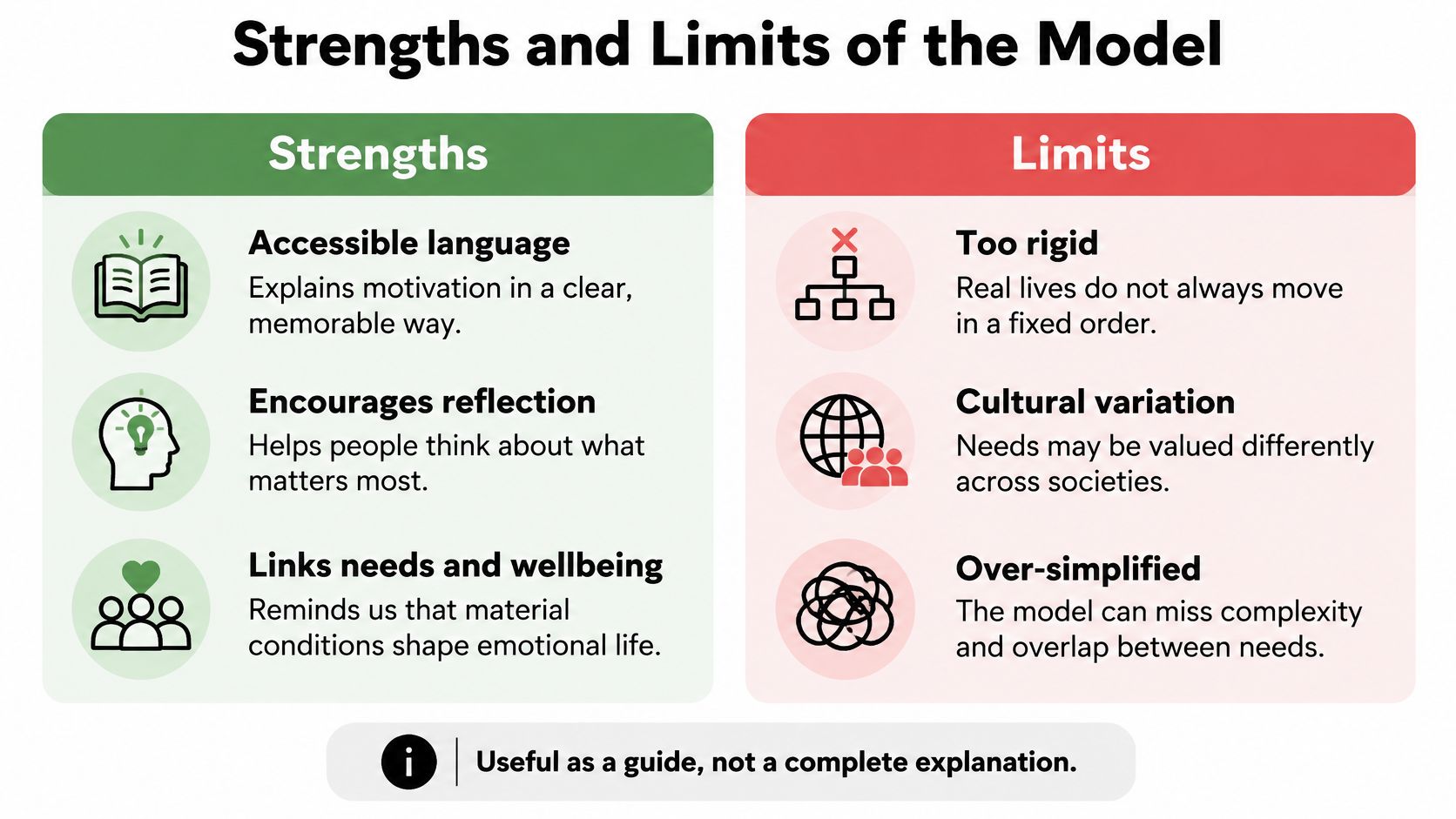
The practical consequence is straightforward. People experience love, creativity, moral purpose and achievement during poverty, illness and bereavement. People with material security struggle with belonging and self-worth. Any model that can't hold those facts will mislead the person applying it, especially if they're applying it to themselves.
Aspect | Where it helps | Where it falls short |
|---|---|---|
Language | Offers shared words for human needs | Labels can flatten complex personal experience |
Evidence | Widely recognised and historically influential | Weak support for a fixed five-level order |
Culture | Prompts reflection on what people value | Individualistic emphasis may not fit collectivist families |
Individual priorities | Leaves room for what a person values most | Cannot predict which need someone ranks higher |
Clinical use | Opens conversation about material pressures | Not a diagnostic tool or a measure of progress |
Culture and individual priority
The model carries an individualistic assumption: that the goal of a life is developing one's own potential. That assumption fits some people and sits awkwardly with others. Someone raised in a family where obligation to relatives comes first may place belonging well above personal growth, and that isn't a failure to self-actualise. It's a different answer to the question of what a life is for.
Individual priority varies just as widely. A person may value creative work above financial security, or accept real hardship for a cause or a person they care about. The hierarchy can't predict which. It can only offer vocabulary.
A clear distinction is worth holding onto here. Historical influence is not empirical support. Maslow's framework shaped education, management thinking and the vocabulary of counselling. None of that demonstrates that needs are arranged in five fixed steps. It demonstrates that the idea was useful and memorable, which is a different claim.
Treat the hierarchy as a memorable map of possible concerns. Not a diagnostic tool, not a measure of progress, and not a rule about what someone should be ready to work on next.
Maslow, Rogers and Exploring Needs in Counselling
Maslow and Carl Rogers were both central figures in humanistic psychology, and both took a generous view of human capacity. Their theories aren't the same, though, and the difference matters in the room.
Maslow's self-actualisation is a concept inside a needs framework. It describes people who appear to be fulfilling their potential. Rogers started somewhere else: with an actualising tendency, a growth drive he understood as present in every person, not a state a minority reach. His person-centred approach focused on the conditions that help growth happen, particularly congruence, unconditional positive regard and empathic understanding.
So Maslow described a destination, loosely. Rogers described a direction of travel with no arrival. That's why the person-centred tradition talks about becoming rather than achieving, and why self-actualisation is better understood as an ongoing process than a rung someone reaches and stays on. There's more on this tradition in what humanistic therapy offers.
What exploring needs looks like in practice
In my integrative work, drawing on person-centred and psychodynamic approaches, the hierarchy functions as background vocabulary rather than an assessment schedule. I don't try to establish which level someone occupies. I'm more interested in what matters to them, which needs feel unmet, and how that's affecting their relationships and their sense of themselves.
That exploration usually goes somewhere specific. Someone may arrive describing a difficulty with a partner or a parent. As we talk, a pattern emerges in how they seek acceptance or respond to rejection, and often a longer history behind it. Others describe something vaguer: a lack of enjoyment, purpose or balance, and it takes a while to find language for what's missing.
The therapeutic relationship does real work here. Feeling accepted and sufficiently comfortable in the room can make it easier to look at material someone hasn't discussed before. That's not a prerequisite being ticked off. It's the ordinary condition for difficult conversations.
Progress doesn't wait for a particular need to be met first. Different aspects get explored together, and that's usually how it goes. People are rarely as tidy as a five-level model implies.
On wider access to support
How people reach support varies, and practical factors shape that as much as emotional readiness. In some places the first question is which professional to contact, and a guide to choosing between psychological and psychiatric care can clarify that. The theory of needs doesn't answer it. Knowing what's available does.
Ben values authenticity, fairness, curiosity, self-understanding, emotional honesty and personal responsibility. Those values shape how I work more than any framework does, and they're why the person in front of me always comes before the model.
Frequently Asked Questions
What are the five levels of Maslow's hierarchy? Physiological needs, safety, love and belonging, esteem, and self-actualisation. Each is set out with examples in the table earlier in this article.
Why is it called a hierarchy of needs? Maslow described needs as arranged in a rough order of dominance. Lower needs usually press harder when they go unmet. It was never a strict sequence, despite how the pyramid is often read.
Must basic needs be met first? Not as a fixed rule. People pursue connection, meaning and self-respect while money, housing or health remain unsettled, and the order varies from person to person and across a lifetime.
Is Maslow's theory still relevant? As a vocabulary for reflection and a reminder that material conditions shape emotional life, yes. Its fixed structure isn't well supported by research.
What are the criticisms of Maslow's hierarchy? Weak evidence for a fixed order, a small and subjectively chosen sample behind the idea of self-actualisation, a cultural bias towards individualism, and the difficulty of fitting overlapping, changing needs into one sequence.
How does self-actualisation relate to mental wellbeing? It describes a sense of growth and meaning someone may value alongside good mental health. It isn't a measure of wellbeing or a requirement for it, and its absence doesn't signal that anything is wrong.
Choosing How to Explore Your Own Needs
The same conversation can feel very different depending on where it happens. Sitting opposite someone in a quiet room suits some people. Others find it easier to talk while walking side by side, where eye contact is optional and movement takes the edge off difficult moments. Online sessions remove travel and let you speak from a familiar space. The setting won't meet a need by itself, but feeling at ease enough to speak openly is a genuine part of what makes counselling useful.
Therapy with Ben offers face-to-face sessions in Cheltenham, online counselling and Walk & Talk sessions. As an integrative counsellor drawing on person-centred and psychodynamic approaches, Ben works with a wide range of difficulties, including anxiety, depression, self-esteem, relationships, emotional difficulties, life changes, identity and neurodivergence.
People tend to arrive with one of two things. Sometimes it's strain in a relationship with a partner, a family member or someone else who matters. Sometimes it's harder to name: a sense that something is missing, whether enjoyment, fulfilment, purpose or a workable balance between work and personal time. That second kind often connects to questions about your sense of self and what you want your life to stand for.
If you're thinking about your own needs, here's a way to start.
Notice which needs feel most uncertain. Skip the question of which level you're on and ask which areas of life feel thin or exposed right now.
Note the situations and relationships involved. Vague unease becomes more workable when you can see where it shows up.
Consider which setting would feel comfortable. A room, a screen or a walk outside. Each suits different people.
Arrange a first conversation. Visit the Therapy with Ben website to get in touch and talk through what you're looking for.
A first conversation asks nothing more than that. If counselling turns out to be useful, it'll be because the exploration fits your life as it is, with needs that overlap, shift and pull on each other.
If you'd like to explore your needs, relationships or sense of fulfilment with someone who won't try to fit you into a level, visit Therapy with Ben to arrange a first conversation. Face-to-face sessions take place in Cheltenham, with online counselling and Walk & Talk sessions also available.


Comments